
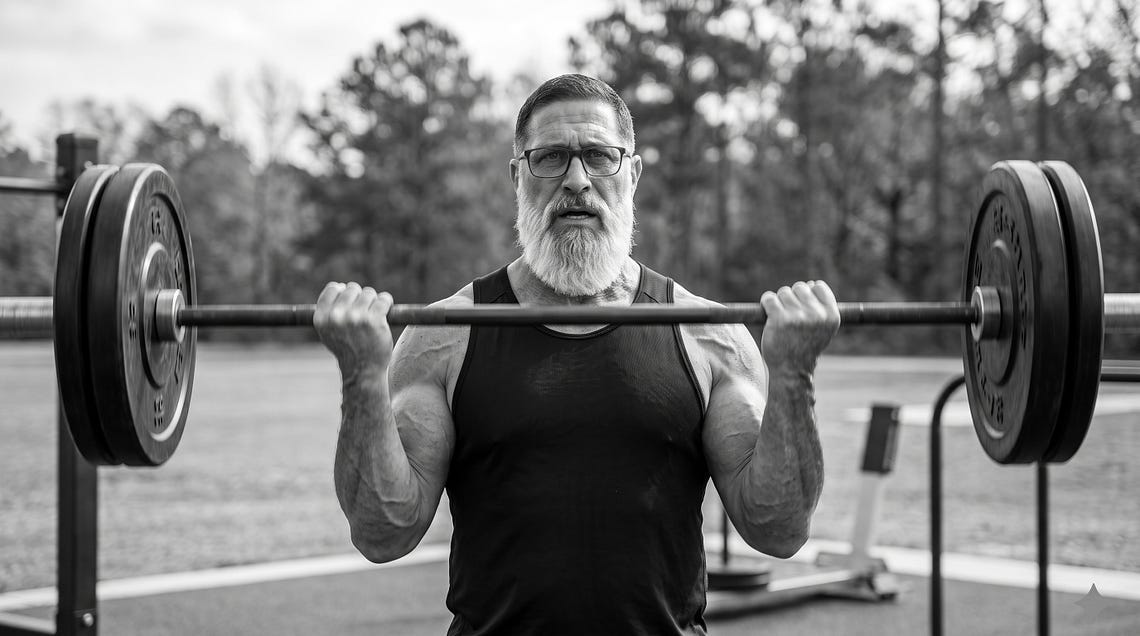
Somewhere along the way we split exercise into two jobs. Cardio for the heart. Weights for the muscle. Everybody past fifty has heard some version of this, usually from a doctor with six minutes and a pamphlet.
That split undersells what’s actually happening. A growing body of research on resistance training and cardiovascular health consistently points to the same conclusion: people who lift have lower resting heart rates and lower blood pressure, alongside the muscle and bone benefits everyone already expects. You don’t need to add cardio to get some of cardio’s benefits. Lifting is already doing part of that work.
I didn’t expect that when I started training seriously. I figured I was there to keep from losing muscle and bone density, and that’s still most of the appeal. But the heart numbers showing up in the research are the kind a cardiologist cares about, and they’re coming from people doing nothing more exotic than machines and free weights a couple times a week. Nothing that would look unusual in any gym around here on a given day.
Blood pressure tends to creep up as we age. Blood vessels get stiffer. The systems that used to keep everything within a comfortable range have lost some of their give. For women, that shift can speed up around menopause, when hormonal changes that once offered some protection to the vascular system fall away. For men it’s usually a slower climb, the kind that turns a routine physical into a conversation about medication before you saw it coming.
This is also the decade when muscle and bone start needing more attention, not less. Muscle mass declines on its own once you’re past fifty if you don’t work against it. Bone density follows the same pattern. So you’ve got two systems needing support at the same time, and it would be inconvenient if the fix for one meant ignoring the other.
It doesn’t work that way. Resistance training moves the needle on both. You’re not running two separate exercise programs to cover two separate problems. You’re running one that happens to cover both.
I get some version of this question a lot: should I lift or should I do cardio, which one matters more past fifty? You’re not choosing between them. You’re figuring out how to fit both in without wrecking your recovery.
Lower-intensity aerobic work pairs easily with lifting. Walk on your off days. Ride a bike after a lighter session. It won’t interfere much, and it can help you recover faster between harder lifting days.
Higher intensity intervals take more planning. Go hard on a bike the same day you hammer your legs in the weight room, and you’ll shortchange one or the other. Your body has a limited amount of recovery time, and asking it to build strength and sprint capacity in the same afternoon is a lot to ask. Space them out. Lift first if both fall in the same session. Put your hardest interval work on a different day from your heaviest leg day when you can. If sleep or joints are already complaining, cut total volume before you cut either kind of training.
That’s the whole system. Pay attention to how you’re recovering, and adjust.
Two questions come up over and over: protein and creatine.
For protein, the range that appears most often in research for adults building or holding onto muscle is around 1 to 1.5 grams per kilogram of target body weight per day. People trying to gain or preserve muscle, or eating in a deficit, tend to do better toward the upper end. That’s not a call to weigh your chicken breast. It’s a number to keep in mind at meals, especially if your current habit runs closer to coffee for breakfast and whatever’s in the fridge for dinner.
Creatine has a longer track record than its reputation suggests. For people already lifting and eating enough protein, it tends to add a modest but real boost in strength and lean mass over time. Five grams a day, plain creatine monohydrate, no loading phase, no cycling on and off. Some people see a small bump on the scale early on. That’s water pulling into the muscle, not fat showing up overnight. If it bothers you, split the dose through the day instead of taking it all at once.
Neither one replaces training. A supplement stack does nothing for a body that isn’t lifting anything, and protein by itself doesn’t build a muscle that has no reason to grow.
If you’ve been treating cardio and strength training like two competing assignments, fighting over the same hours, stop keeping score between them. Your heart benefits from both. Your muscle and bone only really respond to one. Two or three real resistance sessions a week, some aerobic movement you’ll actually keep doing, and enough consistency for your body to respond. That’s a smaller ask than it sounds, and it does more for you than most people expect from a dumbbell.
Most paid newsletters sell you a content library and move on to the next subscriber. Not Done Yet works differently. When you upgrade, that's when I start paying attention. I'll answer your questions. I'll engage with your work. I'll spotlight what you're building. Everything I teach here, I do, and I do it alongside you, not from a distance. The upgrade isn't the end of our relationship. It's the start.
Comments
Nothing yet. Say the first thing.
Sign in to join the conversation.