
When it comes to electricity, Germany and Ireland share a lot of the same woes.
We both rely on fossil fuels for much of our power (52 per cent of Ireland’s electricity comes from fossil fuels, 41 per cent of Germany’s). We’ve both had painful increases in electricity prices as the cost of gas soared in recent years.
We both have ambitious goals for building more renewable energy, but have struggled with local resistance and slow planning processes.
But Germany has pulled ahead of us in one respect. We pay almost twice as much as Germany does for power from new onshore wind farms.
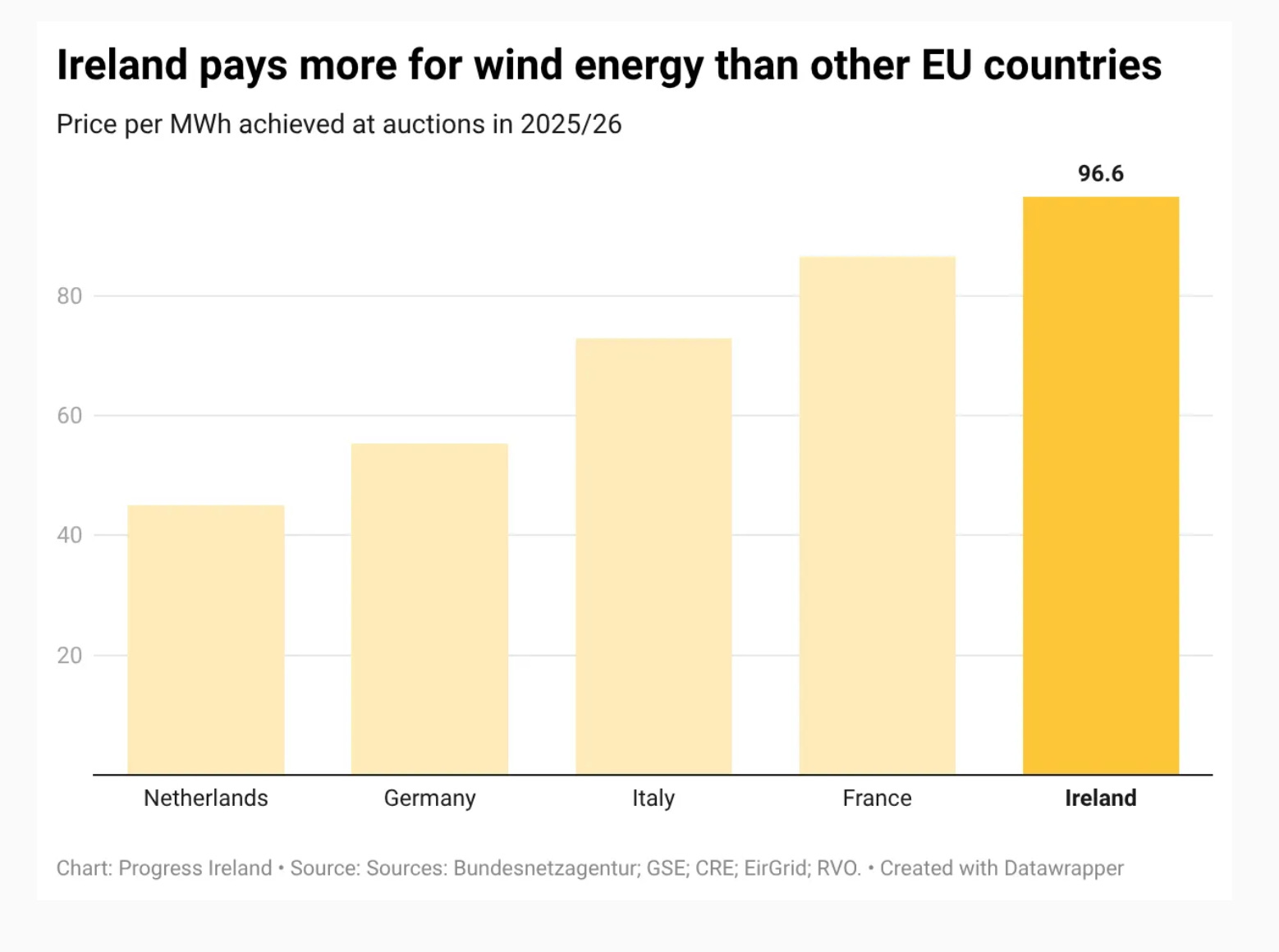
Why does Ireland pay more?
Wind farms don’t publish a full breakdown of what goes into their prices, but a German study outlines the costs of building and operating an onshore wind farm there. We can compare this with publicly available data in Ireland to estimate where the additional costs come from.
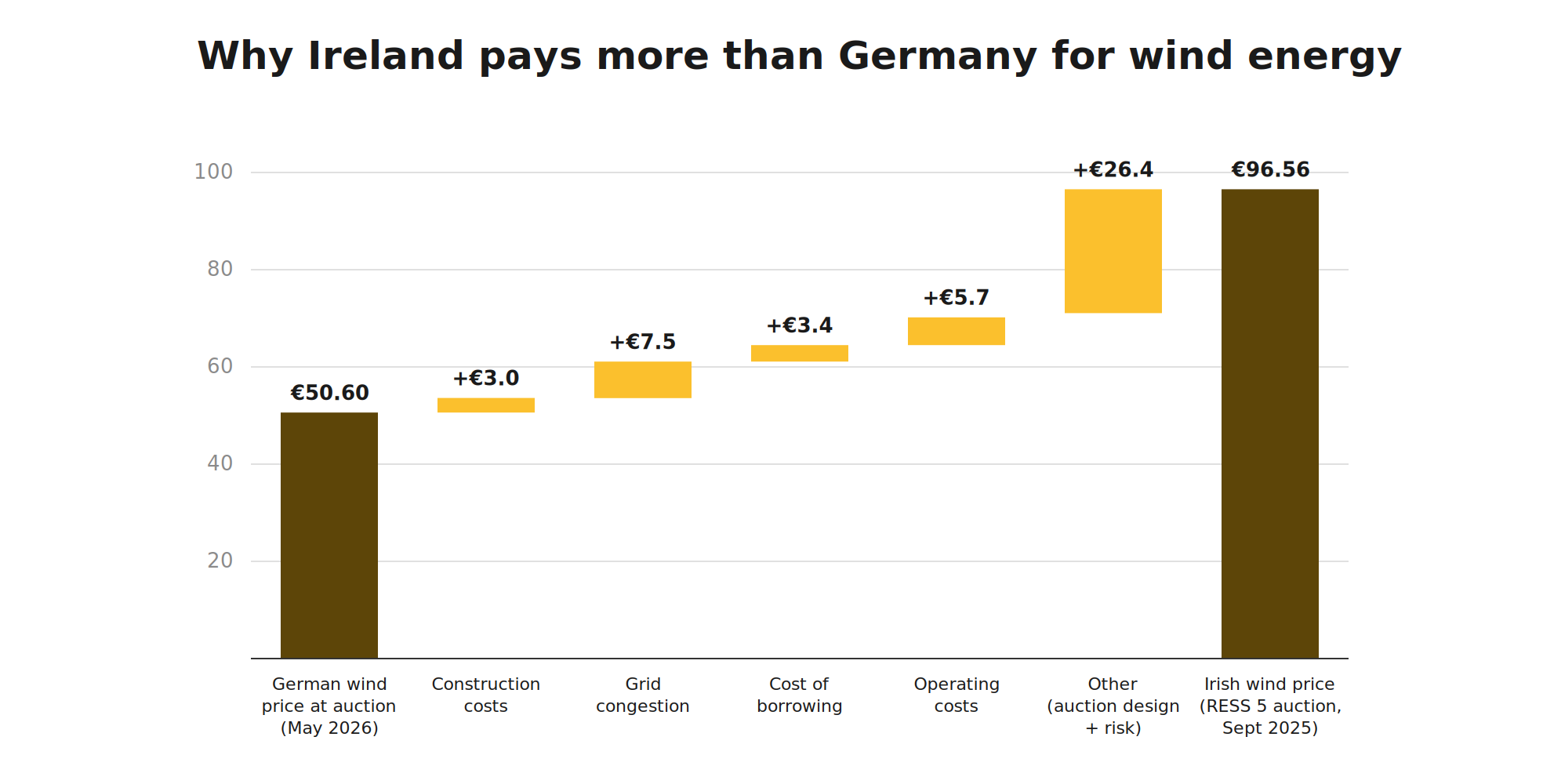
One possible explanation of the higher price of wind in Ireland is that it costs more to build things here. To some extent this is true — it is slightly more expensive to build a wind farm in Ireland compared to Germany.
But differences in construction costs are not large enough on their own to explain the overall difference in the price of wind.
Building a wind farm in Germany costs between €1.3 and €1.9 million per megawatt of capacity. Let’s take the midpoint and call it €1.6 million per megawatt for a German wind farm.
In Ireland, public announcements put the bill at around €1.7 million per megawatt. This adds a modest €3 to the price of wind.
The largest fixed cost for a wind farm is the turbines, but the cost of turbines is fairly standard across countries. This might explain why costs are so similar across the two countries.
If construction costs can’t explain the large difference in price between Ireland and Germany, it could be that our congested electricity network is increasing the price we pay.
When the wind blows, all wind farms in a given area power up and start sending power to the network. This can cause an oversupply of energy at the overall network level, as well as bottlenecks on local power lines. Think of it like traffic congestion: too many cars try to get on the road at the same time.
Ireland and Germany are both struggling with network congestion as we build out more renewable energy. But Ireland has a particularly acute case of congestion.
EirGrid regularly instructs wind farms to power down while the wind is blowing due to congestion issues. In Ireland, 11.4 per cent of available wind power was subject to these capacity constraints last year. In Germany, around 4 per cent of available wind was impacted. German wind farms also receive compensation for the time spent idle.
In Ireland, wind farms are typically not compensated for the time spent idle, so they raise prices on the wind they do sell to cover their costs.
To model out how much this adds to Irish wind prices, let’s assume a scenario in which Ireland only takes wind farms offline 4 per cent of the time, like in Germany. Wind farms can then produce 7.4 per cent more energy, and can spread their costs over more units of energy sold. This would reduce the price they charge on each unit of energy by about €7.50.
Another way to put this is that we pay a €7.50 premium on wind prices due to our congested network.
To pay for the multimillion-euro buildout of a wind farm, developers need to borrow money. Lenders charge higher interest rates for projects that are seen as higher risk.
Wind farms in Ireland are charged higher interest rates than German ones (the German study estimates the German Weighted Average Cost of Capital at 3.9 per cent, while a recent Irish wind farm was financed at 4.9 per cent).
Lenders might consider Irish wind farms to be higher-risk due to uncertainties over planning and grid congestion. This higher cost of borrowing adds around €3.40 to wind prices.
Some operating costs show up in the price of Irish wind that don’t show up in the German price. It’s important to account for these, but they’re not a central part of why Irish wind is more expensive. The same costs are paid for elsewhere by the German taxpayer.
One of these is a charge for community benefit funds. Community benefit funds are pots of money provided to the local area surrounding a wind farm. They’re created to ensure that communities benefit directly from hosting a wind farm.
Irish and German wind farms both pay about €2 per megawatt-hour of energy they produce into community benefit funds, but the German payments don’t show up in wind prices. They’re paid for by the state from general taxation funds.
Similarly, EirGrid charges wind farms to access and use the electricity network. This adds about €3.70 to the price of Irish wind. Germany currently does not have a similar charge, although they are considering bringing one in. The costs are currently paid for from general state funds.
So far we’ve explained about €20 of additional costs that raise wind prices in Ireland when compared to Germany, with the largest category being the network congestion premium. That leaves an additional €26 to account for.
Auction design
Differences in wind auction design likely explain a chunk of the remaining price difference.
In Ireland and Germany, wind prices are set at auctions. Wind farm developers bid on the minimum price at which they’re willing to sell a megawatt-hour of electricity. This is known as the strike price. The developer with the lowest strike price wins.
Wind contracts are designed so that a developer always gets paid their strike price for the energy they produce, even if the price of electricity on the wholesale market falls below this amount.
For example, if a wind farm bids a strike price of €96, and the price of electricity on the open market falls to €80, the wind farm still gets paid €96 for each megawatt-hour of energy they deliver.
This design provides financial security for wind farms. It’s needed because adding more wind farms to the network, which all produce energy when the wind blows, can create gluts and tank the price.
Low prices are good for consumers, but bad for wind farms that need to recoup their high costs of construction. Strike prices ensure they can make their money back.
Ireland’s auction adds another rule to protect Irish consumers. Ireland only ever pays wind farms the strike price. If the wholesale price rises above the strike price, the wind farm pays the state back the difference.
In Germany, wind farms benefit from the price floor but get to keep the upside. They get paid the strike price if the wholesale price falls below it, but they don’t have to pay anything back to the state when the wholesale price is high.
This could explain a good chunk of the leftover costs. Germany’s prices may be lower because German wind farms get to keep the upside when wholesale electricity prices are high.
How much does this impact prices? Giving a definitive figure would involve estimating wholesale electricity prices over the next 20 years, which goes beyond the scope of one humble Substack post.
It’s worth noting that Germany is planning to switch to a more Irish-style system in 2027, so auction design will have less explanatory power going forward.
Germany and Ireland differ on other aspects of auction design too.
Ireland’s price is designed to partially keep up with inflation, which makes Ireland more favourable to wind farm developers. Germany’s price is guaranteed for longer, which makes Germany more favourable. These differences likely net out as having little impact on the overall price.
Risk
In 2024, An Bord Pleanála approved 10 onshore wind farms and refused 12. Wind farm developers have to recoup their costs on refused permissions, so those costs push up prices.
Germany introduced a spate of reforms in 2023-24 to ensure more wind farms are permitted. The most impactful reforms were requiring local authorities to zone more land for wind farms and streamlining environmental assessments. Germany approved 85 per cent more wind energy in 2024 than in 2023, and 48 per cent more again in 2025.
More approvals means lower risk for developers, which translates into lower prices.
Competition
In Germany, the efforts to speed up permitting have led to intense competition among wind farms, which has driven down prices. German wind prices have fallen in the past three years, while Ireland’s are on the rise.
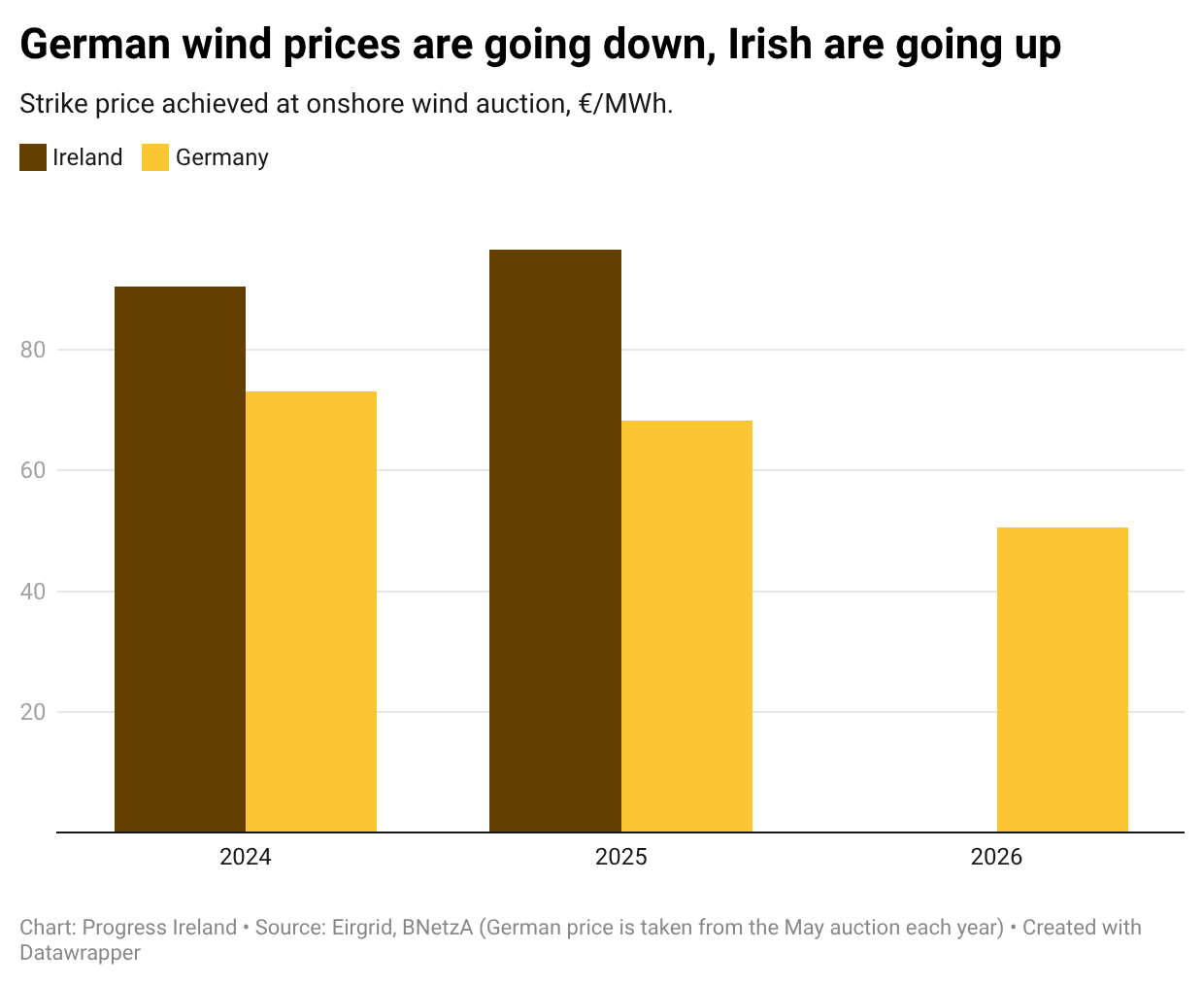
Germany’s electricity system isn’t perfect. But it has a less congested grid than ours and has implemented significant zoning and planning reforms. In doing so, it has managed to greatly increase wind farm approvals and lower prices.
Ireland has made inroads in recent years to speed up wind farm approvals and remove risk from wind farm developers. We now have a mandatory decision timeline of 52 weeks for approving planning applications for new wind farms. New wind farm design guidelines are also being developed to provide additional certainty in the planning process.
But we have yet to see those changes flow through to lower prices. And in the meantime, other challenges persist. Grid congestion adds a premium to wind costs, and planning risk likely further raises prices.
No posts
Comments
Nothing yet. Say the first thing.
Sign in to join the conversation.