
TL;DR: Irish project appraisal normally excludes land use benefits from headline benefit–cost ratios. In a fast-growing country like Ireland, that biases investment against transformative public transport projects. Ireland should model these effects explicitly.
This post is is about the real life consequences of cost-benefit analysis (CBA). A CBA is a tool government economists use to assess projects and decide whether or not they should go ahead.
The basic idea of a CBA is to account rigorously for all the benefits and costs that go into a given project. Inputs might include time saving, construction cost, environmental damage, customer satisfaction, operating costs, and so on.
Next, cost and benefits are converted to a common unit so they can be compared: money. Projects whose monetary value is higher than its costs area deemed to have passed the CBA.
The tricky part of any CBA is the conversion of benefits to euros. What’s a hectare of native wetland worth? A person-day of good health? The warm glow one feels in a beautiful public building?

A CBA requires judgement calls. There is no definitive way to value a native wetland. Honest CBAs can come up with quite different outputs, depending on their methodology.
Nonetheless, in Ireland in 2026, I want to make the case that we’re assessing costs and benefits wrongly when it comes to transport projects. And this methodological choice is leaving us short of housing.
Transport is a special type of infrastructure. It’s not just about transport. It determines the size and shape and to an extent the cost of our home. How long we spend in the car. Our health. Our proximity to family. The health of our businesses. Our social connections.
Transport investments beget further investments. Once a road is built, houses will be built beside the road. Retail parks will be built near the houses. Shopping centres and office parks will follow. New things will tend to be built at the edge of town, where there’s land for parking. All of which will necessitate more roads.
Transport also impacts our bank balance. It does this in two ways: through its effect on incomes and its effects on housing costs.
Transport impacts incomes through agglomeration effects. Agglomeration refers to the benefits that accrue when people are close to each other. The more people are accessible to you, the better will be your job opportunities and the better will ideas spread around. It follows that a more efficient transport system lets you reach more people in a given amount of time.
Transport impacts housing costs because its a constraint on the number of homes that can be built; and the number of homes built in large part determines housing costs. Roads have a tendency to fill up. When they fill up – as is the case around Dublin and Galway – it’s hard to add more homes1.
The big point here is that the choice of transport infrastructure limits how intensively land can be used. Normal roads support suburbs. Buses support dense suburbs. Bus lanes and trams support apartment blocks. Electrified trains support the densest city neighbourhoods.
This is how Tokyo came to be such an unusually big and efficient city. Private train companies built rail lines out into the hinterland. The land around these stations could then be developed at very high density. The rail companies developed the land and sold it off.
These are the transport options available to us, as a fast-growing country in need of around a million homes in the coming decades. We can build more ring roads, like in Charlotte or Atlanta or Houston, and build suburbs and office parks. Or we can electrify more rail, like in Munich or Copenhagen or Bordeaux or Freiburg, and build city-density neighbourhoods around the stations.
This brings me to my complaint with Irish transport CBAs: they don’t fully incorporate transport infrastructure’s impact on land use2.
Transport CBAs focus on a) the ways an investment make the transport system work better and b) its various costs. MetroLink’s core CBA was calculated largely on a fixed-land-use basis. It took into account time savings for users, time savings for the rest of the transport network, safety, extra tax revenues, and all the costs associated with building and running the project. Its business case separately estimated billions in wider benefits, including land-value uplift, but those benefits were excluded from the headline BCR.
It was imagined Metrolink would plonk down in North Dublin, and the existing residents of north Dublin will make use of it, but the composition of North Dublin will not be changed by its presence.
But Metrolink has the carrying capacity of a 17 lane motorway. The idea that it won’t change nearby land use, or that the change in land use shouldn’t be accounted for in its CBA, makes no sense. This is the entire point of building a complex and expensive urban metro system – to move lots more people around the city centre and support more intensive land use. If we don’t want to change land use, why spend all this money on a metro in the first place?
The land use benefits of high capacity rail systems run to the billions. The extension of the Jubilee line in London was found to increase land value near stations by between £2.1 and £2.8 billion.
The sins of Metrolink’s CBA are unimportant since a) the project is going ahead and b) it ought to be going ahead. But what about our next round of transport investments?
In omitting land use changes from CBA, we are systematically discriminating against projects that have the most potential to provide housing. A cheap-and-cheerful dual carriageway can pass CBA scrutiny without accounting for land use changes. But a complex and expensive electrified rail project whose primary benefit is to move large numbers of people will find it hard to pass.
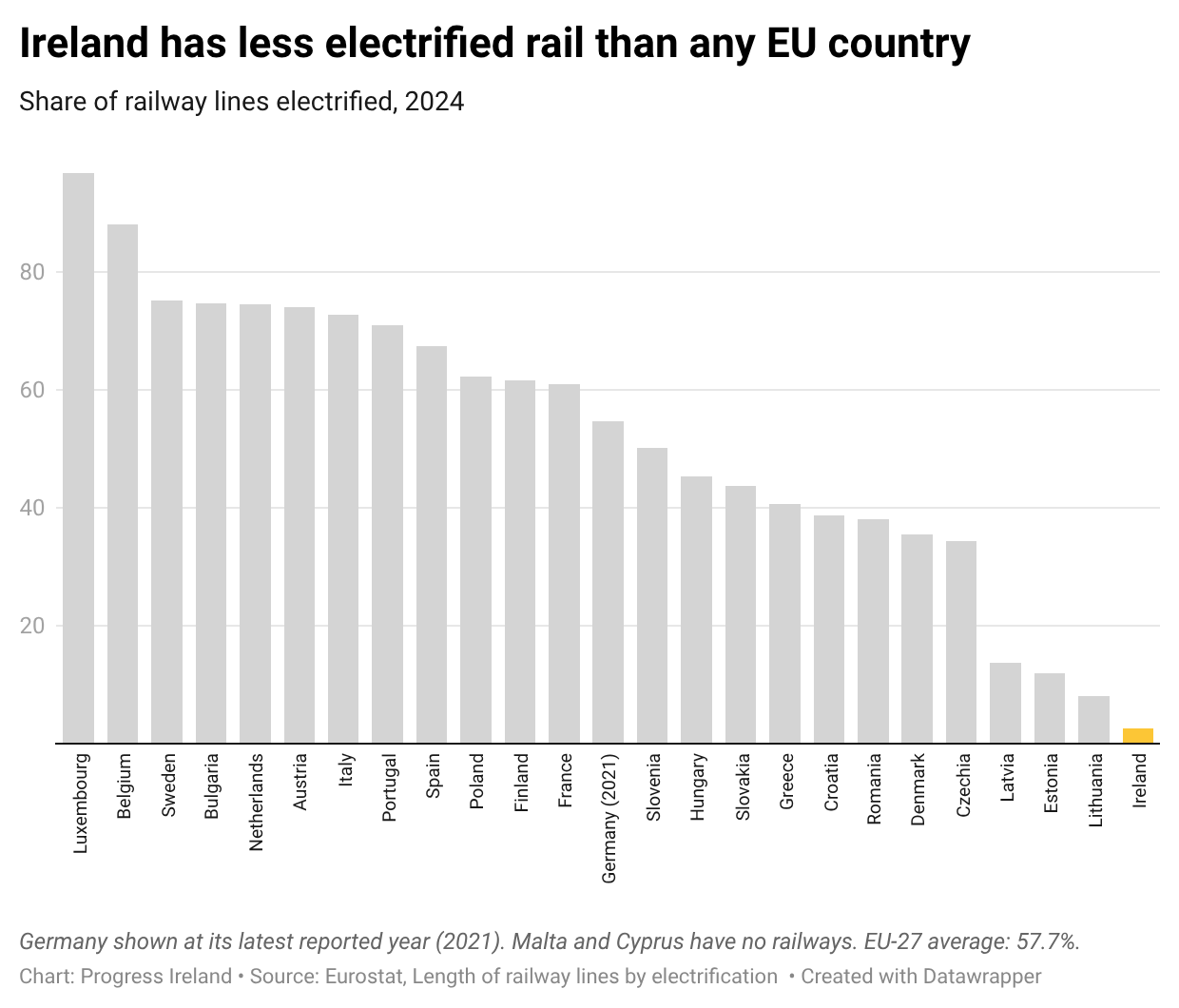
Is it a coincidence that Ireland has the lowest proportion of electrified rail in the EU?
There is another methodology called a Land Use Transport Interaction (LUTI) model. New South Wales in Australia used a LUTI model to account for land use changes in assessing the Sydney Metro West project. It found 20 per cent of gross benefits came from land use changes. That’s very material to whether a project gets green lit or killed.3
The following chart shows differing CBA results for a notional €1 billion rail project using a LUTI and the standard method.
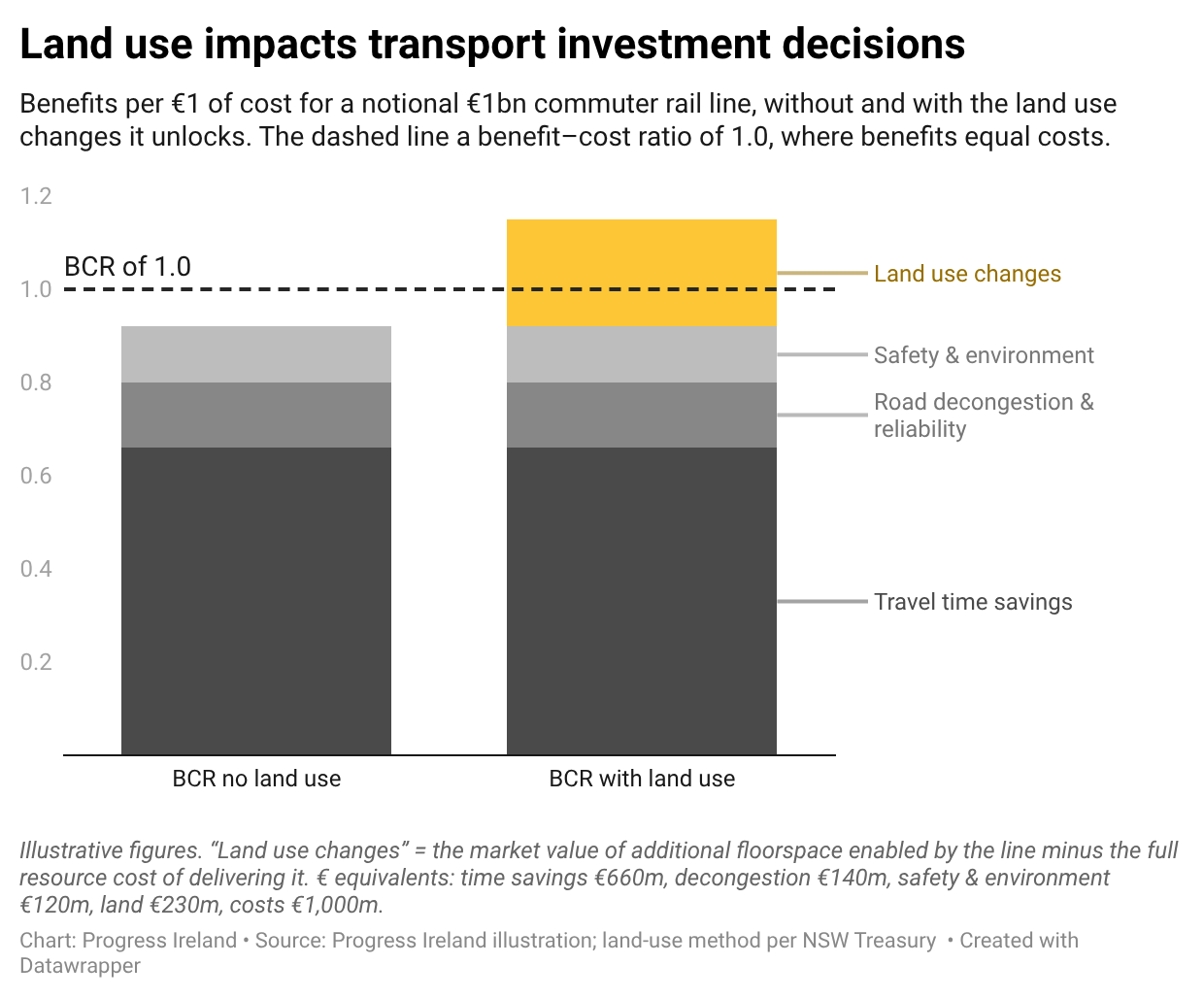
What of my original claim that this CBA methodology is setting us up for a housing shortage? We need around 60,000 new homes per year for decades, per the Housing Commission. We’re not near that number right now and what’s more, we’re running through our stock of suitable development land. We need a bigger pipeline of serviced land. So we need bold transport investments.
For the quantum of homes required, we either need a rake of new motorways or big investments in electrified rail, including the Dart+ Tunnel. These projects are on the long list but they’re not a priority.
The fix would not be difficult. The National Transport Authority CBA methodology is in a document called the Transport Appraisal Framework. The Department of Transport writes it, and the Department can change it. Clause 7.2.3(e) of the rulebook lets a project count the rise in land value – but only where rezoning is agreed as a goal from day one.
Rezoning land is politically and administratively complex. I propose changing the rulebook so that potential future land use changes can be included in a CBA even in the absence of zoning changes.
To be sure, Ireland’s CBA methodology is defensible. Ireland is not an outlier. New South Wales (and parts of the UK government) go further than most other jurisdictions on this.
But we should think about which methodological camp makes more sense for Ireland4. The crux is how static or dynamic the country is.
In a static country with slow population growth, Ireland’s method makes sense. It is a method designed for optimising a static system.
Ireland, though, is far from static. Over the last 30 years, Ireland has been the fastest-growing non-tiny country in the EU. It needs to grow its housing stock by two to three per cent or so for the coming decades. A dynamic country like Ireland should be judging transport investments by how they will contribute to change. All things being equal, a project that enables hundreds of thousands of homes – like a rail line – obviously is more beneficial than one that doesn’t.
The Irish solution to our Irish problem is to sidestep CBAs, and pick projects that make sense. That’s what happened with the Navan Rail line. We’re going ahead with the project – as we should – despite a CBA ratio assessed by the NTA in 2021 at 0.53 to 0.79.
Why not fix the test?
To be sure, there’s nothing stopping us from building more roads. The country is pretty empty. We could widen out the existing motorways and add another ring road to the cities. That’d support several hundred thousand homes. But that’s not the future we’re planning for.
To be fair, the test does mention land use. The Transport Appraisal Framework classes land use as "non-monetisable": the appraiser describes the land use effects in words and gives them a score in a summary table with no euro figure attached.
Attentive readers will ask about double-counting. New South Wales gives a project no credit for rising land prices. It counts the additional land value a project unlocks, then subtracts the full cost of building and any development that would have happened somewhere else anyway.
The Department of Transport took a look at this question in 2025 and concluded that it didn’t make sense for CBA to incorporate land use changes. It said “many of the projects which do lead to significant land use changes will be large and capital-intensive projects, such as new rail lines serving greenfield sites, or brownfield sites undergoing rezoning.” But it didn’t think LUTI models were appropriate due to the methodological challenges of their implementation.
No posts
Comments
Nothing yet. Say the first thing.
Sign in to join the conversation.