
Spare a thought for the Department of Public Expenditure civil servant on a bank holiday Monday morning, who, skimming the news stand, would have spotted The Irish Times‘ cover story:
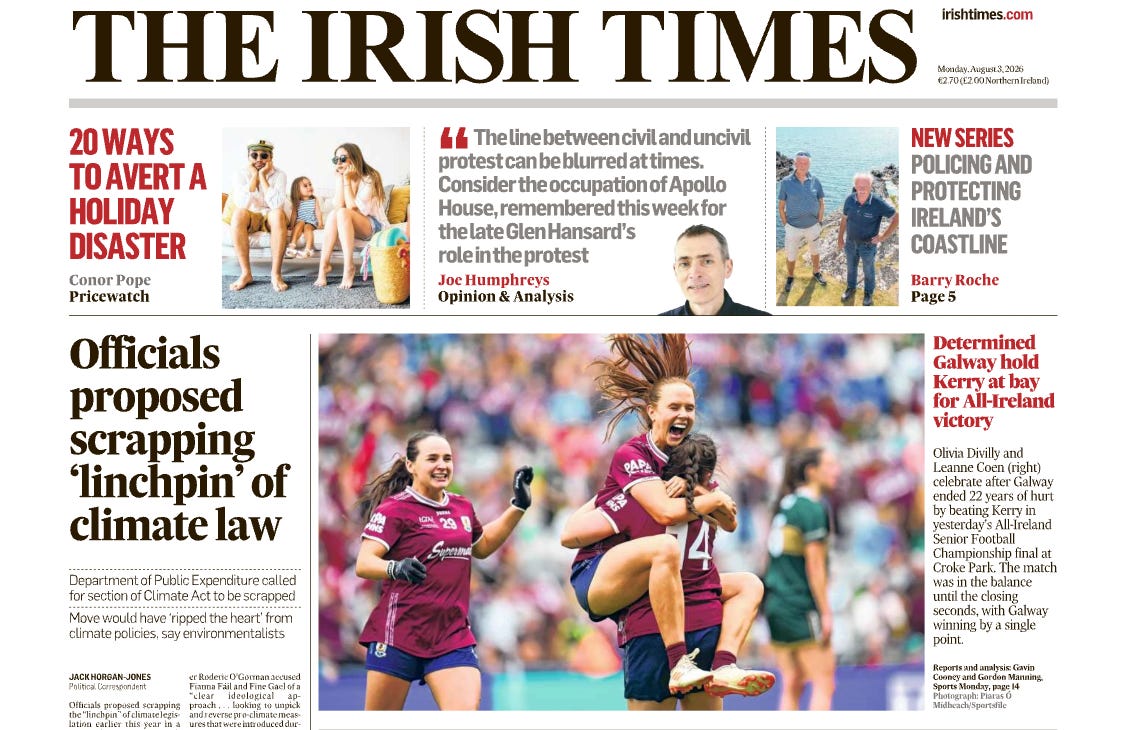
The story was about the Department of Public Expenditure officials’ proposal to disapply a section of the climate act that would require public bodies to perform their functions “in a manner consistent with the mitigation of greenhouse gas emissions, the most recent climate action plans, long-term climate action strategy and the furtherance of the national climate objective.”
The story was not a good one for the government. The opening sentence of the Irish Times piece read: “Officials proposed scrapping the “linchpin” of climate legislation earlier this year in a move that environmentalists say would have “ripped the heart” from climate governance.”
Minister Chambers said, of the act, that disapplying part of it removes an “unnecessary layer that is driving a wider increase and risk around judicial reviews”.
The story gets at a deep problem with government bodies. It is easy to tell a public body to take on a new objective. As the Irish Times story shows, it’s hard to take them away.
This is the curse of joined-up thinking. Joined-up thinking exhorts the state to act in a coherent and holistic way. It tells the Department of Health to consider climate change and the Department of Energy to consider the Irish language.
Joined-up thinking seems right: we all try to live our own lives in a coherent and holistic way. But joined-up thinking doesn’t scale to the level of a state. At that scale its better to have specialised modules that are good at their job: the organs of the state.
The public bodies of the Irish state have been loaded with objectives, which make it harder for them to do their jobs.
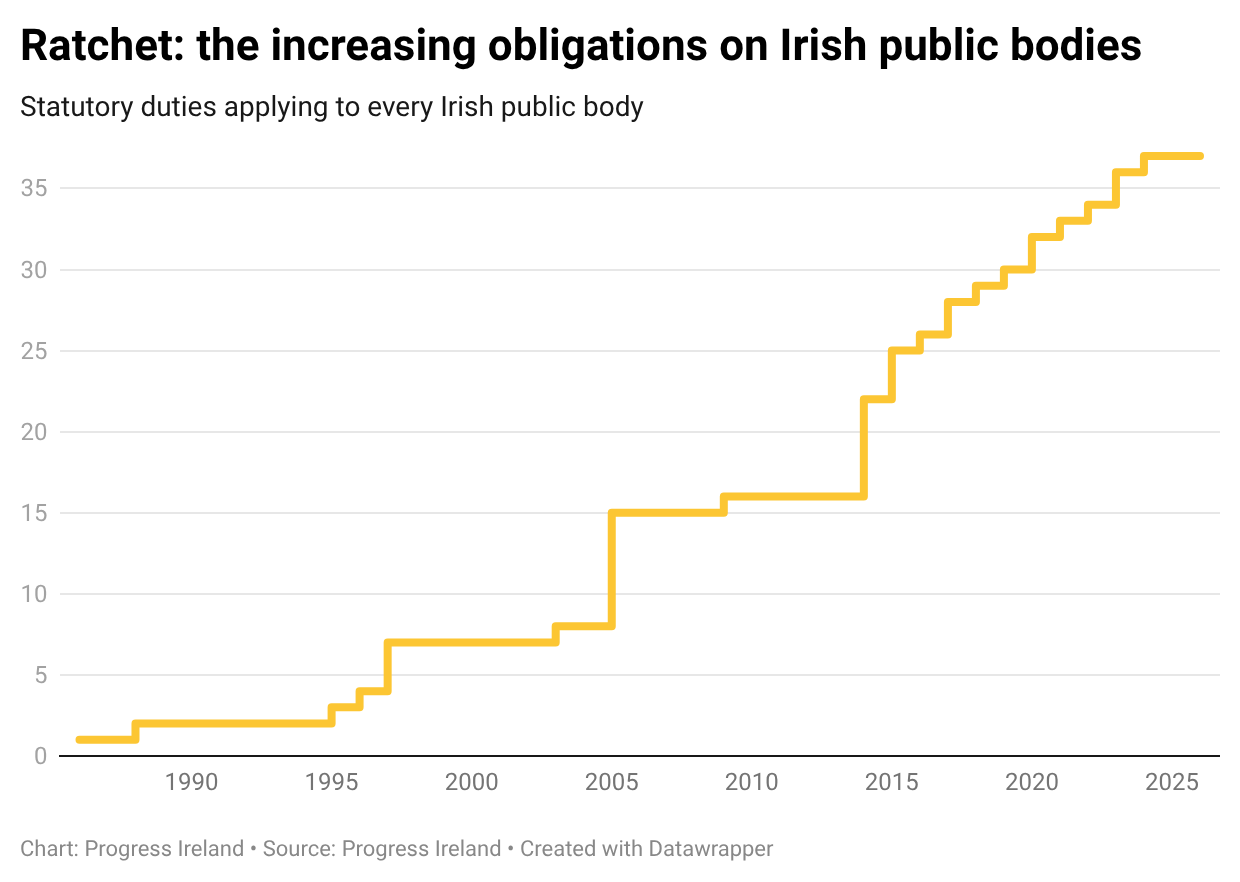
In 2002, an Irish public body carried seven statutory obligations: preserve and transfer its records, keep registers of interests, answer freedom of information requests, protect the personal data it holds, hand over environmental information to anyone who asks, check its plans and consents for effects on protected habitats, and pay interest on late bills.
Today there are 37 of them. In addition to the original seven, they must: provide services and answer correspondence in Irish; make their buildings, services and information accessible, buy only goods and services that are accessible, and appoint an access officer; employ a minimum share of staff with disabilities, 3 per cent then, 6 per cent now; open their data for re-use; play an exemplary role on energy, audit themselves, report their consumption every year, and buy or lease only energy-efficient buildings; eliminate discrimination, promote equality and protect human rights in everything they do, and report annually on how; maintain whistleblowing channels and publish a yearly report on their use; perform every function in a manner consistent with the climate plans; prepare child safeguarding statements; publish a list of which of their officials can be lobbied; run procurement with equal treatment and keep the records to prove it; provide Irish Sign Language interpretation, using accredited interpreters; appoint a data protection officer; sign a data-sharing agreement before passing personal data to another public body; make their websites and apps accessible, and publish an accessibility statement saying how; meet clean-vehicle quotas when buying their fleets; place a fifth of their advertising in Irish, and one euro in every twenty of the advertising budget with Irish-language media; answer social media messages in the language they arrive in, and produce their forms and marketing in Irish; use an Irish or bilingual logo; and have regard to the National Biodiversity Action Plan, reporting every year on what they have done for biodiversity. The thirty-eighth, about cybersecurity, is already on its way from Brussels.
The following chart shows my count of statutory duties applying to every Irish public body.
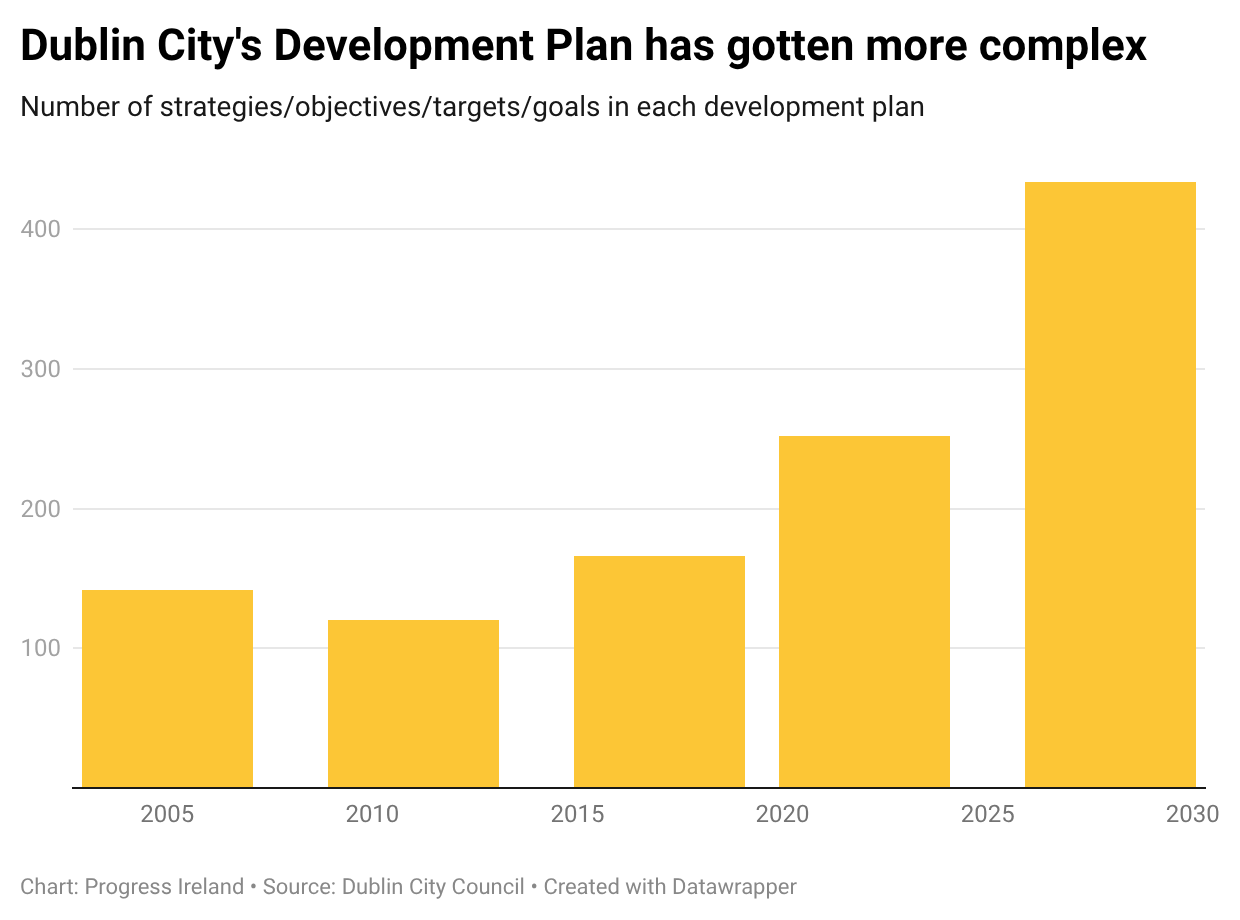
In 2022, I interviewed Dublin City Council’s then chief planner John O’Hara for The Currency about the process of creating a new development plan. He said: “The growth in the number of bodies who want to load their views onto a development plan is amazing. EU, UN, disabled access, every sector thinks they can load their responsibilities onto the development plan. And if you leave anything out, you’re the world’s worst. This should be a user-legible plan. The sin of omission in a development plan is the biggest sin of all.”
The following chart tracks the growth of objectives in Dublin City Council’s development plans over time.
The plague of joined-up thinking doesn’t end at public bodies. Through procurement rules, the state is forcing it on private companies.
In 2000, a company that wanted a government contract gave a price for the work and showed it had paid its taxes.
Today the same company must: manage the work in the way that the Capital Works Management Framework specifies; give a commencement notice, employ an assigned certifier and supply certificates for the work; declare that it did not break environmental law, social law or labour law; pay its subcontractors in the time that the law sets; pay the wage rates, the pension and the sick pay in the Sectoral Employment Order; meet environmental conditions and social conditions; supply a minimum number of clean vehicles and report on these vehicles each year; list its funding from countries outside the European Union (for big contracts); use low carbon cement and low carbon methods; specify low carbon components for a building; calculate the life cycle of a building that is more than 1000 square metres. Next year it must report the embodied carbon of a new building.
Organisations tend to lose focus over time. On day one, the new organisation is focused on the task at hand. It attracts people who care deeply about the task. Its culture is informed by the task. Its incentives reward behaviour that contributes to the task.
Over time, it loses its day-one energy. The problem it was founded to solve gets less acute. Newer recruits arrive with their own priorities. Other organisations insert their priorities. Gradually, the organisation loses touch with its purpose.
The tendency is not confined to public bodies. Companies can lose focus too. 20th century capitalism was dominated by sprawling conglomerates. ACME inc had an insurance division, a paint manufacturing division and a real estate division.
This came to be because ACME was was controlled, not by its shareholders, but by its managers. Managers have different incentives to shareholders. They want a) the fun of managing big companies and b) their companies never to go bankrupt. In the 1970s and 80s, economists started to make the case that companies should not be run in the interests of their managers and employees. Financial economist Michael Jensen said that telling a manager to maximise profits, market share, growth “and anything else one pleases will leave that manager with no way to make a reasoned decision. In effect, it leaves the manager with no objective.”
By the 1990s, shareholders had seized the whip hand back from managers. The result was that companies focused on what they were best at. The likes of ACME were forced to focus on insurance and sell their paint division. US companies ever since have been good at focusing on the Main Thing.
Competition enforces discipline. Unfocused companies don’t make it. They either get bought out by private equity, or they die at the hands of their focused competitors.
Old style capitalism still persists in some places. Where shareholders are not empowered, you will find sprawling inefficient conglomerates manufacturing cement and operating concert halls (this place is called Japan).
The tendency for organisations to lose their focus is universal. But it’s a bigger problem with public bodies because there is no mechanism to automatically discipline them and keep them on track. There’s no private equity firm looking to buy An Coimisiún Pleanála, restructure it and sell it off.
All of which is to say that Irish bureaucracy is in need of a friend.
The left champions public bodies and wants them to succeed. But the left loads public bodies up with contradictory objectives and makes them worse at their job.
The right, on the other hand, distrusts bureaucracy. And to the extent it thinks about it, it tends to starve it of resources.
In theory, Ministers should be lifting obstacles out of the way of public bodies and giving them the best chance at success. Their job is to represent the citizens who depend on public bodies. But we saw this week what happens when a minister tries to reprioritise.
What this does not mean is that the state as a whole should only have a handful of priorities, and ruthlessly deprioritise all others. This is not how governments should work.
What this means is that the part of the state entrusted with disabilities should focus single-mindedly on disability; the part of the state focused on housing should focus single-mindedly on housing, and so on. Allowing agencies to focus on their job will get us much more of everything than telling every agency do every job.
The governance of Metrolink, which is a live issue, is related to this phenomenon.
Right now, the government is deciding how Metrolink’s delivery agency will be overseen and controlled.
The project will be controlled and overseen by the Ministers for Transport and Public Expenditure. All agree that they are the clients and ultimate power sits with them.
Beneath the ministers, all agree that there needs to be drawn a box of some size within which the technocrats running the delivery agency will get on with the business of digging holes, negotiating with suppliers, and making decisions. The question is over how big to make the box.
If the box is too big -- if the delivery agency is given too much latitude -- the agency could go rogue. It could spin out of the state’s control. The Port Authority of the state of New York is the canonical example of an over-powerful and unaccountable state agency.
However, if the box is too small -- if the delivery agency is given too little latitude -- important spending decisions will be made by DPER and Dept Transport bureaucrats, rather than by delivery agency technocrats. This, too, is a major failure mode, and is associated with the most catastrophic cost overruns in metro projects.
Metrolink has grown out of Transport Infrastructure Ireland, The National Transport Authority, The Department of Transport and the Department of Public Expenditure. It is in these bodies’ interests to seek control over the project. They are wary of delegating authority to the delivery agency. They want the box to be small.
As with other objective-burdened public bodies, it falls to the Ministers to represent the interests of citizens in this matter. The minister should give the delivery agency the thing no Irish body has been given in decades — one job.
No posts
Comments
Nothing yet. Say the first thing.
Sign in to join the conversation.