
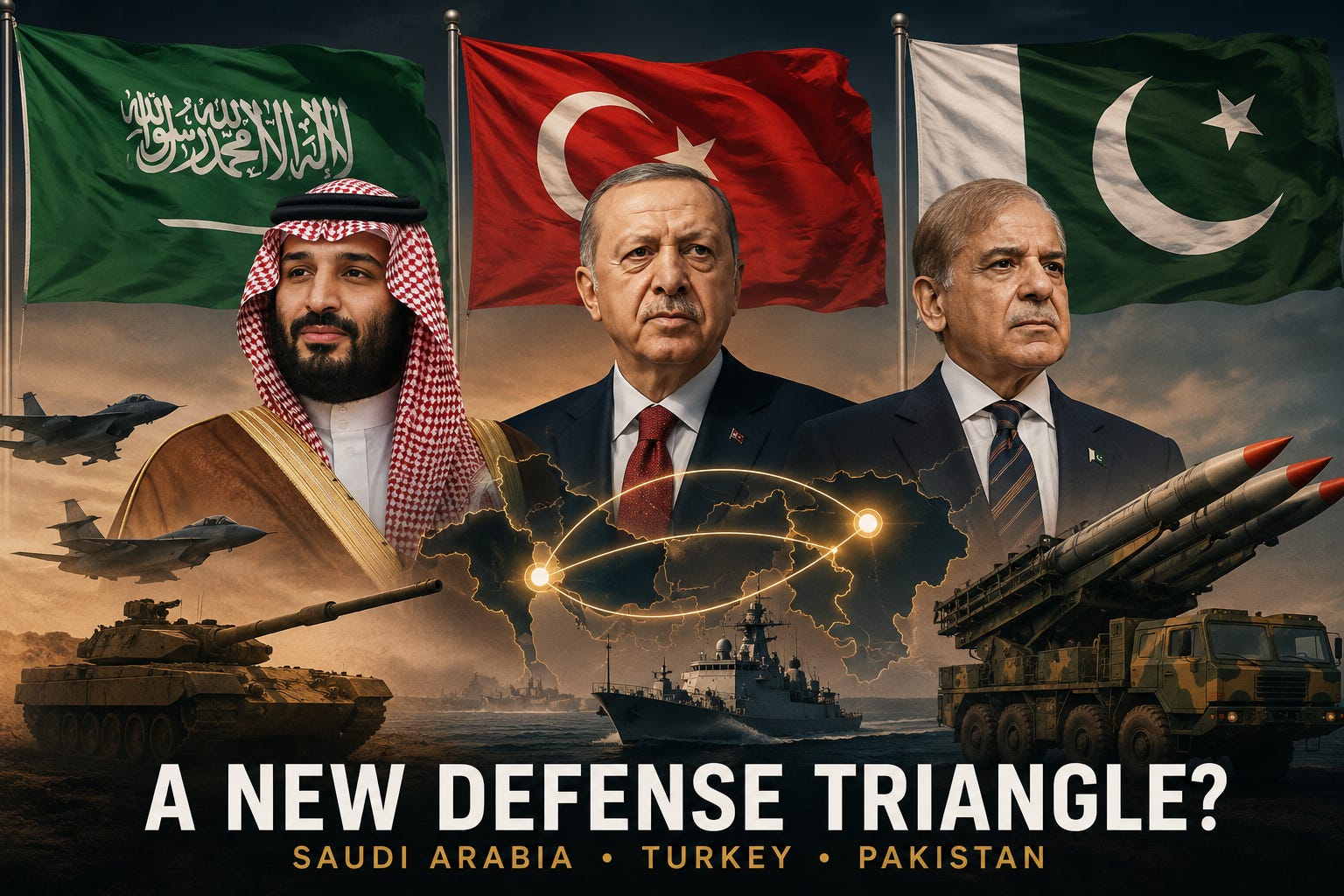
Saudi Arabia, Turkey and Pakistan signed the Mecca Joint Defence Agreement on August 7.
The basic idea is simple: if one of the three is attacked, the others will treat it as an attack on all three.
That sounds familiar because it is.
It is similar in spirit to NATO’s Article 5, although it is not NATO and it does not create the same military structure. Turkey’s foreign minister has said the agreement is technically similar to Article 5, while also making clear that the pact does not name Iran or any other country as an enemy.
But the interesting part is not the sentence on the paper.
It is who signed it.
Saudi Arabia brings money, energy and enormous influence in the Arab world.
Turkey brings one of the region’s strongest defense industries, a large military and a NATO membership that gives it a very unusual position between different power blocs.
Pakistan brings a large, experienced military and, most importantly, a nuclear deterrent.
Put those three together and you get something that did not exist before in this exact form.
You get money + military industry + military manpower + nuclear deterrence.
That does not automatically create a superpower.
But it creates a serious regional security network.
And I think that is the bigger story.
Why would Saudi Arabia want this?
Saudi Arabia has spent decades relying heavily on the United States for security.
That relationship is not disappearing.
But Riyadh has learned a hard lesson over the years: having a powerful friend does not mean that friend will always respond exactly when you need it.
Saudi Arabia has watched missile attacks, drone attacks and regional conflicts change the security picture around it.
So it makes sense for Riyadh to build more than one security relationship.
This is not necessarily Saudi Arabia saying, “We don’t need America anymore.”
It may be saying something much more practical:
“We don’t want our security to depend on only one country.”
That is a very different idea.
And it is probably the most important way to understand this agreement.
Pakistan is the part that makes this especially interesting.
Pakistan and Saudi Arabia already signed a Strategic Mutual Defense Agreement in September 2025.
That agreement said aggression against either country would be considered aggression against both.
So the 2026 agreement did not come out of nowhere.
There was already a security relationship underneath it.
Now Turkey has joined that structure.
That changes the picture.
Pakistan is also different from most of Saudi Arabia’s security partners because Pakistan is a nuclear-armed state.
I would be careful here, though.
It would be wrong to say that Saudi Arabia now automatically has a “Pakistani nuclear umbrella.”
The agreement does not publicly say that.
And Turkish officials have stressed that the pact is defensive and does not target a particular country.
But nuclear capability still changes how other countries think about the alliance.
You don’t need to put a nuclear clause in every sentence for everyone to understand that one of the members has nuclear weapons.
That creates deterrence simply through the existence of the capability.
Then there is Turkey.
Turkey may be the most strategically interesting member of the three.
It is a NATO member.
At the same time, it has spent years building its own defense industry and developing relationships outside the traditional Western alliance system.
Turkey has drones, missiles, naval systems and a growing domestic defense sector.
So Turkey does not just bring soldiers to this agreement.
It brings technology and industrial capacity.
That matters because modern alliances are not only about sending troops.
They are about producing weapons, sharing intelligence, building air defenses, protecting shipping routes and keeping supply chains working.
Turkey can contribute to many of those areas.
The timing matters too.
This agreement comes during a period of serious instability in the region.
And the three countries have already been talking to each other.
Turkey, Saudi Arabia, Pakistan and Egypt have been meeting through the R4 format. In June 2026, their foreign ministers met in Cairo and reaffirmed their intention to coordinate on regional security and stability.
So this is not three countries suddenly waking up one morning and deciding to form an alliance.
There has been a process behind it.
That makes the agreement more important.
It suggests the idea of greater regional cooperation has been building for some time.
Could this become a bigger alliance?
Maybe.
Turkey has already said the door could be open to other countries, with Egypt being one of the most obvious possibilities.
And this is where things could become really interesting.
Imagine adding Egypt.
Now you would have Saudi Arabia’s money and energy power, Turkey’s defense industry, Pakistan’s military and nuclear deterrence, and Egypt’s huge population, military and control of the Suez Canal.
That would be a very different organization.
But I would not call it “Islamic NATO” yet.
That name makes the alliance sound much more complete than it actually is.
NATO has decades of military planning, permanent command structures, integrated forces and established procedures.
This new agreement is much younger.
It has to prove itself.
The real test will not be the signing ceremony.
The real test will be what happens next.
Do they hold joint military exercises?
Do they share intelligence?
Do they build joint defense systems?
Do they create real command structures?
Do they respond together during the next crisis?
Those are the things I would watch.
There is another important point: this is not necessarily anti-Iran.
A lot of people will look at the map and immediately think Iran.
That is understandable.
Iran is a major regional power, and the current security situation makes the question impossible to ignore.
But the countries themselves are saying the agreement is not aimed at Iran or another specific country.
I think we should take that statement seriously.
At the same time, we can recognize the reality that Iran is part of the security environment that these countries are preparing for.
Those two things can be true at the same time.
An alliance does not need to name an enemy to change the calculations of that enemy.
The United States should pay attention.
Not because America has suddenly been pushed out of the region.
It hasn’t.
The United States still has enormous military, economic and diplomatic power.
And Saudi Arabia is not suddenly going to stop dealing with Washington.
But there is a difference between being the only major security option and being one of several options.
That difference matters.
For decades, America’s security role gave Washington enormous influence.
If countries begin building their own security networks, American influence may slowly become less central.
Not because America disappeared.
Because countries have more choices.
And choices create independence.
There is also an economic side to this.
Defense cooperation often creates much more than military cooperation.
If Turkey sells more defense technology to Saudi Arabia and Pakistan, factories grow.
If Pakistan provides military training and cooperation, relationships deepen.
If Saudi Arabia invests in defense industries, infrastructure and technology, it can help create long-term partnerships.
Over time, an alliance can become an economic network.
That is when it becomes harder to break apart.
Countries rarely stay close only because of one treaty.
They stay close because thousands of smaller interests become connected.
But there are serious problems too.
The three countries do not agree on everything.
They have different foreign policies.
They have different relationships with Iran.
They have different relationships with the United States.
They have different interests in Afghanistan, Syria, Yemen, Israel and India.
That matters.
An alliance is easy when everyone agrees about the problem.
It becomes much harder when one country sees a crisis as a threat and another sees it as something to avoid.
The phrase “an attack on one is an attack on all” sounds powerful.
But the real question is:
What happens when they disagree about what counts as an attack?
That is where the difficult part begins.
And then there is India.
Pakistan’s participation adds another layer that cannot be ignored.
Pakistan and India have a long history of military conflict.
Turkey has also developed closer political and defense relations with Pakistan.
Saudi Arabia, meanwhile, has strong economic ties with India.
So Riyadh has to balance relationships that do not always fit neatly together.
This is one reason I would not describe the agreement as a simple anti-India or anti-Iran alliance.
The reality is much more complicated.
Saudi Arabia wants security and economic growth.
Turkey wants regional influence and strategic independence.
Pakistan wants security, economic partnerships and stronger international support.
Each country has its own reasons.
And those reasons can overlap without being identical.
What I think is really happening
I don’t think we are watching the birth of a new NATO.
At least not yet.
I think we are watching something smaller but potentially more important:
countries in the region are trying to build more control over their own security.
For a long time, the Middle East had a simple security model.
America was the biggest outside power.
Local countries had their own armies, but American power was a major part of the regional balance.
Now that model is being tested.
Countries are asking:
What happens if America is busy somewhere else?
What happens if America does not respond?
What happens if Washington’s priorities change?
What happens if the next crisis is too big for one country to handle?
The answer from Saudi Arabia, Turkey and Pakistan appears to be:
Maybe we should build something ourselves.
That is the part I find most important.
The real test begins now.
Signing an agreement is easy.
Building an alliance is hard.
I would watch four things over the next year.
First, joint military exercises.
If they start training together regularly, the agreement is becoming real.
Second, defense technology cooperation.
If Turkey’s defense industry becomes more connected with Saudi and Pakistani systems, the relationship will become deeper.
Third, Egypt.
If Egypt joins, the strategic weight of the group changes significantly. Turkish officials have already indicated that Cairo could be a future participant.
Fourth, what happens during the next crisis.
That is the biggest test.
If one member faces a serious attack, do the other two actually respond?
Because that is when a treaty stops being words on paper.
My biggest takeaway
The world is becoming less comfortable with the idea that one country should provide security for everyone else.
Countries are building backup plans.
Saudi Arabia is building more security partnerships.
Turkey is building more strategic independence.
Pakistan is expanding its role beyond South Asia.
And other countries are watching.
Maybe this becomes a powerful new regional alliance.
Maybe it stays a limited defense agreement.
Maybe it expands.
Maybe disagreements eventually weaken it.
We don’t know yet.
But one thing is already clear:
Saudi Arabia, Turkey and Pakistan have decided that their security cannot depend on one relationship alone.
That is a small sentence with very big consequences.
No posts
Comments
Nothing yet. Say the first thing.
Sign in to join the conversation.