
That makes sense.
Iran is one of the biggest military powers in the region. It has a long and complicated relationship with Saudi Arabia and Turkey, and any new security agreement involving Riyadh naturally raises questions about Tehran.
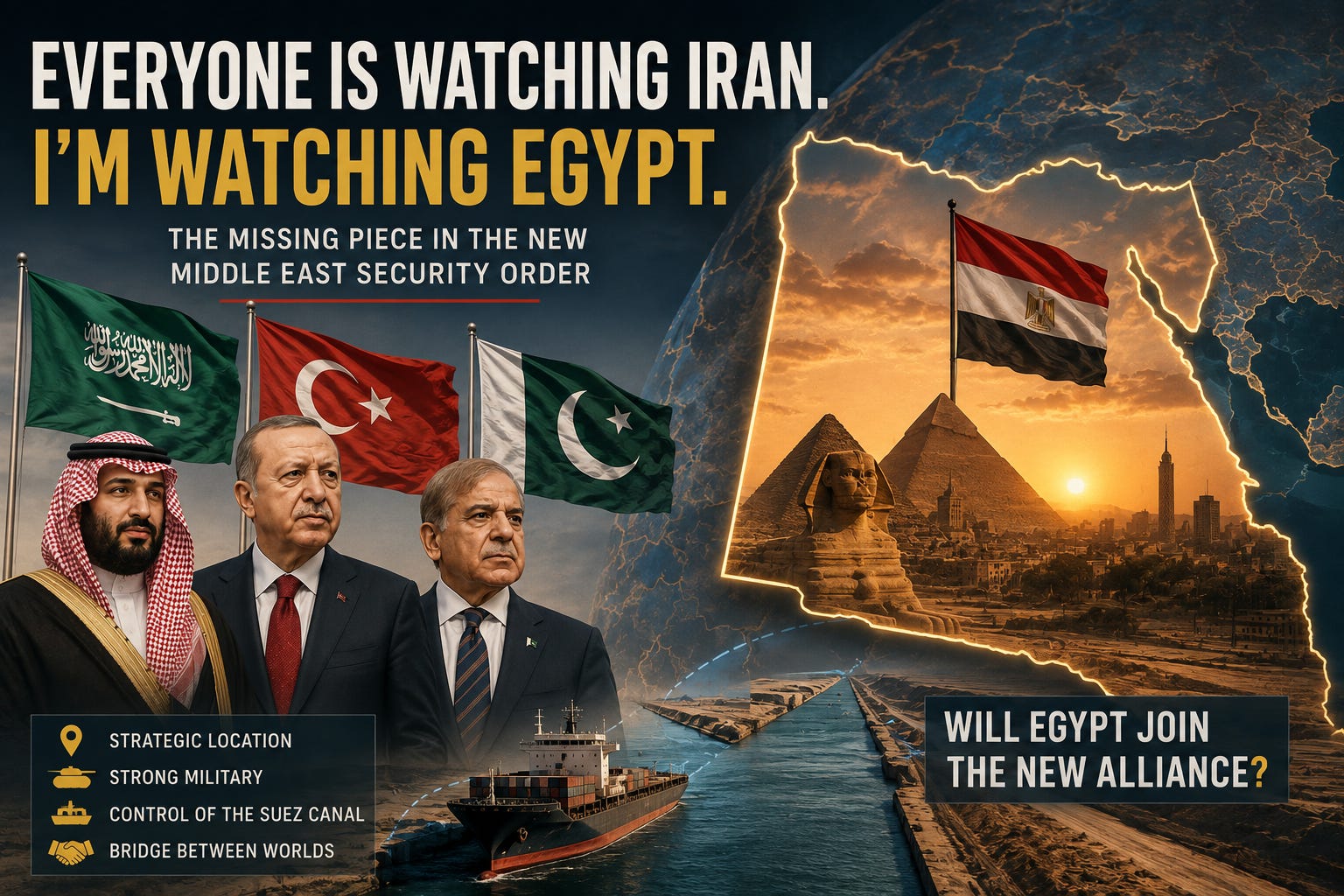
But I think there is another country we should be watching much more closely.
Egypt.
Not because Egypt has joined the new alliance.
It hasn’t.
That is exactly why it is interesting.
Saudi Arabia, Turkey, and Pakistan signed the Mecca Joint Defence Agreement on August 7. The agreement says that an armed attack on one member will be treated as an attack on all three. Turkey’s Foreign Minister Hakan Fidan has since said that Ankara expects Egypt could join after the technical details are worked out.
But Cairo did not sign the agreement.
And I think that tells us something.
Egypt is not some country that suddenly appeared after the Saudi-Turkey-Pakistan agreement.
It was already part of the conversation.
On June 21, Egypt hosted the fourth meeting of what is known as the R4 group, bringing together Egypt, Saudi Arabia, Turkey, and Pakistan.
The four countries discussed regional security, stability, energy markets, trade, and the wider security situation in the Middle East.
They also talked about the importance of collective security in the region.
So the four countries were already talking.
They were already coordinating.
They were already discussing security.
Then three of them signed a defense pact.
Egypt stayed out.
That is the part I find interesting.
Why?
Egypt is in a very different position from Pakistan.
Pakistan can deepen its security relationship with Saudi Arabia without suddenly changing its entire foreign-policy structure.
Egypt has a much more complicated web of relationships.
It has strong ties with Saudi Arabia.
It has growing ties with Turkey.
It has an important relationship with the United States.
It has a peace treaty with Israel.
It controls the Suez Canal.
And it has its own security concerns in Libya, Sudan, Gaza, the Red Sea, and the eastern Mediterranean.
Cairo cannot look at one problem in isolation.
Every decision affects several others.
That may explain why Egypt is being careful.
Joining a defense pact is not the same thing as joining a discussion group.
Once you promise that an attack on one country is an attack on all, you create obligations.
You may be pulled into conflicts that you did not start.
You may have to choose between partners.
You may have to send soldiers or weapons when you would rather stay out.
For Egypt, that is a serious decision.
There are reports that Cairo avoided the Mecca agreement because it was concerned about joining a Saudi-led security bloc.
I would be careful with that claim because it comes through Egyptian media reporting rather than a detailed public Egyptian explanation of why Cairo stayed out.
But even without knowing the private reason, the result is clear:
Egypt was invited into the broader conversation, but it did not sign the defense agreement.
That difference matters.
It suggests that Cairo may want cooperation without giving up strategic freedom.
And honestly, that may be the smartest position for Egypt right now.
This is what makes Egypt different from a country that has already committed itself.
Cairo can watch.
It can see how Saudi Arabia, Turkey, and Pakistan actually implement the agreement.
It can see whether they conduct joint military exercises.
It can see whether they create permanent military structures.
It can see how they handle the next regional crisis.
And then Egypt can decide.
There is no need to rush.
A treaty looks powerful on the day it is signed.
It looks very different six months later when governments have to decide what they are actually willing to do.
This is where things get even more interesting.
Turkey’s Foreign Minister Hakan Fidan has publicly said that Turkey expects Egypt to join the defense pact.
He has also described the agreement as something that could expand beyond the original three members.
That tells us Ankara sees Egypt as strategically important.
And it is not hard to understand why.
Egypt has one of the largest militaries in the Arab world.
It has a huge population.
It sits at the meeting point of Africa, the Middle East, and the Mediterranean.
And then there is the Suez Canal.
The canal is one of the world’s most important shipping routes.
So if you are trying to build a serious regional security network, Egypt is not a small addition.
It changes the map.
Think about what the group would look like if Egypt eventually joined.
Saudi Arabia would bring enormous financial resources, energy power, and influence in the Gulf and Arab world.
Turkey would bring a large military, NATO experience, and a growing defense industry.
Pakistan would bring a large military, strategic depth, and nuclear deterrence.
Egypt would add another major military, control of the Suez Canal, geographic access to both the Mediterranean and Red Sea, and enormous political weight in the Arab world.
That would be much more than three countries signing a defense agreement.
It would start to look like a genuine regional security network.
But there is an important word here:
If.
Egypt has not joined.
And we should not write as if it already has.
Egypt’s position becomes even more complicated when Israel enters the picture.
Egypt has a peace treaty with Israel that has been one of the central pillars of Middle Eastern security for decades.
At the same time, Egypt has repeatedly positioned itself as an important player on the Palestinian issue and has been deeply involved in regional diplomacy around Gaza.
The June R4 statement also placed the Palestinian issue at the center of efforts to create a stable regional order.
So if Egypt joined a broader Saudi-Turkey-Pakistan security arrangement, it would not simply be adding another army.
It would be bringing the entire question of Egypt’s relationship with Israel into the alliance’s strategic calculations.
That could make the alliance more powerful.
It could also make it much harder to manage.
This is another reason Cairo has to be careful.
Egypt has a long-standing strategic relationship with Washington.
It receives substantial American military assistance and has spent decades building military relationships with the United States.
Joining a new regional defense structure would not automatically destroy that relationship.
But it would add another layer.
And Egypt would probably want to make sure that layer gives it more freedom rather than creating new restrictions.
This is the bigger change happening across the Middle East.
Countries are increasingly looking for multiple security partners.
They don’t necessarily want to abandon America.
They simply don’t want America to be their only option.
Saudi Arabia is doing this.
Turkey has been doing this for years.
Pakistan has its own version of it.
Egypt now has a decision to make.
There was a time when relations between Egypt and Turkey were extremely difficult.
That has changed.
The two countries have spent the last few years rebuilding relations and increasing diplomatic and economic cooperation.
That makes the current situation very different from what it would have been a decade ago.
Turkey now wants Egypt inside a regional security arrangement.
Egypt is already participating in the R4 framework with Turkey.
So there is a foundation for cooperation.
But cooperation does not automatically mean alliance.
Countries can work together on one issue and disagree on another.
That is normal diplomacy.
And Egypt has every reason to keep that flexibility.
Here is the part that I think is easy to miss.
Sometimes a country has more influence because it is not locked into one side.
Egypt can talk to Saudi Arabia.
It can talk to Turkey.
It can talk to Pakistan.
It can talk to America.
It can talk to other Arab states.
It can talk to Israel.
That gives Cairo options.
And options are power.
If Egypt joins the new defense pact, it gains security commitments.
But it also loses some freedom.
If it stays outside, it may be able to play a different role.
It could become the country that talks to everyone.
That could be especially valuable during a crisis.
I think that is actually the wrong question.
The better question is:
What does Egypt want this new regional order to look like?
Because Cairo does not have to simply accept the structure created by Saudi Arabia, Turkey, and Pakistan.
Egypt has enough military, economic, geographic, and diplomatic weight to shape the structure itself.
If Egypt joins, it will want a say in how the alliance works.
If it stays out, it can still influence it from the outside.
Either way, Egypt matters.
Iran is obviously important.
The Saudi-Iran relationship matters.
Turkey’s relationship with Iran matters.
Pakistan’s relationship with Iran matters.
But Iran is not the only country affected by the new security arrangement.
Egypt may be the country that determines whether this remains a three-country agreement or becomes something much larger.
And that is why I think the next important question is not:
“What does Iran think about this?”
It is:
“What does Egypt decide to do?”
If Cairo eventually joins, the strategic map changes.
If Cairo stays out, that tells us something too.
It would suggest Egypt wants regional cooperation without being tied to a formal military bloc.
Either way, Egypt has become one of the most important countries to watch.
The Saudi-Turkey-Pakistan agreement may have been signed in Mecca.
But the next chapter of this story may be decided in Cairo.
No posts
Comments
Nothing yet. Say the first thing.
Sign in to join the conversation.