
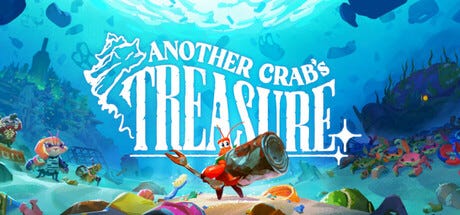
The most profound game I’ve played in 2026 is a Soulslike about a hermit crab.
Another Crab’s Treasure is about a hermit crab, Kril, and his quest to regain his shell. After being informed he has unpaid taxes, a Loan Shark repossesses it until he can pay off his debt. To that end, Kril must venture into the ocean and collect microplastics, the currency of the ocean economy.
All the while, a mysterious Gunk is corrupting the ocean’s citizens. The Gunk drives them mad. The feral creatures attack anyone and everyone, even people they just met. To get his shell back, Kril will also have to confront the source of the Gunk and avoid succumbing to it himself.
There are many ways to approach Another Crab’s Treasure. It can be played in light of the Anthropocene, as an Eco-Marxist critique, or even a Libertarian tract. There is certainly something to all of these.
However, I prefer an angle that is less obvious. I will focus on the first act of the game since it especially stood out to me. Kril’s first forays into the wider ocean begin with his arrival in the Duchy of Slacktide. Here, he faces the realities of a world that has changed since his days in the tidepool.
The first act of Another Crab’s Treasure is a critique of Thomas Hobbes’ social contract theory. It argues that the State, far from securing people’s welfare, makes their lives worse. To understand this critique, I will first explain Hobbes’ theory of the social contract, then interpret the game accordingly.
Where does society come from? It’s an old question for which there is probably not a single answer. However, one of the enduring explanations comes from a 17th century thought experiment: The State of Nature.
Thomas Hobbes, the name most famously associated with this idea, asks us to imagine a world without any governing order. In this world, it is every man for himself:
Hereby it is manifest, that during the time men live without a common Power to keep them all in awe, they are in that condition which is called Warre; and such a warre, as is of every man, against every man.
— Thomas Hobbes1
As Hobbes sees it, the ordinary state of the world is chaos. There is a finite number of resources, and people have infinite desires. Even if one or two people should be friendly, the competition for resources will make violence inevitable. That is not even counting the other causes of conflict. Humanity, in its natural state, is at war with itself.
Hobbes’ solution to this problem is Absolute Monarchy. The only way to prevent total anarchy is to have a singular Power capable of putting everyone in line. That power is the government, the source of laws. Thus, to avoid violence in the State of Nature, everyone must agree to cede some of their rights to the central power. Only then can there be peace.
Technically, Hobbes is proposing a social contract theory of society. Society does not just exist out there in nature. It comes into being by a sort of contract individual members of a society make with each other. Hobbes’ version of that contract is a trade the people make with the sovereign: Freedom for security. By this joint agreement, the Leviathan of the state puts an end to the war of all against all.
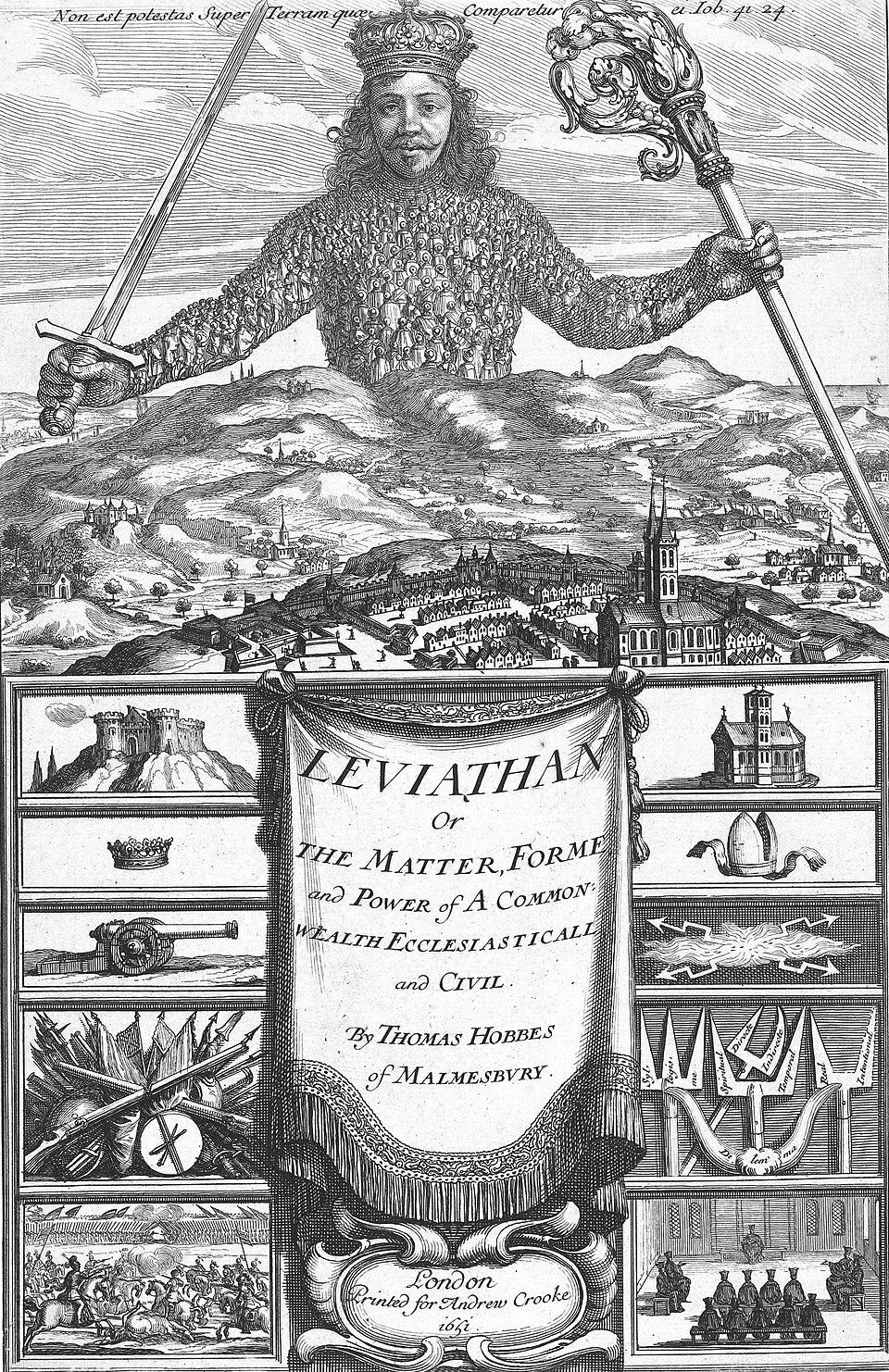
Most Americans would view this version of the contract as tyranny, but it is important to remember that Hobbes wrote Leviathan in the midst of the English Civil War. When the fabric of society is unraveling around you, it is tempting to imagine that a powerful figure could just pull it all back together again. That temptation is not peculiar to his own time.
Hobbes’ argument is a foundation stone for the rhetoric of authority. It is less important for its logical soundness than its imaginative power. The State of Nature conjures images of dense forests, filled with headhunters hurling darts against frantically fleeing men, who themselves carry treasure they took from another tribe not moments before. Such a maelstrom of brutality calls out for someone to stop it.
From this rhetoric of authority comes many familiar ideas—that laws require a supreme enforcer to exist at all, that civilizational progress depends on a powerful state, that freedom and property are in peril unless a sovereign can guarantee them. These premises often simply slip by unquestioned on the back of anxiety about the State of Nature. That is the true power of the Leviathan.
Another Crab’s Treasure calls these premises into question. Kril stares into the face of the Leviathan and dares to ask: Is the State of Nature all that bad?
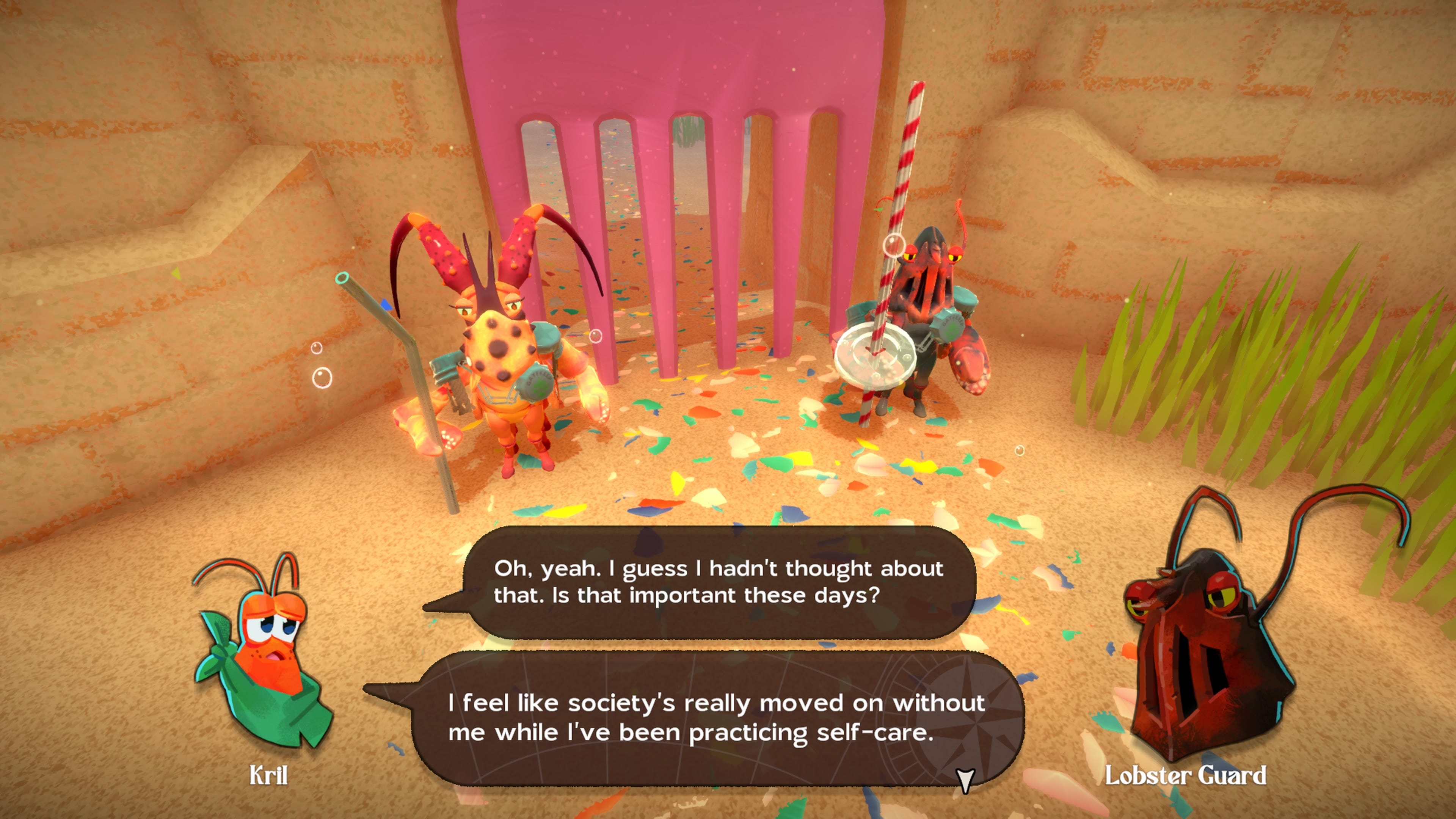
There are many places Another Crab’s Treasure questions the importance of authority, but none are so Hobbesian as Slacktide. This early game level meditates heavily on the validity of authority. The Duchy of Slacktide sets side by side the supposed merits of authority and the harms that authority creates.
The game uses this section to argue that the State is not necessarily better than the State of Nature—in fact, it could be worse.
Slacktide is a frontier territory. In other words, it is a prime candidate for Hobbes’ State of Nature. Before the Duchy is established, no state steps in to interfere when someone takes someone else’s stuff. Theoretically, this means it should be a whirlpool of violence. Our protagonist must be running for his life, right?
Well, it’s not that simple. Kril does seem afraid of birds, but otherwise he enjoys the freedom to sit in his shell. That is, he is free until the Loan Shark shows up to repossess it for unpaid taxes.
When Kril says he is confused, the Loan Shark relies on some very Hobbesian rhetoric to justify his actions:
Ookay, so basically the Duchess of Slacktide owns this whole area now. And she puts a lot of effort into keeping it safe. So everyone who benefits from that has to abide by her rules and pay up once per tide.
In other words, Kril benefits from the social contract, so he must sacrifice for it. Kril objects that the area is not safe, but the Loan Shark ignores him and demands the taxes, ultimately repossessing his shell.
Note the theme here: The intervention of the State makes Kril less safe, not more. Now, without the protection of his shell, he is forced to manage the privations of Nature by himself. He is worse off than he was before. For all the Hobbesian rhetoric about the State securing the safety of its members, it has manifestly failed.
The failure of the Duchy’s social contract becomes even clearer in other conversations. For instance, the crab Verne gets trapped in a tower surrounded by feral enemies. Kril rescues him and asks him why he does not move somewhere safer.
Verne: And give up this prime land the duchess offered me? No way, moray!
Kril: The duchess gave you…land? Isn’t there land all over the place?
Verne: Ah, the simple insights of country folk! This really is the life!
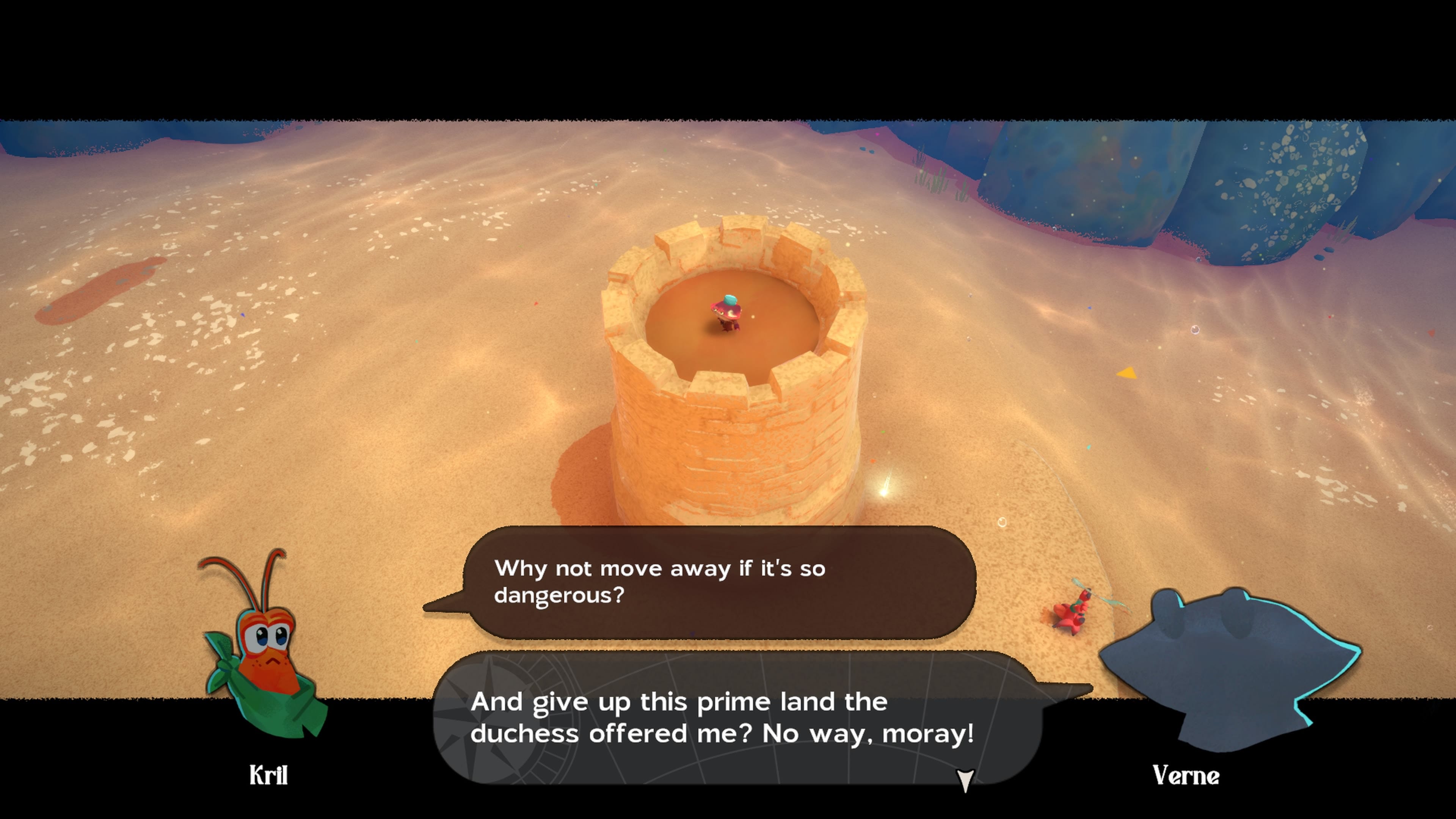
The exchange says a lot about the Hobbesian rhetoric of authority. Verne can patronizingly dismiss Kril’s observation because Hobbes’ theory lurks in the back of his mind. Kril simply does not understand how the world works, Verne thinks. If he understood the social contract, then he would know that land is distributed by the Duchess and protected by her—despite that “protection” not being there when he needed it.
Even creatures who otherwise dislike the social contract have been brainwashed by its rhetoric. One snail commiserates with Kril about their taxes. When Kril says he is trying to get his tax burden relieved, the snail instantly turns against him:
Snail: Oh, I see how it is. You’re some kinda freeloader, aren’t you? Bet you think you can skirt your taxes while the rest of us keep this society together, do you?
Kril: You just said—
Snail: You hermit crabs are all the same. Wearin’ the shells the rest of us worked so hard to create with our own mantles!
Herein lies a key element of why social contracts hold together, even when people do not like them. They make its members feel like they are contributing toward something, a common good. They resent people who seemingly don’t contribute toward that shared good. Sure, no one likes taxes. But they like people who dodge taxes even less.
The epitome of the game’s Hobbesian rhetoric of authority is Captain Nephro, leader of the Duchess’ guard.
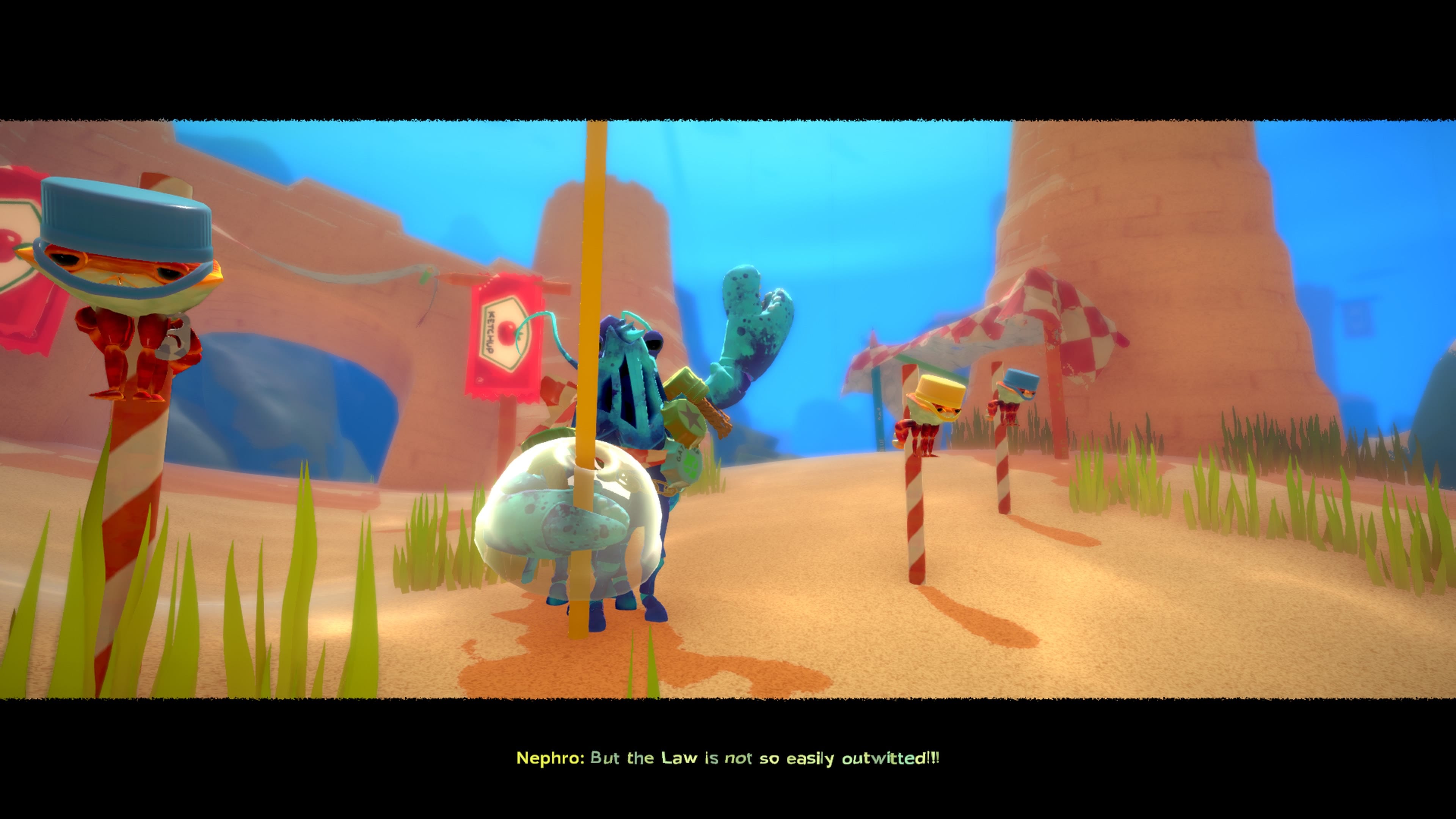
When Kril makes the mistake of taking a can from the vending machine, Nephro storms out of his castle and accuses him of breaking the law. Kril reasonably objects that he did not know and offers to give the can back. Nephro remains dissatisfied. Kril must pay for his transgression with his life.
For Captain Nephro, Kril’s affront is a threat to the validity of the state. The Leviathan depends on everyone fearing it. If anyone can break its laws without suffering punishment from the state, the Leviathan dies and the social contract falls apart. This is why Kril cannot just return the can. The harm is not that he took something that did not belong to him. The harm was that he damaged the fear the Leviathan depends on to survive.
When Kril finally does get to see the Duchess Magista, he finds someone utterly uninterested in the welfare of her subjects. She cares only about how beautiful her palace is, and whether it outmatches her rivals. Little wonder that her supposed “protection” is so limited: She is busy protecting herself.
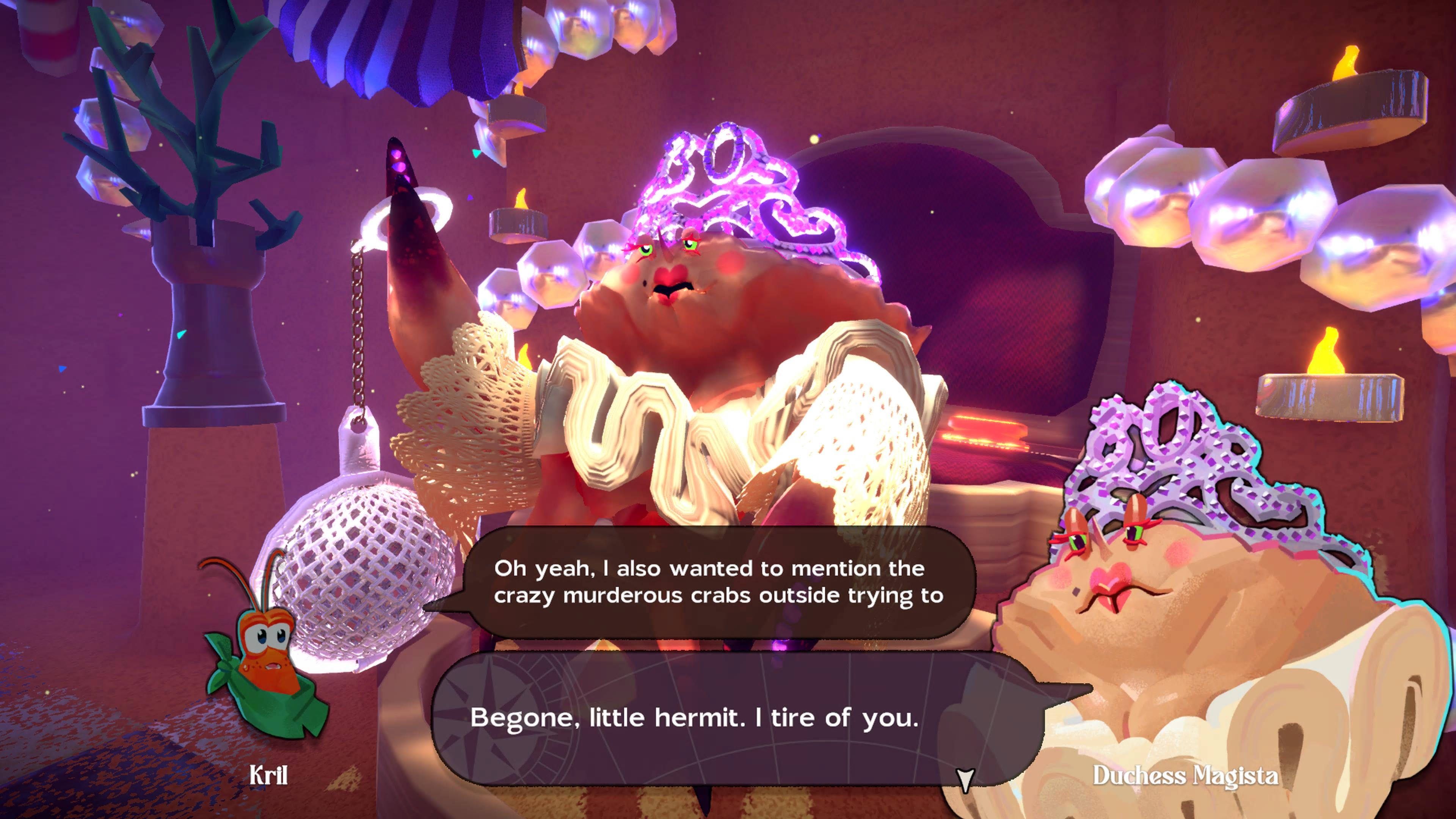
The ideal Hobbesian society does not look like this. It is supposed to be a harmonious place where the sovereign protects the lives of its citizens in exchange for their obedience. Every individual joins together into a single, interlocking whole, an unstoppable dragon that conquers the State of Nature—a Leviathan.
But the Duchy of Slacktide resembles nothing of the sort. All the dangers of Nature are still around, with the additional danger of Loan Sharks and the Duchess’ guards. These additional dangers rely on Hobbes’ argument to justify their actions, but they do not provide the benefits Hobbes says they should.
The game’s point seems to be that in practice, Hobbes’ rhetoric does not fulfill its promises. The state does not protect individuals from the State of Nature; the social contract merely compounds the misery they already suffer. The state does not transcend the war of all against all. It is simply another participant in it. For that reason, it cannot fulfill the function Hobbes outlines for it.
I think the most interesting thing about Another Crab’s Treasure is that it shows how Hobbes created the intellectual conditions for Marx. Karl Marx, the (in)famous founder of Marxism, critiqued capitalism on the grounds that it alienates humans from their labor. It is not right, Marx thought, that a whole class of individuals should sit around and profit off the work of others simply because they invested money.
But Hobbes would argue otherwise. The elite are justified in taking the fruits of others’ labor because they protect the ability to labor at all. Without the Leviathan, no one could farm or build factories. They would be too busy trying to survive the State of Nature.
Another Crab’s Treasure, while not fully embracing Marxism, seems to come down on the side of Marx. Over and over, Kril suffers the injustice of powerful people harming him in the name of property rights. The elite care more about wealth than Kril’s wellbeing.
The second section of the game leans more strongly into a Marxist direction than the first, but Kril’s experiences in Slacktide show where those Marxist sympathies come from. They come from the social contract, the sense that the individual has been forced into a bargain he never wanted. Kril never asked for the Duchess’s “protection,” but he has to pay for it anyway. The social contract says so.
The game suggests that the social contract is ultimately a lie, a smokescreen used by the powerful to justify their oppression. The Leviathan does more harm than good. Sure, Kril had to endure the dangers of Seagulls in the tide pool. But he is certainly no better off under the Leviathan’s watchful eye. The Hobbesian social contract, and the rhetoric of authority that goes with it, is a dangerous falsehood, the game thinks.
There is much more to Another Crab’s Treasure than this opening act, but it struck me as an interesting critique of Hobbes. The game rejects the thesis that a social contract bound by the authority of a sovereign secures the individual. On the contrary, the social contract is an illusion that justifies oppression. The Leviathan does not conquer the State of Nature; it simply becomes another player in it.
The game articulates this critique through Kril’s experiences in the Duchy of Slacktide. The injustice he suffers there shows how the social contract can be used as propaganda for a tyrant. The Duchess Magista, far from protecting Kril, makes the world more dangerous for him.
But I want to end by revisiting the context Hobbes was writing in. Leviathan was written as an antidote to civil war. This was a man who understood what it meant for society to break down. He saw something like the State of Nature with his own eyes. It is easy to sit back and accuse him of supporting tyranny from our comfy, modern states. If we have experienced civil war, it might not be so easy.
Thus, I think it is important for games to approach these topics with nuance. There is a side to this story that Another Crab’s Treasure does not tell, or at least, does not dwell on. I would like to see a game tell that side with the same brilliance Another Crab’s Treasure articulates its critique.
Comments
Nothing yet. Say the first thing.
Sign in to join the conversation.