
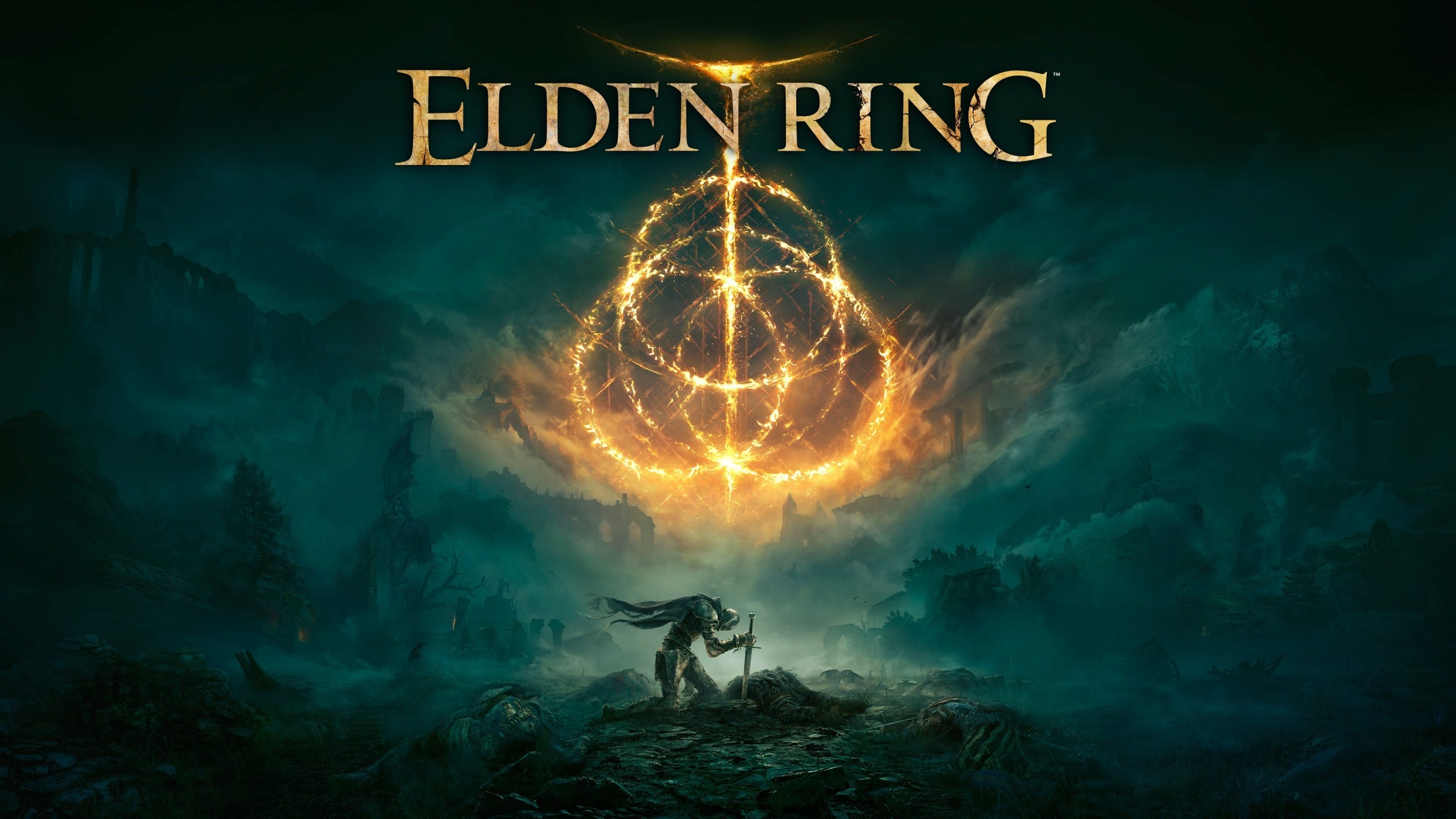
“Cross the fog, to the Lands Between, to stand before the Elden Ring…”
The idea of the sacred is everywhere in Elden Ring. Churches, magic groves, heroic tombs—The Lands Between is filled with places that demarcate the sacred from the profane. These are places where existential meaning has been concentrated. They show what life is for, and why it matters. This much is clear even from a gameplay perspective. If you ever wonder where you are supposed to go, walk toward the giant glowing tree.
Many games play with an idea of the sacred, however. Fromsoftware is not the only developer to realize that putting a giant object in the center of the map orients the world, and that this object ought to have religious significance. These center points, these axis mundi as Mircea Eliade called them, are a way to provide coherence to the world.1 Games have long used these ideas in their design.
What makes Elden Ring a cut above most games is a simple insight: Not everyone agrees about what the sacred is. The Lands Between is a place chock full of competing factions, all with different ideas of the sacred. And this, it turns out, is a source of conflict.
In other words, Elden Ring is obsessed with what we might call the problem of pluralism. What is one supposed to do when there are competing ideas of the sacred? Part of the game’s genius is the way it explores this problem.
But first, a word about the problem of pluralism.
The Problem of Pluralism is the simple fact that people have dramatically conflicting worldviews. A worldview is a configuration of space, time, and agency oriented around something that is considered sacred. When worldviews diverge enough, coexistence becomes difficult, if not impossible. A community cannot form when people live in entirely different worlds.
For a real-world example of this problem, consider World War II. World War II was a clash between three contradictory worldviews: Fascism, liberalism, and communism. No society can be founded on more than one of these at the same time. A liberal society might have fascist sympathizers, and a communist society may have liberal pockets, but only one of these can rule.
The reason worldviews become incompatible is that they hold different things sacred. As Mircea Eliade argued, the sacred has a world-making power. It imbues space, time, and people with structure and meaning. When those structures dramatically conflict, someone has to lose.
Fortunately, video games let us engage in this kind of conflict without actually harming anyone. Elden Ring is one such example. It creates an environment where players can experiment with different worldviews.
Elden Ring’s factions all hold different things sacred. I will try to break down a few of these to show just what they value, and where that appears in-game.
What follows are analyses of the two central belief systems in Elden Ring. Everything else in the game exists either as support or as a response to them.
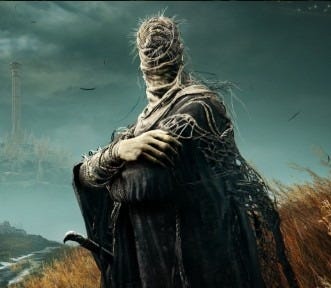
The Shadow of the Erdtree expansion introduced the first historically powerful faction in the Elden Ring universe, the Hornsent. I am covering them first because their worldview is foundational to everything that happens in the base game.
The Hornsent were a race of horned warriors. They once ruled the land under what is now known as the Scadutree. They were cruel masters, having enslaved a tribe of peaceful shamans. They tortured the shamans by lashing them with whips and stuffing them into pots.
The future god Marika was one of these shamans. After making a deal with the Two Fingers, she escaped and founded her own movement. She eventually sent her son, the warlord Messmer, to burn Hornsent civilization to the ground. The Land of Shadow was sealed away from The Lands Between, a gloomy netherworld guarded by Messmer and his fiery knights.
The Hornsent considered the Crucible sacred. It was the foundation of their worldview. While the game is somewhat vague about what the Crucible actually is, it seems to be some kind of primordial force the spurs life onward and changes it.
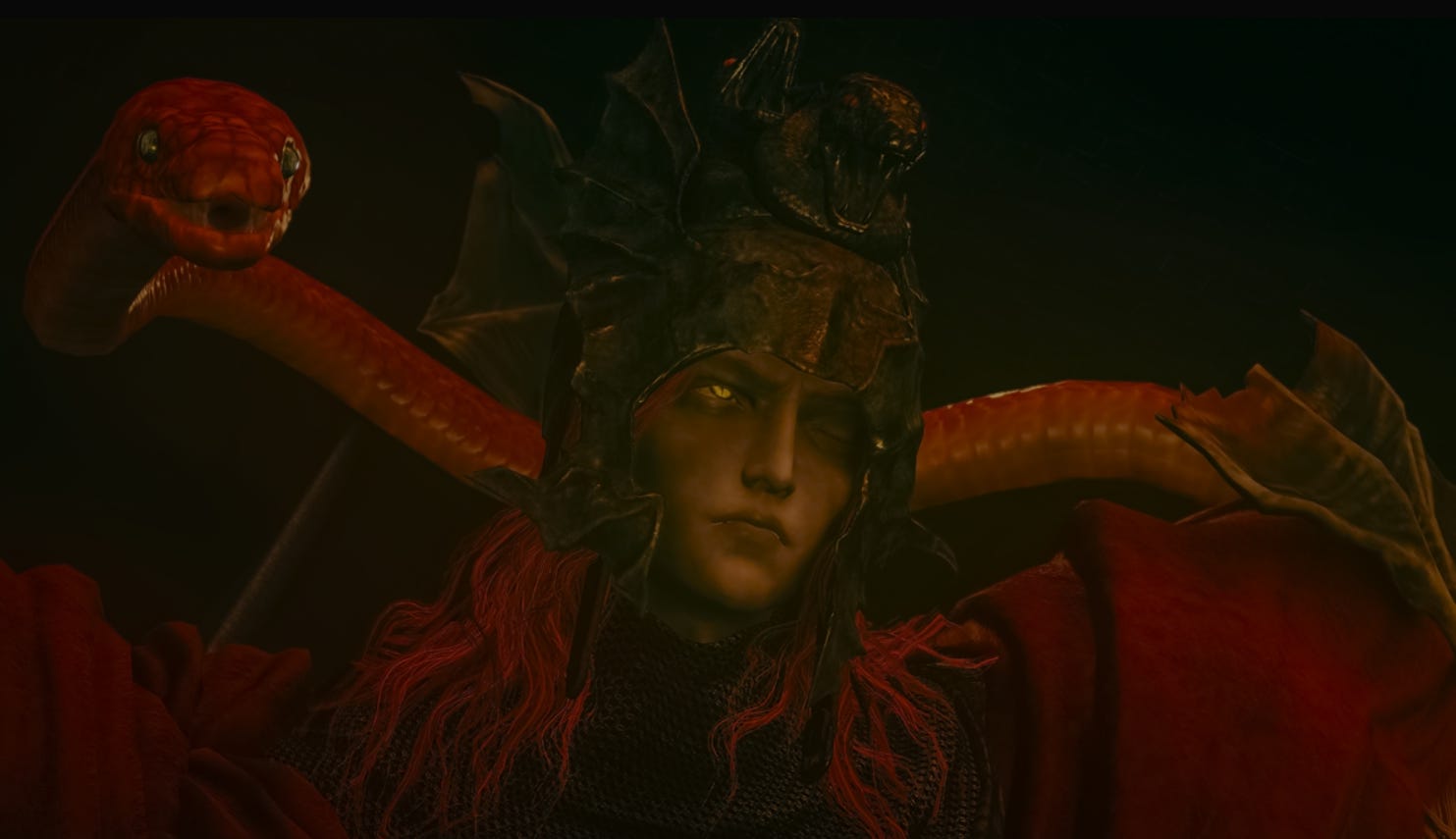
Consider the description of the Fine Crucible Feather Talisman:
A talisman fashioned from thin feathers that embody the aspects of various creatures. Said to have grown on the human body long ago.
Improves backsteps but increases damage taken at all times.
Hornsent view the Crucible as sacred for the refinement wrought through its evolutionary gifts. Most prominently, their tangled horns.
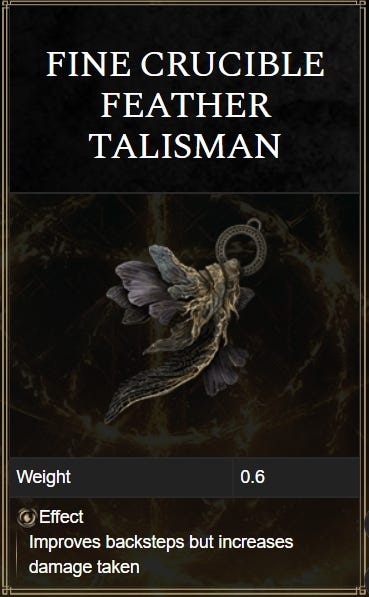
This paints the Crucible as a wild, vibrant force that produces change. No form is static; one creature is always turning into another under the pressure of evolution. The Crucible is nature, red in tooth and claw.
But the Hornsent believed that the Crucible was not arbitrary. The Crucible was “refining” the things it changed. It improved them. That raised an important question: If the Crucible was making progress, what was it progressing toward?
The answer, of course, was divinity. If one could absorb all the power the Crucible was putting into life, then that person would be as sacred as the Crucible itself.
The Hornsent’s entire sense of space and time oriented around channeling the Crucible’s power. The spiral became a sacred symbol. Spirals were circular, yet they progressed upward. Their horns, too, were markers of sacred status. It showed that the Hornsent had been touched by the Crucible themselves.
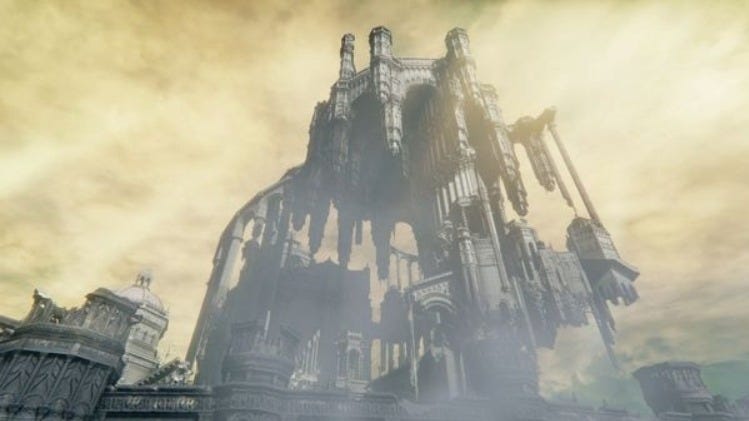
All of this culminated in the Hornsent Manhattan Project, the Gates of Divinity. Their vast tower, stretching up to the heavens, was forged from the malleable flesh of shamans. All those bodies congealed together would channel the power of the Crucible to produce the god they were waiting for. This was their centerpoint, their axis mundi.
Unfortunately for them, it produced Marika instead. It is not entirely clear how Marika got her power, but it had something to do with passing through the Gates of Divinity. Perhaps the Gates allowed her to absorb the Elden Ring within herself. Whatever the case, it greatly empowered the Hornsent’s worst enemy, ultimately leading to the destruction of their culture.
Marika’s faction succeeded the Hornsent as the masters of the Lands Between. Followers of the Erdtree, they conquered their rivals and established their dominance. The Erdtree’s bounty seemed to promise an epoch of unending plenty.
What sort of “bounty” did the Erdtree provide? Lore experts have suggested that the Erdtree’s gift was life itself.2 Under the reign of the Erdtree, natural birth ceased or dramatically dropped. People were literally born from the Erdtree, seemingly a product of the unending life-energy produced by the tree.
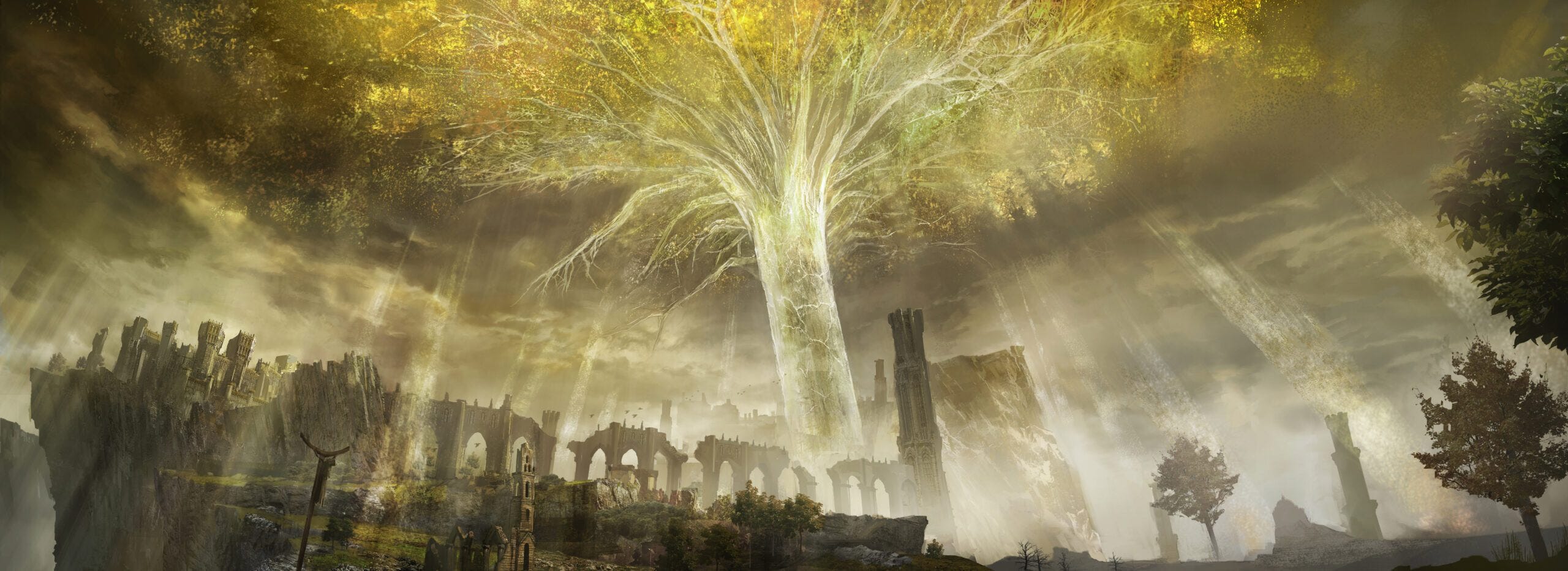
It was not to last. In time, the Erdtree’s blessings ceased to flow. The Erdtree became more an icon of religious faith, and the religious power enforcing it was the Golden Order. While life continued to be recycled by the Erdtree, new life was scarce.
The Golden Order was a stark rejection of the Hornsent’s ideology. Where they prized the proliferation of new lifeforms, the Golden Order valued only traditional “human” organisms. Only the life born from the Erdtree, the life that resembled Marika, was valid. Everything else was an aberration—the artificial Albinaurics, the Omen with their feral horns, and the Fire Giants with their evil fire worship. These beings have no natural place within the order of the Erdtree. Contra the Hornsent, there is only one respectable form of life.
The central tenets of the Golden Order explain why they cared so much about life forms. They boil down to two: “The Law of Regression” and “The Law of Causality.” Both of these are also Incantations that scale with the Faith stat.
The text of the Law of Regression states:
Incantation of the Golden Order fundamentalists. One of the key fundamentals.
Heals all negative statuses, dispels special effects, and reveals mimicry in all its forms.
The fundamentalists describe the Golden Order through the powers of regression and causality. Regression is the pull of meaning; that all things yearn eternally to converge.
Put simply, the Golden Order believes reality is a fundamental unity. The appearance of distinction is merely a mask for deeper Whole. Or, to borrow an Indian formulation of this principle, atman is brahmin. The Individual only manifests an aspect of the Whole.
Miriel, our favorite Turtle Pope, also articulates the Law of Regression in some of his dialogue.
Heresy is not native to the world; it is but a contrivance. All things can be conjoined.
— Miriel, Pastor of Vows
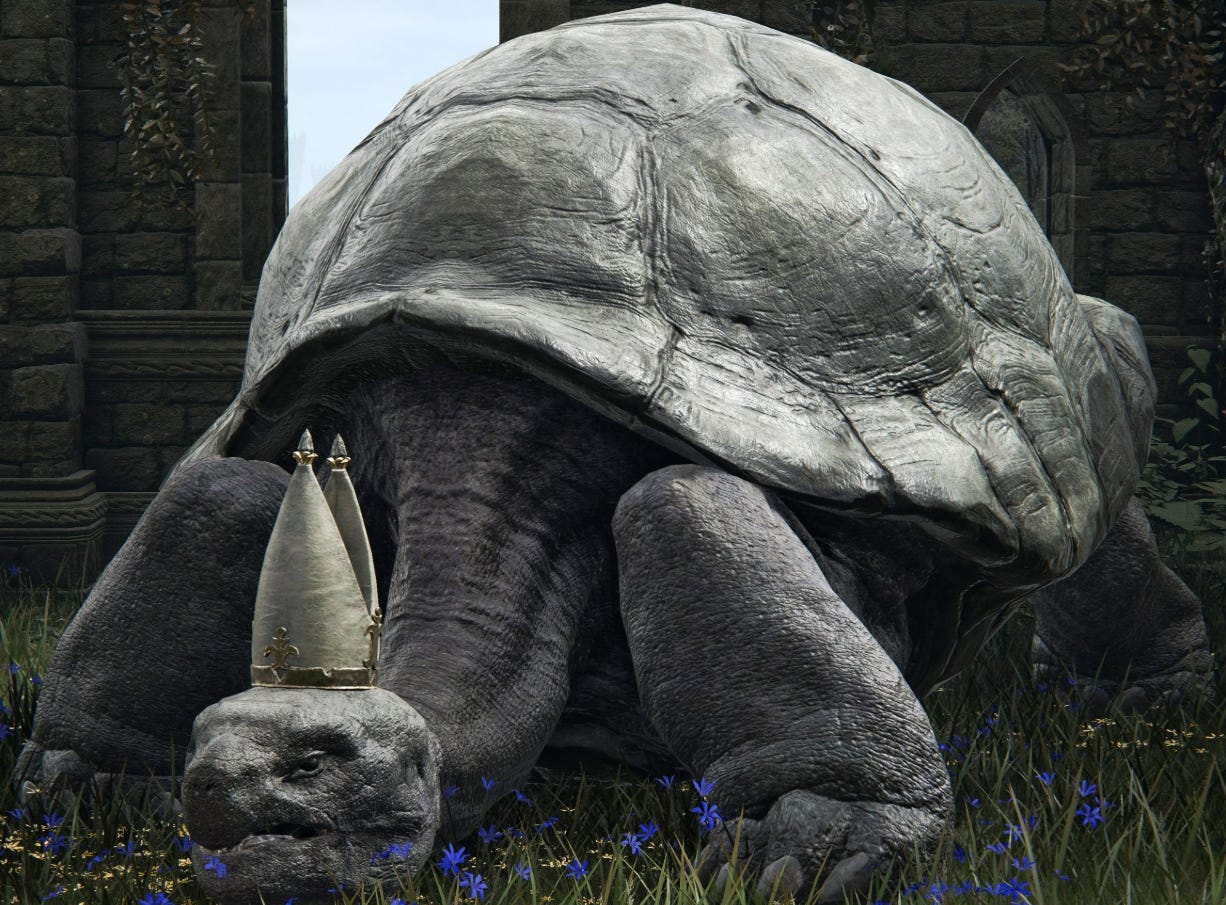
The idea that “all things can be conjoined” betrays the Golden Order’s totalitarian tendencies. Nothing exists that the Golden Order cannot subsume into itself. Logically, this produces the second tenet of Golden Order Fundamentalism: The Law of Causality.
One of the incantations of the Golden Order fundamentalists. One of the key fundamentals.
Manifests a small ring of causality within that allows the caster to automatically retaliate upon receiving a certain number of blows.
The fundamentalists describe the Golden Order through the powers of regression and causality. Causality is the pull between meanings; that which links all things in a chain of relation.
This Law’s central claim is about the fundamental nature of meaning. Meanings are a bit like magnets; they are trying to come together into the Golden Order’s Whole. Nothing in the final analysis is truly contradictory. It all fits together in a perfect Order.
The metaphysics underwriting this entire philosophy is the Elden Ring itself. The Elden Ring is to the Golden Order as the Crucible was to the Hornsent. It is the centerpoint of reality, the natural law belying all things. The runes that abide in everything are but the outworking of this magnificent engine. It is the holy of holies to the Golden Order.
The vision of reality the Golden Order Fundamentalists believes is therefore highly structured. The world is fundamentally Order, not Chaos. Life ebbs and flows from the Erdtree in a cycle of rebirth. And this entire Order revolves around the Elden Ring, perfectly contained in the vessel of Marika. Therefore, life forms ought to reflect that perfect Order: Two arms, two legs, no horns, and the Erdtree’s light shining in their eyes. All else is an unacceptable aberration.
There is one small problem with the Golden Order’s theology: Many creatures exist outside the Erdtree system. Their very existence seems to refute the Law of Regression. Not everything longs to fit together into the Golden Order’s Whole. Some creatures cannot be subsumed into the Order.
Rather than adjust their beliefs, the Golden Order fundamentalists opt to destroy the evidence. Hunters like D ruthlessly persecute Those Who Live In Death, and no more mercy is shown to the Albinaurics, creatures of Scarlett Rot, the Omens, or any number of other “profane” species. But their fates will have to wait for another post, as space does not permit treating them all here.
The Hornsent and the Golden Order hold two diametrically opposed worldviews. One believes in the primacy of Chaos; the other the supremacy of Order. Their differences literally go down to the very bedrock of reality.
The Crucible represents the vitality of nature to the Hornsent, but it represents rampant chaos to the Golden Order. And the Elden Ring, while a reassuring source of divine providence to Golden Order Fundamentalists, represents tyranny to the Hornsent and their successors.
These two cultures hold two very different things sacred. Consequently, the worlds they seek to build are fundamentally incompatible. How is a pluralistic society supposed to accommodate such deep divides? In the case of The Lands Between, they could not.
Knowing the land is doomed to conflict, is tempting to ask which worldview Elden Ring thinks is right. But I think the game does not give any easy answers. Both the Golden Order’s tyranny and the Hornsent’s lust for violence are critiqued. Neither walks away as the unalloyed good of the story. Whether one pursues Order or Chaos, there is always a cost.
The challenge of a pluralistic society is learning how to balance those costs. Ideally, one can create space for seeking the best worldview without resorting to total tyranny. The question of our time is whether that ideal is achievable, or as has happened too many times before, the public sphere will collapse under the weight of worldviews vying for supremacy.
I do not know the answer.
For more on the Axis Mundi in video games, check out:
I particularly like Tarnished Archaeologist’s discussion of this topic. See here:
Comments
Nothing yet. Say the first thing.
Sign in to join the conversation.