
The Logic of Lynch’s Lost Highway
Weekend Read Chief Film Critic Miles Stephenson has never been a David Lynch guy. This year, though, he’s diving headfirst into Lynch’s bizarre, dreamy, and logic-defying filmography. For his thoughts on Eraserhead, Blue Velvet, and Lost Highway, read below.
Too Many Toy Stories?
Pixar’s Toy Story franchise once wholly consisted of what many critics called “the perfect trilogy.” Then, Disney made a fourth. This weekend, it’s releasing a fifth. Nicolas James reflects on whether or not the latest installments have been earned – or are merely another cash grab from the always-greedy Mouse.
Read Receipts, Vol. 4: Toys v. Aliens
Last week, Spielberg’s Disclosure Day opened big. This week, it’s facing stiff competition from the new Toy Story. There’s a very clear winner.
Editor’s Note
By Ryder McNeal
Several months ago, two new films premiered on PREVO: director Steve Herold’s Waimea and Death of an Umbrella Salesman. Coinciding with their release, I wrote about them in The Weekend Read, praising both and calling them “Lynchian”. As I noted, though, those two shorts would not be for everybody. Lynch’s work – and by extension Herold’s Lynchian work – is divisive. Some enjoy the surreal, otherworldly quality with which Lynch infuses his films. Some prefer something a little more grounded.
Although I remain a fan of Herold’s work (there’s a reason Waimea and Death of an Umbrella Salesman won so many awards prior to their arrival on PREVO!), much of Lynch’s has always been, well, too Lynchian for me. Twin Peaks or Inland Empire, for example, just lose me immediately. (This is an unpopular opinion amongst learned film scholars, so I tend to keep that to myself so as not to appear uncultured.)
To my surprise, TWR’s very own Miles Stephenson – who has penned pages and pages of analysis on such divisive films as the Taiwanese “Goodbye, Dragon Inn” (some call it a highbrow Cinema Paradiso; others call it a snoozefest; Miles calls it a “model for the purely visual narrative power of slow cinema”) – is not a part of Lynch’s large, incredibly vocal fanbase. As it turns out, he’s never been much of a Lynch guy, either.
In the wake of Lynch’s passing last year, though, Miles is making a concerted effort to finally “get” what Lynch’s work is all about and what, exactly, animates his legions of supporters. Outside of genuinely enjoying Blue Velvet and Lost Highway, that is an effort that I have all but abandoned. Unlike me, though, Stephenson is persevering, offering his thoughts on Velvet, Highway, and Eraserhead below. Will Lynch win him over before the end of the year? Time will tell.
Another bit of heresy: I’ve never been much of a Toy Story guy either, even back when I was still a member of its target demographic. Nevertheless, I do “get” those films and do understand their immense popularity. They’re objectively great, even if they aren’t my favorite. They’re objectively very profitable, too. So, after the franchise seemingly wrapped in 2010 with Toy Story 3 and Disney seemed to indicate that they were satisfied leaving the franchise alone and letting a “perfect trilogy” breathe, everyone should’ve known that Disney would eventually play with Woody and Buzz again. And, nine years after 3, Toy Story 4 hit theaters, presumably minting a whole new generation of fans. And, of course, becoming a huge hit.
It’s almost commendable, then, that Disney has waited as long as it has to make the fifth installment, which released over the weekend. The latest one features a new toy: an iPad, with which the original gang must compete for attention.
No one’s saying that Toy Story 4 and 5 aren’t cash grabs; the question is: Are they good cash grabs? In his second piece for TWR, Nicolas James – who, last week, criticized The Mandalorian and Grogu as nothing more than a brand advertisement for Star Wars – offers his thoughts on Toy Story.
And finally, Read Receipts, Vol. 4 rounds out the issue, covering how much money the new Toy Story is bringing in (a lot!), how much Obsession has now made (a lot!), and more.
Next week, Close Up returns to highlight two actors who did the impossible: made a short film entirely focused on a conversation in a coffee shop compelling to watch. Hint: it wasn’t low-effort. And, we will have a new episode of First Frame debuting, along with Anthony Fallow’s return; with the next Minions installment releasing in two weeks, he’s analyzing how the last film in the franchise became a mega-viral meme – and smashed the box office.
By Miles Stephenson
This week, some friends and I went to a screening of Lost Highway (1997) as part of Angelika’s “Lynchian: A David Lynch Retrospective.” When the house lights went on, we were still lost in the world of the movie. As we trailed out of the theater, we got busy theorizing, but any attempt to ascribe chronology or cause and effect to the movie left us with more questions than answers. But one thing was undeniable: Lynch brought me to a world of feeling. Some of the feelings I couldn’t even describe or assign a name to; I didn’t “understand” or follow the story, but I felt it from beginning to end. Like many of Lynch’s great works, Lost Highway deliberately dismisses narrative logic in favor of more pre-verbal, pre-rational emotions, the feelings of childhood, of a dream, or of the subconscious.
This is the year I’m diving headfirst into the weird world of Lynch. I watched Eraserhead (1977) with my shocked dad in the middle of the night as we went through all stages of laughter, disturbance, and perplexity at the worm baby. I watched Blue Velvet (1986) with my roommate, who’s not much of a movie person to begin with, and yet he and I both came away thinking the bug in the beak of the robin was strangely brilliant. I even made a deal with my Lynch-obsessed friend that I’d watch the first few episodes of Twin Peaks after he’d been incessantly urging me to do so since high school.
I was never a Lynch guy. I always preferred his contemporaries like David Cronenberg and Peter Greenaway, but when he died, a part of me wanted to revisit his body of work. I first “got” Lynch when I watched Blue Velvet. If I had to summarize it in a sentence, I’d say the movie is a psychosexual coming-of-age story set in a Norman Rockwell painting animated by “dream logic” (we’ll get to this term later). Film critic Pauline Kael’s label of “pop surrealism” gets at what makes this movie’s use of surrealist elements unique: it’s the sinister and strange by way of the hyper-normal, a bug in the beak of a robin.
As opposed to taking us to an alien landscape, like say Antonioni, to disturb, Lynch takes down-home scenes of everyday suburban Americana and makes them sinister. He gives us line readings that are so mundane and “normal” that they sound eerie like Laura Dern saying she’ll honk the horn four times and Jeffrey’s family socializing with Sandy’s family at the end of the film in saccharine platitudes.
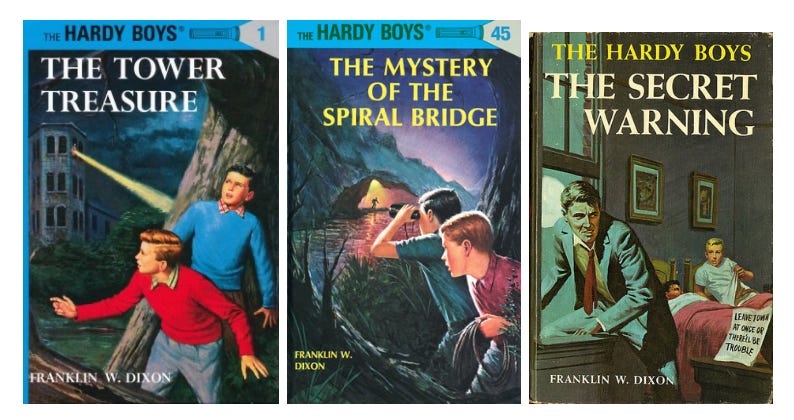
Lynch says he got the idea for this kind of strait-laced middle-class domesticity gone wrong from The Hardy Boys mysteries. Looking at the covers of those books you can begin to understand the world of Blue Velvet.
Then I watched Eraserhead and thought I was going to be sick. In that film Lynch creates creatures so otherworldly and disturbing that my dad asked what drugs he must’ve been on to come up with it. After reading up on Lynch, I discovered it wasn’t a drug that propelled this feeling into Lynch’s mind: it was the anxiety of fatherhood and the decay, fear, crime and industrial gloom of a particularly rough time in the late 60s when he was studying in Philadelphia.
While in school, Lynch lived in the Callowhill neighborhood of Philly, now dubbed “Eraserhood” after his film. In the movie, Lynch imagines this rough neighborhood as an alien wasteland rife with mechanized hissing sounds and claustrophobic polluted factories. If someone were to ask me “what happens” in Eraserhead, I’d skip plot summary and point them instead to this feeling or period in Lynch’s life.
Then most recently I experienced Lost Highway. Here I felt Lynch got closest to the genre trappings which have defined other directors. The movie is at certain points film noir, a pulpy crime thriller with a femme fatale who brings sexy erotic thriller elements. But just when the stamp of genre is about to be firmly placed on the story, when the good guy is going to get attacked by the evil henchman (as would happen in this kind of movie had Lynch not been the director), the movie shifts out of its genre and into a new register: a kind of spacey art film. Lynch withholds the genre thrills at the moment they are about to become too literal and formulaic; at these moments he retreats to the “dream logic” or lack of logic and leaves the viewer puzzled and uneasy as opposed to narratively satisfied and entertained. Critic Clement Greenberg once discussed Russian realist painter Ilya Repin and said “Where Picasso paints cause, Repin paints effect. Repin predigests art for the spectator and spares him the effort, provides him with a shore cut to the pleasure of art that detours what is necessarily difficult in genuine art.” In this analogy, Lynch is my Picasso and so many genre directors are Repin.
Some people say Lynch’s movies like Lost Highway have “dream logic” but I’d go further and say his movies obfuscate logic of any kind. Logic to Lynch is the ruin of his project; it would undermine the feeling he has created and make those emotions subservient to the all-powerful Aristotelian “narrative.” Since Aristotle published his Poetics, writers of drama have been taught to follow the formulaic rising action to climax and resolution story structure. Many filmmakers try to make movies a kind of formulaic stream of narrative tension and try to be as psychological as a novelist. But film can do things that a novel can’t and directors shouldn’t aspire to be clever novelists; they should follow Lynch and aspire to use images and feelings to tell fully realized stories.
At the end of the day, my tastes are more literal than Lynch. My favorite movies are Cassavetes’ The Killing of a Chinese Bookie and Friedkin’s To Live and Die in LA and Lean’s Lawrence of Arabia and Scorsese’s Goodfellas: movies which are defined by their genre labels of “epic” or “gangster film.” And as a writer with a background in novel writing, I like my stories with structure and I like my characters with arcs. That’s why Lynch can be even more valuable to me; Lynch reminds me that movies can transcend these structures and offer an experience not found in any other medium or art form. So go see Angelika’s retrospective on Lynch before it ends on July 24th. Maybe you’ll be disturbed or disinterested in what Lynch is trying to do, or maybe like me, you’ll see movies in a new light.
By Nicolas James
The Toy Story franchise has connected with every generation of children since 1995. With the newest installment, Toy Story 5, expected to earn $170 million at the box office, it proves that nobody is tired of Woody, Buzz, Jessie, and the gang. Even though Toy Story has made drastic changes over the years, for better and for worse, the franchise perseveres by evolving and staying relevant.
Some critics and first-generation fans believe that the franchise should’ve concluded at Toy Story 3 because Andy, the toys’ owner, had an emotional sendoff, but when does Disney ever end their most profitable IPs? If Disney wanted to, they could roll out as many Toy Story films as frequently as possible, like they do with their other franchises. Instead, Pixar only revisits their IPs when there’s a story that’s absolutely necessary to tell.
We can see this by how far apart the movies are from each other. Toy Story 4 came out nine years after the third. There’s still debate whether the fourth one was a necessary installment. Woody leaves his family of toys to be with Bo Peep because he found a new purpose - finding homes for lost toys, and because the new owner, Bonnie, didn’t play with him much anymore. For me, this made the third movie’s conclusion feel vain since Andy specifically pointed out to Bonnie that Woody was his most special toy, but I digress.
Toy Story 4 crossed a billion dollars worldwide at the box office despite fan debate. How is this possible? It’s because Toy Story is for kids, not grumpy adults like me. The franchise always captures the magical feeling of being a kid with a vast imagination. The characters are endearing, selfless, noble role models. Pixar knows that the most important aspects of the beloved franchise that built them are the emotional attachments to the characters and the young demographic.
Toy Story 5 is no exception. It proves to be even more relevant than the fourth one by making screens and devices the villain. Without spoiling too much, the conclusion to this conflict felt predictable coming from a children’s movie, but the idea of kids ignoring their toys and staying glued to a screen all day was the most relevant plot for this new generation. Overall, the film’s message was positive. There is a place for both devices and for toys in a child’s life.
The most unique narrative change Pixar made in this film was having Jessie become the new main character instead of Woody. Woody is still there as the butt of every old man joke, but it’s only natural for a female owner to connect the most with a female toy. Longtime Toy Story fans know that Jessie is more than equipped to take the reins of this franchise, and the emotional journey she goes through of confronting her past cements that.
There are plenty of arguments to be made that Toy Story isn’t as good as it once was, and I admit there are some good points. Rex, Slinky, Hamm, and the Potato Heads have all been reduced to background characters with only a few lines. To all the critics out there who see Toy Story 3 as the franchise’s fitting end, I say there’s nothing wrong with that. That film was definitely the end of an era. Your childhood is over as well, so you can move on with your lives like Andy did. In the meantime, the beloved toys you grew up watching are still doing what they do best - evolving and connecting with a newer generation of audiences.
#1: Toy Story 5 is the year’s biggest opening – and the franchise’s biggest ever. Pixar’s fifth installment debuted to an estimated $160 million domestic ($312 million worldwide) from 4,425 theaters – the largest opening of 2026, past The Super Mario Galaxy Movie, and the biggest start in the 31-year-old series, clearing Toy Story 4‘s $120.9 million. It earned an “A” CinemaScore and a 94% on Rotten Tomatoes against a $250 million budget.
Obsession hits its latest milestone. In third place in its sixth weekend (an estimated $14 million), Curry Barker’s sub-$1-million horror crossed $200 million domestic – only the second original film since Coco in 2017 to get there, alongside Sinners. Its streak of four straight weekends bigger than its opening finally ended, but at roughly $215 million and climbing, the record speaks for itself. How many more weeks will we cover Obsession in this column?
The other one: Backrooms slips past $300 million worldwide. A24’s biggest film ever added an estimated $7 million to reach roughly $175 million domestic and $301 million globally, and it’s now within range of joining Obsession in the $200-million domestic club (the studio had never come close to that number before this year). Weekend Read editor Ryder McNeal contributed $14 towards this milestone last Thursday evening.
Toys v. Aliens. Steven Spielberg’s original UFO thriller held second place but fell about 62% in its second weekend to an estimated $17 million (roughly $78 million domestic). Against a $115 million budget plus another ~$80 million in marketing, a theatrical profit is now in question. Yikes.
The macro: Toy Story 5‘s opening alone out-grossed the entire box office from last weekend (~$119 million). Family films keep powering the year and the domestic box office is running roughly 13% ahead of 2025, even with the World Cup competing for American attention.
No posts
Comments
Nothing yet. Say the first thing.
Sign in to join the conversation.