
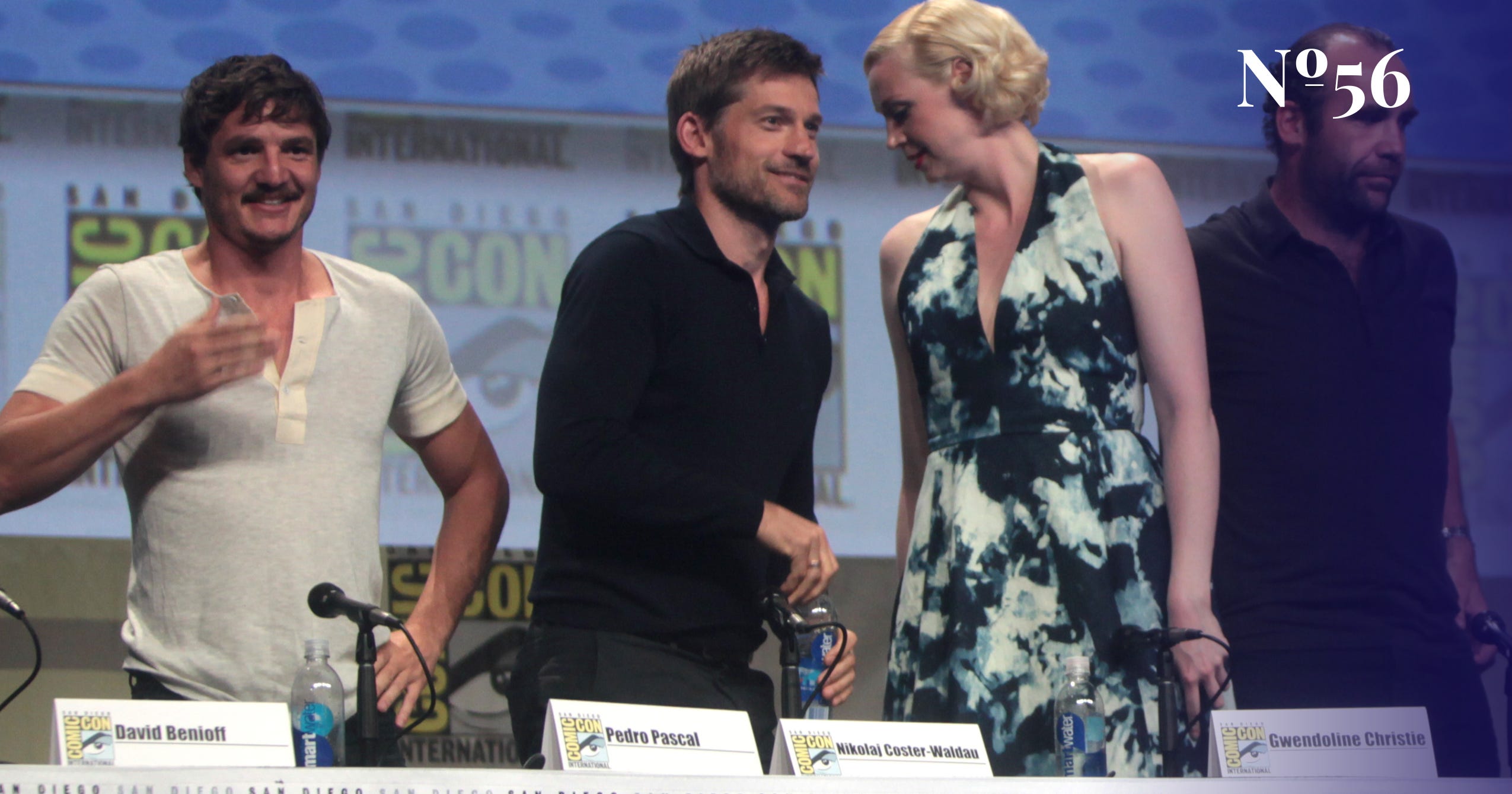
The Moment That Killed Game of Thrones
Miles Stephenson analyzes perhaps the most befuddling (of many) creative choices behind the decline of one of the defining shows of the prestige-TV era.
The Mouse Squeezes Baby Yoda for Every Dollar
The Weekend Read’s newest writer, Nicolas James, diagnoses why The Mandalorian and Grogu fell flat at the box office while Backrooms and Obsession made history.
Read Receipts, Vol. 3
This week: Steven Spielberg lands his biggest-ever opening for an original film, one smash hit closes in on $200 million, and two brand-name franchises collapse in their second weekend.
Editor’s Note
By Ryder McNeal
Much has been written (including in this publication) about The Mandalorian and Grogu’s recent box office defeat at the hands of indie horror darlings Backrooms and Obsession. (For those of you who aren’t up to date on the Star Wars Universe, “The Mandalorian and Grogu” roughly translates to “Pedro Pascal and Baby Yoda”.) While most pieces you are likely to have read focus on what went right for Backrooms and Obsession, too few have analyzed what went so wrong for the latest entry in the Star Wars franchise and what it means for the future of one of the oldest cinematic universes.
Thankfully, we have a new writer, Nicolas James, joining The Weekend Read this week, and he’s a self-described “hardcore Star Wars fan”. In his first piece, he isn’t letting his love for the franchise cloud his judgement, though, calling the latest film a “giant brand commercial”. Nicolas seeks to diagnose the issue with Mandalorianand identify the ailments that are harming Star Wars as a whole. I’d argue that his critique of the way in which Disney has handled the franchise is applicable to virtually every other piece of IP that the Mouse has seemingly sucked dry over the past ten years or so.
Nicolas is the newest in our now three-writer line of Pepperdine MFA students (those who have been reading for a while will remember Peyton Nebens’ screenplay critiques and Emma Lederman’s near-weekly horror recaps), and you’ll be seeing much more from him over the summer. We’re very happy to have him.
Headlining the issue is Miles Stephenson, once again plunging back into the world of Game of Thrones, this time detailing what he calls “the moment that killed [the show]”. Like Nicolas, Miles is a diehard fan of the franchise he’s criticizing this week – he’s even read the books! – and is taking a clear-eyed look at how it all went wrong. The piece serves as a fascinating autopsy of yet another show that had it all before bungling its final season badly. It’s a trend that Game of Thrones kicked off, and we get more examples every year (Stranger Things, for some). For any writers out there seeking to avoid incurring the wrath of their own fanbase, this one is worth a read.
And rounding out the issue is Volume 3 of Read Receipts, this week recapping a box office weekend in which originality dominated. How refreshing.
Close Up and Anthony Fallow will return next week.
That’s all for now.
The Moment That Killed Game of Thrones and the Lesson for House of the Dragon
By Miles Stephenson
We are now one week away from the premiere of Season Three of House of the Dragon, HBO’s newest $160 million play on George R. R. Martin’s once great IP. With this series of articles I’ve tried to look at the good and the bad of the adaptations; in the first installment I gave a critical overview of the three major franchise adaptations from George R. R. Martin’s books and in the second installment I took a deep dive on the character Jon Snow to see what we can learn from his bungled character arc. In the third part of this series I will look at the moment that killed Game of Thrones as an industry-revolutionizing television phenomenon and hopefully identify a lesson for future shows like House of the Dragon.
Game of Thrones is my all-time favorite show; seasons one through four are to me the high-water mark of character-driven prestige TV. Furthermore Martin’s book A Storm of Swords, the third in the series which covers such major events as the Red and Purple Weddings, the Battle of Castle Black, and Jaime’s redemption arc, is one of the only books which captivated me for hundreds of pages at a time where I couldn’t put it down. So now as I proceed to disparage the ending of Game of Thrones, you know it’s coming from the right place; a hope of what could’ve been instead of a mean-spirited denigration.
From the opening scene of Game of Thrones where members of the Night’s Watch are mysteriously slaughtered in a forest, the evil north of the Wall has been established as the great villain of the story: the white walkers, the wights, the Night King, and the apocalyptic event they bring known as the Long Night. Season after season we’ve been told that the political squabbling between houses in Westeros is but a distraction from the existential world-altering event that is coming, and this sentiment is echoed in the protagonistic House Stark words which have become a tagline for the entire story: “Winter is Coming.”
Considering all of this, you can imagine viewers’ surprise when the threat of the Night King is resolved at the beginning of the last season (Episode 3) and the solution to the crisis comes literally out of nowhere. Narratively, this frames the Long Night as a scary appetizer to the battle against Cersei for the throne instead of what it should’ve been: the final conflict to decide the fate of the world.
Then there’s the problem of how our heroes defeated the Long Night: Arya Stark. My own feeling about Arya is that she was an extremely compelling character in the early seasons as the fugitive daughter of a once great house on the run across a tragic war-torn country with the unlikely ally of a surprisingly soft-hearted murderer. Like the relationship between Dunk and Egg in A Knight of the Seven Kingdoms, the duo of Arya and The Hound revealed the most interesting threads in each character during their disturbing but fascinating adventure through the near-apocalyptic Riverlands: Arya learns to transfer her trauma to drive and becomes a killer and The Hound learns to look out for someone other than himself and learns that violence can’t solve your problems. This was a great story.
But many viewers and I were not as captivated once Arya sets off to Braavos to become an assassin of The Faceless Men. Here Arya’s story grows repetitive, loses its stakes, and becomes nearly annoying to sit through, especially Arya’s rivalry with the unlikeable Waif. Near the end of this arc, Arya is stabbed repeatedly in the stomach and dumped into a sewage-ridden canal only to climb out and heal up in a matter of days. If there’s one rule which has governed Game of Thronesand energized every scene with searing tension it’s this: if a character, no matter how good-natured or heroic, makes a strategically poor decision, they will die. But by the later seasons of Arya’s arc, she becomes the exception to the rule and one of the first examples of plot armor in the show.
But let’s set aside one’s feelings about Arya’s story and just look at her as the solution to the Long Night. Game of Thrones showrunners David Benioff and D.B. Weiss said they chose her to kill the Night King because it was unexpected and that Jon Snow killing the Night King would be too obvious and therefore not “right.” But as writers know, just because something is unexpected, doesn’t mean it’s right for the story. The decision to kill Ned Stark in Season 1 is unexpected insofar as killing a protagonist near the beginning of a story is sure to catch a viewer by surprise. But in a deeper sense, Ned’s death echoes the broader theme of the story: in the Machiavellian game of thrones, betrayal and unscrupulous scheming will always defeat honor. Ned Stark died for his honor; that’s who he was. Everyone has at one point in their life felt a version of that moment: a good person did the right thing and they still lost. This tragic theme resonates because as a viewer we have felt this before; it establishes a grey moral system for the rest of the story.
The same can be said for the Red Wedding deaths of Robb and Catelyn Stark. In the moment, these deaths are unexpected, but in hindsight, they’re almost predestined when you understand how the values of these characters are at odds with the moral universe George R. R. Martin has created. Arya killing the Night King is not predestined, it doesn’t communicate anything deeper about the theme or the meaning of the story, and it hasn’t been foreshadowed except for a retconned comment from Melisandre about the color of eyes which Benioff and Weiss spun to support their character decision and hoped we wouldn’t notice. Arya’s list of those she wants to kill are all linked to her enemies from the Lannisters and the War of the Five Kings, the conflict that destroyed her family and her life. The Night King didn’t destroy anything for Arya; as a matter of fact Arya didn’t even know the Night King and the white walkers existed for the vast majority of the show. She learns about their existence and in a matter of days kills their leader and saves the world.
How else could it have gone?
Up until this point, the story would have you believe that one of three characters would solve the crisis: Jon Snow, Daenerys Targaryen, or Bran Stark. Jon’s character has been defined by the conflict in the North. He has led the fight against the white walkers and nearly died in doing so to learn about their weaknesses. He leads the Night’s Watch, the ancient order created to ward off the evil of the North. He brought peace to a millennium-long fight between the Wildlings and the houses of Westeros so that each side could unite against the white walkers. He is the titular “Ice” in Martin’s A Song of Ice and Fire and his last name is literally Snow (or so we think); Jon is set up as the clear hero to kill the Night King and end the Long Night.
But let’s say Benioff and Weiss thought this would be too obvious. Fair enough. Daenerys Targaryen is also a strong candidate. Prophesied as the Azor Ahai, Daenerys is the titular “Fire” in Martin’s A Song of Ice and Fire. With her world-altering dragons, she is the element which can melt away the seemingly invincible ice of the Long Night. Furthermore there would be something delightfully unexpected in the arc of her character if she came to Westeros to take the Iron Throne but realized in the process that there is a greater war which requires her sacrifice; this could’ve deepened Daenerys as a character.
And then there’s Bran. Bran has widely been called the least interesting storyline in Game of Thrones. Martin has said he’s one of the hardest characters to write in the books because his story involves the greatest amount of magic: a problem in a fantasy series which has defined itself by its anti-fantastical, “realistic” elements and moral systems. But I think that slow burn of Bran’s journey from a crippled boy to an all-powerful oracle would’ve been worth it had Bran played a significant role in ending the Long Night instead of being glorified bait for the Night King. With his Three-Eyed Raven ability to see the past and the present, Bran is uniquely equipped to get to the bottom of the evil magic which animates the white walkers. Indeed it is his magical visions which reveal to the viewer how the Night King was created in the first place. Surely Bran can look into the past and use his ability to find the chink in the Night King’s armor. Or maybe he can explain these symbols the white walkers have left since season one when they slaughter people and leave their limbs arranged in shapes like some ancient rune communicating a secret. But no, during the great battle for the fate of the world, Bran simply sits in the Godswood and watches as everyone dies around him until Arya seemingly falls from the sky with a dagger to end the Long Night. We never learn what the symbols mean and the showrunners either forgot about them or raced to finish the story and didn’t allot the time to explain.
So what lesson do we take from this? Every character has a purpose to play in a story and when we, as writers and creators, deny a character their purpose after foreshadowing it for years, the viewer feels cheated. Don’t try to fool your viewers or readers; they’re very intuitive and just because they won’t know how to explain why something is wrong, it doesn’t mean they won’t be able to feel how something is wrong.
Next, unexpected story decisions are not always the right story decisions. Stories have a certain logic, a thematic map which the writer creates but then must also adhere to. This is why stories feel powerful to us; they are a kind of narrative technology which communicates a deeper meaning or truth through lifelike symbols which we connect to. If we forget or ignore our story’s logic, the deeper truth is undermined or lost and the story feels meaningless.
Last, the rising and falling drama should follow a semblance of a three-act structure or your stakes will be undermined and your viewer will be dramatically confused. If you as a writer set up high stakes, creating an event which will be the culmination of confrontation in the story, you should place this event as the second act climax in the three-act structure, followed by a period of descending action into the wrap-up and resolution. If you’ve foreshadowed this climax as the main point of the story, you can’t go from crisis to climax (the Long Night) and then tell the viewer that actually there is another crisis which is even bigger and more narratively important (defeating Cersei). This destroys your stakes for the first conflict and makes your viewer suspicious headed into the second conflict.
If we had the time-bending oracle powers of Bran Stark, I’d go back and try to convince Game of Thrones showrunners David Benioff and D.B. Weiss to place the Long Night at the very end of the final season, the culmination of conflict in the story. I’d implore them to make Jon Snow, Daenerys Targaryen, or Bran Stark the solution to the Night King and to give Arya a finale more befitting of her character, perhaps killing Cersei or Mad Queen Daenerys or dying in the attempt to. I’d try to avoid the disaster that was Season 8 Episode 3 of Game of Thrones and end one of the best shows in television history on a high note. But of course Bran’s magic doesn’t exist in the real world; the best hope we have is to convince future writers, showrunners, and producers of the lessons we took from the past so that our next stories can do the right thing.
The Mandalorian and Grogu: Star Wars Fans Continuing to Hope for Better
By Nicolas James
After seven years, the Star Wars franchise returned to theaters with The Mandalorian and Grogu. You would think that one of the most popular multimedia franchises in history would have audiences flock to the theaters, but the film’s opening weekend underperformed, only grossing $98 million. The second weekend wasn’t much better, dropping 70% at the box office. How could Star Wars’s most popular duo of the modern age sink the juggernaut franchise so low? There are a lot of reasons, actually.
Was the film that bad? I didn’t think so, but it wasn’t that great either. The film itself was full of exciting action spectacle that’s expected in a Star Wars film. Hardcore Star Wars fans like myself were excited to see less mainstream characters like Garazeb Orrelios, the bounty hunter Embo, and Rotta the Hutt make their theatrical debuts. The Mandalorian himself, played by Pedro Pascal, is a great action hero in his own right. The puppetry for Grogu and his Anzellan sidekicks is very commendable as well. There are plenty of aspects to appreciate in this movie.
Having said that, The Mandalorian and Grogu is less of a movie and more of a giant brand commercial for Star Wars. The movies have always capitalized on merchandising, ever since the first film in 1977, but branding has increased over time to the overwhelming standard of Disney. The Mouse has squeezed the profit out of adorable baby Grogu since his debut.
With merchandising as Disney’s top priority for Star Wars, every creative decision seemed to be dictated around selling as many tie-in clothing lines, LEGOs, Squishmallows, and other products as possible. The plot was so mechanical that you could predict every story beat to the very end. Even celebrity appearances from Sigourney Weaver and Martin Scorsese contributed nothing but brand recognition. It was all style and no substance.
From the perspective of a diehard Star Wars fan, The Mandalorian and Grogu was too inconsequential to care about. It doesn’t contribute to any of the galaxy’s overarching story or lore. They’re not trying to stop a grand scheme from the Empire or rebuild the lost culture of Mandalore like they did in the series. All they’re doing is taking out Imperial remnants and butting heads with the criminal underworld. Self-contained stories are fine, but they have to have personal stakes for audiences to care. Too bad the film didn’t have that either.
Not only is the film inconsequential to the Star Wars universe, but it feels inconsequential to the title characters’ personal journeys as well. Din Djarin (The Mandalorian) already had a fully realized character arc from a selfish bounty hunter to a devoted father with a strong moral compass. Now that he’s a full-blown hero, Din Djarin has no more personal stake except getting revenge on his former evil employers. It was clear that the filmmakers relied on Grogu to serve as the film’s emotional crutch.
Grogu definitely had his moments, but his usual shtick couldn’t carry the film’s success. His character arc from a damsel in distress to a capable Force-wielding Mandalorian foundling gives him plenty of substance, but the only reason he’s still relevant to the franchise is to look cute and sell merchandise. It seems Lucasfilm will never learn that adorable, dumb creatures like Ewoks and Gungans can never carry a film.
The most glaring reason why The Mandalorian and Grogu failed so spectacularly was because it was overshadowed by the phenomenal low-budget horror films that also played in theaters, Obsession and Backrooms. This independent underdog double victory sets a great precedent for studios to invest in young filmmakers with original concepts over repetitive franchise films. The Mandalorian and Grogu was Disney’s safest project to bring Star Wars back into theaters, but if their defeat proves anything, it’s that Star Wars can’t play it safe. They need to make bold creative decisions to keep up, and I’m not talking about the “killing off Luke, Han, and Leia” kind of bold. I’m talking about good writing and an actual effort in filmmaking above all else.
A misconception about The Mandalorian and Grogu‘s defeat is that audiences aren’t interested in Star Wars anymore. That’s simply not true. The benefit to an oversaturated supply of Star Wars content is that there are always hidden gems. Andor is the brightest gem in the pile of Disney Plus shows because of its mature storytelling and political intrigue that’s becoming alarmingly relatable. Not only that, but this year alone, Lucasfilm released the marvelously animated crime series Maul – Shadow Lord, based on the titular standout villain we’ve all loved to hate since 1999. Star Wars has enormous potential and shouldn’t cower from theaters after a box office bomb.
The biggest shame about the failure of The Mandalorian and Grogu is that Star Wars deserves to be watched in theaters. The franchise has survived exclusively on Disney Plus for seven years. Fans are getting bored with the supply line of poorly produced live-action shows. Going to the theater is not only a great experience, but a worldwide tradition that the Star Wars franchise used to dominate. Now that renowned Star Wars showrunner Dave Filoni has stepped in to run Lucasfilm, they can hopefully reevaluate what audiences want out of the franchise, outside of consumer products. The world hasn’t stopped believing in the Force.
Read Receipts, Vol. 3
Weekend of June 12-14th, 2026
#1: Disclosure Day gave Spielberg his biggest-ever opening for an original. Steven Spielberg’s UFO thriller debuted to an estimated $44 million domestic ($92.9 million worldwide) from 3,824 theaters – well above its ~$35 million projection. It’s his fifth-biggest opening ever and, more tellingly, the largest of his career for a title not based on existing IP, also a record for his Amblin banner. The catch: a $115 million budget plus ~$80 million in marketing means it needs to clear roughly $300 million to profit, and a soft “B” CinemaScore heading into Toy Story 5 next weekend points to steep drops ahead.
#2: Obsession is days from the record books. Curry Barker’s sub-$1-million horror film took an estimated $19 million in its fifth weekend – down just 25% – pushing its domestic total to roughly $188 million. It’s now posted four straight weekends bigger than its $17.2 million opening, a feat almost no film achieves, and within days it will become the fifth horror film ever to cross $200 million domestic and only the second original film since Coco in 2017 to get there, alongside Sinners. It is already the biggest movie in Focus Features’ history.
The collapse: last week’s two IP plays cratered. Scary Movie fell about 70% to an estimated $15.6 million in its second weekend, and Masters of the Universe dropped 71% to roughly $8.8 million – confirming the ~$170–200 million He-Man bet as one of the year’s defining flops.
The macro: the three-day weekend totaled an estimated $119.4 million – down 34% from last week and 22% from this frame a year ago – but 2026 is still running at roughly $4.1 billion year-to-date, the strongest pace since 2019.
What it means for filmmakers: Two young directors and perhaps the most famous filmmaker of all time dominated the box office. What do their films have in common? Originality.
No posts
Comments
Nothing yet. Say the first thing.
Sign in to join the conversation.