
First Frame, Episode Three, Coming This Week
In Episode Three of our summer series devoted to interviewing PREVO’s most interesting filmmakers, we hear from director Morgen Ludwig and composer Eli Denson, the duo behind our Spring 2026 Best Music winner, Laid Bare.
Close Up Vol. 3: Chris Ahn
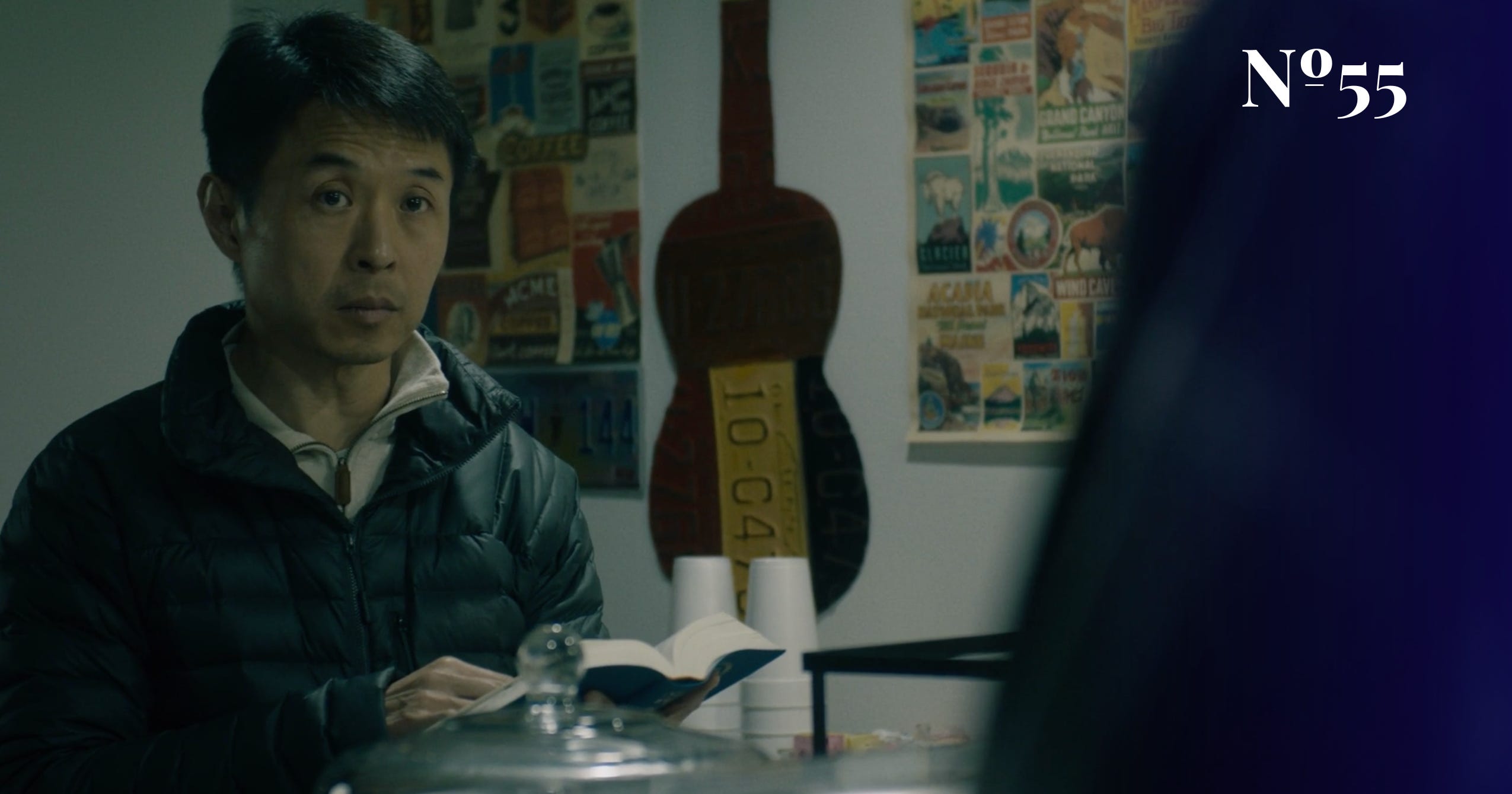
Every week this summer, we put one standout performance from the PREVO catalogue under the lens. This week, it’s Chris Ahn in First Night, the Vanderbilt-produced short about a newly immigrated Korean father trying to order a meal for his family at an American deli with only a dictionary. It’s a deceptively simple premise that rests entirely on its lead – and Ahn turns the film into one that might make you cry.
Read Receipts, Vol. 2
In Read Receipts, we make sense of the weekend’s box office receipts. This week, a $200-million blockbuster sinks while the cheapest films in theaters keep cleaning up. More below.
NEXT WEEK
Where in the world is Anthony Fallow? Working on a new assignment for The Weekend Read. He returns in next week’s issue, along with a fresh face joining the team.
Editor’s Note
By Ryder McNeal
If you read last week’s issue of The Weekend Read, you may recall our astonishment at the marketing campaign behind the student-produced short FEMCEL. Put simply, student films do not have marketing campaigns – and they almost certainly don’t have successful ones! FEMCEL, directed by Caroline Murray and starring Kiera Nusbaum, was the exception. Not only did it have one, but Nusbaum became a minor campus celebrity: Are you that girl from FEMCEL?
This week, I spoke with student filmmakers who are just as remarkable – though for a different reason. For the uninitiated: student film scores are not usually well-thought-out. Which is a shame, because here at PREVO HQ, a great score is one of the first things that can make a film stand out from its opening moments – even an adeptly edited royalty-free track (you don’t need Scorsese-soundtrack money). The vast majority of the time, the score is an afterthought, barely considered during the edit and sometimes just laid over the final cut rather than tailor-made to it.
So, when director Morgen Ludwig submitted LAID BARE, his Indiana University thesis film, to our Spring Student Film Competition several months ago, a few things stood out before even pressing play. First of all: the runtime. Twenty-five minutes.
Another note from PREVO HQ: shorts approaching the thirty-minute mark can be concerning – often, they’re overstretched, meaning there’s too little budget spread over too much runtime. Putting the entirety of a $5,000 budget into a ten-minute film is usually a better strategy than putting that same budget into a thirty-minute film.
The second: the genre, body horror.
A year and a half ago, I was unable, shamefully, to finish The Substance. (Loved the first ninety minutes that I did make it through, though!) And since then, I hadn’t dared delve back into any body horror. I also couldn’t recall ever receiving a submission in the genre since launching PREVO. Like a long runtime, body horror is a difficult genre to sustain on an indie budget because it’s so effects-heavy. To a unique degree, these films rely on the strength of their bloody visuals, and convincing gore is expensive.
Plus: a submission from IU? Do they have a film school?
With some trepidation, I pressed play.
Throughout its twenty-five-minute runtime, Laid Bare is wildly ambitious. It’s set in the world of high art and tells the story of a struggling artist who begins to find success with a gory gimmick: mutilating himself for his art.
Somehow, Ludwig nails the film, stretching its budget and his resources very, very far. Perhaps most impressively, it convincingly captures the art world. (Short films rarely attempt settings this big.) Every concern that Laid Bare would fall victim to its own ambitions was gradually assuaged, and by the end of it, I was thoroughly impressed.
But the thing that caught my attention most, other than the pair of lead performances, was the score. Composed by Eli Denson, each piece of music propels the film through its runtime, making twenty-five minutes feel like five. The film’s grand finale, for example, is especially memorable and largely hands the spotlight to Denson.
A few months later, I was completely unsurprised that Laid Bare took Best Music at our most recent awards ceremony. But I was still intensely curious how it had been done – what kind of budget was Ludwig working with? Was this really an undergraduate BFA thesis film? Is IU secretly home to a first-rate film school?
In this week’s episode of First Frame, I finally got the chance to ask Ludwig and Denson all these questions and more. The answers left me just as surprised as I had been by the quality of the film itself. Later this week, my full conversation with the pair will be hitting PREVO, so keep an eye out for a notification when it does.
Elsewhere in this issue, we’re bringing you Volume Three of our Close Up series. This week, we’re looking at Chris Ahn, the star of the Vanderbilt-produced First Night, which has been a staple of the PREVO catalogue for some time now.
And rounding out the issue is this week’s Read Receipts, recapping the most notable headlines from this week’s box office – including a poorly received high-grosser (Scary Movie) and a surprisingly well-reviewed flop (Masters of the Universe).
Next week, we’re bringing you a longer issue, complete with a return from Anthony Fallow and the first piece from the newest writer to join our team.
That’s all for now.
Close Up, Vol. 3:
Chris Ahn in First Night
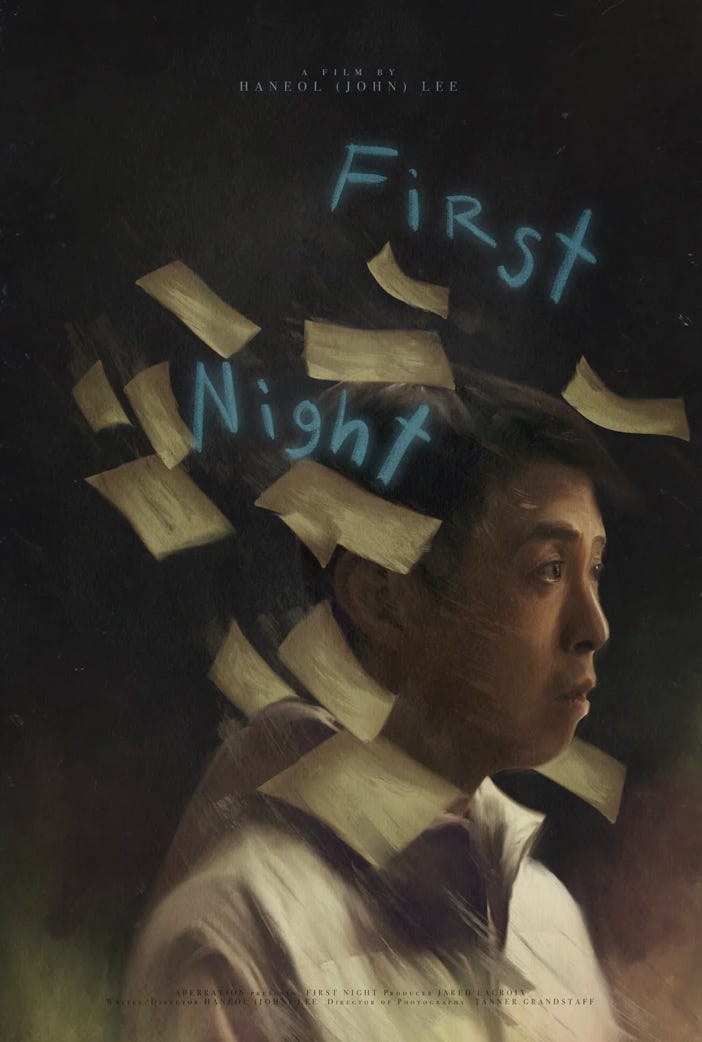
While some performances – like those highlighted in the last two volumes of this series – must effectively ground short films with lofty premises, others have the difficult task of working from an incredibly simple premise and elevating it to another level. Chris Ahn’s starring role in First Night is of the latter variety. First Night, directed by Vanderbilt student Haneol Lee, has a strikingly simple premise (a far cry from Hikikomori‘s or Casting Dad‘s): a newly immigrated Korean father must order a meal for his family at an American deli – armed with only a dictionary.
Based on a story from Lee’s childhood, First Night is the exceptionally rare film that translates a director’s own experience into something genuinely affecting. Here’s a statement from Lee on his intention:
“This film is based on a true story of my parents. In my family’s early days in America, there was a day when my father spent 2 hours in a sandwich shop trying to order something without knowing English. Back then, I, a 10 year old, didn’t think much of it. Now, 10 years later, while eating in a small deli shop, my father revealed to me the embarrassment and the fear he felt when ordering a sandwich. This was interesting to me. Compared to green card difficulties and visa difficulties that many immigrants including my family face, buying a sandwich seemed trivial to me. Yet, my father expressed that it was in these small moments where he felt the most vulnerable and frankly scared. After hearing this story, I became interested in how society views the hardships of immigrant families.
When we think of the struggles of immigration, we hyperfixate on the big political problems. While these struggles are completely true, we as a society forget to think about the little things that we fight on a day to day basis such as picking up medication or ordering food.
Through First Night, I present a raw vignette of these little tasks that can be difficult in our immigrant experience. Now, I don’t present this to belittle our immigrant community and ask for pity. Rather, it’s quite the opposite. In these moments of small crises, we immigrants always find victory and if we can’t, there is always a moment of joy and happiness that can be found. This is the narrative I want to tell and bring hope into the old idea that we immigrants are repressed and depressed. We stand strong and no matter what happens we can find joy and victory.”
The cinematography and pacing already lend the short an elevated feel, but the majority of the heavy lifting falls to Chris Ahn, playing the father. Ahn plays the role with an appropriate mix of apprehension and frustration as he first enters the deli and unsuccessfully attempts to order soup. The deli employee informs him that there is no soup, and in perhaps the most clever editing trick Lee employs across the film’s eleven-minute runtime, the audio is cut completely from the scene as the employee speaks (no, your headphones aren’t broken). The simple trick – used to memorable effect in Sound of Metal (2019), which won the Academy Award for Best Sound – conveys the anxiety of being unable to understand a single word someone is saying.
Ahn, defeated, returns to his family, who are waiting in a car just outside. They’re hungry, and soon, Ahn’s character heads back into the deli for a second attempt. Going much further would put this writeup at risk of being spoiler-y, but a Letterboxd review of First Night from user “Keeks” puts it succinctly: “The first short film to make me cry.”
Again, most films, whether they run eleven minutes or two hours, fail to nail the emotional payoff for which they’re aiming. Across its short runtime, though, First Night accomplishes its goal of being truly affecting, and too much credit can’t be given to Ahn, who, although largely reactive throughout, brings a much-needed emotional side to his character in the film’s final moments, ultimately making the whole thing land perfectly.
If you do decide to watch First Night, stay for the credits. No, there’s no Avengers-esque post-credits scene, but there is a perfect pairing of photos (once again, won’t spoil) sure to make you tear up if the final moments haven’t already.
Read Receipts, Vol. 2
Weekend of June 5-7th, 2026
#1: Scary Movie is back from the dead. The franchise’s sixth entry – and its first in thirteen years – opened to an estimated $56 million ($105M worldwide), the best domestic debut in series history, on a budget of roughly $30 million. The Wayans-family reunion is also being called the first real hit for R-rated comedy since before the pandemic. Too bad it’s getting panned.
The cautionary tale: Masters of the Universe sank on contact. Amazon MGM’s He-Man tentpole, directed by Travis Knight, managed only about $30 million against a budget reported between $170 and $200 million – a faceplant even with respectable reviews. This one’s no Barbie, but the positive reviews have been pleasantly surprising.
Obsession with ROI. In its fourth weekend, Curry Barker’s sub-$1-million horror film dropped only about 9% (~$24 million) and pushed its domestic total north of $140 million. This film – with a budget probably equivalent to The Mandalorian and Grogu’s catering spend – is destroying everything else right now.
Kane Parsons is officially many things. Backrooms held at roughly $25 million in its second weekend and – having crossed $100 million in six days – is now A24’s highest-grossing film ever, on a ~$10 million budget.
The macro: the top ten combined for roughly $180 million, one of 2026’s biggest weekends, while The Super Mario Galaxy Movie became the year’s first film to cross $1 billion worldwide.
What it means for filmmakers: The winners were cheap (again) – Obsessionunder a million, Backrooms around ten, Scary Movie around thirty. The loser (again) cost $200 million. So, you, yes you: Go shoot a film! Then submit it to us!
No posts
Comments
Nothing yet. Say the first thing.
Sign in to join the conversation.