
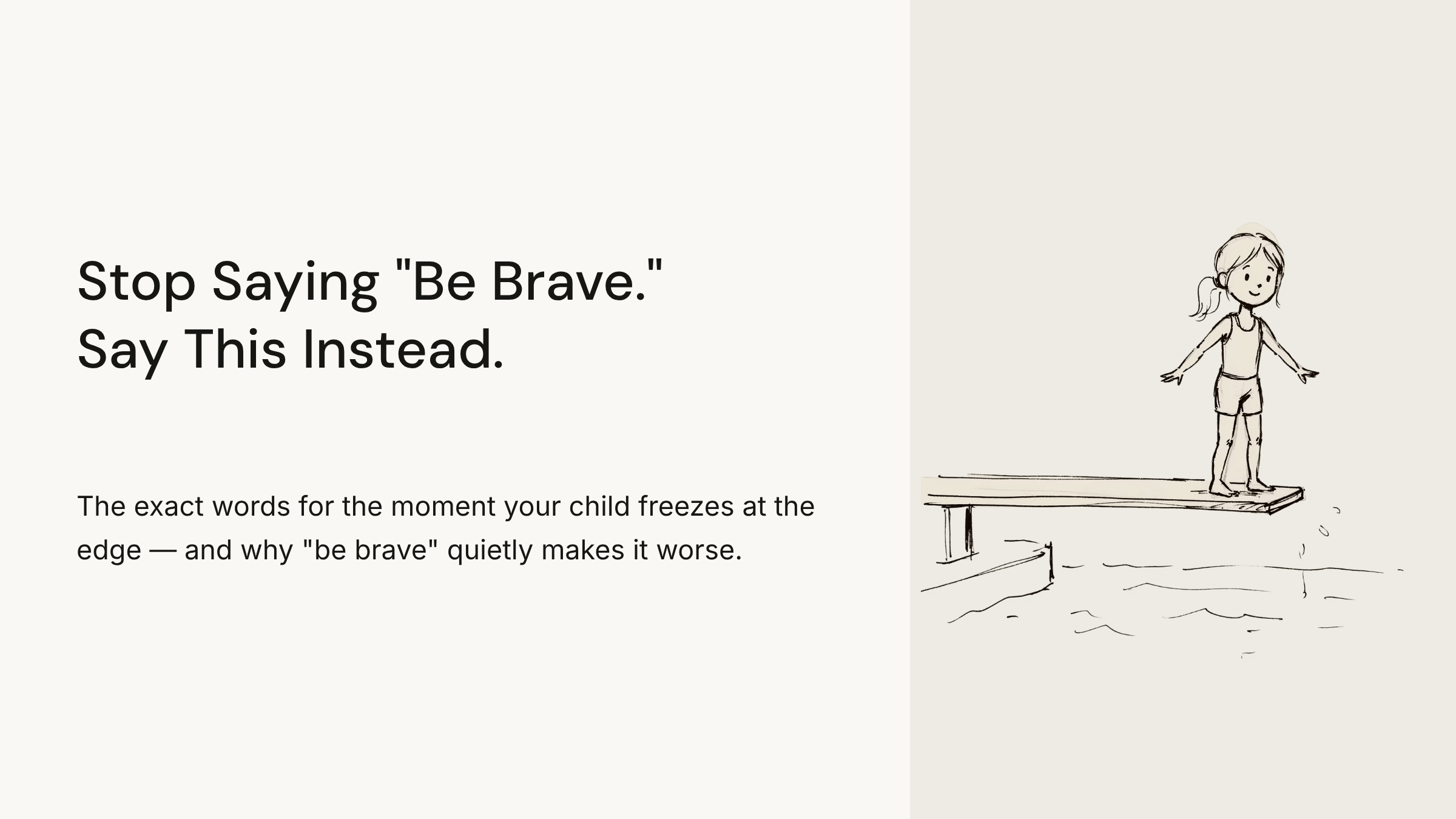
“Come on. You’ve got this. Just be brave.”
I’ve said all three to my kids. I’ve watched all three bounce off a frozen child like pebbles off a window. For years I thought the problem was my daughter’s nerve. It wasn’t. It was my script — and the script is the one thing I could actually fix.
Watch what that sentence actually asks of a child.
Be brave is an instruction to feel a specific way on command. But courage isn’t a feeling they can reach for like a jumper on a hook. It’s not sitting in there, dormant, waiting for you to remind them it exists. When you tell a frozen ten-year-old to be brave, you’re asking her to manufacture an internal state she cannot produce — and then, when she can’t produce it, she has a second failure stacked on the first. Now she’s not just scared of the pool. She’s failing at being brave, in front of you.
There’s a worse layer. Saying be brave names the danger. It confirms there is, in fact, something here worth being afraid of — otherwise why would you have said it? You meant it as fuel. She hears it as evidence. The stakes just went up.
This is The Courage Command — the parent’s instinct to order courage into existence, spoken warmly, that quietly does the opposite of what it intends. Almost every default line we reach for is a version of it. You’ve got this. Don’t be scared. Big kids can do it. Show me how brave you are. Every one asks the child to summon a mood.
Here’s the reframe that changes everything, and it’s the whole foundation of what follows:
Courage is a verb your child performs, not a mood they locate.
You will never talk a child into the feeling. But you can almost always invite them into the movement — and here’s the part school never taught any of us: the feeling arrives after the movement, not before. Get the body across the line first. The confidence shows up a few seconds later, slightly out of breath, wondering what the fuss was about.
So we stop trying to fix how they feel. We give them words that make the moving smaller. That’s the entire job of the script.
Everything depends on the opening move, because the opening move is where almost every parent loses.
Your child says the excuse. I don’t even like swimming. It’s boring. I’ll go next time. And your instinct — a good, loving, reasonable instinct — is to argue with it. You do like swimming, you asked to join! It’s not boring, look how much fun they’re having. There is no next time, it’s now.
You’ve just made a fatal move. You’ve turned the moment into a debate, and a debate is something your child can win by simply refusing to be convinced. Worse, arguing the excuse treats the excuse as real. It isn’t. I don’t like swimming is not information about swimming. It’s the sound courage makes when it’s losing — a reasonable-sounding exit dressed up so nobody has to say the true sentence, which is I’m scared I’ll be bad at this in front of everyone.
So the first move is not to argue. It’s to mirror.
The Mirror is one sentence that names what you actually see, without judgment and without the word scared:
“Looks like your body’s not sure about this yet.”
That’s it. Say it lightly, almost like a weather report, and then stop talking.
Look at what that sentence does. It doesn’t argue the excuse, so there’s nothing to win. It doesn’t name fear, so it doesn’t raise the stakes. It puts the hesitation in the body (”your body”) rather than in her character (”you’re being shy”), which makes it a passing state rather than a fixed truth about who she is. And the word yet does quiet, enormous work — it tells her this is a moment on a timeline, not a verdict.
Then you wait. The silence after The Mirror is not empty. It’s the most important part. You are giving her the one thing the Courage Command never does: room to move without being watched for a performance.
Comments
Nothing yet. Say the first thing.
Sign in to join the conversation.