
My son had the subject-selection form open on the laptop for forty minutes and hadn’t typed a thing.
Fifteen years old, cursor blinking in a box that basically asked him to name the rest of his life. His friends, he told me, already knew. One’s doing medicine. One’s going into engineering. And him?
“I don’t know what I want to be,” he said. Not sad, exactly. More like he was confessing to something.
That word — confessing. As if not knowing were a failing he’d been hiding.
I almost did what every parent does. I almost started helping him narrow it down, find the answer, close the box. And then I stopped, because I realised the box wasn’t the problem.
What if not knowing isn’t the thing to fix — what if it’s the thing to protect?
We raise children to believe that knowing is safety and not-knowing is danger.
Have a plan. Know the answer. Pick a lane. From the first “what do you want to be when you grow up?” — asked of a four-year-old, as if it were a reasonable question — we teach them that a good life is a known life, mapped in advance, and that uncertainty is a gap where competence should be.
Call it The Certainty Trap — the belief that security comes from knowing what’s next, and that a child without a plan is a child who’s behind.
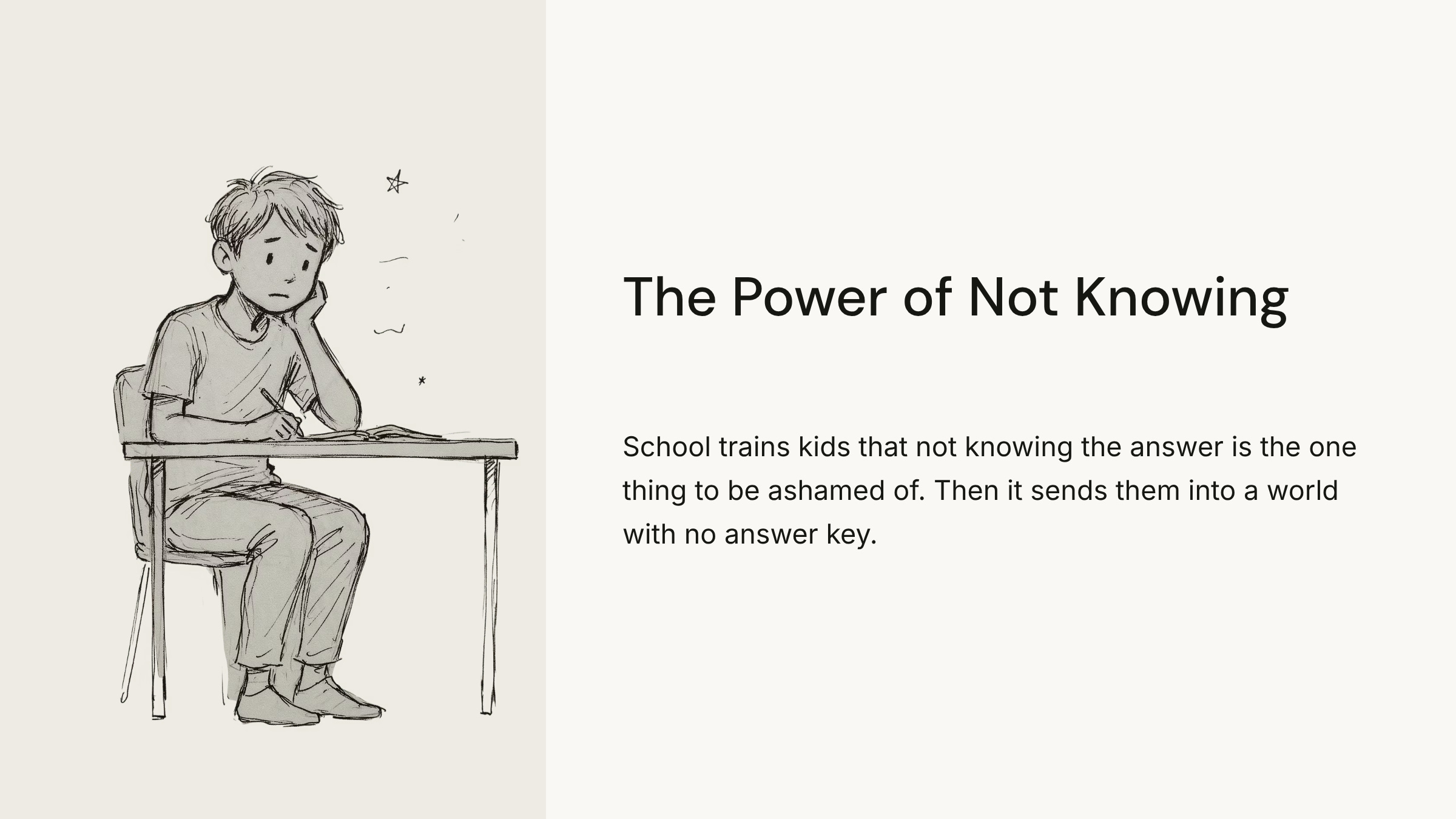
School is built on it. Every question has an answer in the back of the book. Every unit has learning outcomes printed before the first lesson. Twelve years of training a child to believe that not knowing the answer is the one state to be ashamed of, corrected out of, never to sit in.
And then they graduate into a world that has no back of the book.
No answer key. No printed outcomes. Half the jobs my son will hold probably don’t exist yet. The plan he’s being pressured to write at fifteen will collide with a reality nobody can forecast — and the child who was taught that the plan is safety will feel, the moment it breaks, that he has failed. When actually the plan was always going to break. That was never the problem. The problem is that we never taught him what to do when it does.
Here’s the part the Certainty Trap hides from us.
You cannot walk through a door you refuse to admit you can’t see. And you can only see new doors when you stop insisting you already know where the corridor leads.
Every given moment contains within it doorways of opportunity. But they stay invisible to the child who has decided, at fifteen, that the route is fixed and the only job is to march it. The kid with the rigid ten-year plan isn’t safe. He’s blindfolded — walking past every door that isn’t on the map he drew before he knew anything.
The child who can say I don’t know what’s next — and not flinch — is standing somewhere far more powerful. Call it what it is: the golden vortex, the space between everything he’s meant for and anything he’d previously imagined. It’s not a hole in his plan. It’s the widest his life will ever be. Every possibility is still live. Nothing has been foreclosed. He hasn’t lost the answer — he’s standing in the room where all the answers are still available.
Not knowing isn’t the absence of a future. It’s the presence of every future at once, before he’s been talked into spending them all on one.
The capability we actually want to build isn’t knowing what’s next. It’s the nerve to stand in not-knowing without panicking — and to keep moving anyway, meeting the next real moment instead of the imagined map.
So I didn’t help my son fill in the box.
I asked him a different question. “Forget what you want to be. What did you actually like doing this term — the stuff where you lost track of time?”
He thought about it. Design tech. Arguing a case in that debate thing. Helping his mate rebuild a bike.
None of those is a career. All of them are doorways. And the point wasn’t to pick one and march — it was to choose the next term as an experiment, not a verdict. Try the thing you’re curious about. See what it makes available. Then choose again.
You’ll get the chance to do this in the smallest moments. The ten-year-old paralysed choosing an elective because “what if I pick wrong.” The teenager who won’t start the project because he can’t see how it ends. Every one is a chance to teach the same thing: you don’t need to see the whole staircase. You need to take the step in front of you and let it show you the next one.
My son typed something in the end. Not a destiny. A direction. He looked a little lighter, and he said something I wrote down: “So I’m allowed to not know yet.”
Allowed. Like a permission he didn’t know he had.
On Thursday I’ll give you the exact words for the moment your child freezes over a choice they think is permanent — a short way to turn “what if I pick wrong” from a threat into an experiment, so they can move without needing to see the end first.
For now, one question. Not about your child — about you.
Where in your own life are you clutching a plan for safety, when the honest, more powerful move is to admit you don’t know what’s next yet — and let the doorways appear?
Because our kids don’t learn to trust not-knowing from what we tell them. They learn it from watching whether we can stand in it without panicking.
No posts
Comments
Nothing yet. Say the first thing.
Sign in to join the conversation.