
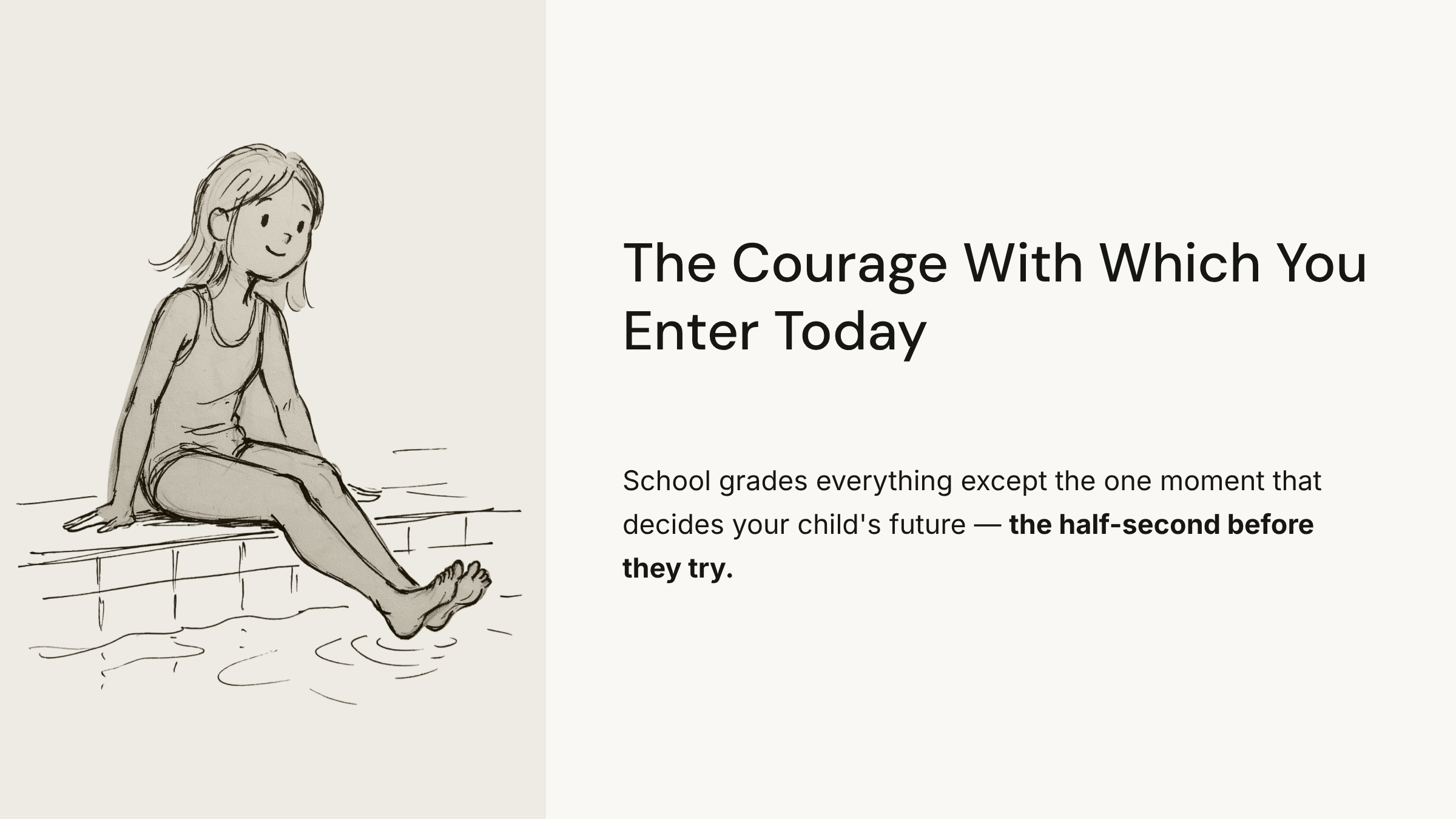
My daughter stood at the edge of the pool with her toes curled over the tiles.
The swim squad had already pushed off. She’d asked to join them for three weeks. Begged, actually. And now the water was right there, and her whole body had gone still in that particular way ten-year-olds go still — not scared exactly, just negotiating.
“I’ll go next time,” she said.
I watched her replay it. Every previous time she’d frozen. Every time she’d told herself she wasn’t a squad kid. The past was standing on the tiles with her, and it was heavier than she was.
Here’s the question I couldn’t shake as I stood there: was she deciding about swimming, or was she deciding about something much bigger?
There’s a line I keep coming back to: the courage with which you enter today will become the fate that you meet tomorrow.
Read it twice. It’s not saying courage makes today feel good. It’s saying courage today literally becomes the shape of your child’s life later. The entering is the fate. They compound into each other.
School has no column for this.
It measures whether she got the spelling right, whether the answer matched the key, whether she sat still. It never once measures whether she was willing to walk to an edge she’d frozen at before and go anyway. There is no rubric for entering. No teacher marks it. And yet it is the single capability that decides whether the adult version of her ever asks for the promotion, the date, the second chance, the harder table.
Every one of those adult moments is the same shape as the pool tiles. A threshold, a pause, and a body deciding whether yesterday gets a vote. Call that pause The Entry Point — the half-second between wanting a thing and moving toward it, where the whole future quietly gets decided. School drills a thousand answers into her and never once trains the one moment that governs whether she’ll use any of them.
We’ve been sold a quiet lie — that confidence comes first and action follows. That she’ll try the squad once she feels ready.
She won’t. Nobody does.
The courage comes from entering while still unready. Everything else is a memory of yesterday dressed up as a reason. Feeling ready is not the ticket to the moment; it’s the reward you’re handed a few seconds after you enter without it. The child who learns this at ten has a forty-year head start on the adult who’s still, at fifty, waiting at the Entry Point for a green light that was never coming.
Now here’s the part that’s easy to miss.
The quote doesn’t ask her to force her will upon her fate. It asks her to arrive fully into each moment as it’s presented. Those are opposite instincts, and most of us coach the wrong one.
We tell our kids to want it more. Push harder. Beat the fear. That’s force — and force is exhausting, which is exactly why it doesn’t last. The kid white-knuckling their way through a piano exam is not building courage. They’re building dread with good posture.
What the water actually asked of my daughter was smaller and far harder: stop consulting yesterday. The frozen kid isn’t in the present at all. She’s standing on the tiles running a highlight reel of every past freeze, and then obeying it.
Call it The Replay Loop — the moment where a child stops meeting what’s in front of them and starts re-watching what already happened. The Replay Loop feels like caution. It’s actually just the past, voting.
Courage is what breaks the loop. Not by wanting harder — by arriving. By meeting this pool, this Tuesday, this version of herself, none of which have failed at anything yet.
The child who can do that isn’t building a clean, tidy story where everything works. She’s building a mosaic — messy, uneven, one entered moment stacked on the next. And that mosaic, not the highlight reel, is the actual person she becomes.
You’ll see it in the smallest things, long before the big ones. The new kid she hovers near but won’t approach. The hand that half-raises in class and comes back down. The dish she won’t try because last time something was gross. Each one is a tiny threshold — her rehearsing either the Replay Loop or the entering.
Notice what the Replay Loop and the Entry Point have in common: both are invisible. You’ll never see the reel playing behind your child’s eyes, or catch the exact half-second they retreat. What you can see is the retreat dressed as a reasonable excuse — I’m tired, it’s boring, I’ll go next time, I don’t even like swimming. Those aren’t lies. They’re the shape courage takes when it loses. Learn to hear them, and you stop arguing with the excuse and start standing quietly beside your child at the edge.
My daughter got in the pool, by the way. Not because I pep-talked her. I just said, quietly, “You don’t have to be good today. You only have to get in.” Something in that made the water smaller. The past needs you to perform. The present only needs you to arrive.
She came out coughing, goggles fogged, having swum badly and finished last.
“Can we come back Thursday?” she asked.
That’s it. That’s the whole capability, forming in real time. Not the swimming — the coming back. One entered moment quietly rewriting what she believes she’s capable of entering next.
On Thursday I’ll give you the exact words — a short script for the moment your child is frozen at their own edge, that lowers the bar from be brave to just enter, with versions for the five-year-old, the ten-year-old, and the eleven-year-old who’s now too cool to admit they’re scared at all.
For now, sit with one question. Not about your child.
Where in your own life are you still standing on the tiles, replaying yesterday, waiting to feel ready before you enter?
Because they learn courage the same way they learn everything that actually matters — by watching which one of us gets in the water.
No posts
Comments
Nothing yet. Say the first thing.
Sign in to join the conversation.