
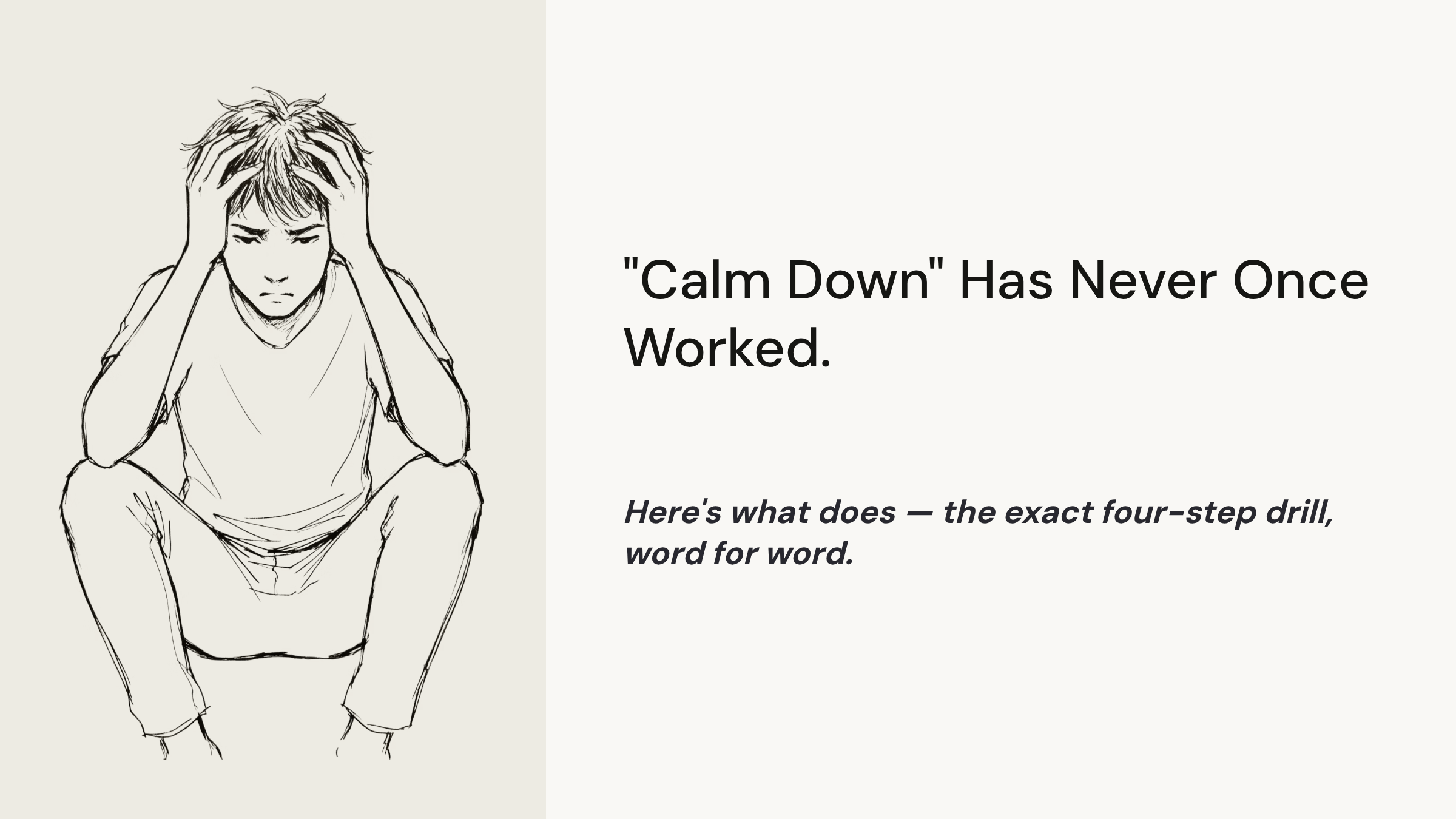
“Calm down.”
I have said it to a mid-meltdown child roughly ten thousand times, and I can now report the success rate with confidence: zero. Not once. If anything, it pours fuel on the fire.
The problem was never my child’s inability to calm down. It was that I was handing them a destination with no road to it — and doing it in the two seconds when they were least able to build one. What they needed wasn’t a command. It was a move.
Watch what those two words actually ask of a hijacked child.
When your child is flooded — furious, humiliated, mid-reaction — the thinking part of their brain has effectively gone offline. Blood, attention, and energy have all rushed to the alarm system. In that state, calm down asks them to produce the one thing the flood has temporarily switched off: calm. It’s like asking someone to read you their phone number while they’re holding their breath underwater. The capacity isn’t there right now, and demanding it just adds failure to panic.
And there’s a second, sharper problem. Calm down. You’re overreacting. It’s not a big deal. — every one of these quietly tells your child that their reaction is the problem. So now they’re fighting two fires: the original spark, and the new message that they’re bad for having caught alight. Call it The Second Fire — the one the parent accidentally lights by treating the child’s flooded state as misbehaviour. And the Second Fire almost always burns hotter than the first, because now it’s personal, and it’s coming from you.
Here’s the reframe that changes how you show up in these moments:
You cannot talk a flooded child into a pause. You can only give them a move that makes one.
The Gap I wrote about Monday — the space between feeling and reacting — is not installed through insight in the heat of the moment. Insight is offline. It’s installed through a physical, repeatable action small enough that a hijacked brain can still perform it. That’s the whole shift. Stop trying to reason them into calm. Start handing them a drill their body can run even when their mind can’t. And here’s exactly what that drill is.
The first move is not to fix the feeling. It’s to name what’s happening — because naming is the first crack of light in the Hijack.
The Name is one short sentence that says, out loud and without a trace of blame, that a hijack is underway:
“Something just grabbed you.”
Or, for a phone moment: “That message got you.” For a sibling explosion: “He found your button.”
Say it lightly, like you’re pointing at weather, not at a flaw. And notice the precise work it does. It puts the problem outside your child — the message grabbed them, the button got pushed — rather than inside their character. You’re not saying you’re out of control. You’re saying something is trying to control you, which is a completely different sentence, and a much more useful one. It hands your child an enemy that isn’t themselves.
That tiny externalising is the first millimetre of Gap. For a heartbeat, your child stops being the anger and starts seeing it — and you cannot pause a thing you’re fused with, only a thing you can see. The Name creates the seer.
Do not, in this moment, explain any of that. Just say the sentence and move to the next step, because naming alone won’t hold. It buys you a millimetre. The next move widens it.
Comments
Nothing yet. Say the first thing.
Sign in to join the conversation.