
My son was three sentences deep into explaining something he loved before he caught himself.
He’d lit up — properly lit up, the way he used to before he learned not to — about a book, talking fast, hands moving. Then his phone buzzed, a name from school flashed up, and I watched it happen in real time. The light went out of his face. He shrugged. “Anyway. It’s whatever. I don’t really care.”
But he did care. I’d just watched him care. He’d cared enormously about ninety seconds ago.
Something had reached in and told him that caring wasn’t safe — and he’d handed over the volume knob without a fight.
When your child says “I don’t care,” which voice is actually talking — theirs, or the room’s?
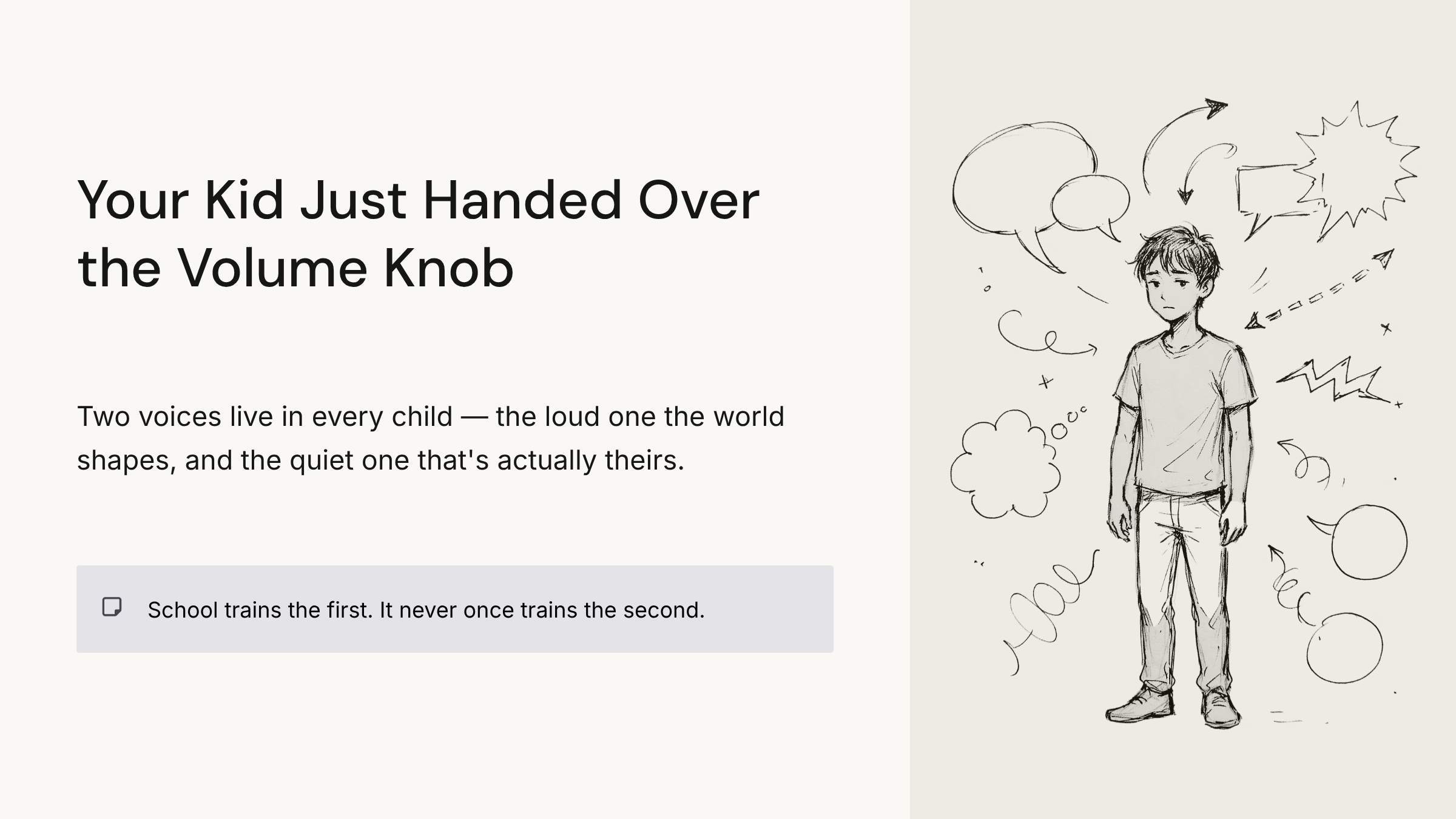
There are two voices speaking inside every child, all the time.
One is loud — the voice of the world. Every instruction, expectation, and “you should” they’ve ever absorbed. Teachers, peers, feeds, the entire chorus telling them what to want, what to reach for, what’s cool, what counts. It’s constant and confident and everywhere. The other is quiet: a single voice that stands alone, the one that knew, ninety seconds ago, that the book was wonderful. Their own inner knowing.
And here’s what almost no one tells parents: school is the loudest source of that first voice. Twelve years of following external instruction toward milestones someone else chose — reach this, achieve that, this is what a good student wants. It is a magnificent training academy for listening to the world. It offers no rubric whatsoever for listening to yourself.
So the quiet voice goes quieter. Not gone — quiet. It gets outvoted so many times that a child stops consulting it. Watch the moment it happens and you’ll see what I saw on my son’s face: the instant he stopped asking what do I think? and started asking what do they think? Call it The Handoff — the quiet transfer of authority from a child’s own knowing to the crowd’s.
The danger was never that my son will listen to the loud voice sometimes. Everyone does; some of it is even wise. The danger is a child who hands the knob over so completely that, years from now, he looks down and finds his hands empty — a whole life woven from a storyline he didn’t write, wondering where his own voice went. It didn’t go anywhere. He just stopped being able to hear it under the noise.
Now here’s where most advice gets it exactly half-right, and the half it misses is the important one.
The fix is not “ignore the world and trust your gut.” That’s just the opposite ditch — a child who dismisses every outside voice is as lost as one who obeys them all, only louder about it. The loud voice isn’t the enemy. It carries real wisdom: the teacher who sees something true, the friend whose warning is worth heeding, the accumulated knowledge of people who came before. Truth is fragmented everywhere. Splitting the two voices into wholly good and wholly bad throws away half of it.
The actual capability — the one that takes a lifetime and that school will never grade — is discernment. Knowing which voice to listen to, when. That’s the wisdom underneath all of this: not choosing a side, but developing an ear fine enough to tell, in any given moment, which one to follow.
That’s a far harder thing to raise than a rebel or a rule-follower. A rebel just flips the default and obeys the opposite. A rule-follower never questions it. What you actually want is a child who can hold both voices at once — hear the room and hear themselves — and then choose, deliberately, which one gets the final say this time. Sometimes the crowd is right and the wise move is to listen. Sometimes it’s dead wrong, and everything depends on your child being able to still hear the quiet one underneath.
You’re not teaching him to shut out the world. You’re teaching him to never lose the sound of himself inside it.
So when my son said “it’s whatever,” I didn’t argue that he did care. That just starts a fight he’ll win by digging in.
Instead, later, quietly, I asked him a different question: “Forget what anyone at school thinks for a second. Genuinely forget them. What did you think of it?”
He was quiet. Then, carefully, like testing whether the floor would hold: “...I actually thought it was really good.”
“That’s the one I want to hear,” I said. “You can care what they think too. Just don’t let it be the only voice in the room.”
You’ll get these moments constantly, disguised as apathy or as going along with things. The friend group that decides what she’s allowed to like. The “everyone’s doing it.” Each one is a small Handoff — and each is a chance to ask the one question that turns the quiet voice’s volume back up: never mind them — what do you think?
On Thursday I’ll give you the exact words — a simple, repeatable question you can ask in the ordinary moments that helps your child find their own voice before the world’s voice drowns it, with versions for the little ones and the teenager mid-shrug.
For now, one question. Not about your child — about you.
Whose voice have you been mistaking for your own — and when did you last get quiet enough to hear the one that’s been yours all along?
Because our kids don’t learn to trust their inner voice from a lecture about being themselves. They learn it from watching whether we can still hear ours.
No posts
Comments
Nothing yet. Say the first thing.
Sign in to join the conversation.