
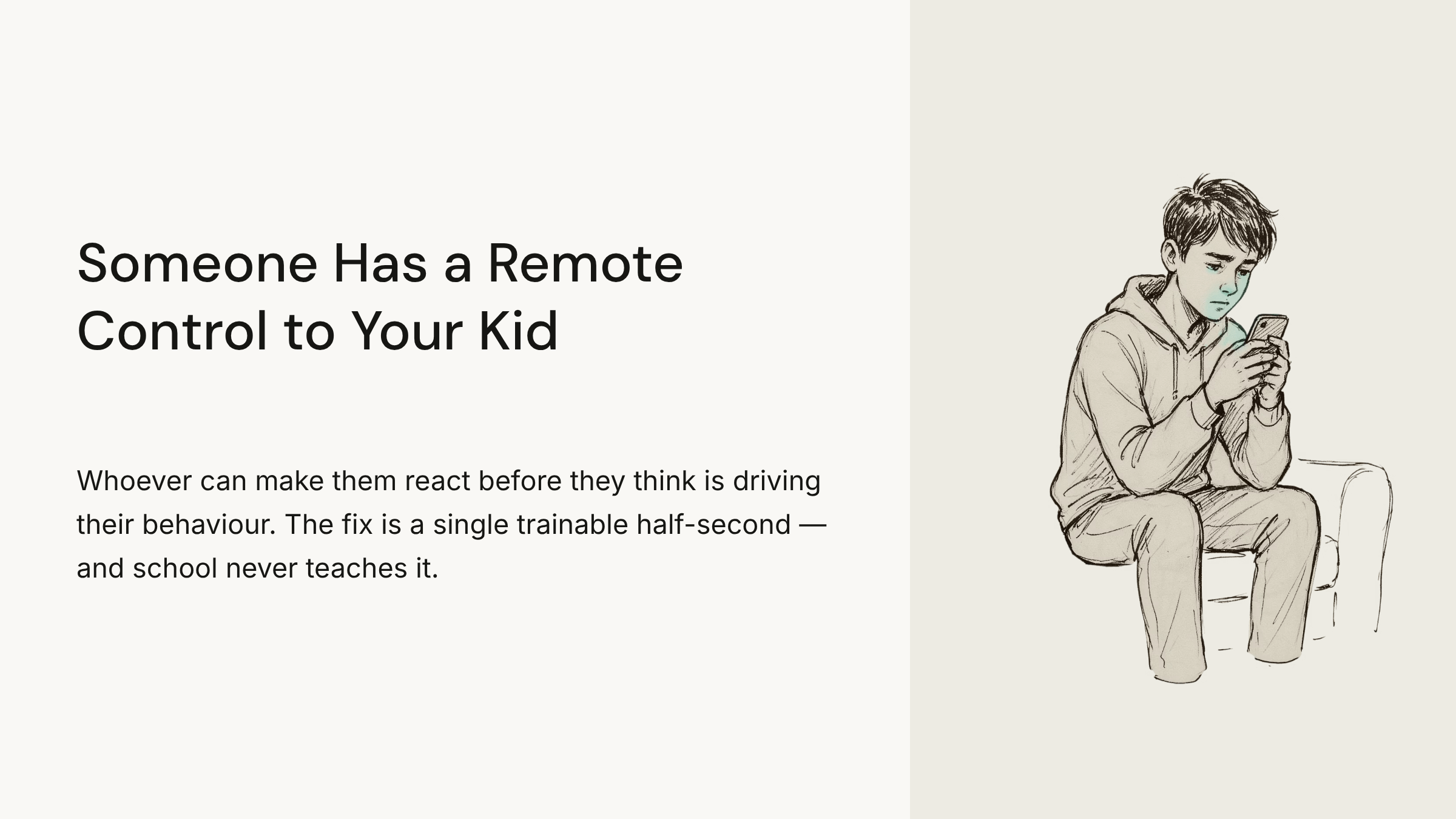
I watched my son’s whole face change in about half a second.
His phone buzzed. He glanced down at the group chat, and something in a message hit him — his jaw set, his shoulders came up, and his thumbs were already moving before he’d taken a breath. Whatever had been typed, he was about to answer it, fast and hot.
Fifteen years old, and a single line of text on a screen had just taken the wheel.
He wasn’t choosing his response. He was being operated — by a classmate who, deliberately or not, had found the button and pushed it. And my son had no idea it was happening. To him it just felt like being right.
When something can make your child react before they’ve had a chance to think — who’s actually in control of your child?
Here’s what looks like a character flaw but isn’t.
When a strong feeling hits — anger, hurt, the sting of an insult — a child’s brain routes it straight to reaction, no stop in between. That’s not bad behaviour. It’s biology. The part of the brain that pauses and chooses, the prefrontal cortex, doesn’t finish wiring until the mid-twenties. Which means your child is neurologically built to act before they think, more often than you are, and to feel completely justified while doing it.
Call it The Hijack — the half-second where something outside your child reaches in and takes control of what they do next, while it still feels, from the inside, like their own free choice.
And almost nothing in their world is training them out of it. School runs on instant response — bell rings, you move; question asked, hand up; prompt given, answer produced. Twelve years of rewarding the fast reaction and never once the deliberate pause. Meanwhile the devices in their pocket are engineered to collapse the gap — designed by very smart people to convert a feeling into a tap before thought can intervene, because your child’s instant reaction is the product being sold.
So here’s the uncomfortable truth: whoever can make your child react instantly is holding a remote control to your child. The classmate who knows which insult lands. The app that knows which notification pulls. The stranger online who knows that outrage travels fastest. Every one of them can drive your child’s behaviour — as long as there’s no pause where your child gets to decide for themselves.
Now here’s what the quote understands that our whole culture has forgotten.
Self-protection is learning how to take a pause between what you feel and how you react. Not suppression. Not “calm down.” A pause. A deliberate widening of the space between the spark and the fire — and in that space, and only there, lives every ounce of your child’s freedom.
Call it The Gap — the trainable distance between what your child senses and what they do about it. A child with no Gap is at the mercy of anyone who can provoke them. A child who can hold the Gap, even for three seconds, becomes almost impossible to control — because in those three seconds, the power quietly moves from the person pushing the button back to the person deciding whether to respond at all.
And inside the Gap lives the deepest line in the quote: what you engage with is what you empower. This is the part that reframes everything. Not every message that lands deserves a reply. Not every insult deserves a war. Not every notification deserves a thumb. The child who learns to ask, in the pause, is this even worth my energy? — has discovered that the real power was never in reacting well. It was in choosing what to react to at all, and letting the rest fall to the ground, unanswered and unfed.
You don’t protect your child by removing every provocation from their life. You can’t. You protect them by building the one thing no provocation can survive: a child who pauses.
So I didn’t grab my son’s phone.
I just said, quietly: “Hey — you don’t have to answer that right now.”
He looked up like I’d said something in another language. Right now was the only speed he knew. So I said the thing I want him to eventually say to himself: “That message made you angry. That’s fine. But angry-you and ten-minutes-from-now-you might want to send really different things. Give the second one a chance to show up.”
He put the phone down. Picked it back up four minutes later and typed something far shorter, far cooler than what would have flown out at second zero. Then he said something I wrote down: “I still said what I meant. I just didn’t say the dumb version.”
That’s the whole skill. Not silence. Not swallowing it. Just the Gap — long enough for the wiser response to arrive.
You’ll get these moments everywhere, long before the phone. The younger one who hits back before the sentence is finished. The instant “that’s not fair.” Each is the same reflex, and each is a chance to widen the same Gap.
On Thursday I’ll give you the exact words — a short, repeatable way to build the pause into your child in the heat of the moment, so they can find the Gap themselves instead of needing you to hold it for them, with versions for the little ones and the teenager mid-Hijack.
For now, one question. Not about your child — about you.
What keeps hijacking you — the notification, the tone in the text, the comment that ruins your morning — and what would change if you widened the space before you fed it your energy?
Because our kids don’t learn the pause from being told to calm down. They learn it from watching whether we can feel the spark and not reach for the match.
No posts
Comments
Nothing yet. Say the first thing.
Sign in to join the conversation.