
The article ran. Lander responded. Some of the response is worth answering.
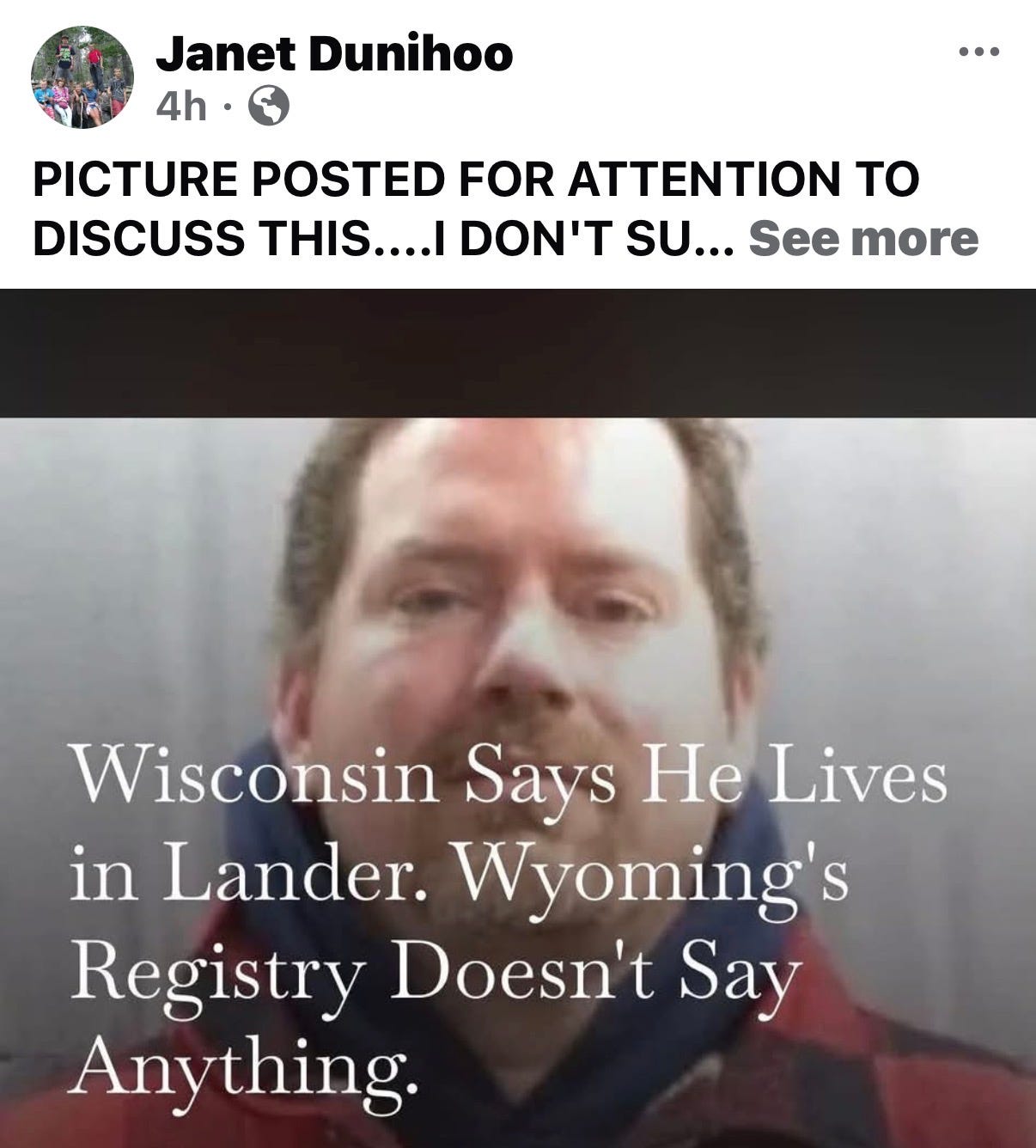
Multiple anonymous accounts have suggested the timing of this story is about the August 18 municipal election, because the owner of Mr. D's Food Center is a candidate for mayor.
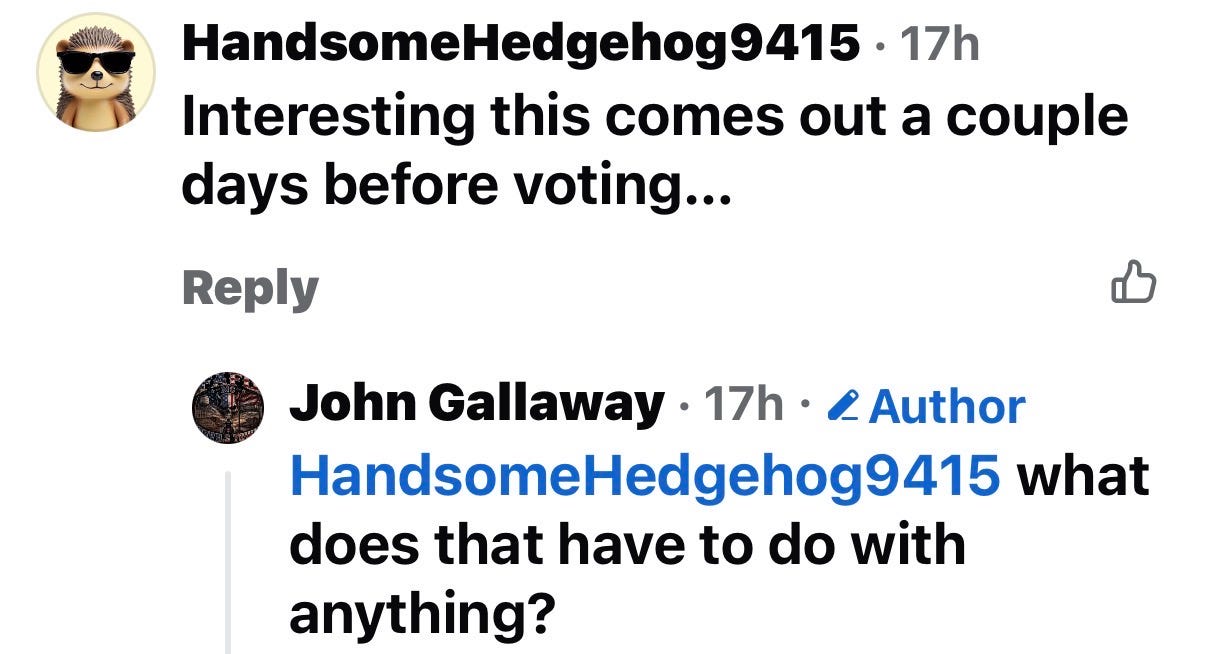
I did not know that when I started. I don't live in Lander. I have no stake in who runs Lander, no relationship with any candidate, no opinion about the race, and no intention of forming one. I write about crimes against children and about what government records do and don't show. That's the entire brief.
The timing was driven by a Wisconsin Department of Corrections registry entry with a verification date of June 10, 2026, and by an email from the Wyoming Attorney General's office sent this month. Those are the clocks I was working on.
If a business in Lander employs someone with this record, that's a fact about the business. What the public does with that fact is the public's business, not mine, and it would be exactly as true in November. Anyone who thinks a man's criminal history becomes newsworthy or unnewsworthy depending on the municipal calendar has an odd theory of what journalism is for.
Now the part that matters.
I couldn't nail this down before publication, and I said so in print. One of his defenders has offered one answer, publicly, in a comment thread:
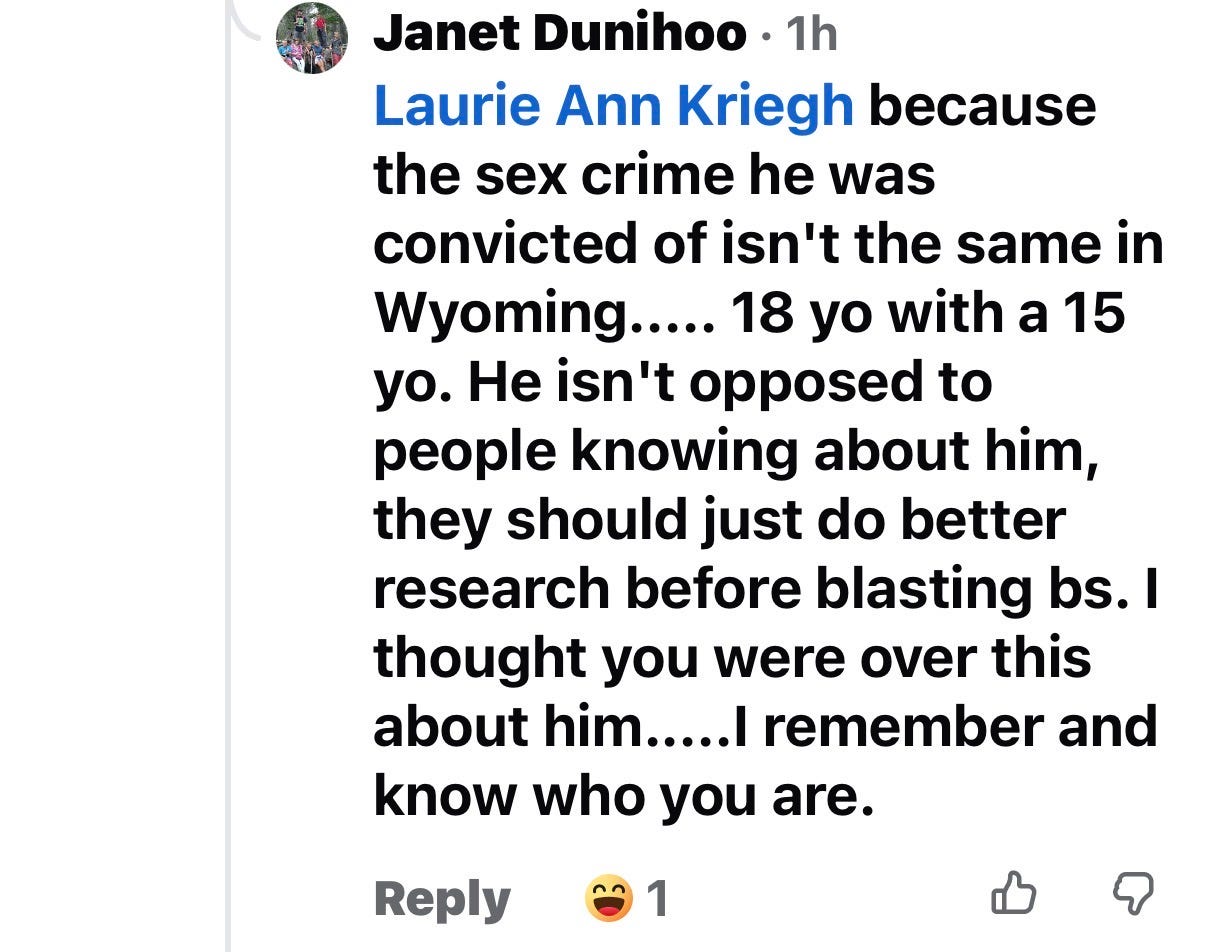
"the sex crime he was convicted of isn't the same in Wyoming..... 18 yo with a 15 yo"
That tracks the statute. Wyoming's closest analogue to Wisconsin's second-degree sexual assault of a child, W.S. 6-2-316(a)(i), requires that the actor be seventeen or older, the victim between thirteen and fifteen, and the victim at least four years younger than the actor. Wisconsin's 948.02(2) has no age-differential element at all. It's sexual contact or intercourse with anyone under sixteen, full stop.
An eighteen-year-old and a fifteen-year-old is a three-year gap. Wisconsin makes that a felony, Wyoming doesn’t
So there it is. He isn't unregistered because he's hiding, according to his side.
That is a real gap and a question for the Legislature if it’s true. I'd have written that story on its own. I am looking into it.
But I want to be honest about something, because his defenders keep insisting the age-gap point is the whole story and everyone else is smearing him.
It stopped being the whole story the moment I read the court file.
Not the 1993 convictions. Those, standing alone, are a hard case about age-of-consent lines and I would not have written a word about a man carrying only that.
What kept me on it, all from published Wisconsin Court of Appeals decisions:
Sexual relations with both parents and with his sister. Sexual aggression toward girls beginning at age ten. Sexual contact with two foster brothers. Two incidents of intercourse with the family dog. An incident in which he forced a woman to have sex with a dog, photographed it, and publicly displayed the photographs to humiliate her. Dropping out of treatment after being confronted with a report that he had sexually assaulted a twenty-two-month-old child. Diagnoses of paraphilia not otherwise specified and antisocial personality disorder, the second of which his own expert conceded.
Then, in 2013: a psychopathy score of 32.5 out of 40, a circuit court finding that he'd been untruthful on a polygraph, and that court describing the untruthfulness combined with psychopathy as a dangerous combination.
Then, in 2018: a judge discharged him. I printed that too, twice, high in the piece, because it's true and because it's the most important fact in his favor.
I need to correct something in the first article.
The court opinion lists "sexual relations with both of his parents" inside a recitation of his offense history, and I reproduced it in that context. That was wrong, and it's the one thing he said in his own defense that I think is right.
That conduct began when he was a child. A boy in sexual contact with both of his parents is a boy being raped by his parents. It belongs in this record as something done to him, not by him, and I should have said so the first time.
I'm saying it now. It doesn't change anything else in the file, and it isn't a favor. It's a correction I owed.
This is the phrase, and it's the reason I keep doing this work.
Here is the full argument, as posted publicly by one of his defenders:
"Maybe all of you should actually approach him as the human being he is, and a very decent one at that, and talk to him. Sit down with him and ask him about his past... He will tell you the truth."
And later in the same comment:
"Research the difference between 'allegations' and 'convictions'. He 'allegedly' did much worse than he was 'convicted' of."
Read that second sentence again. That is a defense.
The argument being made, out loud, in a community forum, is that the man is a good guy because the worst things in his file were never formally proven, and the person making it has evidently been told what those things are, has weighed them, and has decided they don't count. Not that they didn't happen. That they weren't convicted.
I want to be fair to her: she is not wrong that allegations differ from convictions. That distinction is load-bearing in a free country and I'll defend it. But it does not do the work she wants. Sworn expert testimony recited in a published appellate opinion is not a rumor. A circuit court's finding that a man lied on a polygraph is not gossip. And a man's civil commitment as a sexually violent person, for twenty-two years, is not a formality that follows from nothing.
The rest of the argument:
"He's worked at the same place for a year or so... nobody has been harassed or assaulted in any way at his job either. If he's that 'high risk' of re-offending, it would've happened already."
This is the load-bearing claim of every enabler in every one of these cases I have ever covered, and it is worth taking apart carefully, because it sounds like evidence and isn't.
One year without a detected, reported, and publicly known offense is not a finding of low risk. It's an absence of information. Sexual offenses against children are among the least reported crimes in the country. The median child victim does not disclose immediately, and many never disclose at all. "Nothing has happened" and "nothing has been reported" are different sentences, and only one of them is supported by a person's confidence in their coworker.
More to the point: this man was committed for twenty-two years, much of it in a secure facility. A period without offenses while under supervision or observation is exactly what the Wisconsin courts kept saying was insufficient. Two appellate panels and a circuit court heard versions of "he's been fine lately" and found it didn't establish what he wanted it to establish.
"He was dealt a very shitty hand in life."
He was. I said so above, and I meant it. Childhood victimization is real, it is common in offender histories, and it deserves compassion.
It is not a risk assessment. The two things are unrelated. A man can be both a victim deserving of sympathy and a person a community is entitled to have accurate information about. Treating those as mutually exclusive is how these situations persist.
"Too many finger pointers, no proof."
Every fact in the original article is a citation to a government record: Wisconsin Circuit Court Access, the Wisconsin DOC Sex Offender Registry, published Court of Appeals decisions, filed legislative testimony, and correspondence from the Wyoming Attorney General's office. The case numbers are printed. Anyone can pull them in ten minutes.
"No proof" here means "I did not look."
Buried in the same threads, someone defending the store wrote:
"in the state of wyoming employers do not have to do background checks if the employee is not working with kids, vulnerable adults, or a Healthcare worker... and three he's not on the wyoming registry so how were they to know."
That is precisely my thesis, and I'm grateful for it.
That's the story. Not that anyone at Mr. D's did anything wrong. That a Wyoming employer, checking the place Wyoming tells you to check, would have found nothing, because a four-year age differential in a 2007 statute means a man on another state's lifetime registry doesn't appear on ours.
The same commenter also confirmed, from the friendly side, that he "still reports to Wisconsin," and that hotel and motel management is what brought him to Wyoming in the first place, meaning that before the deli, he held positions with keys, guest lists, and after-hours access to occupied rooms.
Nobody in Wyoming had a way to know that. That's the gap. That's all I've been saying.
I want to be careful here, because this is an area where advocates on both sides overstate, and I'm not going to hand anyone a reason to dismiss the rest.
Sexual recidivism rates overall are lower than most people assume. Hanson and Bussiere's meta-analysis of 61 studies covering more than 23,000 offenders found an average sexual reoffense rate of about 13 percent over four to five years. That figure is real and it belongs in this conversation.
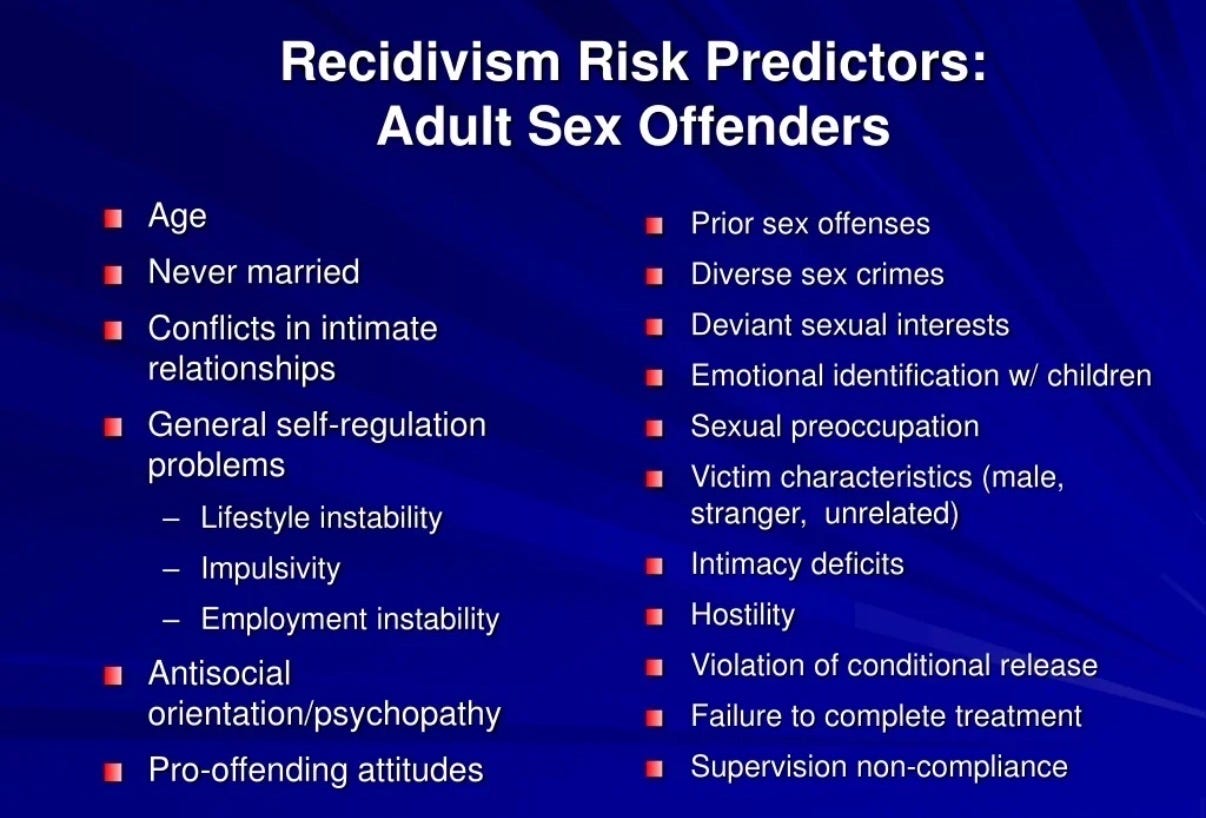
But the same body of research is emphatic that the average conceals enormous variation, and it identifies with unusual consistency which offenders sit at the top end.
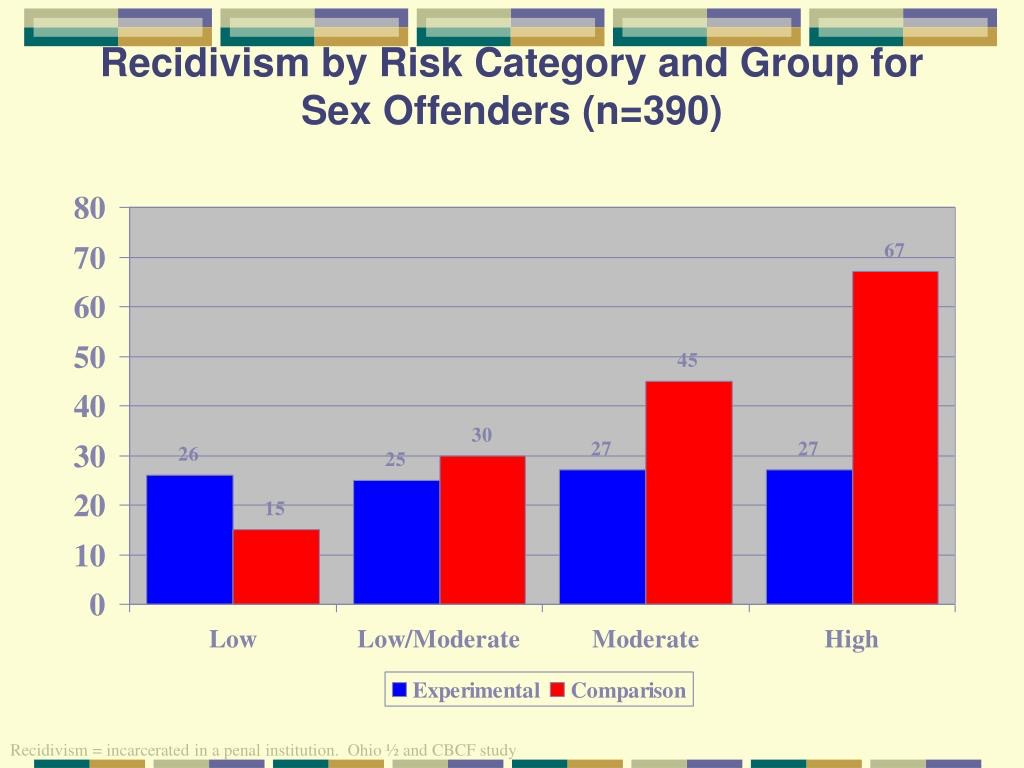
The single strongest predictor of sexual reoffending, across multiple meta-analyses, is deviant sexual preference, a measured sexual interest in children. Hanson and Morton-Bourgon's later meta-analysis, covering 82 studies and nearly 30,000 offenders, identified two major predictors: deviant sexual preferences and antisocial orientation. Materials prepared for the Wisconsin Legislature's own 2006 special committee on crimes against children put the spread bluntly: low-risk offenders reoffend at roughly 7 to 12 percent, high-risk offenders at roughly 51 to 62 percent.
Two factors. Sexual deviance and antisocial orientation.
In 1998, a Wisconsin court heard testimony diagnosing this man with paraphilia and antisocial personality disorder. In 2013, a Wisconsin court described his combination of sexual deviancy and psychopathy, scored at 32.5 out of 40, as a dangerous combination.
The court wasn't editorializing. It was describing, in plain language, the exact two-factor profile the recidivism literature identifies as high-risk.
One more finding, and it's the uncomfortable one. A follow-up study of 136 extrafamilial child molesters assessed phallometrically found that 31 percent were convicted of a new sexual offense within an average of 6.3 years, and that behavioral treatment specifically designed to alter inappropriate sexual age preferences did not affect recidivism.
I am not going to tell you deviant arousal can never change. The honest statement is narrower and bleak enough: we do not have good evidence that we know how to change it, and the treatment approaches aimed squarely at changing it have not demonstrated that they reduce reoffending.
That is what a court is doing when it discharges someone under Chapter 980. It is not certifying that a man has been cured. It is finding that the State can no longer carry a burden of proof. Those are different things, and the discharge order says the second one.
Wyoming already prohibits certain registered offenders from school grounds under W.S. 6-2-320. We have decided, as a state, that some histories justify keeping some people out of some places.
We have not decided anything about a man who carries that history but doesn't appear on our registry.
So: should Wyoming law address employment in places children frequent, grocery stores, restaurants, motels, by people who are on another state's lifetime sex offender registry, even where our own statute's age-differential requirement means they don't register here?
I don't think that question answers itself, and I'm not going to pretend it does. I've spent years arguing against expanding state power over where people can be, and I meant it. There are real costs to a rule like that. It makes reentry harder, it can push people toward instability, and instability is itself a risk factor. Anyone who tells you this is simple is selling something.
But right now Wyoming hasn't weighed those costs, because Wyoming hasn't noticed the category exists. That's not a policy choice. It's a blank space.
Ask your representative. Ask your senator. The Attorney General's office already told a citizen that's the only place this can be fixed.
He came to the comments himself. He wrote that the record was "alleged and disproved by polygraph," that most of it was his own victimization by his parents, and that he was "cleared by DCI after a full investigation."
I told him what I'd tell anyone. Given a record that includes a court finding of untruthfulness and a diagnosis of antisocial personality disorder, I can't take his account on faith. But if he produces documentation of a clearing polygraph or a DCI determination, I will read it, verify it, and print what it says. That offer is open and it does not expire.
He deleted his comments.
The offer stands anyway. Documents, and I'll run them.
Sources: Wisconsin Circuit Court Access records, Brown County cases 1992CF000437, 1992CF000458 and 1996CI001156; Wisconsin Court of Appeals Nos. 97-3789, 98-3179 and 2012AP2021; Wisconsin Department of Corrections Sex Offender Registry; W.S. 6-2-316, 7-19-302; Wis. Stat. 948.02(2); correspondence from the Wyoming Attorney General's Office; Hanson and Bussiere (1998); Hanson and Morton-Bourgon (2005); Rice, Quinsey and Harris (1991); materials prepared for the Wisconsin Legislative Council Special Committee on Review of Crimes Against Children (2006). Public comments quoted as posted in a public community forum.
No posts
Comments
Nothing yet. Say the first thing.
Sign in to join the conversation.