
His address was verified in June. He does not appear on Wyoming's registry, and when a Wyoming citizen asked the Attorney General's office why, the answer she got was that the state can't do anything about it.
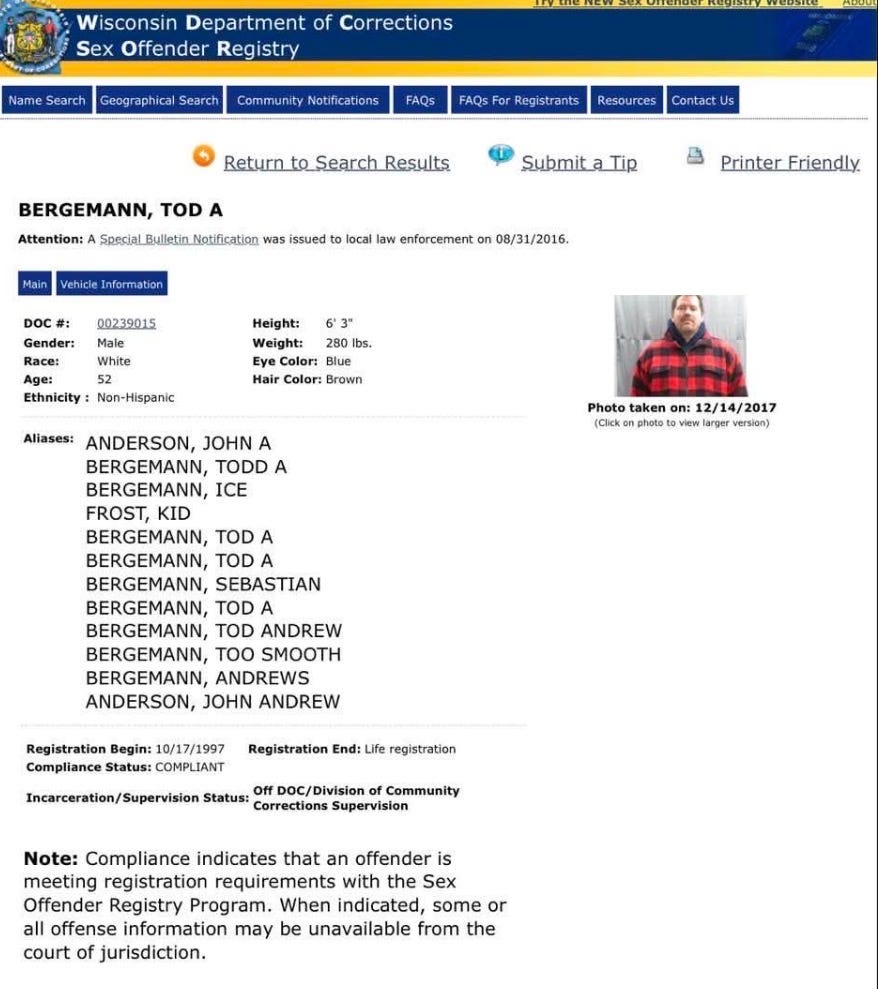
Pull up the Wisconsin Department of Corrections Sex Offender Registry and search the name Tod A. Bergemann. The record that comes back lists a residence in Lander, Wyoming, tagged "OUT OF STATE COUNTY." Report date: September 1, 2025. Verified date: June 10, 2026. The registrant responded to the state's most recent mailing.
Registration End: Life registration.
Compliance Status: COMPLIANT.
Now search Wyoming's registry for the same man. He isn't there.
Neither of those facts is a scandal by itself. Together they describe something people in this state should understand about a system most of us assume is doing more work than it is.
The registry entry, DOC #00239015, lists three qualifying entries out of Brown County:
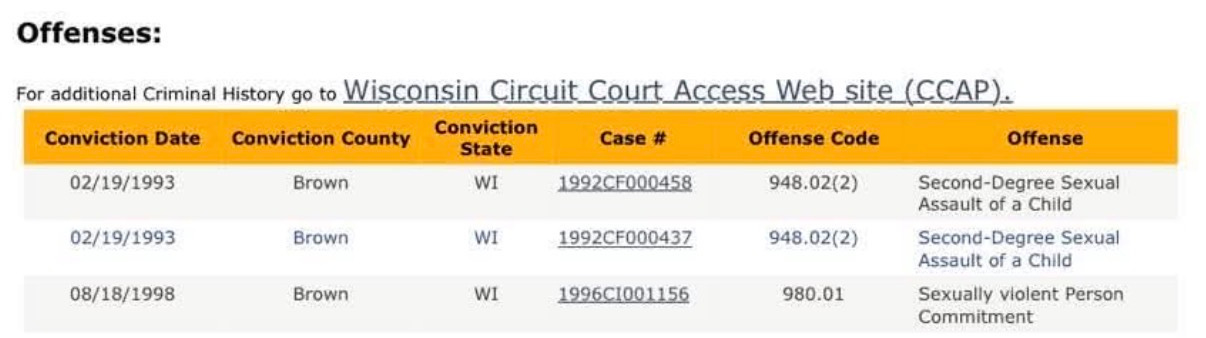
- February 19, 1993 — case no. 1992CF000437, Wis. Stat. § 948.02(2), second-degree sexual assault of a child
- February 19, 1993 — case no. 1992CF000458, § 948.02(2), second-degree sexual assault of a child
- August 18, 1998 — case no. 1996CI001156, § 980.01, sexually violent person commitment
Registration began October 17, 1997. It does not end.
The commitment case is the one with a paper trail worth reading. Two unpublished decisions from District III of the Wisconsin Court of Appeals lay out what the trial court heard.
The first, No. 97-3789, filed October 6, 1998, recites the testimony of Dr. Raymond Wood: sexual relations with both of Bergemann's parents and his sister; sexually aggressive behavior toward girls beginning at age ten; charges beginning at fourteen, including sexual contact with two foster brothers; two incidents of intercourse with the family dog; and an incident in which he forced a woman to have sex with a dog, photographed it, and publicly displayed the photographs to humiliate her.
He was charged with four counts of assaulting fifteen- and sixteen-year-old girls and pleaded guilty to one count of sexual assault and one count of attempted sexual assault. Three of the victims testified that he had threatened them. He dropped out of treatment twice — once after being confronted with a report that he had sexually assaulted a twenty-two-month-old child. Wood diagnosed paraphilia not otherwise specified and antisocial personality disorder. Bergemann's own expert, Dr. James Armentrout, agreed with the second diagnosis.
The second decision, No. 98-3179, filed November 30, 1999, is shorter. Bergemann conceded he was still a sexually violent person and argued only that the State hadn't proven he would reoffend if released for outpatient treatment. Dr. Travis Hinze's written report, admitted into evidence, said treatment had not substantially reduced his risk of future sexual violence and that effective treatment could only be provided inside a secure mental health facility.
I am not characterizing this man. Courts did, in documents anyone can pull off a state website.
His name also turns up in Wisconsin legislative files. A criminologist named M. Jenny Edwards submitted written testimony supporting Assembly Bill 666 in January 2018 and Senate Bill 139 in September 2019, listing him among Wisconsin cases where animal sexual abuse ran alongside sexual offenses against people. Her 2019 letter describes the dog incident as involving a child and says the images were posted online. The 1998 court opinion says a woman, and says the photographs were publicly displayed. Where an advocacy submission and a judicial opinion conflict, I take the opinion.
He was still committed in 2011, and still fighting it. A third Court of Appeals decision, No. 2012AP2021, decided August 13, 2013, describes what the circuit court heard at that stage.
He was at Sand Ridge Secure Treatment Center, in Phase Two of a four-phase program. Dr. Kopetskie testified that he had not demonstrated an understanding of the thoughts and arousal patterns tied to his offending. Dr. Pierquet scored him at 32.5 out of 40 on a psychopathy measure and testified that the combination of sexual deviancy and psychopathy carries a higher rate of reoffense. The circuit court found he had been untruthful on a polygraph and described the untruthfulness combined with psychopathy as a dangerous combination. It noted a history of what it called sexualized coping, and episodes of self-sabotage. Both parties had signed a stipulation; the court rejected it.
That was 2013. What happened next is why I'm laying this out in order rather than by impact.
The docket in 1996CI001156 shows an order for supervised release on August 30, 2016, with a residence on Highway 57 in De Pere to be established by September 8. The day after that order, Wisconsin issued a Special Bulletin Notification to local law enforcement — the state's highest level of community notification.
On March 17, 2018, Bergemann wrote the court himself asking for discharge. A formal petition followed in May, along with a letter from Sand Ridge Secure Treatment Center. On August 13, 2018, Judge Donald Zuidmulder signed an order of discharge under Chapter 980. Case closed, twenty-two years after it opened.
That discharge means a court applied a legal standard and concluded the State could no longer prove he was substantially likely to commit another act of sexual violence. Five years after a judge called his psychopathy score and his dishonesty a dangerous combination, a different judge looked at the same man and let him go. Both findings are in the same file. The second one is the one that governs.
If we only respect court findings when we like the outcome, we don't respect court findings. So I'll say it plainly: he did what Wisconsin required of him, and a judge released him.
The lifetime registration survived the discharge. That's the design. Commitment ends; registration doesn't.
A man named Tod Bergemann works as a deli chef at Mr. D's Food Center in Lander. His public Facebook profile lists the job as starting September 5, 2025 — four days after the report date on the Wisconsin registry entry. His bio reads: "By the Grace of God and sacrifice of Jesus, I am saved. Advocate of Correctional Re-entry."
On February 15, 2024, he posted publicly: "When I was 15 they said I wouldn't live to see 25. When 25 they said I would spend my whole life in prison. Guess they weren't fortune tellers, as I am 50 today and still alive and out of prison 6 year. God is good."
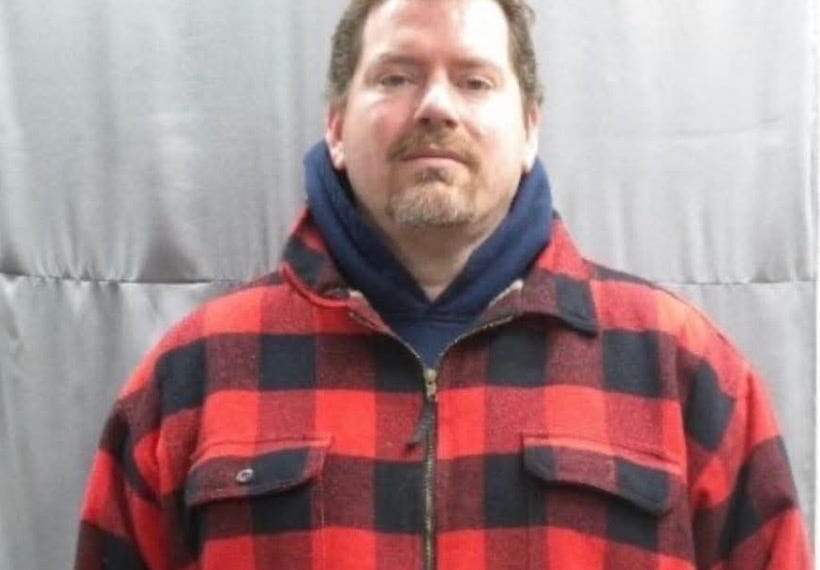
Fifty on February 15, 2024 means born in February 1974, matching the age of 52 on the registry. Out six years points to 2018, the year of the discharge order. The registry photo, taken December 14, 2017, is recognizably the man on the profile. And the registry lists his residence in Lander.
The registry also lists eleven aliases. Two of them are John A. Anderson and John Andrew Anderson.
His Facebook profile is public. Anyone can open it without an account, a friend request, or a login.
Meta's terms of service say a convicted sex offender is not permitted to use the platform at all. That is a company policy, not a law — the Supreme Court struck down state bans on registrants using social media in Packingham v. North Carolina in 2017 — but it is the platform's own stated rule, and it plainly isn't being enforced here. Add it to the list of systems that were supposed to catch something and didn't.
Scroll the profile and you find what you'd find on most people's: community events, holiday gatherings, a Christmas parade in downtown Lander, family photographs, pictures with pets. Ordinary things. Some of the photographs include children. Some include elderly residents from a local facility.
I want to be careful here, because this is where a story like this usually goes wrong.
Being on Wyoming's registry would not have kept this man off a sidewalk during a Christmas parade. It would not have kept him out of a deli, or off Facebook, or away from a family holiday. Wyoming doesn't work that way, and I don't think it should. The restrictions that attach to registration in this state are narrow and specific, and expanding them into a general license to control where a person may stand is exactly the kind of authority I've spent years arguing against.
That is not what a registry is for.
A registry is for information. Its entire function is to put a fact where people can find it, so that an employer, a facility that serves vulnerable adults, a neighbor, or a parent can weigh it and decide for themselves what it means to them. Some will decide it means nothing — a court discharged him, after all, and people are entitled to build a life after that. Others will decide differently. The point of the system is that the choice belongs to them.
In Lander, that choice hasn't been available. Anyone who looked him up in the place Wyoming residents are told to look would have found nothing. Trust and access get extended every day on the assumption that the database is complete. Here it isn't. Wisconsin's is — and Wisconsin is not where these people live.
Wyoming's registration statute, W.S. § 7-19-302, requires registration by people living in Wyoming who have been convicted of qualifying offenses, including out-of-state convictions comparable to Wyoming crimes. Second-degree sexual assault of a child is not a marginal case. It sits close to the center of what any registry exists to capture.
So why isn't he on Wyoming's?
In March 2024, a Wyoming woman who had encountered his name wrote the Attorney General's office and asked exactly that. She sent along a link to the Wisconsin court file. Kellsie J. Singleton, a Senior Assistant Attorney General in the Criminal Division, wrote back the same morning saying she would likely need to contact the court and obtain the actual records, and would follow up.
Two years later, in August 2026, after he surfaced in Lander, the same woman wrote again. Singleton's reply:
"DCI is limited in its ability to register offenders outside of the confines of the statute. The only recommendation I have for you is to contact your Representative or Senator and have he or she look into it. I apologize that there isn't much more than I can do as the attorney for the agency."
Read that carefully. It isn't a brush-off, and it isn't an admission of failure. It is a lawyer for a state agency saying, in writing, that the agency has no authority to do what's being asked, and that the remedy lives in the Legislature.
Which raises questions worth putting to the people who can answer them.
If two felony convictions for second-degree sexual assault of a child don't bring a man inside the confines of the Wyoming statute, what does? Which provision is doing the excluding — the comparability analysis for out-of-state convictions, the age of the convictions, the fact that he arrived here already registered somewhere else?
Does Wyoming have any mechanism for receiving a registration from a state that holds a registrant for life? Wisconsin verified a Lander address in June. Did anything about that verification reach Wyoming, and if it reached anyone, who?
Wisconsin issued a Special Bulletin Notification to local law enforcement in 2016 — the highest level of alert that state has. Did any equivalent notice ever cross the state line?
And the plainest one: how many other people are in this category right now? Not this man. The category. People registered for life somewhere else, living here, invisible to the database Wyoming residents actually check.
I don't know the answer to any of those. I know the state's own lawyer says the fix is legislative, and I know she told a private citizen to take it to her representative. That is a strange thing to have to tell somebody who asked a straightforward question about the criminal history of a man living in her town.
Wyoming residents check the registry and believe an empty result means something. In this case, a state a thousand miles away holds a more current and more complete picture of who lives on a street in Fremont County than Wyoming's own public database does.
I have spent a lot of ink in this state arguing against handing government open-ended authority, and I'm not reversing that here. I don't want DCI empowered to register whoever it finds alarming. Infrastructure built for good reasons gets inherited by people with worse ones, and that argument doesn't stop being true because the subject matter is ugly.
But there is a difference between a limit the Legislature chose and a gap nobody noticed. Wyoming decided that certain histories warrant public notice. It is hard to believe anyone in Cheyenne sat down and decided that two felony child sexual assault convictions plus a sexually violent person commitment shouldn't qualify. That looks like an oversight, and oversights get fixed by the body that wrote the statute.
The Attorney General's office already said where to take it. Your representative. Your senator. That's not a dodge. Given the statute as it stands, it may be the only honest answer available.
I have no evidence that Tod Bergemann has done anything wrong in Wyoming, and I looked.
I am not saying he is violating a registration requirement. Wisconsin lists him as compliant. Wyoming's own lawyer says the state can't reach him. Whatever is broken here is broken in statutes and interstate plumbing, not in one man's paperwork.
I am not saying his 2018 discharge is meaningless. A court made a finding. That finding stands.
What I am saying is that two state governments hold different pictures of the same address, and the one that's wrong is ours.
No posts
Comments
Nothing yet. Say the first thing.
Sign in to join the conversation.