
“[AI] is replacing, in some cases, lower value human capital with the financial capital and the investment capital we’re putting in.” The same thing that happened to farm labor, and the same thing that happened to manufacturing labor, is now coming for knowledge work… the question becomes: if wage labor has been the primary distribution mechanism in a labor-based system, what happens when labor is no longer the main mechanism…
Standard Chartered CEO Bill Winters, 19/5/26
If every household has voting shares and stakes in robotics companies, data centers, the power grid, chip manufacturers, and other core assets, then households benefit from what those companies do. They also have a say in how those companies operate. That expands democracy into the marketplace.
David Shapiro, 14/7/26
When we look back on this time in the decades to come, I think we will realise we were standing in the foothills of the singularity – nothing less than the dawning of a new age for humanity… But to realise its immense promise, we have to navigate this critical period of development thoughtfully and carefully. Urgent action is needed to address risks that might arise as we get closer to AGI.
Demis Hassabis, 14/7/26
For the last 18 months I’ve been banging out Substack posts with monotonous regularity that point out AI is already disturbingly powerful, is rapidly becoming more powerful, and that this is inevitably going to significantly disrupt labour markets thereby profoundly transforming economies and societies.
The problem those of us offering these warnings have faced isn’t so much disbelief as inertia. Plenty of people, not least members of the politically influential professional-managerial class, have been worried about being automated out of a job for some time.
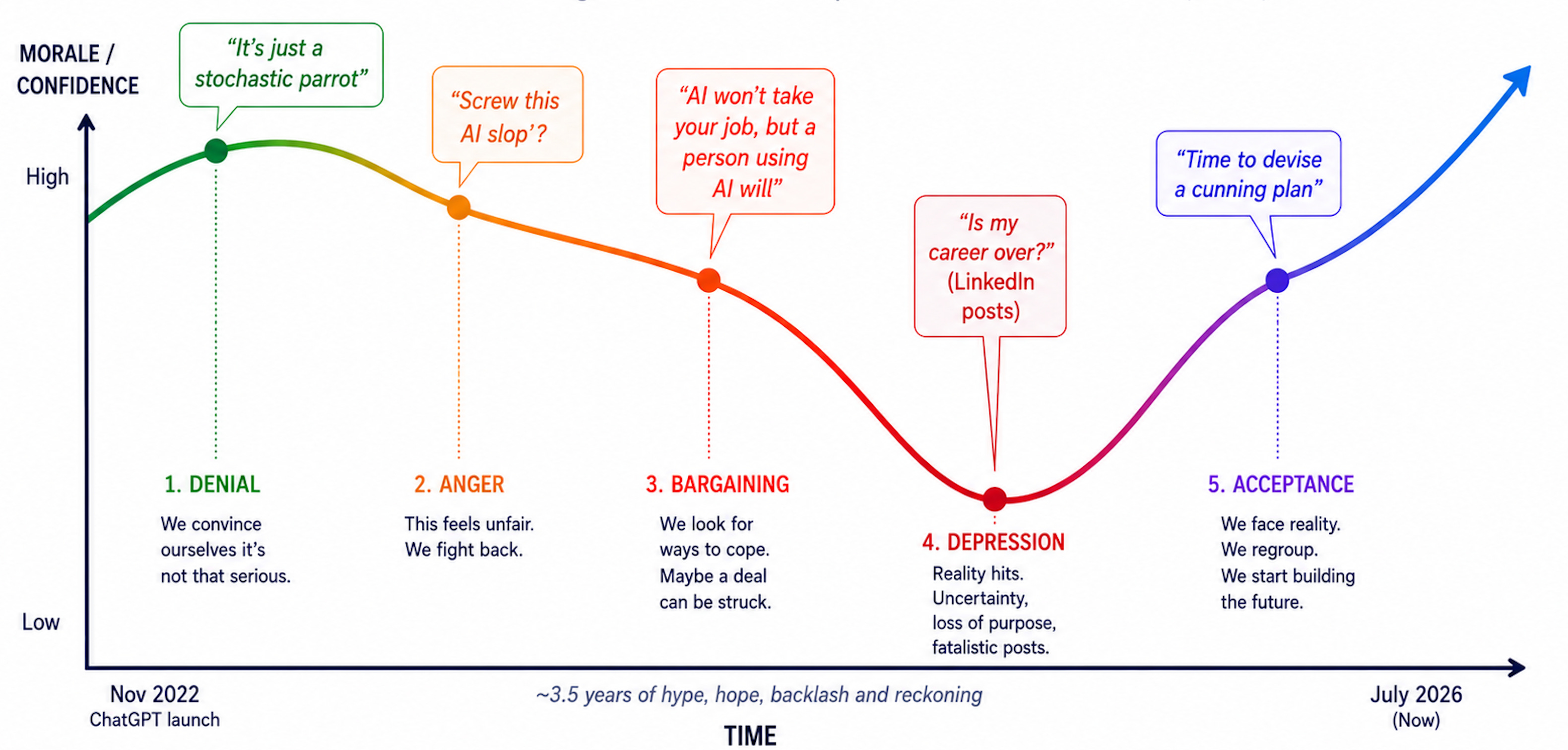
But unlike Large Language Models, human beings are emotional not logical entities. Confronted with a life-changing event, a human’s typical reaction isn’t to immediately devise a cunning plan to navigate the upcoming transformation as best as possible. It’s to embark on a prolonged, five-stages-of-grief journey. Here’s how that has played out over the last four years.
Denial: “AI is just a stochastic parrot”, “AI can’t really write/code/reason”, “AI will only ever be used to augment, not replace, human labour”.
Anger: Lawsuits over training data, artist, actor and author backlash, ‘AI slop’ as a term of abuse, publications banning AI-generated content.
Bargaining: “AI won’t take your job, but a person using AI will”, “AI is fine for first drafts, but humans will always have to do the final edit”.
Depression: See the tsunami of “Is my career over?” LinkedIn posts from struggling copywriters, illustrators, translators, junior developers and graduates. A general sense of fatalistic resignation in many professional forums.
Acceptance: AI is already disturbingly powerful, is rapidly becoming more powerful, and this is inevitably going to significantly disrupt labour markets thereby transforming economies and societies. Maybe it’s time to get serious about devising a cunning plan to navigate the upcoming transformation as best as possible?
We must act now
At the start of this week, an impressive slice of high-value human capital from across the occupational and political spectrum – Daron Acemoglu, Yoshua Bengio, Ben Bernanke, Tyler Cowen, Jeff Dean, Niall Ferguson, Reid Hoffman, Vinod Khosla, Paul Krugman, Yann LeCun, Alvin Roth, Eric Schmidt, Michael Spence, Joseph Stiglitz, Max Tegmark and Jerry Yang – conceded the warnings long issued by a smaller, more prescient slice of elite human capital – Sam Altman, Dario Amodei, Nick Bostrom, Mo Gawdat, Tristan Harris, Stephen Hawking, Geoffrey Hinton, Elon Musk, Stuart Russell, Ilya Sutskever, Jaan Tallinn and Eliezer Yudkowsky – were directionally correct.
Those on the first list of names added their imprimatur to We Must Act Now: A Statement on AI’s Transformation of the Economy. Here’s what the statement, um, states:
1. AI may become radically more powerful over the next 10 years.
2. This could drive an unprecedented transformation of our economy, larger than the Industrial Revolution, but unfolding over a vastly shorter time frame. It could bring risks, including large-scale job displacement, as well as opportunities such as major gains in living standards.
3. Economists, policymakers and technology leaders must act now to understand the economics of transformative AI and to build the incentives, guardrails, and institutions needed to steer AI in a direction that complements humans and benefits society.
The only quibble I have with those 88 words is the following – “over the next 10 years”. Barring an apocalypse, AI will be unimaginably more powerful in 2036 than it is now, but this isn’t an issue we’ve got a decade to address. Even the (in comparison to what’s coming) unspectacular AI currently available is powerful enough to automate vast swathes of white-collar work.
Those at the coalface expect vastly more powerful AI – call it what you will: transformative AI, Artificial General Intelligence (AGI), Artificial Superintelligence (ASI), recursively self-improving AI, an intelligence explosion, rapid take-off, the Singularity – to arrive by 2030 and, potentially, as early as 2027.
To coin a phrase, humanity has continued to enthusiastically summon the AI demon without engaging in much due diligence around (a) who will (initially) control the demon and, rather more importantly, (b) whether the demon can long remain under human control.
What benefits society?
It’s become a motherhood statement to aver the benefits of AI should be spread around rather than captured by elites. That, as the cream of the human capital crop asserted earlier this week, policymakers should “steer AI in a direction that complements humans and benefits society”.
As ever, the challenge lies in determining what “complements humans” and “benefits society”. I suspect, say, Jeff Bezos or Xi Jinping would have a rather different conception of the good society than the median citizen of a first-world nation.
AI in the hands of the politicians
Given I’ve brought up Xi, let’s start with the tech totalitarianism AI could facilitate if the political class seizes control of it.
Especially since 1989, the CCP’s collective mind has been focused on maintaining the CCP’s stranglehold on Chinese society. Even before AI came along, the Chinese government invested in hundreds of millions of facial-recognition cameras, built the Great Firewall to block foreign platforms, and insisted on mandatory real-name registration and state access to all-in-one apps like WeChat, which merge messaging, payments, and identity into a single surveillance-rich stream.
China’s social credit scheme was introduced in 2014 to ensure “the trustworthy roam everywhere under heaven while making it hard for the discredited to take a single step.”
In the service of ensuring it’s hard for the discredited to take a single step, those who step out of line face bans on flights and high-speed rail, restrictions on luxury spending, exclusion of their children from private schools, limits on loans and property purchases, and disqualification from civil service jobs. There’s also deliberate public shaming, including names published online, faces on billboards, and in some localities a special ringtone warning callers they’re dealing with a deadbeat. (There are far fewer carrots – fast-tracked services and easier credit – than there are sticks.)
It could be argued the Chinese have long organised their society around the ‘strict father’ model and that kind of heavy-handed authoritarianism would never fly in liberal democracies.
Colour me unconvinced. The Anglosphere recently endured a decade of illiberal, left-wing authoritarianism at the hands of those on the right side of history, and it’s not hard to find examples of illiberal right-wing authoritarianism either, past or present.
Would the handful of brave souls who dared to question the, ahem, “progressive overreach” back in 2020 have done so if it meant risking significantly more than a social media pile-on and exile from polite society?
AI in the hands of the plutocrats As Palantir CEO Alex Karp
Let’s move on to what happens if the ‘business-friendly’ policy settings that have been in place since circa 1980 are maintained. The risk here isn’t that the plutocratic class will attempt to capture all the upsides of AI while shifting all the costs onto the lower orders. Doing that would almost certainly set in train events that would not end happily for the people who found and/or invest heavily in tech companies.
“The biggest challenge to A.I. in this country is political unrest. If I were sitting here in private with my peers, I’d be telling them the country could blow up politically and none of us are going to make any money when the country blows up.”
The obvious solution to this problem, if you’re a member of Karp’s class, is to work out a way to capture most of the benefits of AI but spread around enough crumbs from your table to stop the lower-value human capital from erecting guillotines. The contemporary equivalent of the Roman ruling class providing a grain dole or Bismarck introducing the world’s first welfare state to inoculate Germany against socialism.
So, if you were a plutocrat who recognised the need to redistribute a little bit of AI-generated wealth to maintain social stability while still wanting to ensure you (and your descendants) remained unimaginably wealthy and powerful, how would you go about things? First off, you’d fight like hell to maintain ownership of the capital stack – the chips, the data centres, the models, and the intellectual property those models generate. After all, this is where the value of an automated economy pools.
What would then trickle down to the common folk is a stipend. Some form of universal basic income, pitched not as a share of ownership but as a benefit, revocable and means-tested. Generous enough to cover the basics and even an occasional treat. But never enough to accumulate capital. The stipend-receiving citizen of the future will find themselves in much the same position as welfare recipients are today, and dependents don’t get to dictate terms.
Having taken care of the bread part of the equation, plutocrats will probably be smart enough to also throw a few bucks at the circuses. In the highly automated near future, engrossing distractions – endlessly agreeable AI companions, sex robots, synthetic media tailored to each user’s dopamine profile, an ever-expanding pharmacopoeia of mood-altering drugs – could be manufactured at scale at relatively little cost.
It’s also worth remembering that he who controls the technology also (largely) controls the narrative. Those in control of popular AI models will have the kind of agenda-setting clout that my compatriot Rupert Murdoch couldn’t imagine in his wildest dreams.
We got a taste of what this might look like a couple of years ago, when Google Gemini was generating images of ethnically diverse Nazis, and sometimes refusing to generate images of Caucasians, in line with the political exigencies of the era.
AI in the hands of the people
This is the happy ending to the AI transformation story. The one the afore-quoted Shapiro and his fellow travellers in the ‘post-labour economics’ movement are sketching out.
Rather than settling for a lifetime of heavily surveilled UBI dependency, the Shapiros of the world argue the (now unemployed) workers should receive an ownership stake in AI. As Shapiro flags, this is likely to involve a portfolio of ownership mechanisms, including some or all of the following. Sovereign wealth funds holding stakes in the data centres, chip fabs and robotics companies and paying every citizen a dividend.
Baby bonds so 18-year-olds start adulthood with capital.
Employee ownership schemes.
And, the really radical bit, ordinary citizens holding voting shares in core AI assets.
As fantastical as those proposals may seem, they are by no means unfeasible or even unprecedented. Norway taxed its oil boom into a US$2 trillion fund that owns 1.5 per cent of every listed company on earth. Likewise, Alaska has paid every resident an annual dividend (funded by state oil royalties) since 1982. And Australia built one of the world’s great distributed-ownership machines – US$3 trillion in superannuation – long before anybody began seriously contemplating post-labour economics.
Ultimately, the mechanisms aren’t as important as the ownership. In the same way you don’t get rich working for someone else, the bottom 90-95 per cent of the income distribution aren’t going to benefit greatly from the great AI transformation unless they secure an equity stake in it.
Don’t mourn, organise
One of the iron laws of politics is that a well-organised minority almost always trumps a disorganised majority. The Silicon Valley power players have long been extremely well-organised. The political class is, as ever, well-organised enough to ensure its interests are taken care of come what may.
Up until recently, the rest of the population was disorganised.
But the first real stirrings of organisation – what’s left of the union movement mobilising, the data centre revolt, the growth of the post-labour movement, content creators demanding copyright protection, the rise of ‘AI populist’ politicians – are now emerging.
Contrary to what I’ve thus far assumed, all may not be lost.
To quote a rather more successful Substacker, know hope.
No posts
Comments
Nothing yet. Say the first thing.
Sign in to join the conversation.