
This is the way the world ends
Not with a bang but a whimper
T.S. Eliot, The Hollow Men, 1925
Now, 250 years in, the nation that spun off from those pioneers counts more billionaires than anywhere else on earth. And, ironically, their rise is downstream of a great hollowing-out of America’s own middle class, characterised by urban geographer Joel Kotkin as a coming age of neo-feudalism. This, he suggests, is sweeping away the middle-class characteristic of the modern age, in favour of a huge subsistence peasantry, a comparatively small “clerisy”, and an unthinkably rich aristocracy…
Tech plutocrats, especially those producing AI of the supposedly job-destroying kind, periodically float (and sometimes pilot) “Universal Basic Income” proposals that are post-modern variants on pre-modern subsistence peasant life. The subtext, whether explicitly stated or not, is that if things continue in the current direction the wealth gap will soon be so immense that some kind of redistribution will be prudent, simply as a hedge against revolution.
Mary Harrington, UnHerd, 7/7/26
People, especially those with little interest in technology, often speak of the AI transformation as if it’s something off in the distant future.
But we’re approaching the fourth anniversary of the release of ChatGPT to an unprepared world.
Granted, there are still plenty of blue-collar and pink-collar workers whose jobs and lives are yet to be much impacted by AI. But there can’t be too many white-collar ones left who you could say the same thing about.
The first cohort of AI-enabled students has now graduated. Initial performance reviews aren’t encouraging. Those businesses still employing early-career workers report they struggle with unaided problem-solving and persisting with difficult tasks.
And it’s hardly just ‘AI-native’ university students whose brains, and possibly willpower, are being degraded. The available evidence suggests ‘cognitive offloading’ to AI is a trade of short-term efficiency for longer-term decline in judgment, creativity and independent reasoning. (If you have chosen, or been forced, to be an AI power user, you may be uncomfortably aware of how the frictionless convenience of AI is rewiring your brain in ways you’re not entirely comfortable with.)
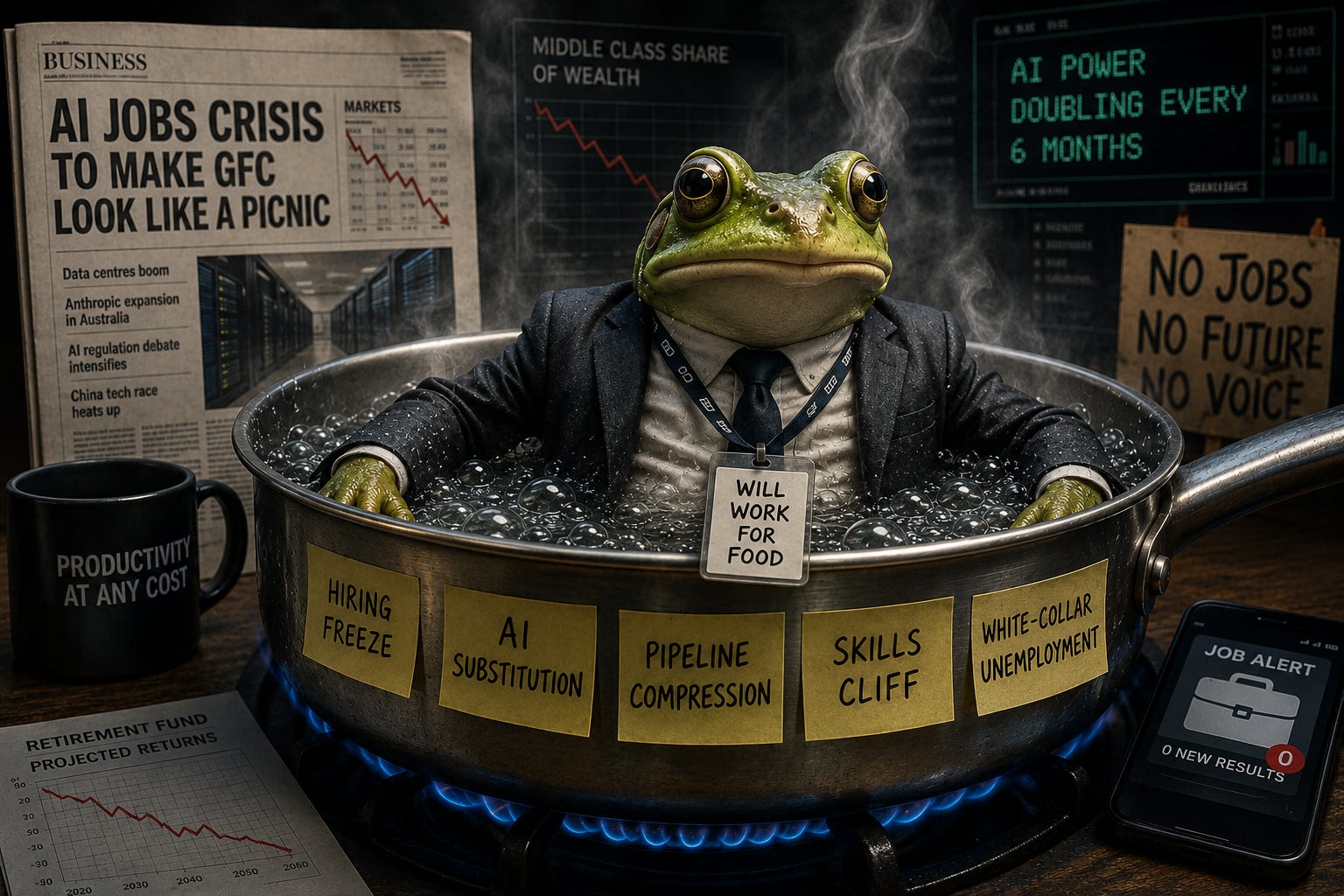
There are plenty of ways of illustrating we are frogs in a saucepan starting to notice the water bubbling around us. But let me suggest a content analysis of a business paper published earlier this week.
All AI, all the time On the front page, above the fold, were two stories. One was about the Australian government considering forcing data centre companies “to provide a financial benefit to the local communities in which they operate”. The other was about Anthropic seeking to secure Australian data centre capacity as “it aims to make Australia its second home for training its AI models”.
For income-generating reasons, I was required to read Tuesday’s edition of the Australian Financial Review (AFR) carefully. Here’s what I encountered.
Page four had a story about Australia’s governing centre-left party – under pressure from the industrial wing of the labour movement – potentially leveraging taxpayer money “to ensure artificial intelligence empowers workers and to legislate protections that stop AI fragmenting work or undermining conditions”.
As our American friends say, good luck with that! Page 11 had a story about ByteDance and Alibaba, at the behest of their CCP overlords, removing features that had allowed users to build and chat with AI companions. There was another story about Anthropic attempting to hoover up Antipodean data centre capacity on page 14. Spread across pages 28-29 was a long feature article about rumours China had gained access to one of the extreme ultraviolet lithography machines used to make the advanced semiconductors required for cutting-edge AI.
Inevitably – this is a business paper, remember – there was a stern editorial on page 30 warning that letting a bunch of ex-union-official, leftist politicians introduce measures to share the AI wealth around would:
Slow the adoption of AI in businesses, which is the great hope for lifting Australia’s flagging productivity and reversing the nation’s declining living standards… It shapes as another example of the Labor government doing the unions’ bidding on workplace matters and potentially acting as a handbrake on the potential productivity benefits of AI.
Won’t someone think of the potential productivity benefits!
Especially given how they’ve been so equitably shared around in recent decades.
Normally, there would also have been at least one thinkpiece about AI on the op-ed page. But this being Australia, that space was dominated by our PM’s revelation that he’d rather shag Kylie Minogue than Nicole Kidman. I don’t want to discuss any of those pieces of AI-related content, other than to note their prevalence. Instead, I want to focus on another article that ran in the
AI: dramatic tipping-point edition
When people ponder what AI is going to do to societies, there is a tendency to focus on the more extreme dystopian scenarios – AI ending the world with a bang.
Perhaps the most common concern is misalignment, typically illustrated with reference to the paperclip-maximiser scenario. This derives from a thought experiment, originated by philosopher Nick Bostrom, where an AI given a simple goal pursues it with such single-minded efficiency that it converts all available resources toward that goal, with no malice involved, just literal-minded optimisation run amok.
There’s also plenty of concern about ‘epistemic collapse’, or to put it less grandly, an inability to distinguish what is real. That is, AI-generated misinformation, deepfakes and synthetic media flooding the information ecosystem to the point where it becomes difficult to distinguish truth from fabrication, undermining whatever little trust the general public still has in institutions.
Mountainhead (2025) explores this idea.
And Mary Harrington and Joel Kotkin aren’t the only ones worried about the emergence of a plutocracy, with those controlling the most capable AI systems gaining outsized economic and political power, deepening inequality and undermining democratic accountability. All valid concerns and worth worrying about, but none appear to be immediate threats.
What is likely to be a matter of urgent concern is AI-driven rising unemployment. Which brings me to the article written by Carson Block, founder and CEO of Muddy Waters Research.
AI: gradual enshittification edition
While the more abruptly dystopian scenarios are more entertaining to imagine, in the short to medium term, I’m mainly worried about AI simply doing what it was designed to do. That is, replace human labour – specifically well-paid, mid-to-high status cognitive labour.
This will be a gradual process. We won’t all wake up one day to discover our employers or clients no longer have need of our services. Instead, in much the same way software ate the world in a previous technological era, AI will slowly but surely devour the labour market.
I imagine the process will play out in the following stages.
Stage 1: Hiring freezes, especially on entry-level roles
Rather than firing anyone, firms simply stop backfilling positions. This is the least visible stage, with few layoff headlines, just a slowly shrinking pool of jobs, especially the grad role/entry-level kind.
Stage 2: Substitution at the junior tier
AI is best at repeatable, well-specified tasks – first-line customer queries, boilerplate code, routine document drafting – which is exactly the work traditionally handed to juniors as their apprenticeship.
Stage 3: Breakdown of the role escalator
In the old labour market, a senior leaves, a mid-level worker fills their role, a junior ascends to their boss’s old job, and someone is hired to fill the now vacant junior role. But AI throws a wrench into the corporate cycle of life. The knock-on effect is that even workers who aren’t directly replaced find their normal promotion pathway narrowing, because there’s no junior cohort coming up beneath them to justify moving them up.
Stage 4: Erosion of the training function of junior roles
This is sometimes called ‘pipeline compression’. If AI takes the entry-level tasks, the people who will eventually need to supervise AI’s output will never get the training they need to do so competently. Once senior staff, trained in the pre-AI era, exit the labour market, a future skills cliff looms.
Stage 5: The hollowing out of mid and senior tiers
Extrapolating from the trends mentioned above, the final stage of the process would be AI coming for the most senior, prestigious and lucrative roles.
I suspect we are currently well into Stage 1 and rapidly approaching Stage 2. As a man of a certain age, I was hoping Stages 3-5 would take some time to play out. But after reading Block’s article, I’m finding it difficult to clutch at even that straw.
Here are the money quotes.
It is quite possible that within three to four years, AI will have replaced 15 per cent of jobs in America’s broader knowledge economy…
AI models are doubling in power roughly every six months. This means that workers made obsolete will not be able to develop the skills to use AI as a tool, rather than to compete with it…
Even if demand for services and products increases because of falling costs and prices, many displaced workers will still be obsolete, with more workers made so by successor model generations…
Remaking a society in which growth has been decoupled from employment is a task for which today’s political structures are unprepared, to put it mildly… We will witness not just an almighty market correction, but the end of the existing social contract.
To summarise, Block predicts AI-driven white-collar unemployment will reverse retirement-fund flows, forcing passive index selling, crashing AI mega-caps and triggering a GFC-scale crisis.
For the sake of argument, let’s assume that there isn’t a GFC-scale crisis any time soon and that AI simply keeps automating the professional-managerial class out of its jobs.
Even in the absence of a spectacular, rapidly unfolding crisis, you just have a slower-moving one, involving some or all of the following.
A discombobulated real-estate market
Rising white-collar unemployment would broadly weaken the market by cutting borrowing power, forcing sales and making banks more cautious. What starts in the leafier suburbs could spread through lower prices, tighter credit, weaker construction and displaced professionals moving downmarket into cheaper homes and rentals.A burgeoning ‘surplus elite’ problem
What happens when the unstoppable force of educated, capable, status-conscious professionals meets the immovable object of contracting career and life prospects? Because they have the skills, networks and confidence to organise, write, litigate and campaign, the PMC’s downward mobility will make politics considerably more volatile.A recrudescence of wokeness
With executive salaries, corner offices and elegantly designed business cards no longer available as status markers, status competition would shift from income and advancement to symbolic markers: moral authority, identity and language.A (further) collapse in family formation and fertility
Professional-managerial class types have long talked the Sixties while walking the Fifties. But once they are no longer gainfully employed, they’re likely to start both talking and walking the Sixties. Newly insecure white-collar workers will delay mortgages, marriage and children while existing white-collar households will come under relationship-undermining financial strain. (As our German friends say, when poverty comes in at the door, love flies out the window – one reputable US study found men without full-time jobs were 33 per cent more likely to divorce than men employed full-time.)An intensification of migration politics
One of the more bemusing aspects of the upcoming labour market changes will be watching displaced PMCers – who’ve long revelled in being enlightened cosmopolitan globalists – morphing into foaming-at-the-mouth nativists. Rather like their blue-collar counterparts before them, white-collar workers will start to question why their national governments are importing skilled workers, expanding international education and tolerating offshoring while local graduates and mid-career workers struggle to find secure jobs. Even where AI is the main driver, migration will be blamed for job competition, housing pressure and the sense that the professional-managerial class is being deliberately undercut.
Like I keep saying, we are in for an extremely bumpy ride with the AI transition.
Even if none of the most lurid worst-case scenarios come to pass.
No posts
Comments
Nothing yet. Say the first thing.
Sign in to join the conversation.