
The Wedding-Guest sat on a stone:
He cannot choose but hear;
And thus spake on that ancient man,
The bright-eyed Mariner…
He went like one that hath been stunned,
And is of sense forlorn:
A sadder and a wiser man,
He rose the morrow morn.
Samuel Taylor Coleridge, The Rime of the Ancient Mariner, 1798
It is quite true what philosophy says: that life must be understood backwards. But then one forgets the other principle: that it must be lived forwards.
Søren Kierkegaard, 1843
“If you can’t be a good example, then you’ll just have to be a horrible warning.”
Often attributed to Keith Richards, but apparently coined by British novelist Catherine Aird, circa the late 1980s
As a special birthday treat – for me, see more below – I’m giving the AI doomerism a rest this week. Instead, I’m doing something no other Substacker or journalist has yet thought to do – give Christopher Nolan notes on The Odyssey.
Before, like the ancient man I now am, turning that film review into a launching pad for a long-winded diatribe where I futilely attempt to force some of my hard-earned wisdom on the utterly uninterested younger generation.
1971 – the year everything started to go wrong
If you go to a website called wtfhappenedin1971.com, you’ll find a collection of over 75 charts all showing some economic or social trend that appears to bend sharply around 1971.
This is when:
Nixon took the US dollar off the gold standard. Covering the impacts of this is a whole other post. But to summarise, it contributed to stagflation which, in turn, set the stage for the Thatcher-Reagan neoliberal revolution. More lastingly, it facilitated inflation, ballooning debt and asset bubbles. Some also argue it contributed significantly to the wage stagnation and rising inequality of the following five and a half decades.
Pay started decoupling from productivity (i.e. wages began flatlining while productivity kept rising).
The house-price-to-income ratio started getting out of whack. House prices have risen and fallen over the last half century, but the general trend has been unrelentingly upwards. In functional real estate markets, people can purchase a home for 3-4X their household income. That figure is now 10X-plus in many of the Anglosphere’s metropolises.
While you can’t blame 1971 for the West’s collapsing fertility – that trend started in the late 1960s, as the post-war baby boom ended – it was around this time that people started having fewer children.
Likewise, while you can’t neatly trace the rise in political polarisation to 1971, it was also around this time that those on the Left and Right stopped seeing those on the other side of the chamber as the loyal opposition and started seeing them as enemies determined to extinguish everything they hold dear.
Once again, the start of the feminisation of society can’t be portrayed as starting in 1971. But in the post-WWII era, middle-class families began sending their daughters as well as sons to university. By the late 1960s/early 1970s, the first generation of PMC women were starting to take up roles other than nursing and teaching.
Of course, female participation in the workforce had upsides – not least for university-qualified professional women – but as writers such as Helen Andrews have been noting of late, it also had downsides. (Amazingly, it turned out femininity also has a shadow side and not all the ills of the world are attributable to toxic masculinity.)
Inevitably, 1971 was the year I was born. Along with the likes of Marc Andreessen, Julian Assange, Sacha Baron Cohen, Elon Musk, Marco Rubio, Winona Ryder, Snoop Dogg, Justin Trudeau, Tupac and Mark Wahlberg.
If you widen the net to people born around 1971 (i.e. 1970-1972), you can add the following names to the list: Ben Affleck, Andre Agassi, Matt Damon, Cameron Diaz, Idris Elba, Eminem, Liam Gallagher, Geri Halliwell, Dwayne ‘The Rock’ Johnson, Sadiq Khan, Christopher Nolan, Gwyneth Paltrow, Priti Patel, River Phoenix, M. Night Shyamalan, Louis Theroux, Uma Thurman and Melania Trump. (Inconveniently, the Google founders, Sergey Brin and Larry Page, weren’t born until 1973.)
Nolan, Damon and I are all currently 55. While Odysseus’s age is never made clear, he’s somewhere in the 45-55 age range when he returns home.
Let me provide a 55-year-old’s perspective on The Odyssey.
The Odyssey – a middle-aged man’s perspective
Like many men of a certain age, I find race-neutral casting irritating, particularly when it’s self-evidently historically inaccurate. That noted, I didn’t find Nolan’s casting choices, with one exception, objectionable. After all, it is a fantastical yarn and, unless Nolan was going to confine himself to actors of Hellenic heritage, there was no getting around race-blind casting. Yes, Helen wasn’t Kenyan-Mexican, but neither was Odysseus of English, Finnish, Scottish and Swedish descent (as Damon is).
The one bum note in what is otherwise a magnificent symphony is the gimmicky casting of Elliot Page. Not so much because of the trans thing, but because it’s difficult for somebody who looks like a 14-year-old lesbian to pass as a battle-hardened soldier.
I’m also not concerned by Nolan overlaying Christian morality onto a pagan world. Isn’t the mark of a great work of art that it can be interpreted in a multitude of ways? Few of the musicians who’ve covered Leonard Cohen’s Hallelujah are Jewish Zen Buddhists. I doubt anyone not immersed in Judaism and profoundly influenced by Zen could have written that song. But that hasn’t stopped singers of all faiths and none delivering exquisite covers.
So, forget about what our American friends call Monday morning quarterbacking and watch the film at the earliest opportunity.
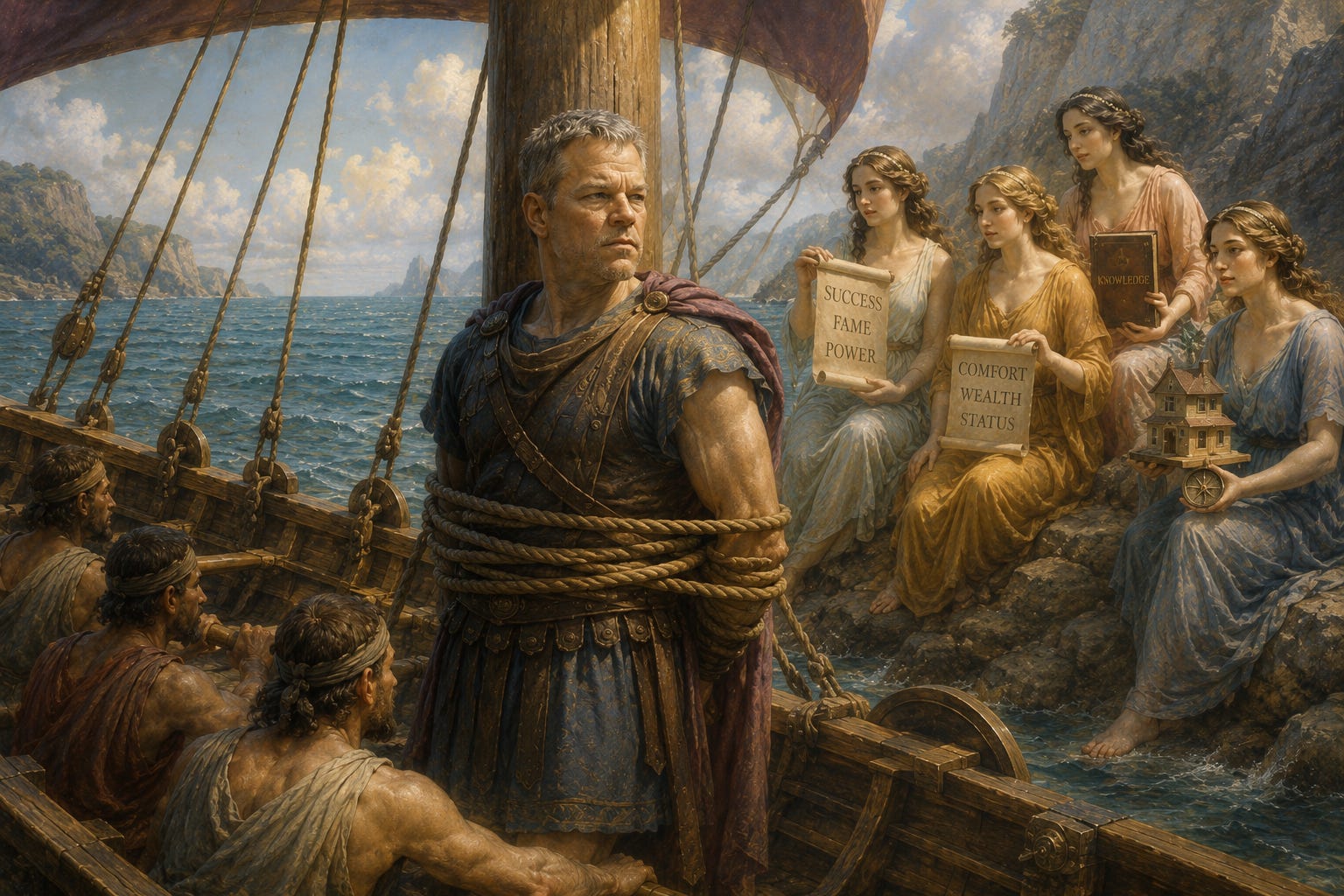
As is the case with many enduring narratives, The Odyssey isn’t really about military battles and monsters. Well, it is, but at a metaphorical level it’s about the journey through life with all the usual waystations on the hero’s journey. A journey even the least heroic are forced to embark on once they reach adulthood – departure, trial, temptation, loss, endurance, and the longing to reach somewhere that feels like home.
Sooner or later, we all have to navigate our own Scylla and Charybdis. Sooner or later, our hubris trips us up. Sooner or later, many of us realise we’ve been hitting the lotus flower (booze, consumerism, drugs, food, gambling, porn, sex, social media, workaholism) a little too hard for a little too long. And sooner or later, we all come to understand in our bones that everything will die – our loved ones, the world we once knew, and, most concerningly of all, us too.
The wisdom of the elders
I flirted with the idea of providing 55 pieces of life advice, but quickly realised that in today’s attention economy, ain’t nobody got time for that. So I cut it down to five.
Having now fully matured into a grey-beard loon, here are my tips for younger players.
There’s no such thing as a free lunch
There are endless variations of this life lesson. Some common ones are: “You don’t get something for nothing”; “There’s always a catch”; “You have to pay the piper”; “You can’t have your cake and eat it too”; “Everybody wants to go to heaven, nobody wants to die”; “There are no solutions only trade-offs” or – my favourite and Edith Piaf’s last words – “Every damn thing you do in this life, you have to pay for”.
The point is everything comes at a cost. The bill may not fall due immediately. But the longer you put off settling the tab, the more likely it is you’ll have to pay it back with interest.
You can easily judge the character of a man by how he treats those who can do nothing for him
The temptation to kiss up and kick down in whatever status hierarchies you’re enmeshed in is ever present. Your life – and the lives of those around you – will be happier if you resist it. (If you’re going on a first date, observe how your potential paramour treats the waiter. If they’re obnoxious, understand they’ll be treating you in a similar fashion down the track.)
Be nice to people on your way up, because you’ll meet them on your way down
Further to the above point, individuals, organisations, classes, ethnic groups, generations, nations and civilisations that are currently at the top of a status hierarchy often assume that their fortunate circumstances will endure indefinitely. This typically results in the belief they can endlessly kick down on individuals, organisations, classes, ethnic groups, generations, nations and civilisations less fortunately located.
I’ve failed to convince my fellow members of the professional-managerial class to take this approach, but it’s always worthwhile considering how you treat those who currently have less clout than you. And how they might treat you, should the tables be turned someday.
If you don’t run your own life, somebody else will
Unless you’re independently wealthy – and, often, even then – you’ll have limited control over your own destiny. But you do have some control and should guard it jealously. I can’t guarantee pursuing the life you want will end in happiness. But leading the life someone else has chosen for you often leads to unhappiness. As we Australians often observe, you ‘don’t want to die wondering’ about what could have been had you’d been a little bolder.
Advice is largely useless
One of the highlights of my magazine journalism days, back in the Beforetimes, was getting to spend a few hours chatting with Christopher Hitchens. For some reason, we got on to the subject of what advice he’d pass on to his three children.
Here’s what Hitch told me:
The one thing that does not transmit across the generations is advice about love and marriage. Everyone has to find out by making their own ridiculous blunders. No, if that sort of advice could be transmitted generationally, we would have evolved incredibly fast. It can’t be, and advice of that sort isn’t taken anyway, even if it’s good.
And therein lies the tragedy. The curse of the grey-beard loon is the same as that of Cassandra – you may be telling the truth, but nobody is interested in hearing it. Especially those who would most benefit from it.
As Hitchens observed, it is near impossible to transmit any wisdom you’ve accrued to others. Like Odysseus, every man and woman must set out on their own voyage, fight their own battles, betray others and be betrayed in turn, then learn from their own costly mistakes.
That is how Zeus has willed it.
No posts
Comments
Nothing yet. Say the first thing.
Sign in to join the conversation.