
My 14-year-old went back to school last week after five years of homeschooling. He’s returning to the same school he was at before, the one we’d pulled him out of during COVID as an experiment. The experiment quietly worked, so we kept going. Now, with high school ahead, it was time to bring him back to a classroom.
The tricky question was: which grade?
By age, he should join grade 9. But he’d been placed a grade ahead the last time he was there, so his old classmates were all a year older than him and now in grade 10. The school was open to putting him in either. My husband and I quietly wanted grade 9. We also knew, as parents of a teenager, that pressing that opinion would be the surest way to push him toward grade 10 instead. 😅
So we didn’t press. He turned the decision over for weeks.
One evening, he asked Pinwheel.
What came back wasn’t pressure. It was a clear read of what he was actually deciding, and a specific answer: grade 9.
The best part was addressing his concern about “being a grade behind.”
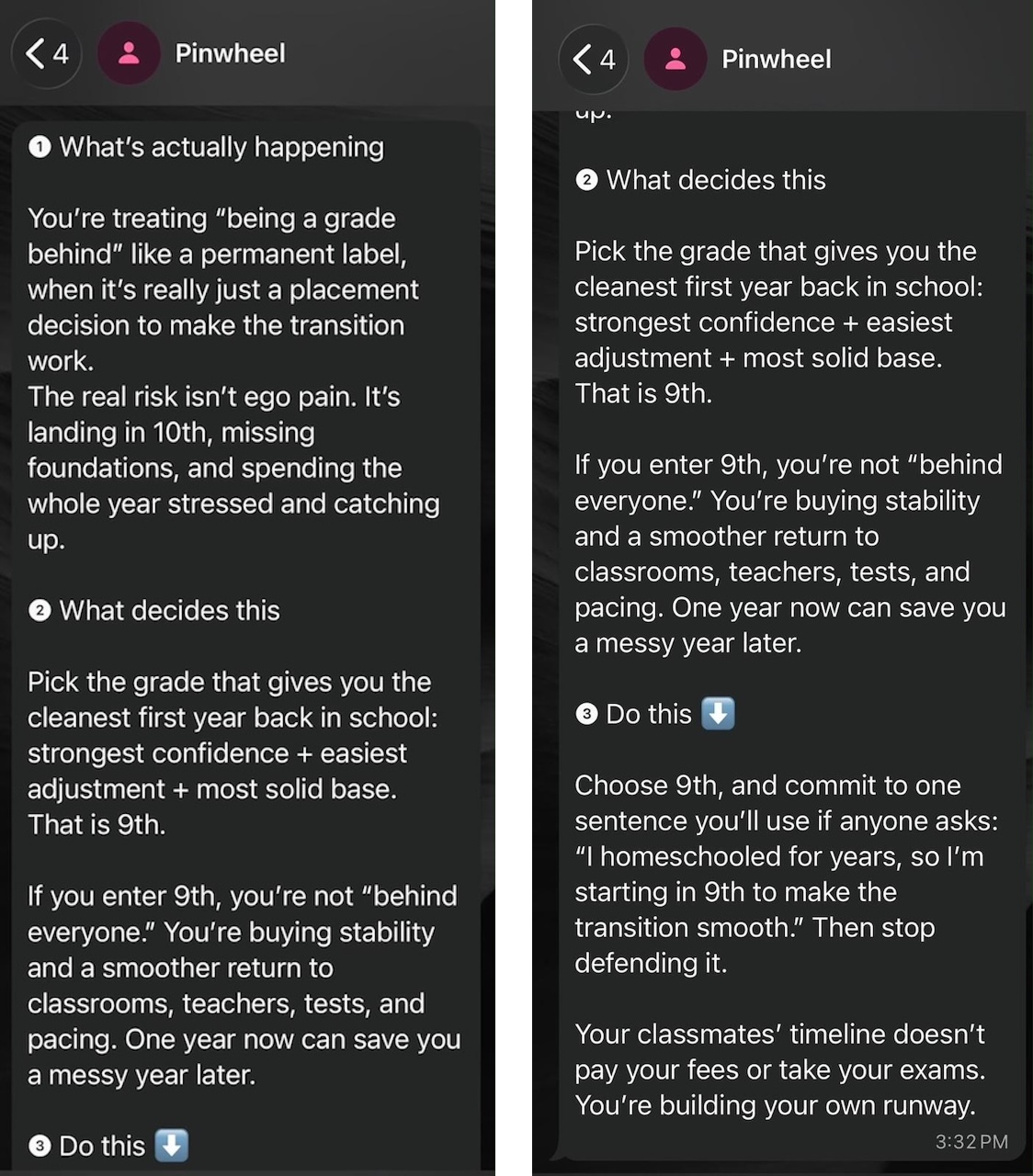
He chose grade 9 and started this week. Too early to say for sure, but he came home yesterday and mentioned that all the kids look a bit older. I’m quietly relieved we didn’t push him the other way.
Two things struck me about that whole story.
The first was obvious: he made a hard decision cleanly, without either parent muddying it.
The second one took me longer to notice. He remembered to ask.
He’d used Pinwheel a handful of times before this. It wasn’t a habit for him. And still, at the exact moment he was stuck, he thought of it.
Most of us, at his age or well past it, don’t.
Think about the last time you were in the middle of something hard. A decision. A conflict. A spiral. The moment you actually needed a tool.
Now think about all the tools you already know. The ones you’ve read about, tried, learned, benefited from. Journaling. Ten-ten-ten. Talking it out with a specific friend. Pre-mortem. 5 Whys. A walk before you decide. The if-then rule you set for yourself six months ago.
How many of those did you reach for in the moment?
If you’re honest, probably none. Or maybe one. It’s not because they don’t work. But in the acute moment, your brain doesn’t hand them to you. It hands you your default: rumination, procrastination, texting the wrong person, opening the fridge.
The gap between “tools I know work” and “tools I use when I need them” is one of the strangest gaps in adult life. Almost nobody talks about it.
Three things are going on.
One: stress narrows options. When you’re in the middle of a hard thing, your brain doesn’t scan its full library of practices. It reaches for what’s most familiar. The tool you used twice last year isn’t familiar enough yet. Your habitual response is.
Two: we tell ourselves this problem is different. “The last time was work stress. This is family stuff. Different situation. Different tool.” Usually not true. Usually the same cognitive shape wearing a different costume. But the “different this time” story protects us from having to actually use the tool.
Three: the tool doesn’t remind us of itself. Most tools live in your notebook, your Kindle, your memory of a good conversation. They don’t reach out. They don’t sit next to you at 2 a.m. asking to be used. If the tool has zero presence in your acute moment, of course you don’t reach for it.
He remembered to ask Pinwheel for one very small reason. Pinwheel lives in WhatsApp. WhatsApp is where his life happens. There’s no app to open, no login, no notebook to find. The moment it occurred to him to ask something, the tool was already there.
That’s the design principle for coming back to a tool. Zero friction between the moment of need and the moment of use.
If a practice requires you to go find your notebook, open your journal, remember which technique, and set up the right frame, you will use it once, maybe twice, then stop.
The tools that stick are the ones that meet you where you already are. A walk you take anyway. A friend you already text daily. A phone that’s already in your hand.
We collect tools. We read articles. We save practices. We tell ourselves we’ll use them “the next time this comes up.” Then next time comes up, and the tools stay collected, and we spiral the old way.
The interesting question isn’t which tool works. Most of them do, at least somewhat, at least sometimes.
The question is: which one will you actually reach for?
Not the fanciest. Not the one you read the best article about. The one that’s closest to you when you need it. The one with the least friction between your acute moment and the first useful thought.
For my son, that turned out to be Pinwheel. For you, it might be something else: journaling, a specific person, a walk, a prayer, a practice you already have. The choice matters less than the presence.
The tool you’ll come back to is the one that comes back to you.
That’s part of why I built Pinwheel the way I did: on WhatsApp, no app, no signup. I feel the tool has to be there when you are, not one download and one login away.
If you’ve been meaning to try it: Pinwheel. ❤️
Comments
Nothing yet. Say the first thing.
Sign in to join the conversation.