
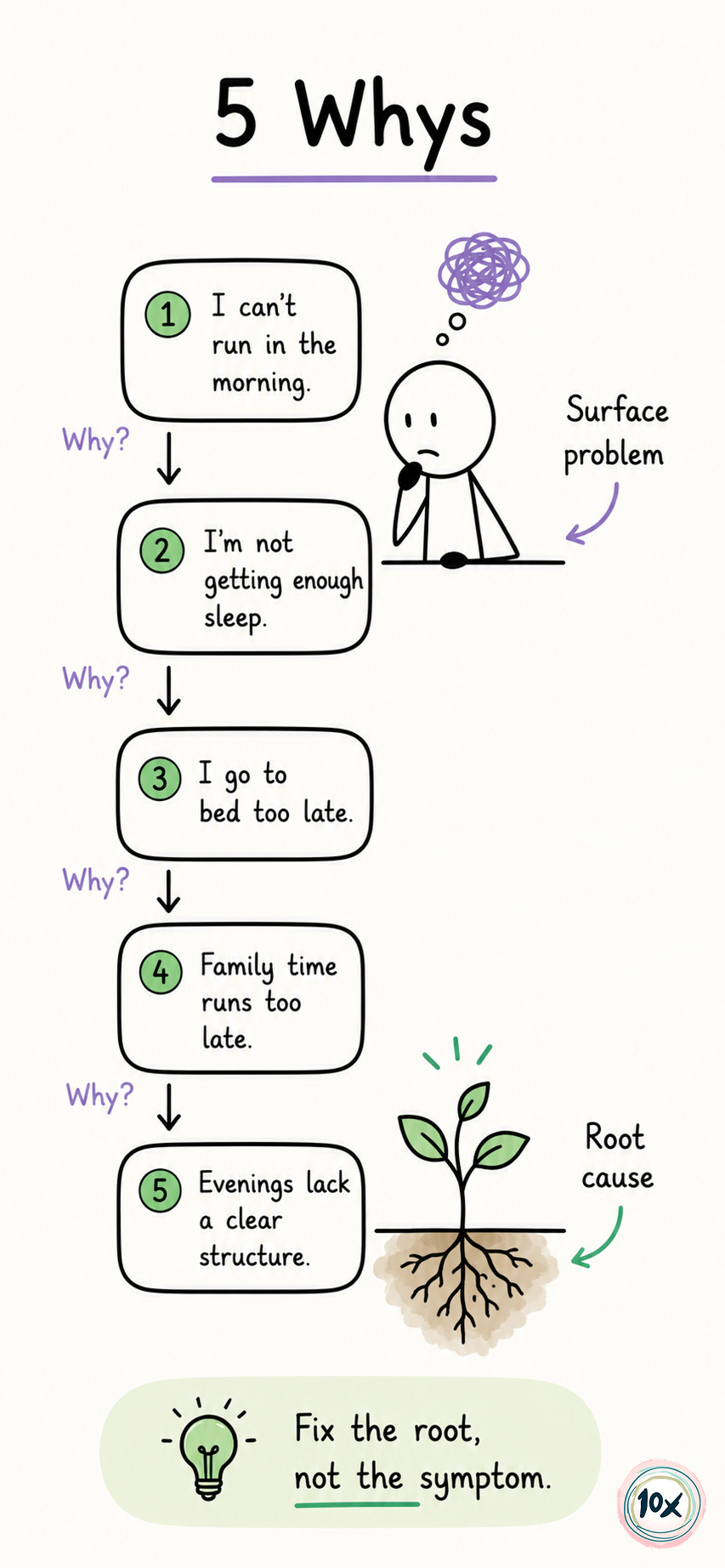
For a stretch earlier this year, I couldn't get out for my morning run consistently. My first explanation was “I'm not motivated enough.” That was Why-1. Four whys later, I was somewhere else entirely. I'd been going to bed too late because our family evening time kept spilling over. Which meant I wasn't sleeping enough. Which meant I couldn't get up at 6:30. The problem wasn't discipline. It was the shape of our evenings.
The tool comes from Toyota, of all places.
Sakichi Toyoda built it into the company’s manufacturing culture in the 1930s. When a machine stopped, workers weren’t allowed to just fix the immediate breakage. They had to ask “why?” until they got to the actual cause. Usually five whys got them there.
It works just as well outside a factory.
When something isn’t working, write down the problem in one sentence. Then ask why. Answer honestly. Then ask why of the answer. Repeat.
Five is a rough guide, not a rule. Sometimes three whys is enough. Sometimes it takes seven. The point is to keep asking until you hit something that, if you fixed IT, would actually stop the problem from recurring.
The fix is usually at the last why, not the first.
Our first explanation for a problem is almost always a symptom, or a plausible-sounding cause we’ve told ourselves without testing.
“I keep procrastinating on this report.” Why?
“The deadline feels far away.” Why does that matter?
“Because I haven’t blocked time for it.” Why haven’t I?
“Because I don’t know how long it’ll take.” Why don’t I?
“Because I don’t know what ‘done’ looks like.” Why?
“Because I never asked my boss what success on this report actually means.”
Five whys. The first fix (block time) wouldn’t have worked. The last fix (ask the boss) actually solves it.
Each “why” forces the brain to pick a specific answer, and specific answers chain into further specific answers. Around three or four whys, you tend to hit something structural: a missing system, a routine that’s off, a conversation you haven’t had. Something you can actually change.
The surface answer is almost always about willpower or motivation. The real answer is almost always about a system.
The 5 Whys goes wrong when:
❶ You stop at the first satisfying answer. “I’m not motivated” sounds true and complete. It rarely is. Push past it.
❷ You answer with blame instead of cause. “Because my colleague is disorganized” is a description, not a cause. The next why becomes hard. Try to phrase each why in terms of a system or condition, not a person.
❸ You go abstract too fast. “Because society values busyness” might be true but you can’t fix it. The 5 Whys works only if the last why lands on something you can actually change this week.
Reach for it when:
The same problem keeps coming back
Your solutions haven’t quite fixed it
You catch yourself explaining the situation the same way each time
The obvious fix isn’t working
Skip it when:
The situation is genuinely unclear (5 Whys diagnoses causes; it doesn’t clarify what’s happening)
You’ve already run this exercise on the same problem
You’re under time pressure and need any fix now, not the right fix
The reason overthinkers benefit disproportionately is that we’re excellent at surface diagnosis. We can articulate exactly why something isn’t working, in complete sentences, with confidence. The trap is that the first articulation is usually incomplete, and we mistake it for complete.
5 Whys is a way of forcing yourself past the first answer.
Most problems don’t need a smarter solution. They need a more honest question.
Comments
Nothing yet. Say the first thing.
Sign in to join the conversation.