
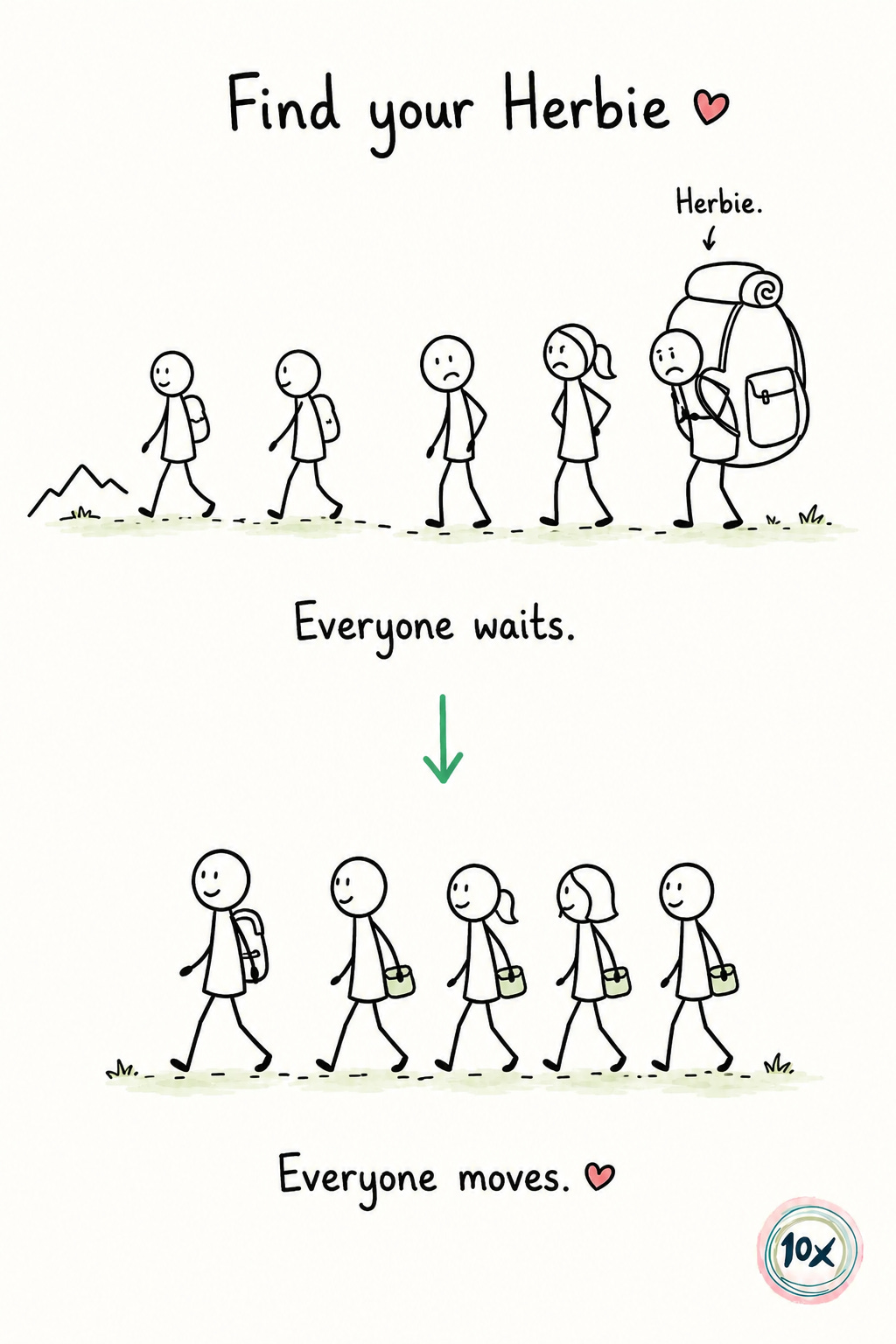
Alex Rogo, a factory manager, takes his son on a Boy Scout hike. The boys set off in a single-file line. Some are fast, some are slow. The fastest boys naturally move to the front, while the slower ones fall further and further behind.
Now and then, Alex has to stop the whole group and wait for the boys at the back to catch up.
Then he notices one boy in particular: Herbie.
Herbie is the slowest hiker. He is also carrying an enormous backpack.
Alex has a realisation: it doesn’t matter how fast the other boys walk. The group cannot move faster than Herbie.
Herbie is the constraint.
And then comes the clever part.
Alex redistributes some of Herbie’s load among the other boys and moves Herbie to the front of the line.
Herbie gets lighter. Herbie gets faster.
The whole group gets faster.
That story is at the heart of the Theory of Constraints, introduced by Dr Eliyahu M. Goldratt in his 1984 book The Goal.
Although it’s a business management philosophy, it’s useful for all walks of life.
Theory of Constraints: Every complex system has at least one bottleneck or a limiting factor that’s preventing it from reaching its goal.
Improving parts of the system that are not the bottleneck will not help improve the overall performance.
You move at the pace of your slowest part.
Think of a chain. You can make every link stronger, but the strength of the chain is still determined by its weakest link.
And yet, this is almost the opposite of how we approach our lives.
When something isn’t working, we tend to improve everything.
I’m going to reset my life, I’ve told myself a hundred times.
I’m going to be active, productive, calm, focused, and organized! I’ll catch up on my work, exercise, eat better, spend more time with my family, meditate, read, write… and somehow become a better version of myself by bedtime.
Ideal day.
It never works.
None of those are bad ideas. But nothing matters if I keep trying to optimize the entire system without asking the more important question:
Where is my Herbie?
Try this question for yourself:
If I could fix only one thing in my life right now, what change would make everything else easier?
That one question can completely change how you approach improvement.
Here are some common constraints in the following areas:
→ Cash flow: You’re building, but not selling.
→ Finances: You’re earning enough, but spending more than you realiZe.
→ Health: You’re exercising, but your energy is too low to sustain it.
→ Energy: You’re in bed for eight hours, but your phone is wrecking your sleep quality.
→ Relationships: You’re not fighting, but you’re not actually resolving anything either.
→ Time: You’re busy all day, but most of your time goes to low-value tasks.
→ Food: You’re avoiding junk food, but your everyday meals are still heavily skewed towards carbs.
My family and I have been struggling with sleep lately. We kept blaming the obvious things: watching TV during dinner, lingering after dinner, not getting into bed on time.
All true. But none of them was the constraint.
The bottleneck was dinner itself. We were simply eating too late.
Moving dinner from 8:00 to 7:00 removed the bottleneck downstream. Suddenly, everything else became easier: finishing up after dinner, getting ready for bed, getting into bed earlier.
We didn’t need a better bedtime routine. We needed to move our Herbie.
At the beginning of Grade 12, my daughter was struggling with Math.
Her teacher’s advice was essentially: improve your Algebra.
Technically correct, but almost useless advice. It’s like telling someone to “work harder.”
The more useful question is: what exactly is getting in the way?
She eventually realised that her constraint wasn’t actually her mathematical understanding. It was her GDC, the Graphing Display Calculator used by many high school students.
As she had been homeschooled during her primary years, she hadn’t developed the same fluency with the calculator as students who had been using it for years. She knew the basics, but she was slow.
That slowness was affecting her entire Math paper.
She could know how to solve a problem and still lose time because she was fighting the tool.
So instead of trying to “get better at Math” in the abstract, she focused on getting really good at using her GDC.
Her grades climbed from around 50% to 89%.
The solution wasn’t to improve everything. It was to find the bottleneck.
This is why I find the Theory of Constraints so useful outside business.
We often mistake activity for progress. We add habits. Download apps. Buy books. Make elaborate plans. Start exercising. Change our diet. Try to wake up earlier. Reorganise our calendars.
None of it works because we’re optimising the wrong part of the system.
The question isn’t:
What can I improve?
There will always be plenty of answers to that.
The better question is:
What’s the one thing currently limiting everything else?
So the next time you find yourself stuck, don’t try to improve everything.
Find your Herbie. Lighten his load. Put him up front. Then see the whole system move. 🙌
P.S. If you're not sure what your Herbie is, that's exactly the kind of question Pinwheel is built to help you find. Message it your situation, and it'll name what's actually slowing you down.
It’s free and only a WhatsApp message away. ❤️
Comments
Nothing yet. Say the first thing.
Sign in to join the conversation.