
The chart below (this variant from John Hanger (@johnrhanger) on X) has been shared a bunch. Instead of plotting each electricity source against the calendar, it lines them all up at the same time that each first crossed 100 terawatt-hours of annual output and follows how fast each grew from there. Coal, gas, oil, hydro, and nuclear all climb slowly, taking decades to build real scale. Solar (yellow) and wind (blue) go nearly vertical, reaching in ten or fifteen years what the old sources needed thirty-five to approach.
Battery dispatch (the first dark red line, confusingly similar to lighter red for nuclear) the electricity that batteries actually delivery onto the grid is the newcomer. It is climbing the steepest line, outpacing even the trajectory set by solar and wind. That is the frame for the five stories below: storage isn’t promising to take off someday, it is already on the fastest growth curve the power system has ever produced, and the only real question is who builds it.

John Raymond Hanger @johnrhanger
"Solar is moving fast. Really fast. Batteries are moving faster." Solar is creating the fastest global shift in electricity generation in history! Battery deployment is often firming solar or wind, thereby boosting the grid shares of solar and wind. reneweconomy.com.au/solar-is-alrea…
1:07 PM · Jun 24, 2026 · 6.72K Views
12 Replies · 97 Reposts · 297 Likes

China added 66.43 GW / 189 GWh of new-type storage in 2025 alone, more than triple North America and 72 percent of the global total for the year. In December ‘25 alone it commissioned roughly 18 GW, which is more than the entire United States had installed across the whole year — which left its cumulative fleet near 145 GW, close to 40 percent of the planet’s grid batteries (pv magazine).
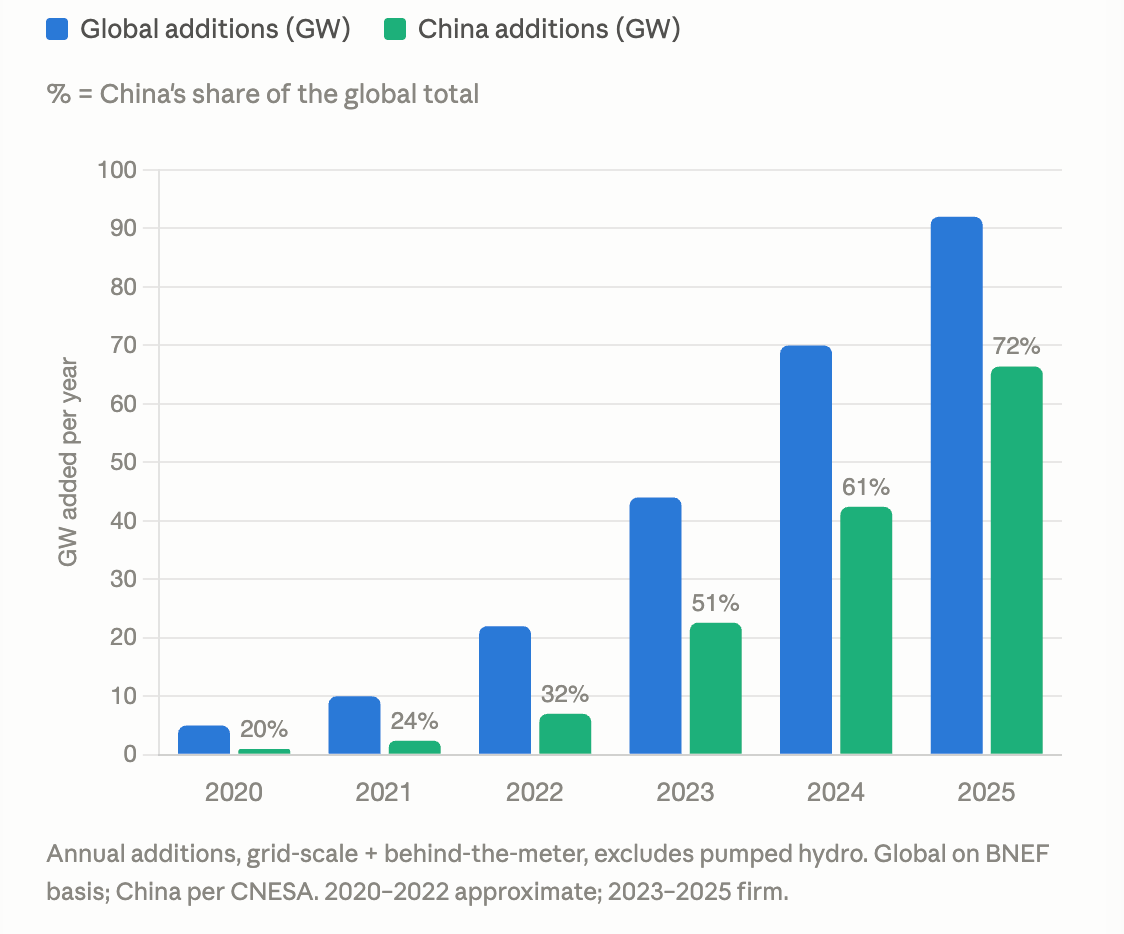
China is in the league of its own, as its share of annual global grid-scale storage installs has actually been increasing, see graph above. But the battery story is starting to be quite meaningful outside of China.
The United States is the obvious runner-up, but it’s accelerating too. It added 3.3 GW / 8.4 GWh in the seasonally slow first quarter of 2026, a Q1 record across utility, residential, and commercial segments at once (Utility Dive), with developers planning 24 GW of utility-scale batteries this year against 15 GW in 2025 and the federal Energy Information Administration expecting installed capacity to double by the end of 2027 (EIA). Texas, California, and Arizona account for roughly 80 percent of this growth with Texas alone takes more than half.
Last December the Saudi grid operator switched on 7.8 gigawatt-hours of battery capacity spread across three desert sites near Najran and Khamis Mushait, built by China’s Sungrow and large enough to claim the title of the world’s biggest single grid-storage installation (pv magazine). Many observers had doubted KSA’s commitment to renewables, but this was one way to confirm that Riyadh was serious about its green ambitions.

Masdar@Masdar
Today we broke ground on Masdar’s first renewable energy development in Kazakhstan, a 1GW wind farm featuring a 600MWh Battery Energy Storage System. The project is led by Masdar alongside W Solar, Qazaq Green Power, a Samruk-Kazyna Fund company, and the Kazakhstan Investment
1:02 PM · Jun 29, 2026 · 488 Views
2 Replies · 3 Reposts · 2 Likes

Kazakhstan had almost no grid-scale storage a year ago, yet in a single quarter it landed two near-identical billion-dollar projects: TotalEnergies' Mirny, a 1 GW wind farm with a 600 MWh battery, reached final investment decision in April (Astana Times), and Abu Dhabi's Masdar broke ground on its own 1 GW wind farm with a matching 600 MWh battery in June (Astana Times). Two oil-world giants just bet a billion dollars each on wind and batteries in an oil-exporting state. That should tell us something about where smart money thinks power is going.
India is the clearest picture of a market scaling off a near-zero base, adding a record 4.6 GWh of storage in the first quarter of 2026 (more than ten times the prior quarter) to reach a cumulative 5.9 GWh, with 18 GW of fresh tenders issued in those three months and Rajasthan alone holding 42 percent of the national fleet (pv magazine).
The honest caveat is that 5.9 GWh is a rounding error against China’s 189, which is exactly the point of reading these five stories together: the technology has plainly won, but whether storage becomes a genuinely global industry or stays a Chinese one is the question the next few years of these installation figures will actually settle.
Sources: pv magazine — China added 66.43 GW in 2025 · Utility Dive — US Q1 2026 record · EIA — 2026 capacity additions · pv magazine — Saudi 7.8 GWh · Astana Times — Kazakhstan Mirny FID · pv magazine — India Q1 2026 record
Comments
Nothing yet. Say the first thing.
Sign in to join the conversation.