
We are back again with the third and final (sort of) layer of the energy stack! I covered the other layers (generation & transmission) in two previous series.
Welcome to part 1 of a quick series on the basics of distribution! This is the why and how energy gets to end users.
Distribution is the final stage in the electricity supply chain. It is the process of delivering electricity from a power plant to an end user, whether that’s homes, businesses, or industries.
It is the part of the layer we come in contact most directly with - every time you plug your electronic device into the wall via outlet, you’re on the receiving end of distribution!
Power first enters primary distribution lines. These carry electricity to distribution substations (in this post we covered about how substations work in a transmission context). It’s a similar operating mode here but for distribution, they’re just located near the point of use.
These substations are where transmission voltage (often in the hundreds of kilovolts) is lowered to reach safe local use levels. They also:
Centralize monitoring, protection, and switching
Redistribute power across the local grid
Provide a site to test systems and equipment
Add or disconnect power lines as needed
Reroute power during outages for reliability
The output of a substation typically includes multiple lines at different voltage levels, routed in several directions. For example, commercial or industrial users often require significantly more power than residential ones. These customers may be connected directly to:
Primary distribution lines (4–35kV) if they are truly big enough
Subtransmission systems (46–138kV) which sit between high-voltage transmission and lower-voltage distribution
Most other end users receive electricity through a transformer that steps down the voltage to:
Utilization voltage: the voltage actually used by devices like household appliances, lighting, and industrial machinery
Service voltage : the voltage delivered by the utility (commonly 120V or 240V in the U.S.), distributed across the local network - for context, in the US residential power typically runs at 120 volts and 60 hertz.
Similar to transmission substations, distribution substations have transformers as well, referred to as distribution substations, which step down voltage to utilization voltage. A single transformer often supplies multiple customers via secondary distribution lines (to your house, my house, Sam’s business).
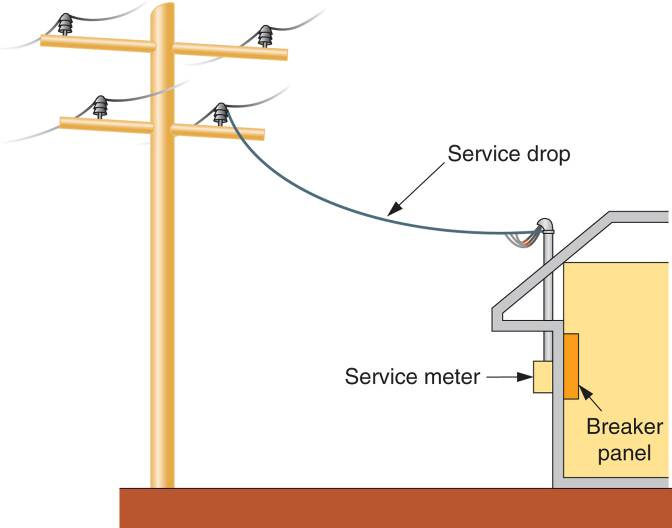
From there, power flows through service drops. These are the wires that connect the distribution transformer to individual customer sites. They are mostly installed overhead, though in urban areas they’re usually underground. Rural areas rely on utility poles, and suburban areas are a mix - you might see them in your neighborhood. All of these service conductors are insulated to ensure safety.
Service drops connect directly to homes and lead to electricity meters, which measure consumption.
From the meter, electricity flows into the service panel (or breaker box), which contains the main breaker and individual circuit breakers or fuses. These serve as safety mechanisms, isolating different circuits in the home.
Finally, electricity moves through internal wiring, behind the walls, and into your outlets, light switches, and appliances
This is the flow of power starting at the transmission substation:
Transmission substation → primary distribution line → distribution substation (with transformer) → secondary line → service drop → meter → breaker box → wiring → your outlet → your phone charger → your phone
There are two main types of distribution network architectures: radial and networked. They play different roles in how electricity is delivered based on geography, demand density, and resilience needs.
Radial networks work like a tree. Each customer receives power from a single path or source. They’re:
simple to design and operate
mostly used in rural and suburban areas
cost effective
Despite their simplicity, they’re often less resilient. However, many include emergency connections including switches that can be reconfigured in the case of faults, maintenance, or line failures. These backup plans let utilities isolate problem areas and restore service more quickly.
Network systems feature multiple sources of supply operating in parallel. These are:
more complex and expensive to build
mostly used in urban areas or dense commercial zones
designed for high reliability and load balancing
Because power can flow through multiple routes in these systems, they can better withstand localized outages and support concentrated energy demand.
The distribution grid is managed by a combo of:
Investor-owned utilities
Municipal utilities
Electric co-ops
Each varies significantly in how they plan, fund, and upgrade distribution infrastructure. These differences matter especially when considering:
Innovation incentives: for example, IOUs often face slower approval cycles due to regulatory oversight
Funding availability: publicly owned utilities may have more direct access to federal or local funding than investor-owned
Data transparency: policies around grid data sharing differ widely by utility type
In part 2, we’ll discuss bottlenecks to distribution: transformer shortages, aging infrastructure, grid congestion, and more. See you there!
No posts
Comments
Nothing yet. Say the first thing.
Sign in to join the conversation.