
As a reminder from part 1 of this series, the interconnection queue is the process by which energy projects (generation & transmission) get submitted to be approved to join the grid.
With over 2,600GW of capacity waiting, almost 95% of which is renewables, and median wait time of over 5 years, the interconnection queue is one of the biggest chokepoints holding up the entire clean energy transition right now.
The good news is that there are some efforts underway to unblock this. Welcome to the last part of this miniseries: part 2!
According to the U.S. Department of Energy some ways of the key ways to mitigate this growing backlog are:
enhancing data transparency
streamlining approval processes
promoting economic efficiency
maintaining a reliable grid
One of the biggest nationwide policy reforms we’ve seen on this issue in years was FERC Order no. 2023. Issued July 2023, the order significantly reforms how projects are evaluated.
Traditionally, transmission providers studied requests to interconnect one by one as they came in, a “first-come, first-served” serial process. When transmission providers were processing fewer projects each year, many of which were larger hydropower, nuclear, coal, and natural gas projects, this process was acceptable.
However, this one-at-a-time process is now far from sufficient. Today’s queue is thousands of projects strong, more distributed, and overwhelmingly renewable.
The new order from FERC requires transmission providers to study projects in batches or “clusters,” referred to as a “cluster study process.”
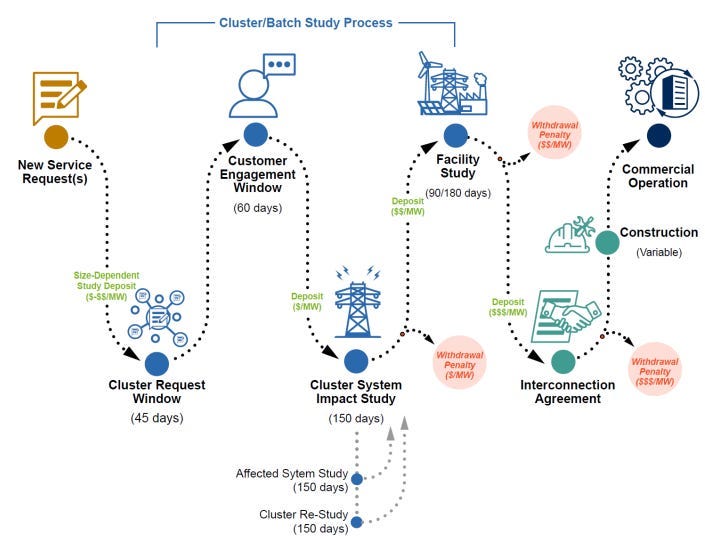
The order also includes the following key changes to speed up the process:
penalties for transmission providers that fail to complete studies on time
stricter financial readiness and site control requirements for interconnection customers to discourage speculative projects
measures to make it easier to integrate generating facilities with unique operating characteristics, such as battery storage projects
While the order mandates cluster studies, it’s important to call out that implementation of this policy varies by region.
Some RTOs like ERCOT already have more flexible models for integrating projects into the grid, while others are only just now shifting.
ERCOT
ERCOT is one of the most flexible systems because its "connect & manage"1 approach focuses interconnection request studies on just what local upgrades are needed for a project to connect to the grid. Unlike the rest of the US, ERCOT doesn’t examine the possible need for broader network upgrades, which takes longer and is more complicated.
PJM
PJM has begun a reliability resource initiative2 which fast-tracks up to 50 high-priority projects from PJM interconnection queue based on commercial viability and market impact. So far, 51 projects have been selected, a total of about ~9300MW capacity (9.3GW), which are targeting agreements signed by Jan 2027.
MISO
MISO has initiated an expedited resource addition study (ERAS)3. This includes unlimited project intake, in which projects are selected by state regulators. These additional studies are run separately from MISO's main queue. While this proposal was first rejected in May 2025, it was resubmitted in June of 2025 and awaiting approval.
SPP
Southwest Power Pool is also engaging an ERAS4. Similar to MISO, it is looking to enable a one-time process outside the standard queue to expedite additional studies.
The Watts study, done in 2021, claims that GETs (grid-enhancing technologies) - which include dynamic line ratings, advanced power flow control and topology optimization - could enable Kansas and Oklahoma to integrate 5,200 MW of wind and solar generation currently in interconnection queues by 2025, which is more than double the development possible without the technologies. For more details on what GETs are and how they work see transmission part 3!
Accordingly, a few companies are working on such solutions, as well as broader efforts to automate and streamline this historically manual process.
Pearl Street Technologies: develops software like SUGAR (for transmission providers) and Interconnect (for project developers) to streamline the interconnection study process. SUGAR accelerates modeling & simulation, and Interconnect provides scenario analysis and risk assessment platforms for projects in the queue.
GridUnity: provides interconnection lifecycle management, a platform that centralizes data and offers tools for managing cluster studies, enhancing transparency, and integrating with existing utility systems. Their main objective is working to solve the data accuracy problem.
Clean Power Research: PowerClerk is a product that automates and streamlines the interconnection process and enhances communication between utilities and applicants.
Tapestry is partnering with PJM5 to speed up interconnection. PJM is expecting capacity shortfall by 2029/2030 (meaning they are not able to reliably meet demand) due to slow pace of new generation interconnects, generation retirements, and demand from data centers. Tapestry provides a Grid Planning Tool which is already used in Chile to simulate future grids 86% faster with 30x more scenarios, as well as Grid Aware which uses visual data (e.g., Google Maps) for inspections and identifying needed repairs.
Between FERC’s new mandates and regional reform, there’s momentum building to speed up the queue, but the clock is ticking. Delays grow increasingly unaffordable, and with demand surging, we still need more solutions, faster.
Up next is a series on distribution and where this growing demand is really coming from! See you there.
https://www.utilitydive.com/news/connect-and-manage-grid-interconnection-ferc-ercot-transmission-planning/698949/#:~:text=341-,ERCOT,Renewables'%20director%20of%20market%20design.
https://www.klgates.com/Regional-Grid-Operators-Attempt-to-Tackle-Resource-Adequacy-by-Fast-Tracking-Generator-Interconnection-6-6-2025#:~:text=PJM%20was%20the%20first%20among,8
https://www.klgates.com/Regional-Grid-Operators-Attempt-to-Tackle-Resource-Adequacy-by-Fast-Tracking-Generator-Interconnection-6-6-2025#:~:text=PJM%20was%20the%20first%20among,8
https://www.klgates.com/Regional-Grid-Operators-Attempt-to-Tackle-Resource-Adequacy-by-Fast-Tracking-Generator-Interconnection-6-6-2025#:~:text=PJM%20was%20the%20first%20among,8
https://insidelines.pjm.com/pjm-google-tapestry-join-forces-to-apply-ai-to-enhance-regional-planning-generation-interconnection/
No posts
Comments
Nothing yet. Say the first thing.
Sign in to join the conversation.