
This is part 2 (the final part!) of a miniseries on energy distribution.
In part 1, we covered what distribution is, how it works, and who operates it. Now we’re digging into the challenges and what’s being done about it. Welcome!
Let’s start with the hardware problem: we don’t have enough transformers (the importance of them is covered in part 1 and in previous posts on transmission). And the ones we do have are getting old.
As of late 2024, the US had between 60–80 million distribution transformers.
According to NREL, the number of transformers needed could increase by up to 260% by 2050.1
Over half of residential transformers are already near end-of-life, with many over 40 years old.
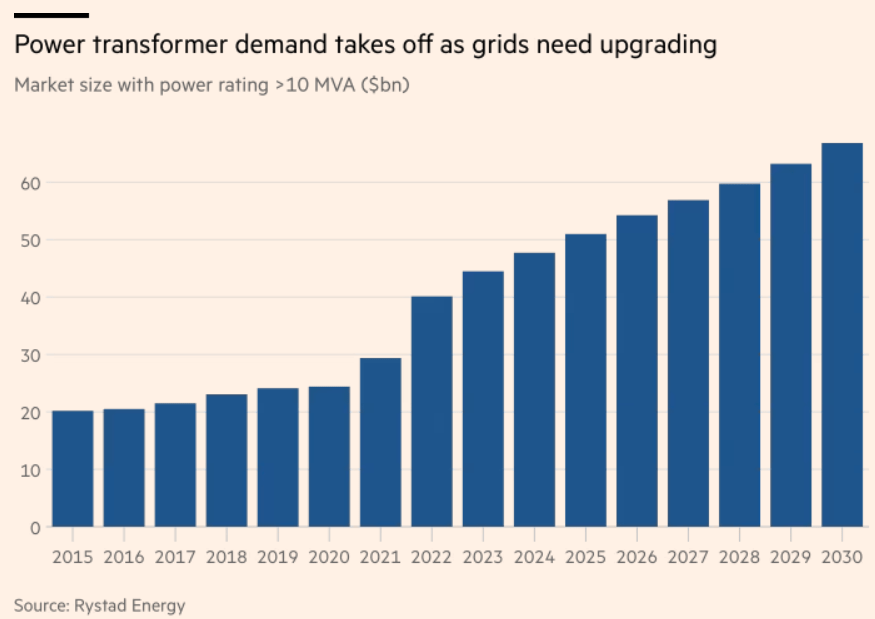
Long lead times: large units now take 80–120 weeks to arrive2
Supply constraints: specialized electrical steel is expensive and hard to source domestically
Design fragmentation: there are over 80,000 transformer types across the U.S., making production and standardization a nightmare
Workforce shortages: there aren’t enough skilled laborers building this technology, and investment delays are compounding the issue
Unfortunately, solving this won’t be quick. Solutions like design standardization and strategic reserve stockpiling require policymaker coordination and long-term investment.
The transformer bottleneck is just one facet of a broader problem which is that the grid is old. It’s the same bottlenecks facing the transmission layer. Load growth, climate-related stress, and delayed upgrades have meant more strain and more frequent failure at the distribution level. Maintenance budgets haven’t kept pace with what’s needed.
These increased costs and reductions in flexibility also make it harder to support things like DERs or real-time rerouting (more on this later).
Grid congestion occurs when there’s not enough capacity to move electricity from where it’s generated to where it’s needed. While it often starts at the transmission level, there are ripple effects into distribution. Congestion is caused by everything we’ve mentioned: aging infra and increased load. It results in:
Line losses as wires overheat (old wires, aberrant weather conditions)
Prices spike for end users on the constrained side of the grid
Fossil fuel use increase while renewables are blocked
Distributed energy resources (DERs) include renewables like rooftop solar, batteries, EVs, and heat pumps. They are highly flexible, create energy closer to the point of use so they don’t rely on transmission lines, and are clean. But integrating them is straining distribution infrastructure. This is for a few reasons:
DERs require two-way power flows (imagine an EV getting charged via the grid, and selling that capacity back to the grid in times of high demand so EV owners can make a profit), which many grids weren’t built to handle.
EV charging and electric heating add load intensity, often unpredictably.
Utilities often lack the tools, models, or policies to integrate DERs at scale.
I’ll go deeper on DERs in a separate post. They’re exciting - there have been many technological advances, cost declines, favorable policies, and customer demand for them (with varying adoption regionally), but the distribution system struggles to keep up.
According to the NIAC report3, several key steps are already underway:
Better forecasting to anticipate demand and secure manufacturing early
Long-term supplier agreements for critical materials like electrical steel
Large utilities are building "storm stock" inventories to plan better and build resilience
Encouraging fewer transformer designs (standardization) for faster, cheaper manufacturing
Some regional grid operators, like ERCOT4 in Texas, are already creating transparency tools such as:
Nodal pricing maps that show where power is expensive due to congestion
Real-time market signals that help utilities and developers plan around chokepoints
If we can see where congestion is happening, we can design smarter interventions, including new infrastructure and software.
Modernizing distribution can be enabled by the adoption of new tech across the board:
Smart grid software for real-time rerouting
Advanced metering infrastructure (AMIs) for dynamic pricing and outage visibility
Energy storage to shave peak loads and add dispatchable capacity
Public-private collaboration to streamline permitting, funding, and project execution
Virtual power plants (VPPs) aggregate DERs virtually so they can act as a single grid resource. These are gaining traction as a way to reduce strain on physical assets.
Several companies are already leading on distribution-focused innovation:
Camus Energy: provides a grid orchestration platform to help utilities and energy providers manage and integrate DERs with AI and ML
Utilidata: enhances the electricity distribution grid by providing real-time, data-driven insights to utility companies by leveraging AI
Gridware: specializes in grid monitoring and maintenance. Their tool Gridscope uses sensors to detect and predict faults, such as those that could cause wildfires and vegetation encroachment. Platforms like Gridscope help utilities respond to outages more quickly and safely, while also providing data to improve asset management and reduce the risk of hazards broadly
Weavegrid: an interesting software and data layer that works on connecting EVs to the grid
In coming posts, we’ll dive into DERs, storage, and load balancing. See you there!
https://www.nrel.gov/news/detail/program/2024/what-is-driving-the-demand-for-distribution-transformers
https://www.woodmac.com/news/opinion/supply-shortages-and-an-inflexible-market-give-rise-to-high-power-transformer-lead-times/
https://www.cisa.gov/sites/default/files/2024-09/NIAC_Addressing%20the%20Critical%20Shortage%20of%20Power%20Transformers%20to%20Ensure%20Reliability%20of%20the%20U.S.%20Grid_Report_06112024_508c_pdf_0.pdf
https://www.nrg.com/insights/energy-education/transmission-and-distribution.html
No posts
Comments
Nothing yet. Say the first thing.
Sign in to join the conversation.