
The following article was written for the liberal think tank BrightBlue and is also available on their Substack, Centre Write. The version below is my original. All opinions are my own; they should not be taken as endorsing any wider policy agenda.
One of the more persistent challenges of teaching essay-writing to sixth formers is many teenagers’ tendency to mistake stridency for sophistication. Some of our elected politicians suffer from a similar confusion.
In the past weeks, former Prime Minister Lord Cameron accused the current Labour government of trashing education policies proven to raise standards out of a sense of “spite”. Education Secretary Bridget Philippson fired back by rubbishing essentially all education reforms implemented during Cameron’s premiership and promising to repeal them. Neither position shows much nuance, or much regard for the evidence.
Fortunately, there is a model answer to hand for those seeking a guide to education reforms implemented by the Cameron government and chiefly associated with Michael Gove, the most energetic Education Secretary of the modern era.
Dani Payne of the Social Market Foundation last year provided an excellent assessment of Gove’s impact on British schooling. Gove’s reforms, Payne concluded, largely succeeded in raising standards in the ‘academic core’ but at the cost of pupils’ mental wellbeing and sense of belonging (see image below). In 2003, she points out, Britain was above average for both maths attainment and belonging. By 2022, maths remained above average but belonging had collapsed, placing Britain near the bottom.
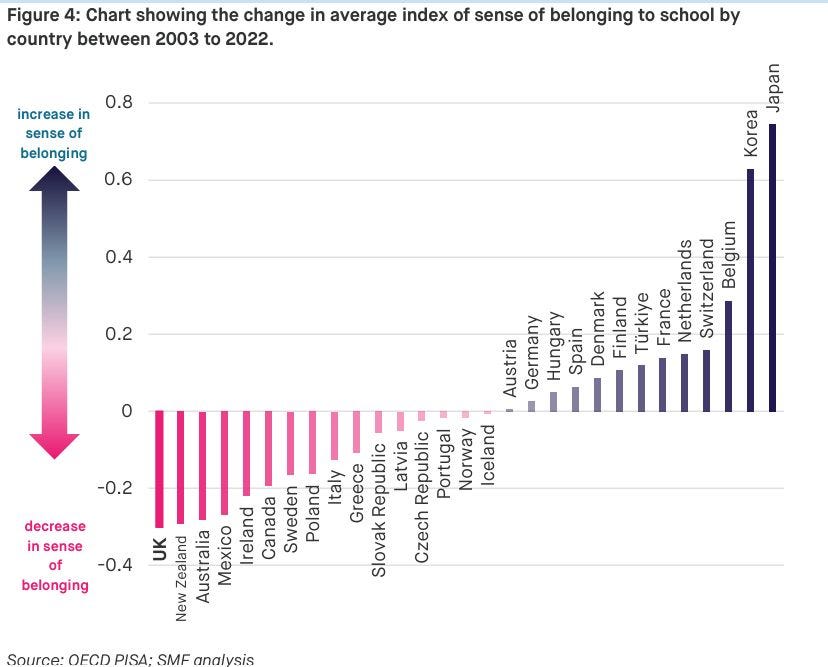
The situation has not improved. Post-Covid, schools have suffered alarming spikes in pupil absenteeism, more pronounced in some communities than others. A recent international study of pupil engagement found that British children’s experience of school followed a conventional pattern—enjoyment and progress being generally high in primary, waning in secondary—but to a more extreme degree than in other, similarly affluent countries. The OECD has found that almost one-in-seven Britons aged 15 to 24 are outside of education, employment or training. That’s almost a million lives being idled away. The equivalent figure for the Netherlands is one-in-twenty-five.
As the recent Schools White Paper rightly points out, Britain has the least satisfied and optimistic 15-year-olds of any country in Europe. The schooling system is far from the exclusive cause of generational despondency, but as a system—as opposed to individual schools—it is not helping.
How much of this can we attribute to the Gove reforms? The negative factors most commonly cited by fellow educators are the increasing burden of high stakes assessment, the lack of choice extended to pupils during their teenage years, and the ‘crowding out’ of typically high engagement activities outside of the taught curriculum. Each bears scrutiny.
The average 16-year-old will spend around 30 hours in an examination hall subject to relatively reductive tests of their receptivity to rote learning. The nature of this assessment ripple backwards in time, affecting what it taught, what is not taught, and how, from Year 7 onwards. Small wonder that engagement is in crisis in many schools. (To anticipate a common reaction: it is perfectly possible to believe in the importance of a knowledge-rich curriculum, as I do, while judging our existing examination system to be seriously flawed.)
It’s harder to assess the impact of restricting pupils’ choice over what they study. I supported the introduction of the Ebacc in 2011 as a corrective to the proliferation of low-value qualifications designed to flatter schools’ accountability measures rather than to equip young people with expertise useful in modern life. Fifteen years on, however, it is clear that they have not, as Gove argued, made British education “broad, deep and balanced” but narrow, superficial and, for many, lacking in relevance. The picture is complicated by the fact that pupil engagement seems to hold up marginally better in countries like France or Japan, where pupils have even less choice over curriculum pathways than in Britain.
The crowding out of creative arts subjects and co-curricular activities from state schools is, on a personal view, the most serious and socially regressive consequence of the Gove reforms. Schools unable to engage students in creative arts, sports, or other areas that speak to personal fulfillment, have unsurprisingly found it harder to generate enthusiasm for more traditional study. This development was exacerbated by the downward pressure on school budgets caused by fiscal austerity, which made these activities unaffordable for most schools. Hannah Rolley of Oxford University has rightly called attention to the fact that enjoyment in education has often been treated as a liability in the state sector, or at least in those schools to serve predominanly disadvantaged communities.
(Fee-paying schools spared the same financial and accountability pressures have, tellingly, held fast to the creative arts and to cocurricular activities. Access to a wider education is today one of the primary drivers of middle class parents’ preference for private over state schools.)
The above is only contingently related to what has become in retrospect the signature reform of the Gove years—system-wide academisation. My own view is that academisation was essential to address underachievement in specific schools and specific regions, but at the national level it too often became a kind of cipher for substantive school reform. I’ve had too many conversations with partisans on both sides, unable to sustain a debate about what, substantively, should (or should not) happen in schools as a result (or instead of) academisation. High concepts like “independence”, “accountability” or “energy”, are simply too attractive a cheat code for politicians, civil servants and other wonks keen to skip the Big Boss battle of what actually works in schools.
The school I lead, the London Academy of Excellence, has been successful in part because of the Gove reforms—we would not exist without the creative disruption to the schooling system provided by the Free Schools Programme—but also because of our ability to swerve the unintended consequences of those reforms.
We operate at a phase of education where students exert the most choice over their curriculum. By introducing school-developed elective courses, we have extended students’ ability to tailor their learning pathways, within a curated framework. We have, critically, developed one of the largest cocurricular programmes in the country to keep engagement high, increase connectedness, and build character. A survey of our students conducted by British Future found that cocurricular activities “proved an important channel to improving students’ sense of rootedness and connection with their surrounding community”. And we have been successful in raising the philanthropic capital necessary to support all of this activity through periods of austerity.
We should not over-romanticise the pre-Govian past. I well remember the shocking levels of educational underachievement in working class communities, including my own, in the 1980s and 1990s. Conversations on the journey to collect our GCSE results did not centre on our plans for the future, but whether we expected to have ‘passed’ anything. The answer for most of my peers was ‘no’. Substantially all education policy introduced during the first quarter of this century has been motivated by a sincere desire to make this experience history. I believe this description applies to both Gove and to Philippson. Gove was good at diagnosis; less good at prescription. We must hope that Philippson is good at both.
No posts
Comments
Nothing yet. Say the first thing.
Sign in to join the conversation.