
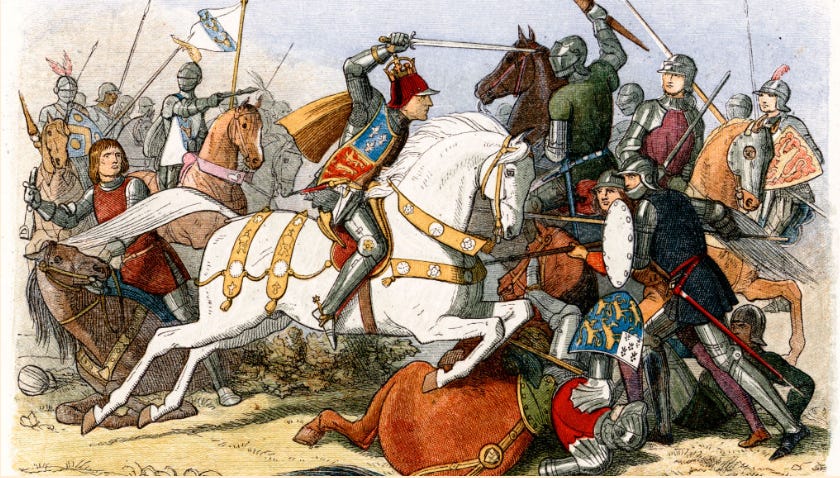
A little over a decade ago, an anonymous history teacher crafted a sardonic reply to Michael Gove, then-Education Secretary and boostering for a self-consciously Whiggish version of British history to be taught in schools. Our “Island Story,” Gove called it: a straightforward hop, skip and jump from the Magna Carta of 1215 to the Representation of the People Act 1983. Do mention the War. Don’t mention the slave trade. All his own work.1
The riposte took the form of a lesson plan, shared via the TES website, which asked students to compare chunks of Gove’s introduction to the 2013 draft history curriculum with translated passages from Nazi Reichserziehungsminister Berhard Rust’s 1934 guidance on ‘heritage’ studies. All across England, Year 9 students came to the reasoned conclusion that if your educational philosophy is pretty tough to distinguish from the Nazis’, you are probably not in a good place.
Gove lost his skirmish in the history wars–mostly due to the all-but universal condemnation of academic historians (Sir Richard Evans described Gove’s draft as “a pub quiz, not an education”) but school history teachers, too, played their part. Imagine our collective horror, 12 years later, to be presented with a proposed history curriculum that makes Gove’s version look nuanced and inclusive by comparison.
Thanks for reading Powerful Knowledge ! This post is public so feel free to share it.
Reform UK recently unveiled plans for a “patriotic history of the British Isles”. The proposals, announced in time for St George’s Day, would require schoolchildren in England to cover events such as the Magna Carta, the Wars of the Roses, the English Civil War, the Glorious Revolution, the Act of Union, the Enlightenment and Victorian Britain. The party has said teaching on British imperialism or the country’s legacy of slavery must be “paired with the teaching of a non-European occurrence of the same to ensure balance”.
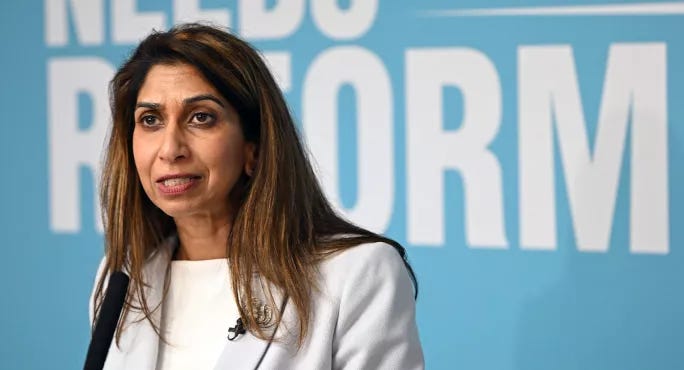
Suella Braverman, Reform’s recently-installed education spokesperson, accused schools of (somehow) having taught children “to be ashamed” of Britain’s past while omitting lessons about Britons who fought for freedom. All of this, she said, was (somehow) in service to successive Conservative and Labour governments’ “mass migration agenda”. Under a Reform government, teachers would be required (somehow) to teach in a way that “rekindle[s] national pride” while avoiding “a progressive lens” or “modern narratives”.
We should dissect Reform’s proposals carefully–even if they were not formed that way. This is now a national political party and a serious contender to form the next government.
Reform wants British history to form a minimum of 60 percent of the subject’s assessed content. Taken at face value, this would not be much of a departure from settled practice. Students studying history at GCSE are required to take four papers, two of which are focused on British history, a third of which is likely to involve a topic such as the First World War or the Cold War, both centrally important to British history, and a fourth focused on the history of a different society. A Level History tilts slightly further away from the British Isles, so would be more affected, but not radically so.
Teaching of historical topics in Key Stages 2 and 3 is more varied, but as both are recognised as leading towards public qualifications, it typically involves many of the topics and events to which Reform is so attached. For some students in some schools, Reform’s blunt quota would almost certainly represent a reduction in the amount of time spent on British topics. I doubt this is Braverman’s intent.
All of the historical events cited by Reform have a place in the education of British schoolchildren. How could they not? Most of them, in fact, already feature prominently in taught curricula. What they do not have, and what seems to be envisioned, is exclusivity. The playlist of British history’s ‘bangers’ is typically braided with historical fare that Reform may find more challenging–things like the colonisation of the Welsh Marshes, the Act of Uniformity, the Gordon Riots, the Peterloo Massacre, the Newport Uprising, the seige of Sidney Street, Bloody Sunday, the Brixton Riots and, yes, slavery.
A mature perspective on British imperialism must explore how and how far it was fuelled by rivalry with other European states. This is important historical context and an opportunity to draw meaningful comparisons. I’m doubtful, however, that this is what Braverman is getting at. There is, after all, only so much comfort to be taken from knowing one’s ancestors weren’t as awful as the Belgians in their treatment of colonised peoples. Gove, it was said, would have rehabilitated General Gordon. Reform might do the same for General Dyer.2
And what of that reference to “non-European” examples of imperialism and slavery? Does Reform really think this is absent from English schools? The past few years have seen a minor surge in interest in schools teaching about medieval African kingdoms, much of it sparked by Professor Toby Green’s work. The practice of slavery was common in these societies. Is this curriculum development welcomed by Reform UK? Again, this does not seem likely. In any case, it’s a suspect moral calculus that regards revulsion at human bondage as a fixed variable that can be subject to long division over many cases. Slavery as practiced by Europeans is not rendered less-than-reprehensible by being recognised as less-than-unique.
The core of Reform’s agenda for schools is, therefore, none of these things. Rather it lies in the party’s apparent desire to swap out the teaching of history and historical enquiry in favour of what the historian and journalist David Broder calls “memory politics”. Memory politics is history-as-propaganda: the deliberate selection and presentation of historical themes and events to justify and reinforce a contemporary political narrative.
Reform’s narrative is that Britain has been so unabashedly positive a force in world history that only wokeism or academic churlishness would lead one to point out its internal strife, its contradictions, its democratic missteps, or its mixed record as a sponsor of “freedom” around the world. Braverman’s reference to migration is the faulty dog whistle that alerts everyone to what else might, and what might not, belong in that narrative.
The resort to memory politics is also founded on the misapprehension that young people are disenchanted with Britain because they no longer revere the Great Men of British History. (Capitals and gender definitely intended.) Braverman cited a 2022 survey by Policy Exchange that found only 20 percent of young adults have a positive view of Winston Churchill while also showing that only 41 percent of them were proud to be British. Post hoc ergo propter hoc? No, as it happens. Post hoc enim proper hoc. Young people have many reasons to feel disillusioned without assembling a historical rogues gallery to take the blame. Modern Britain has rogues aplenty.
But then, it always has. Many of those rogues were also, inconveniently, heroes. Nelson’s undoubted physical bravery and leadership qualities are not diminished by his vocal support for the slave trade. Educators do not and must not shirk from such conclusions. Neither do students, who, as the historian David Olusoga told an audience in London last week, “accept multifaceted historical personalities in all their complexity” without needing to settle on one, definitive judgement.
Ironically, the group that seems to struggle most with this sort of nuance can be found among Reform’s fellow travellers on the Right. Lord Andrew Roberts, about as Establishment a figure as one can imagine, was compelled last year to defend Churchill from attacks by right-wing commentators discomfitted by Winnie’s relative liberality when it came to civic rights, opposition to isolationism and downright warmth towards Europe.
There is an unavoidable truism here. People and societies are complex. They do not instantiate ideas perfectly, or consistently. History teaches us that. Whatever distracts us from that lesson, is something else.
Quite literally. Gove fired Niall Fergusson, no member of the ‘wokerati’, from the project because his take was too cosmopolitan.
No posts
Comments
Nothing yet. Say the first thing.
Sign in to join the conversation.