
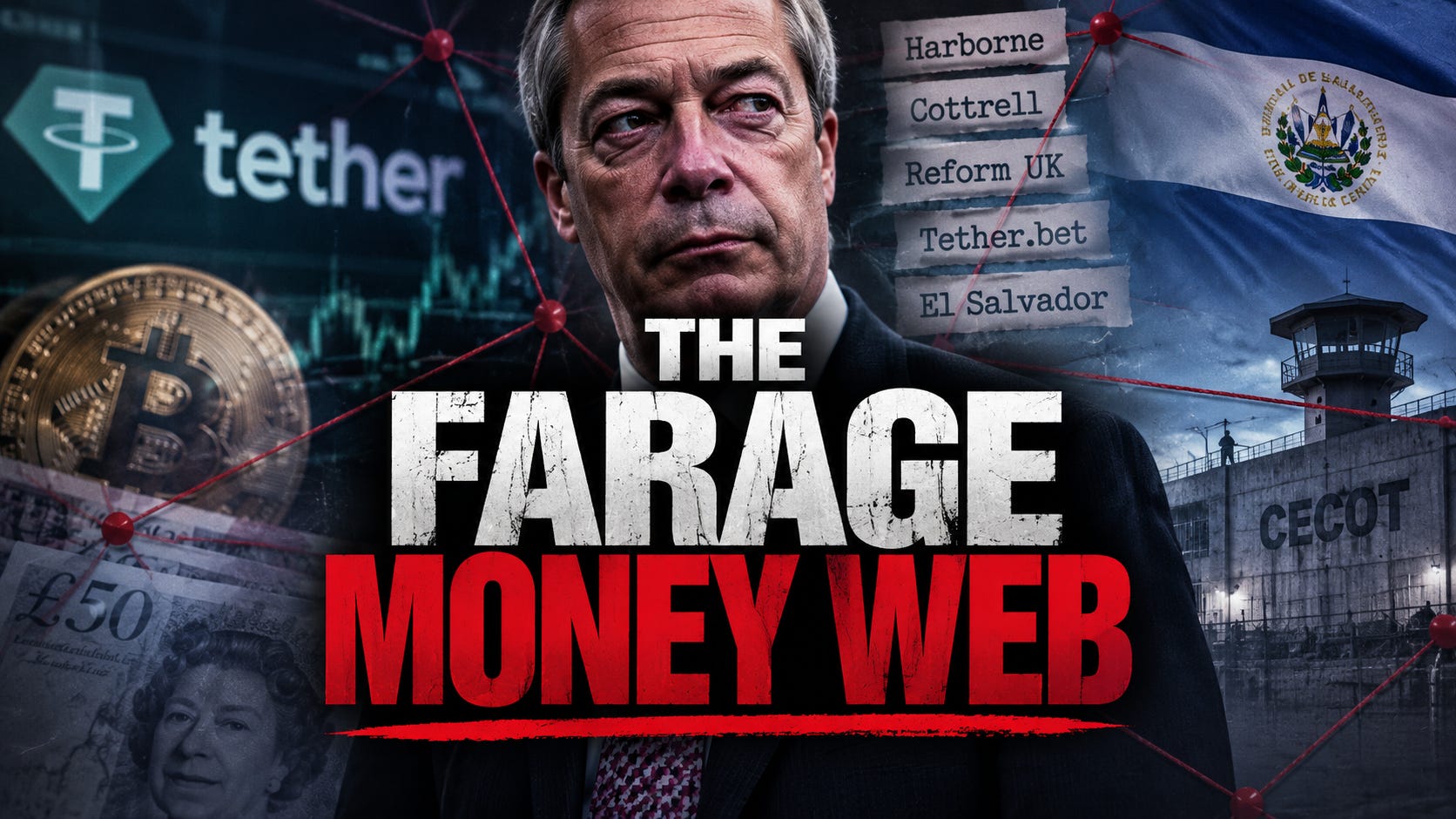
There is a point in any investigation where the individual stories stop looking individual. The net starts to close, and the web of lies and deceit starts to reveal itself.
For months, the financial stories surrounding Nigel Farage and Reform UK have arrived separately. A £5 million personal gift here. A millionaire donor there. A convicted fraudster paying for staff and security. Money moving through somebody’s mother. A mysterious loan to Richard Tice. Cryptocurrency. Offshore gambling. Montenegro. Tether. El Salvador.
Taken one at a time, each can be explained, disputed, denied or dismissed as somebody else’s business. Put them on the same table and the picture becomes rather harder to ignore.
That does not mean there is a conspiracy. It does not mean Nigel Farage is secretly taking instructions from cryptocurrency billionaires, or that Reform UK’s policy towards El Salvador was written in some smoke-filled room by Tether executives. After digging through the relationships, I cannot find evidence establishing either of those things.
What I can find is a remarkably small network of people whose money, businesses and political relationships repeatedly intersect around Farage and Reform UK.
So I did some deeper digging into Reform, Nigel Farage, Richard Tice, the backers and the El Salvador connection, to see where the dots connect, like I did with my deep dive into the network behind Turning Point UK, UKIP and Nick Tenconi, my piece Who Is Behind Turning Point UK?
And once you start following the intersections, you eventually arrive in El Salvador, again and again. Which is too often for it to be a coincidence.
Christopher Harborne is one of the most important people in Nigel Farage’s political life, despite being considerably less famous than the man whose politics he has helped finance.
Harborne is a British businessman and cryptocurrency investor who became a substantial shareholder in Bitfinex and its sister company Tether. Delaware court proceedings have described him as holding roughly 12% of both companies, while making clear that he was a minority shareholder rather than an executive running their day-to-day operations.
He is also an extraordinary political donor.
Across the Brexit Party and Reform era, Harborne has supplied Farage’s political project with millions of pounds. The Sunday Times currently describes him as having given Reform £12 million, in addition to the £5 million he transferred directly to Farage himself in April 2024. Other reporting puts his cumulative support for Farage’s parties considerably higher when earlier Brexit Party donations are included.
That £5 million is where the story becomes particularly interesting.
Farage says it was an unconditional personal gift. Harborne’s lawyers say it was made with no expectation of anything in return. A document was apparently produced saying precisely that.
Fine. Sounds like they’re really covering their arses on this. Then came another detail.
According to senior Reform sources who spoke to The Guardian, Farage had told colleagues only weeks earlier, in March 2024, that returning to frontline politics would cost him roughly £1 million a year in lost earnings.
On 5 April, Harborne suddenly transferred £5 million to him.
That does not establish a deal. It does, however, create a perfectly legitimate question about what the money was really for.
Farage has variously talked about security, lost income and the entirely personal nature of the gift. He has insisted that because he was not an MP when he received it, he had nothing to declare.
Parliament’s standards watchdog disagreed sufficiently to investigate the matter. That inquiry resumed after Farage returned to Parliament following his self-triggered Clacton by-election.
The £5 million therefore sits in a strange space. We know who paid it. We know who received it. We know the date. We know what Farage had reportedly been saying about the financial cost of returning to politics shortly beforehand.
What we do not have is evidence of a quid pro quo. That distinction matters enormously. Because the next part of the story is the murky world of cryptocurrency.
Harborne’s fortune is deeply connected to Tether, one of the most powerful businesses in cryptocurrency.
Tether issues USDT, the dominant dollar-linked stablecoin. Unlike Bitcoin, whose price can rocket or collapse dramatically, a stablecoin is designed to maintain a fixed value. USDT is intended to stay worth one US dollar.
That makes Tether enormously important to the crypto economy. And it makes government-backed digital currencies potentially important to Tether. If central banks issue their own digital money, private stablecoins could face a very different competitive and regulatory landscape.
Which brings us back to Nigel Farage.
Farage has become an outspoken opponent of a British central bank digital currency, generally known as the digital pound or, rather unfortunately, “Britcoin”. He has personally pressed Bank of England governor Andrew Bailey on cryptocurrency regulation and the digital-pound project. Bailey later said he would have postponed one meeting had he known at the time that Farage’s £5 million gift from Harborne was under investigation.
Again, there is no evidence Harborne instructed Farage to do this. Farage may simply believe what he says he believes. Politicians and donors frequently share ideological interests. That is, after all, one reason wealthy people donate to politicians in the first place.
But the alignment exists.
A politician receives extraordinary financial backing from a substantial shareholder in one of the world’s dominant private stablecoin businesses, then becomes an energetic opponent of a potentially competing state-backed digital currency.
That does not prove corruption. It absolutely merits scrutiny.
And then Tether moved house.
On 13 January 2025, Tether announced that it was relocating its headquarters to El Salvador.
The company had obtained a Digital Asset Service Provider licence there and planned to establish its first physical headquarters in the country. CEO Paolo Ardoino told Reuters that he and other senior figures would also relocate personally.
President of El Salvador, Nayib Bukele was delighted.
His response to Tether was wonderfully concise:
“Welcome home.”
El Salvador had spent years positioning itself as the world’s great national cryptocurrency experiment. Bukele made Bitcoin legal tender, courted crypto investors and constructed a regulatory environment deliberately intended to attract digital-asset businesses.
Tether was an enormous prize. So by January 2025, one side of our network looked like this:
Christopher Harborne
→ major Tether shareholder
→ Tether
→ El Salvador
The other looked like this:
Christopher Harborne
→ millions of pounds
→ Nigel Farage and Reform UK
Those are both documented. What happened next is where things become considerably more curious.
One important correction emerged while checking the research behind this piece.
Reform’s El Salvador prison proposal did not suddenly appear in August 2026.
Farage had already publicly proposed sending serious offenders to overseas prisons, explicitly including El Salvador, in July 2025. The Financial Times reported the policy on 21 July that year.
That matters.
It means the idea has a longer paper trail than the current reporting initially suggested. It also gives us a clearer chronology.
Tether announced its move to El Salvador in January 2025.
The Trump administration began transferring Venezuelans to El Salvador’s CECOT prison in March.
Then, in July, Farage publicly named El Salvador as somewhere Britain could send prisoners.
By August 2026 the proposal had become considerably more developed. Reform said it had already held talks with El Salvador, and party chair Lee Anderson was preparing to travel there to discuss the scheme.
This chronology actually cuts both ways.
It makes the simple “Reform suddenly invented El Salvador because Tether is there” theory weaker. There is an obvious independent political inspiration: Donald Trump and Nayib Bukele had already demonstrated the idea publicly.
But it leaves another question completely unanswered.
Who opened Reform’s talks with the Salvadoran government?
That is the missing link. And nobody appears to have publicly established who did make the introduction either. And that is a question worth pursuing.
Especially because we have not finished with Harborne and Cottrell.
Not remotely.
George Cottrell has been orbiting Nigel Farage for a decade.
He worked with UKIP, became close to Farage and was arrested in the United States in 2016. He ultimately pleaded guilty to wire fraud and served time in prison. Afterwards he established himself in Montenegro, where his world increasingly involved cryptocurrency, gambling, wealthy clients and politics.
Meanwhile his relationship with Farage continued.
Reporting has described Cottrell paying for or arranging staff, security and accommodation connected with Farage’s political operation. The Sunday Times investigation described three members of Farage’s social-media operation being recruited and paid, alongside security and housing support.
Farage has described Cottrell as a friend.
Cottrell has never been listed as a conventional large Reform donor.
Which makes what happened with his mother rather interesting.
In 2024 Fiona Cottrell made substantial donations benefiting Reform UK. Nothing inherently unusual there. British citizens are allowed to donate money to political parties, provided the legal requirements are met.
Then journalists followed the money backwards.
According to financial-industry sources cited by The Guardian, George Cottrell transferred $2,047,693 into his mother’s bank account.
Those payments arrived in three chunks.
And each arrived shortly before Fiona Cottrell made major political donations.
The Guardian reported that one $1.4 million transfer arrived before Fiona gave £1.075 million to Britain Means Business, an organisation controlled by Reform deputy leader Richard Tice. Other transfers of more than $300,000 preceded her direct donations to Reform.
The timing ranged from roughly 24 to 72 hours.
Bankers asked Fiona where the money had come from. She reportedly told them it came from George. The money then moved into British politics.
That does not automatically mean George Cottrell illegally donated through his mother. The legal question is who was the true donor.
A person may receive money legitimately from somebody else and later independently decide to make a political donation from their own assets. But if money is supplied specifically so that another person can donate it on the supplier’s behalf, British political-finance law becomes extremely interested indeed.
The police became interested too.
The Metropolitan police have been investigating the £500,000 in direct Reform donations made by Fiona Cottrell as part of an inquiry into whether donation restrictions were circumvented.
George Cottrell’s lawyers have maintained that his mother made her own political decisions.
There is therefore a disputed question of intent.
There is considerably less dispute about the money having moved.
The Cottrell trail does not stop with Farage.
In December 2024, George Cottrell transferred £78,100 to Tisun Investments, a company associated with Reform deputy leader Richard Tice.
Tice says it was an ordinary commercial loan connected with property and unrelated to politics. The money was subsequently repaid. But bankers scrutinised the transaction and it was among payments reported under the UK suspicious-activity reporting system.
A suspicious activity report is not evidence that a crime occurred. Banks file them precisely because they are required to flag transactions that merit further examination.
Still, by this point our supposedly separate stories are becoming rather crowded.
Harborne funds Farage and Reform.
Cottrell supports Farage.
Cottrell transfers millions to Fiona.
Fiona donates to Reform and to a Tice-controlled organisation.
Cottrell separately lends money to Tice’s company.
And then another business appears.
Tether.bet.
This part requires care because the name is a trap.
Tether.bet is not known to be owned by Tether Limited.
Anyone calling Tether.bet “Tether’s casino” is currently making a claim the evidence does not support. But the connections and coincidences are too great to ignore. What we do know is interesting enough without making anything up.
Tether.bet was an offshore gambling operation serving wealthy gamblers, including customers in Britain. It reportedly offered extremely high betting limits and operated without a Gambling Commission licence permitting it to serve the British market.
And two familiar names appear around it.
George Cottrell.
Christopher Harborne.
The Sunday Times investigation published this weekend reports that Cottrell was a significant figure around Tether.bet and that millions connected with the operation reached him. Cottrell disputes the characterisation of him as an operator and says his relationship with the business was simply that of a customer who knew its owner.
Then there is the payment chain.
British customers were reportedly directed to make and receive payments through Fispay, a UK company owned by Mowbray Jackson, another figure within Farage’s wider circle.
Fispay in turn made and received payments using IFX. And IFX is wholly owned by Christopher Harborne. However, Harborne and IFX say Harborne does not participate in the company’s management or operations.
Sure, ownership of a company does not mean personally knowing every transaction it processes. But it means the diagram has acquired another line:
Tether.bet
→ Fispay
→ IFX
→ Christopher Harborne
while separately:
Tether.bet
→ George Cottrell
→ Nigel Farage
and:
Christopher Harborne
→ Nigel Farage / Reform
That is no longer speculation.
Those relationships are reported and, in several parts, supported by corporate records.
What remains unproven is what they mean collectively.
And then suddenly last week Tether.bet shut down.
Visitors were told the brand was no longer operating and customers with balances should request withdrawals. That happened while journalists were examining its UK operations and connections.
Again, chronology is not causation. But something stinks in all this.
I have found no public regulator statement saying the Gambling Commission ordered the closure, and no evidence demonstrating that the Sunday Times investigation caused it.
The temptation in a story like this is always to fill blank spaces with the most exciting possible answer. As much as I want to, the fact is the blank spaces between the facts are interesting enough.
One of the most important unresolved questions is who actually owned Tether.bet.
Another is exactly what Cottrell’s role was.
Another is why a gambling platform using the name of one of the world’s largest cryptocurrency companies could operate for years without any documented corporate relationship to that company.
And then there is a photograph.
Farage, Harborne and Cottrell were photographed together at lunch in London in July 2020.
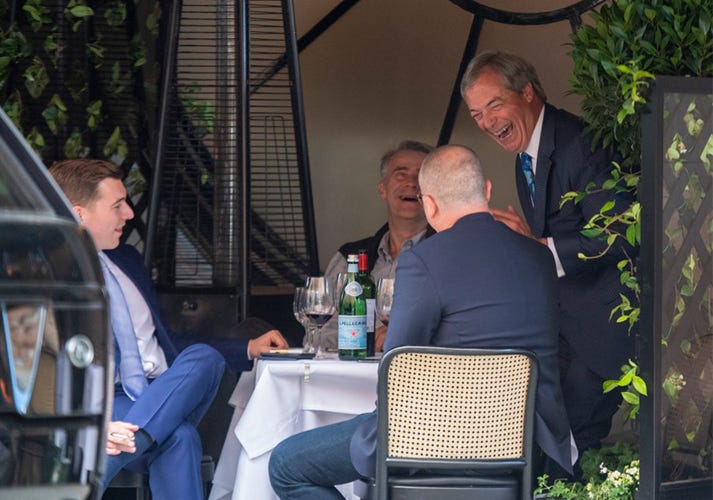
That meeting is real, we have the photographic evidence. What we can’t establish is what was said at that meeting. There are no minutes. No contract. No corporate document I have seen says: this meeting created the gambling business.
So we leave the line dotted. That is what an investigation is supposed to do. But the connections are mounting up all the same, we just haven’t established the smoking gun yet. But circumstantially, the whole shit show stinks to high heaven.
Strip away all the excitement, all the political tribalism and all the desire to yell “gotcha”, and the underlying structure is still extraordinary.
Christopher Harborne is a major financial supporter of Nigel Farage and Reform UK.
Harborne holds a substantial minority interest in Tether.
Tether relocated its headquarters to El Salvador.
Farage received a £5 million personal gift from Harborne shortly after reportedly telling Reform colleagues that returning to politics would require roughly £1 million a year.
Farage subsequently became a prominent opponent of the Bank of England’s digital-currency plans.
George Cottrell has provided significant financial and practical support around Farage.
Cottrell transferred more than $2 million to his mother shortly before she made large donations benefiting Reform.
Cottrell separately lent £78,100 to Richard Tice’s company.
A gambling operation called Tether.bet served British customers without a UK gambling licence.
A company owned by Harborne sat in its reported payment chain.
Cottrell was closely connected to the operation according to investigative reporting, although he denies being an operator.
Tether.bet has now shut down.
And Reform UK wants Britain to enter into a prison arrangement with El Salvador, where Tether is headquartered.
Those are the facts currently on the board.
Here is where I disappoint anyone hoping for the final scene from a conspiracy thriller. I cannot establish that Christopher Harborne told Nigel Farage what to say about cryptocurrency.
I cannot establish directly that Tether had anything to do with Tether.bet. I cannot establish that George Cottrell controlled Tether.bet. I cannot establish that Harborne, Cottrell or Tether introduced Reform UK to Nayib Bukele’s government.
I cannot establish that Reform’s El Salvador policy was designed to benefit Tether.
And I cannot establish that the millions of pounds flowing around this network represent anything unlawful beyond the matters already being examined by authorities.
That does not make the investigation a damp squib. Quite the opposite. Because journalism is not supposed to begin with the answer and reverse-engineer the evidence until it fits. Too many mainstream media outrage machine outlets do that these days, so I have to stick to the facts I can find.
The uncomfortable reality though is more interesting.
Nigel Farage has built his political operation around a remarkably concentrated group of wealthy supporters. Some of those supporters have complicated international business interests. Some of their money has travelled through unusual routes. Some transactions have concerned bankers enough to be reported to the authorities. Police and parliamentary regulators are examining parts of that financial landscape.
One of Farage’s biggest benefactors owns a significant chunk of the world’s dominant stablecoin business. That business moved to El Salvador. Farage has challenged British policy in a way potentially advantageous to private stablecoins. His party wants a commercial relationship with El Salvador.
And another offshore enterprise, carrying the Tether name but with no proven corporate relationship to Tether itself, has now pulled Harborne and Cottrell into the same story through its payment network.
You do not need to invent a conspiracy.
The documented network is already worthy of scrutiny.
There is one question I keep returning to.
Not “Did Tether order Reform’s El Salvador policy?” There is no evidence for that. Not “Did Harborne buy Farage?” There is no evidence establishing that either.
The useful question is much smaller.
Who introduced Reform UK to the government of El Salvador?
Reform says talks have already happened. So somebody made contact. Somebody knew whom to call. Somebody arranged the conversation.
Perhaps the answer is completely mundane. A diplomat. An adviser. A Reform staff member following the Trump precedent. Perhaps the Salvadoran government itself approached them.
If so, fine. Establishing that would actually remove one of the most intriguing possible connections in this story.
But until that answer exists, the line remains open. And there are rather a lot of lines of enquiry already open here. The money around Nigel Farage does not move in straight lines. It moves through donors, businesses, friends, relatives, private gifts, companies, loans and offshore jurisdictions.
That alone does not make any of it corrupt. It does make one thing increasingly difficult to argue, as Nigel keeps trying to shrug it off, the net is closing, and the money web is revealing itself.
And the more you look into it, the more it looks like Reform, Farage and even Tice’s hands are far from clean in all of this. We will see how the many on-going investigations into them play out.
Thanks for reading! This post is public so feel free to share it.
Stop the Boats, Start the Bullshit
Who Is Behind Turning Point UK?: Nick Tenconi, UKIP and the network bringing American-style Christian nationalism into British politics
When Does a Riot Become Terrorism: The uncomfortable question raised by Thetford
The World’s Smallest Violin for Britain’s Biggest Victim
The Ann Widdecombe Case and the Mechanics of Narrative Collapse
Bin Face vs Frog Face - Special Report: Clacton 2026 Candidate Assessment
The Political Obituary of Nigel Farage (We Hope)
Nigel Farage: The Billionaire’s Man of the People
The Fall of Nigel Farage: The Pint-Man Prophet Finds the Bar Tab
Farage’s Brexit Betrayal Myth Is Just the Same Old Con in a New Hat
Farage Is Not Demanding Democracy. He Is Demanding Advantage.
Farage vs the Evidence: A forensic dismantling of the “two-tier Britain” narrative
How Do You Bring Them Back?: The Outrage Machine, the Failure of Politics, and the Working-Class Case for Reason How do you bring them back?
The Tide Is Coming In: Migration Is History Coming Home
Don’t Let Them Turn Henry Nowak Into a Race War Poster
Is Britain Turning Far Right, or Is the Megaphone Just Too Loud?
Fear, Freedom, and the Emotional Architecture of Politics
Democracy, Populism, and the Death of the Nation-State
Reform UK and the Cult of the Outrage Machine
Normalising Hate: The Political Decay of Post-Brexit Britain
Exposing the “Grooming Gangs” Myth: White British Men and the Truth About Sexual Abuse in the UK
The Big Lie vs The Big Truth: Who Really Abuses Women and Children in the UK
Debunking Common Myths About Immigrants and Asylum Seekers in the UK

No posts
Comments
Nothing yet. Say the first thing.
Sign in to join the conversation.