
Jason Arday’s death should not be turned into somebody else’s political prop.
That needs saying first, because there is already a temptation to make the story tidier than the evidence allows. Professor Arday died on 13 August, little more than a week after resigning from Cambridge amid renewed allegations about plagiarism and aspects of his academic record. His family subsequently described years of sustained abuse and said the latest campaign of misinformation had become too much for him. People close to him have spoken about the devastating effect the loss of his career and reputation was having on his mental health.
None of that gives us licence to say Nathan Cofnas killed Jason Arday. It does not give us licence to say Cambridge killed him, or the newspapers killed him, or that some shadowy cabal sat around a mahogany table and engineered the whole thing.
There is no evidence for that. And in these pieces I research and write, I can only work with the evidence, the facts, and hopefully still reveal a network beneath the news that needs examining.
Arday’s death has forced attention onto the people who were attacking him, and once you start looking carefully at one of the most prominent of them, Nathan Cofnas, you very quickly discover that you are no longer looking at one unpleasant academic with some grotesque ideas about race.
You are looking at a complex network of academics and political figures. Not a secret society. Not a single organisation. Not a conspiracy in which everyone receives instructions from the same Bond villain stroking a cat in in a big black leather chair.
Something rather more mundane, and therefore potentially more powerful.
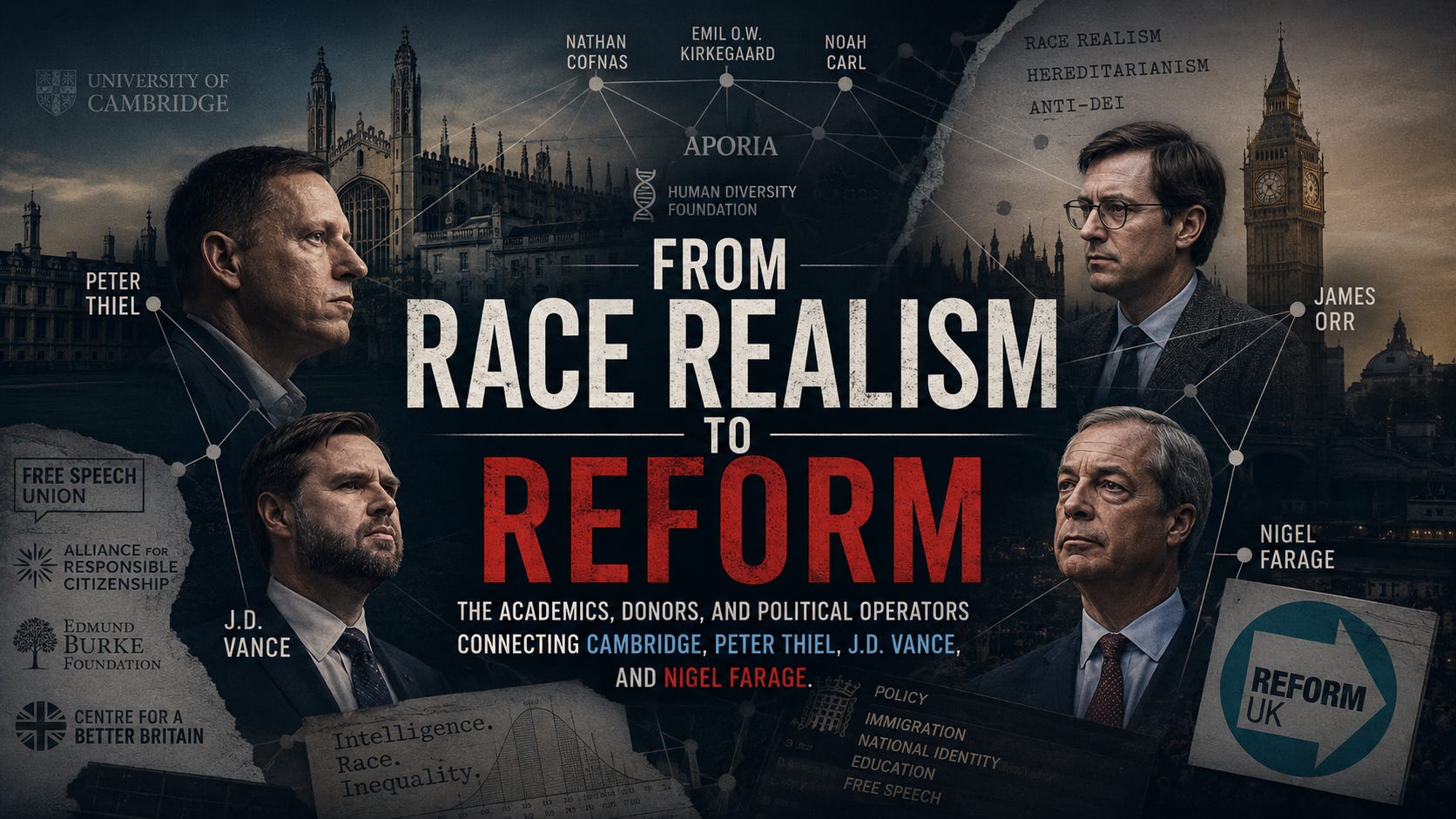
A network of academics, publications, donors, think tanks, legal campaigners and political operators. They do not all believe the same things. They do not all work together. Some would reject the views of others completely. But they do overlap. They publish one another. They appear at the same conferences. They recommend one another to wealthy patrons. They sit on one another’s boards. They defend one another’s right to speak. And, eventually, some of them end up helping to write policy for political parties.
That last bit matters. Because one end of this story contains people discussing genetic differences between races. The other contains Nigel Farage, and Reform.
And between those two points are considerably fewer degrees of separation than I expected.
Cofnas is useful because he is unusually frank.
A lot of modern hard-right politics arrives wrapped in euphemism. “National preference.” “Academic freedom.” “Meritocracy.” “Civilisational confidence.” “Demographic change.” “Restoring standards.”
Cofnas dispenses with much of the wrapping.
He describes himself as a “race realist” and hereditarian. He argues that average differences between racial groups in intelligence and other characteristics have substantial genetic causes. He opposes affirmative action and DEI programmes, and he believes mainstream conservatism cannot defeat what he calls “wokism” without first persuading elites to accept his view of racial difference.
He calls the project a “hereditarian revolution.” Again, not my phrase. His.
In perhaps his most notorious passage, Cofnas imagines a genuinely colourblind American meritocracy and predicts that Black representation at Harvard would collapse. Black professors, he writes, would approach zero. Black people would disappear from almost all high-profile positions outside sport and entertainment.
There are ways of debating affirmative action. There are ways of debating merit, social mobility, educational inequality and admissions policy.
“Almost no Black people would make it on merit” is certainly one of the more revealing contributions to the genre.
But the really important part of Cofnas’s writing is not simply what he thinks about Black intelligence. It is what he thinks should happen next.
Cofnas talks explicitly about winning over elites. His argument is that changing laws is insufficient because institutions will remain governed by people who believe in racial equality. What has to change, in his view, is the intellectual consensus itself. A new counter-elite must be built. Universities, media and other institutions must be persuaded to accept hereditarian explanations of racial inequality.
He approvingly quotes a political formula that runs from winning arguments, to winning elites, to winning regimes. That is not somebody idly wondering about IQ statistics. That is a political strategy.
And it is worth being very precise about what Cofnas is not, because precision makes the rest of this story stronger.
He is not a Christian nationalist. He is culturally Jewish and secular. He has publicly rejected white nationalism and antisemitism, and has defended Israel. He does not appear to belong to an extremist organisation, nor does the evidence show him advocating political violence.
Indeed, part of Cofnas’s project appears to involve rescuing hereditarianism from precisely the people who make it impossible to sell.
He has criticised neo-Nazis, antisemites and white nationalists within the broader race-realist world. The problem, from his point of view, is not that biological racial hierarchy is morally toxic. The problem is that too many of the people associated with it are so obviously toxic that respectable elites will not listen.
So the project becomes one of rehabilitation. Remove the swastikas. Add footnotes, and get your hate speech peer-reviewed.
Cofnas is not operating alone. Around him sits a cluster of researchers and writers concerned with intelligence, genetics, racial differences and what is sometimes called “human biodiversity”.
Names recur. Emil O. W. Kirkegaard. Noah Carl. Bo Winegard. Richard Hanania.
There is also Aporia, an online publication which became an important home for arguments about hereditarianism, intelligence and race. And behind some of these projects sat something more tangible than internet debate: money.
The Human Diversity Foundation, established in the United States, became a significant funding vehicle for research and media associated with race and intelligence. Investigative reporting established that American technology entrepreneur Andrew Conru provided more than $1 million to the organisation. After being confronted with evidence about what some of the network had become involved with, Conru withdrew his support and said the project appeared to have moved away from the non-partisan academic research he thought he was supporting.
That is important because it demonstrates something which is too often missed when this material is dismissed as a collection of strange men arguing. There is infrastructure, researchers, publications, podcasts, conferences, grants, patrons.
This does not prove that everyone funded through this ecosystem is a racist or shares Cofnas’s views. It does mean these ideas are not simply floating around without institutional support.
But then we get to Peter Thiel.
Peter Thiel appears repeatedly when you start mapping the modern intellectual right.
Thiel is not simply a wealthy conservative donor. He has spent years cultivating intellectual movements and political figures, supporting contrarian thinkers and searching for alternatives to liberal democracy’s prevailing assumptions.
Most famously, he became an extraordinary political patron of JD Vance. Thiel backed Vance professionally and then poured $15 million into supporting his 2022 Senate campaign.
That relationship is not conjecture. It is one of the defining financial relationships in modern American conservative politics.
But Thiel also appears on the edges of the race-science story.
According to investigative reporting, Emil Kirkegaard met Thiel in 2019. Kirkegaard subsequently said he recommended Nathan Cofnas and Noah Carl to Thiel as researchers whose work might interest him.
That is the evidence. There is no evidence that Thiel subsequently funded Cofnas. There is no evidence that he funded Noah Carl. There is no evidence that Peter Thiel secretly bankrolls the modern race-realist movement. But somebody within the race-science ecosystem meeting one of the most influential political billionaires in America and recommending Cofnas and Carl to him is not meaningless either.
It is a connection. And connections is what this piece of research I’ve done is about. And Thiel connects elsewhere in this story much more directly.
To JD Vance. And to James Orr.
If Nathan Cofnas is the intellectual starting point of this investigation, James Orr may be the most politically consequential person in it.
Orr is a Cambridge academic in philosophy of religion and a major figure in British National Conservatism. He has spent years building relationships across the Anglo-American right.
He is close to JD Vance. He has been described as Vance’s British intellectual guide or “sherpa”. Their relationship is personal as well as political. Vance and his family have stayed with Orr. Orr has praised Vance publicly and moved within the same National Conservative circles.
Orr also has his own relationship with Peter Thiel. At the Mathias Corvinus Collegium’s 2025 summer festival in Hungary, Orr interviewed Thiel on stage. Then in early 2026 Orr hosted Thiel at Cambridge for a series of talks known as the Antichrist Lectures.
Whatever else one thinks about that title, you have to admire the total absence of subtlety. So now we have a documented route:
Kirkegaard meets Thiel and recommends Cofnas and Carl.
Thiel becomes the decisive financial patron behind Vance’s political rise.
Vance is closely connected to James Orr.
Orr himself hosts and interviews Thiel.
And then James Orr goes to work for Nigel Farage.
Not metaphorically. Not in the vague sense that he writes articles Farage might have read. Orr became a senior adviser to Farage and subsequently Reform UK’s Head of Policy.
That is the point where this stops being merely a story about strange ideas travelling through universities. The ideas have reached somebody whose job is helping shape the platform of a political party seeking government in Britain.
Orr is interesting precisely because he is not Nathan Cofnas.
He is not a race scientist. I have found no evidence that Orr believes Black people are genetically less intelligent than white people. I have found no evidence that he supports Cofnas’s hereditarian programme.
Drawing that line without evidence would be intellectually lazy and journalistically reckless.
Orr belongs to a different ideological tradition. National Conservatism. Post-liberalism. Christian conservatism. A politics which argues that liberal individualism has weakened nation, religion, family and social cohesion, and that government should actively restore those things.
Orr speaks about a “politics of national preference”. He has praised Viktor Orbán’s Hungary. He has advocated a British equivalent of America’s ICE immigration agency. He takes deeply conservative positions on abortion and national identity.
He also sits inside an extraordinary collection of organisations.
The Edmund Burke Foundation, associated with the National Conservatism movement.
The Alliance for Responsible Citizenship, which brings together major figures from the international religious and cultural right.
The Free Speech Union.
The Roger Scruton Legacy Foundation.
The Centre for a Better Britain.
Different organisations. Different purposes. But Orr provides the bridge.
And some of those bridges lead directly to Viktor Orbán’s Hungary.
The Mathias Corvinus Collegium is one of the most significant institutions in Orbán’s intellectual ecosystem. It is heavily supported by assets provided by the Hungarian state and has been used to cultivate conservative intellectual networks internationally.
James Orr has appeared at MCC events.
The Roger Scruton Legacy Foundation, where Orr has been a director, has reportedly received more than £500,000 from MCC, representing the overwhelming majority of its funding during the relevant period.
Again, we need to resist the seductive stupidity of the conspiracy diagram.
Receiving money from an Orbán-connected institution does not mean Viktor Orbán phones James Orr every Tuesday morning with fresh instructions. It does mean substantial Hungarian-backed money has helped sustain organisations within the same British National Conservative ecosystem that Orr occupies.
That is relevant.
Particularly because Orr now writes policy for Reform UK.
There is one particularly interesting institutional crossover between Orr’s world and Cofnas’s.
The Free Speech Union.
The FSU, led by Toby Young, supported Nathan Cofnas during his dispute with Emmanuel College after the college terminated its association with him over his writings. The FSU framed its involvement as a free-speech issue.
There is no evidence that the organisation endorsed Cofnas’s hereditarian views. Defending somebody’s right to say something is not the same as agreeing with what they said. But James Orr sits on the FSU’s advisory council.
Which means we now have another institutional intersection.
Cofnas enters the FSU ecosystem because of his race-realist controversy.
Orr sits within the same organisation while simultaneously operating in National Conservative circles. Orr then becomes Reform’s policy chief.
That does not prove Cofnas’s racial ideas travelled into Reform.
It proves the networks overlap.
Which is what I’m attempting to show here, how all these people connect, in a growing global network.
The clearest bridge into Reform is the Centre for a Better Britain.
Orr chaired its advisory board before moving directly into Farage’s operation.
Leaked documents reported in the British press described the organisation as being in direct contact with Reform UK and Nigel Farage. Its financial backing reportedly came from two significant Reform donors, David Lilley and Mark Thompson.
So here the chain is not ideological inference.
It is organisational. Reform donors fund a policy organisation. James Orr chairs its advisory structure. The organisation communicates directly with Farage. Orr then becomes Farage’s adviser and Reform’s head of policy.
That is about as direct as political influence gets. The Centre describes its mission in terms very similar to Orr’s own rhetoric: post-Brexit, pro-nation, pro-sovereignty and built around what he calls national preference.
Reform’s subsequent platform has increasingly emphasised similar themes: aggressive immigration restriction, opposition to DEI, stronger nationalism and major institutional confrontation.
We should not claim Orr personally invented every Reform policy that resembles something he has previously advocated. We do not have the internal documents to prove that. But neither should we pretend the appointment of an ideological intellectual as Head of Policy has nothing to do with policy.
That would require its own impressive feat of cognitive dissonance.
This investigation began with a suspicion that we might be looking at a network of Christian nationalist academics pushing racial theories. The evidence does not support that, but it does show that there is a network of hard right conservative academics that have political influence and ties in the UK, USA and into Europe.
So to recap, what we can and can’t say. Cofnas is not a Christian nationalist. Noah Carl is not meaningfully part of a Christian nationalist project. Kirkegaard is not best understood through religion. The race-realist side of the network is largely secular and obsessed with genetics, intelligence and heredity.
The National Conservative side is different.
James Orr, Patrick Deneen, Rod Dreher and others draw heavily from Christianity, post-liberal political theory, national identity and arguments against modern liberalism.
JD Vance’s Catholicism is increasingly important to his worldview.
Yoram Hazony’s National Conservatism is rooted in a religious understanding of nationhood, but Hazony is Jewish, which rather complicates the lazy habit of labelling every traditionalist movement “Christian nationalism”.
The most accurate picture is not one ideology. It is overlapping ideologies with common enemies.
Liberalism. DEI. Multiculturalism. Immigration. Universalist ideas about equality. Political influences in contemporary university. The administrative state, and the belief that institutions should remain politically neutral.
They disagree about why these things are wrong. They may diagnose them differently, but they have a remarkably similar list of targets.
And then we return to where this started.
Jason Arday.
The allegations concerning his academic work did not originate entirely with Nathan Cofnas, and the subsequent evidence cannot simply be wished away because Cofnas holds appalling views about race.
Liverpool John Moores University had previously investigated allegations concerning Arday’s PhD and did not uphold plagiarism charges, attributing problems to honest and reasonable error.
Cambridge initially defended Arday strongly. Then new material appeared. Cofnas publicised alleged textual overlaps. The Times conducted its own examination. Other newspapers investigated further questions about Arday’s academic work and biography.
Cambridge announced a new investigation. Arday resigned. He denied wrongdoing.
Days later, he was dead.
We do not know what the outstanding investigations would ultimately have concluded.
We do know his family says he had suffered years of abuse and that the latest campaign had become unbearable. We know people close to him described a man devastated by the destruction of his reputation.
And we know that one of the people driving renewed scrutiny was an academic who has publicly written that, in a genuine meritocracy, Black people would disappear from almost every elite occupation outside sport and entertainment.
That does not invalidate evidence Cofnas produced. He’s not a stupid man, he maybe a dangerous man, but he knows his game. Facts do not become false because the person presenting them is vile. But neither does it make Cofnas’s worldview irrelevant when examining his sustained interest in one of Britain’s most prominent Black academics.
Motivation and evidence are different questions.
Both deserve scrutiny.
The easiest way to discredit this entire subject would be to claim that Peter Thiel secretly pays Nathan Cofnas to develop racist theories which James Orr then whispers into Nigel Farage’s ear. That’d be a neat connection to make, but as it stands now there is no direct evidence for that.
There is no evidence Thiel funded Cofnas, or Reform UK is controlled by the Human Diversity Foundation through James Orr. There is no evidence that James Orr endorses racial hereditarianism. Or any evidence of a central committee coordinating any of this.
There does not need to be.
Modern political movements rarely operate that way. This is something my investigations are showing, a pattern of flexible networks.
One person funds a research foundation. Another edits a magazine. Somebody recommends a researcher to a billionaire. The billionaire finances a politician. The politician befriends an academic. The academic builds institutions and conferences. A free-speech organisation provides legal support when somebody in another part of the network gets thrown out of a college.
A think tank takes money from political donors. Its chairman joins a political party. Ideas that once lived in obscure journals start appearing in mainstream political language.
Nobody has to issue orders. They only have to keep opening doors for one another.
The most disturbing thing I found during this research was none of this is a secret. It is all out there, to be found online, openly in public. Nathan Cofnas publishes his racial theories openly. The Human Diversity Foundation’s financial backing became documented. Peter Thiel’s support for JD Vance is public record. James Orr’s relationship with Vance is discussed openly. Orr interviewed Thiel in Hungary and hosted him in Cambridge.
James Orr’s positions in National Conservative organisations are public. His involvement with the Centre for a Better Britain is public. That organisation’s links to Reform and Reform donors have been reported. And Orr is now Head of Policy for Reform UK.
There is no hidden chamber. There is an ecosystem.
That may be harder to dramatise than a conspiracy, but politically it is much more interesting. Because conspiracies require coordination. Ecosystems only require compatibility.
And what links these people is not that they all agree about race, Christianity, genetics, democracy or even capitalism. It is that different sections of the hard right have discovered they can help one another dismantle the liberal institutions they all dislike for different reasons.
The race realist wants to destroy egalitarian assumptions. The post-liberal wants to destroy liberal individualism. The National Conservative wants to restore national hierarchy. The anti-DEI activist wants to capture institutions.
The billionaire wants political and intellectual alternatives to the existing order.
The populist party wants policy, personnel and money.
Nobody needs to agree on everything. They only need to agree on what has to go. And now some of the people who spent years debating how to replace that order are no longer merely writing essays about it.
They are advising governments. Funding politicians. Building institutions.
And, in Britain, helping write the policies of Nigel Farage’s Reform UK.
That is not a conspiracy theory.
It is considerably more ordinary than that.
Which is precisely why we should be paying attention.
Thanks for reading! This post is public so feel free to share it.
The Farage Money Web: Tether, Cottrell, millions in unexplained political finance, and the road that keeps leading back to El Salvador
Stop the Boats, Start the Bullshit
Who Is Behind Turning Point UK?: Nick Tenconi, UKIP and the network bringing American-style Christian nationalism into British politics
When Does a Riot Become Terrorism: The uncomfortable question raised by Thetford
The World’s Smallest Violin for Britain’s Biggest Victim
The Ann Widdecombe Case and the Mechanics of Narrative Collapse
Bin Face vs Frog Face - Special Report: Clacton 2026 Candidate Assessment
The Political Obituary of Nigel Farage (We Hope)
Nigel Farage: The Billionaire’s Man of the People
The Fall of Nigel Farage: The Pint-Man Prophet Finds the Bar Tab
Farage’s Brexit Betrayal Myth Is Just the Same Old Con in a New Hat
Farage Is Not Demanding Democracy. He Is Demanding Advantage.
Farage vs the Evidence: A forensic dismantling of the “two-tier Britain” narrative
How Do You Bring Them Back?: The Outrage Machine, the Failure of Politics, and the Working-Class Case for Reason How do you bring them back?
The Tide Is Coming In: Migration Is History Coming Home
Don’t Let Them Turn Henry Nowak Into a Race War Poster
Is Britain Turning Far Right, or Is the Megaphone Just Too Loud?
Fear, Freedom, and the Emotional Architecture of Politics
Democracy, Populism, and the Death of the Nation-State
Reform UK and the Cult of the Outrage Machine
Normalising Hate: The Political Decay of Post-Brexit Britain
Exposing the “Grooming Gangs” Myth: White British Men and the Truth About Sexual Abuse in the UK
The Big Lie vs The Big Truth: Who Really Abuses Women and Children in the UK
Debunking Common Myths About Immigrants and Asylum Seekers in the UK
No posts
Comments
Nothing yet. Say the first thing.
Sign in to join the conversation.