
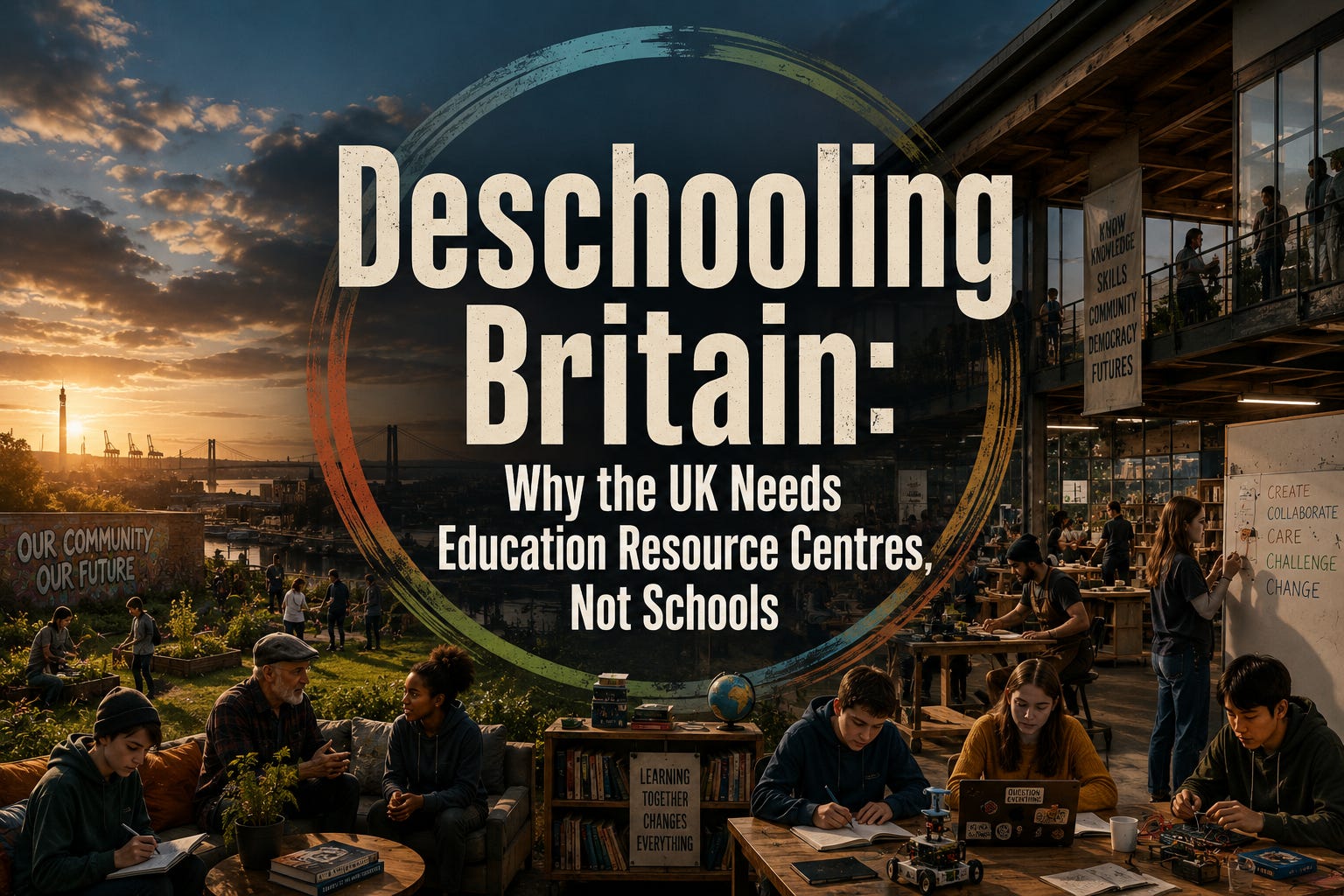
This essay is part of my ongoing series Deschooling Britain: Why the UK Needs Education Resource Centres, Not Schools. Across the series, I’m arguing that education and schooling are not the same thing, and that Britain needs to think far more radically about how people actually learn. Instead of endlessly patching a failing school system, I’m exploring the case for public Education Resource Centres: community-rooted learning spaces built around self-actuated learning, inclusion, peer exchange, AI literacy, practical knowledge, civic life, and the simple idea that education should belong to everyone, not just the timetable.
The argument began with a simple refusal.
Education is not schooling.
That sounds obvious once said plainly, but it is one of those truths a whole society can misplace for generations. We have treated school as if it were the natural container of education, as if learning becomes serious only when enclosed by timetable, uniform, classroom, attendance code, assessment grid and the grim little machinery of institutional measurement. We have confused the building with the act, the process with the purpose, the grade with the person, the system with the life it claims to serve.
And because of that confusion, we keep trying to repair the wrong thing.
Every few years, Britain announces another educational fix. More rigour. More discipline. More phonics. More maths. More academies. More behaviour policies. More inspection. More aspiration. More skills. More accountability. More technology. More ministerial phrases arranged into a shape that briefly resembles thought. The machinery is adjusted. The vocabulary changes. The deeper assumption remains untouched.
Children go to school.
School delivers education.
Education is measured.
The system continues.
But what if the assumption itself is the problem?
What if the crisis is not simply that schools are underfunded, overtested, overstretched, unequal, punitive, narrow, exhausted and increasingly asked to absorb every social failure produced elsewhere, though all of that is true enough? What if the deeper crisis is that we have allowed one institutional form to monopolise the meaning of education?
That is the question this essay has tried to hold open.
Not as a glib attack on schools. Not as a sneer at teachers. Not as a fantasy in which children educate themselves through vibes, broadband and a table full of craft supplies. The best teachers are often the last human force resisting the deadening logic of the system they work inside. They build relationships where policy builds categories. They notice children whom data merely tracks. They keep humour alive in places where bureaucracy would happily laminate the soul if it improved compliance.
This is not an argument against teachers.
It is an argument against making teachers defend a structure too narrow for the educational work now required.
The school has become overloaded because so much else has been stripped away. Youth services, libraries, adult education, public space, community support, mental health provision, local culture, civic trust. Schools are asked to compensate for broken social infrastructure while being judged as if children arrive untouched by poverty, housing, hunger, trauma, digital life, family stress, racism, disability, loneliness or the low hum of national exhaustion.
Then, when children struggle, the system names the child.
Disruptive.
Absent.
Low ability.
Not engaged.
Behind.
At risk.
Excluded.
The labels may sometimes describe something real, but they rarely ask the deeper question: what kind of educational world did this child enter, and what did it make possible or impossible?
Ivan Illich warned us about institutions that define need and then present themselves as the solution. Schooling did exactly that. It taught us to believe that education is something delivered by authorised institutions, in authorised spaces, according to authorised sequences, measured by authorised outcomes. Learning outside that frame became informal, secondary, supplementary, enrichment, hobby, life experience. Nice, perhaps. Not quite official.
But human beings do not learn only officially.
They learn in streets, kitchens, parks, buses, bedrooms, workshops, care homes, libraries, shops, gardens, online spaces, youth clubs, community centres, arguments, friendships, work, grief, boredom, failure, repair, play and the strange accidental moments when the world breaks through the programme. Illich understood the educational power of the unplanned. Colin Ward understood that children read and remake the city long before adults give them permission. Paulo Freire understood that education must help people read the world, not merely decode approved texts about it. Dewey understood that education is life itself, not preparation for life. bell hooks understood that liberation requires the whole person to enter the learning space. Holt understood that children often learn more about fear, evasion and performance from school than any curriculum document is willing to admit.
These thinkers do not give us a finished model.
They give us permission to stop mistaking the current one for destiny.
The Education Resource Centre is one attempt to imagine what comes after that permission.
Not a school with beanbags.
Not a youth club with better Wi-Fi.
Not a library rebrand.
Not alternative provision in a nicer font.
Not an edtech showroom where children are quietly handed over to platforms while adults congratulate themselves on modernity.
An Education Resource Centre is a public learning commons. A civic institution built around the understanding that education is self-actuated, supported, social, practical, intellectual, digital, emotional, democratic and lifelong. It gathers resources, but understands resources broadly: books, tools, workshops, studios, kitchens, digital labs, AI systems, mentors, peers, elders, archives, gardens, questions, histories, community problems, expert knowledge and lived experience.
It asks a different first question.
Not, “What lesson are you in?”
But, “What are you trying to understand, make, solve, practise, repair, question, express or become?”
That question changes everything.
It changes the learner from passive recipient to active participant. It changes the adult from commander to facilitator, without removing expertise or authority. It changes assessment from exam worship to evidence of growth. It changes community from backdrop to curriculum. It changes AI from cheating machine or corporate saviour into one tool in the commons. It changes inclusion from retrofit to design principle. It changes education from childhood processing to public infrastructure.
The model is not anti-structure.
That accusation must be buried properly. Education Resource Centres would need more intelligent structure, not less. Safeguarding. Core skills. Literacy. Numeracy. Direct teaching. Specialist support. Portfolios. External moderation. Qualifications. Formal pathways. Professional facilitators. Community governance. Clear entitlements. Rigorous evaluation. Strong public funding. AI ethics. SEND expertise. Family support. Serious training. Public accountability.
Freedom without scaffolding reproduces inequality.
Support without freedom reproduces schooling.
That is the hinge.
Self-actuated learning does not mean leaving learners alone to discover themselves while adults hover nearby composing grant reports. It means learning activated from within the learner and supported from around them. It means curiosity, interest, anger, skill, need, place, identity and question become starting points, not endpoints. The facilitator’s job is to widen the room. Gaming opens into code, narrative, ethics and probability. Cooking opens into chemistry, culture, health and budgeting. A local housing problem opens into politics, statistics, planning, law and journalism. Music opens into maths, history, technology and emotion. A bike repair opens into mechanics, sustainability, design and care.
Relevance begins the journey.
It does not limit the destination.
That distinction is crucial, especially for working-class learners and marginalised communities. Too often, education systems offer the poor a smaller education dressed up as practicality. Life skills instead of philosophy. Employability instead of history. Behaviour repair instead of intellectual depth. Basic competence instead of beauty. The Education Resource Centre must reject that. Every learner has the right to powerful knowledge, difficult knowledge, abstract knowledge, practical knowledge, creative knowledge, civic knowledge, and the kind of knowledge that makes them harder to manage.
That is why inclusion sits at the heart of the model.
Not as a separate department.
Not as a laminated policy.
Not as the heroic labour of a SENCO trying to hold back the tide with a spreadsheet and a half-hour meeting.
Inclusion means designing from difference. It means understanding that there is no standard learner, only systems that pretend there is one because administration finds variety inconvenient. It means sensory-conscious spaces, flexible time, assistive technology, direct support, trauma-informed relationships, high expectations, multiple forms of assessment, family trust, specialist provision and dignity. It means not making children prove distress before the environment adapts. It means seeing the learner who does not fit not as the problem to be solved, but as the test of whether the system deserves to exist.
If an Education Resource Centre only works for the confident, articulate, already-supported learner, then it has failed.
The measure is the anxious learner. The autistic learner. The dyslexic learner. The young carer. The excluded learner. The bored learner. The angry learner. The traumatised learner. The gifted but institutionally allergic learner. The learner who has been told, explicitly or quietly, that education is not for them.
Can the model make a place for them without lowering the ceiling?
That is the test.
Assessment must follow the same logic. Exams may remain where useful, but they cannot remain the organising religion of childhood. A grade can be useful. It can also be absurdly small. It cannot show the whole learner. It cannot show process, reflection, collaboration, contribution, recovery, revision, teaching, making, caring, questioning or the moment a young person begins to believe their own mind has weight.
Portfolios, exhibitions, peer review, mentor feedback, practical demonstrations, written work, oral defence, formal qualifications and public contribution together give a richer picture. They show learning in motion. They make it harder for AI to replace thought because the learner must explain process, choices, mistakes, evidence and development. They allow literacy and numeracy to be protected without reducing all education to test preparation. They honour the fact that real competence often appears through doing, revising, explaining and contributing, not merely through sitting silently under timed conditions.
The grade pins.
The portfolio moves.
And education is movement.
The evidence does not give us a finished national ERC system. It gives us something more honest: the components are already alive. Peer tutoring works when structured. Metacognition matters when taught properly. Collaborative learning works when designed well. Makerspaces can develop practical and creative capacities. Reggio Emilia shows the pedagogical power of environment, documentation and civic respect for children. Hellerup shows how architecture can embody different assumptions. Big Picture Learning shows advisory relationships, projects, exhibitions and internships can structure serious personalised learning. Democratic schools show that young people can participate in governance. Libraries, Idea Stores, DOKK1 and public makerspaces show that learning infrastructure can exist beyond school. AI research suggests potential when tools support rather than replace thinking.
None of this proves the whole model.
It does prove the model is not fantasy.
The organs are alive. What is missing is the public body to hold them together.
International comparison makes the same point in another way. Finland, Estonia, Denmark, Reggio Emilia, South Korea, each teaches something different. Trust matters. Digital public infrastructure matters. Architecture matters. Documentation matters. Civic culture matters. Seriousness about learning matters. But performance is not the same as human flourishing. A system can produce results and still wound the people inside it. A system can credential people without genuinely educating them. A system can appear successful because it has become very good at measuring what it already values.
The lesson is not that Britain should copy anyone.
The lesson is that education systems are choices.
Britain has made choices too. High-stakes accountability. Market logic. Inspection pressure. Narrowing measures. Weakening public infrastructure. Treating adult education, youth work and libraries as expendable edges. Expecting schools to fix what social policy damages. Treating technology as either threat or procurement opportunity. Reducing community knowledge to enrichment. Treating children as future workers before they are present citizens.
These choices can be unmade.
Or, more accurately, better choices can be built.
That building must begin carefully. Not with revolution by press conference. Not with abolishing every school and hoping Tuesday discovers a pedagogy. It begins with pilots, places and proof. A serious Education Resource Centre in a real community. High-status, publicly funded, professionally staffed, democratically governed, properly evaluated. Start where need is great, but do not create second-class provision. Build with the community, not on it. Use existing civic spaces where possible. Connect libraries, colleges, universities, youth work, adult learning, digital access, workshops, family support and local expertise. Give every learner a named facilitator and a learning plan. Protect core skills. Offer qualifications. Build portfolios. Publish evidence. Learn from failure. Build again.
Hull would be one place to imagine this, not as a site of deficiency, but as a city dense with memory, humour, struggle, culture and local intelligence. But the model could grow elsewhere too, shaped by place. The point is not to clone. The point is to create a national framework for local learning commons.
A country serious about education would not ask only how to improve schools.
It would ask what public learning infrastructure the twenty-first century requires.
Because the future we are sending young people into is not stable. AI is transforming knowledge work. Climate crisis is reshaping place. Misinformation is corroding public life. Work is insecure. Communities are fragmented. Mental health is strained. Democracy is brittle. Loneliness is rising. The old promise that school leads neatly to job, stability, citizenship and belonging now looks increasingly like a brochure from a country that no longer exists.
In that world, children need more than schooling.
Adults need more than memories of schooling.
Communities need more than underfunded institutions trying to survive.
We need places where people learn how to learn again. Together. Across age, background and ability. With books and tools, screens and gardens, arguments and archives, kitchens and studios, data and stories, AI and human judgement, formal knowledge and local memory. Places where practical intelligence and academic knowledge meet without one patronising the other. Places where young people are not processed but known. Places where adults can return to learning without shame. Places where older generations are not discarded. Places where community problems become shared inquiry. Places where education is not a corridor to the labour market but a practice of freedom, competence, contribution and democratic life.
That is what Education Resource Centres could be.
Not perfect.
Not easy.
Not cheap.
Not immune to bureaucracy, capture, failure, stupidity, political cowardice or the British instinct to turn every good idea into a pilot scheme with a logo and no heating.
But possible.
And possibility matters.
Because one of the most damaging things a failing system does is shrink imagination. It teaches people that the current arrangement is the only serious arrangement. That every alternative is naïve. That every radical proposal is childish. That realism means accepting managed decline with better branding. That the best we can do is repair the machinery, oil the gears, adjust the sorting mechanism and hope fewer children fall through before the next inspection cycle.
No.
Realism should begin with reality.
The reality is that schooling, as currently designed, is too narrow for the educational, social and civic tasks being demanded of it.
The reality is that teachers cannot keep absorbing the failures of wider society while being blamed for the results.
The reality is that children learn in the world, not only in classrooms.
The reality is that communities hold knowledge the system wastes.
The reality is that exams measure some things and distort others.
The reality is that AI will change learning whether institutions are ready or not.
The reality is that inclusion cannot be built as an afterthought.
The reality is that public learning infrastructure has been weakened precisely when we need it most.
And the reality is that education is too important to leave trapped inside one inherited institutional form.
The school was one way of organising education.
It does not have to be the last.
If Britain is serious about learning, it must become brave enough to imagine education after school.
Thanks for reading! This post is public so feel free to share it.
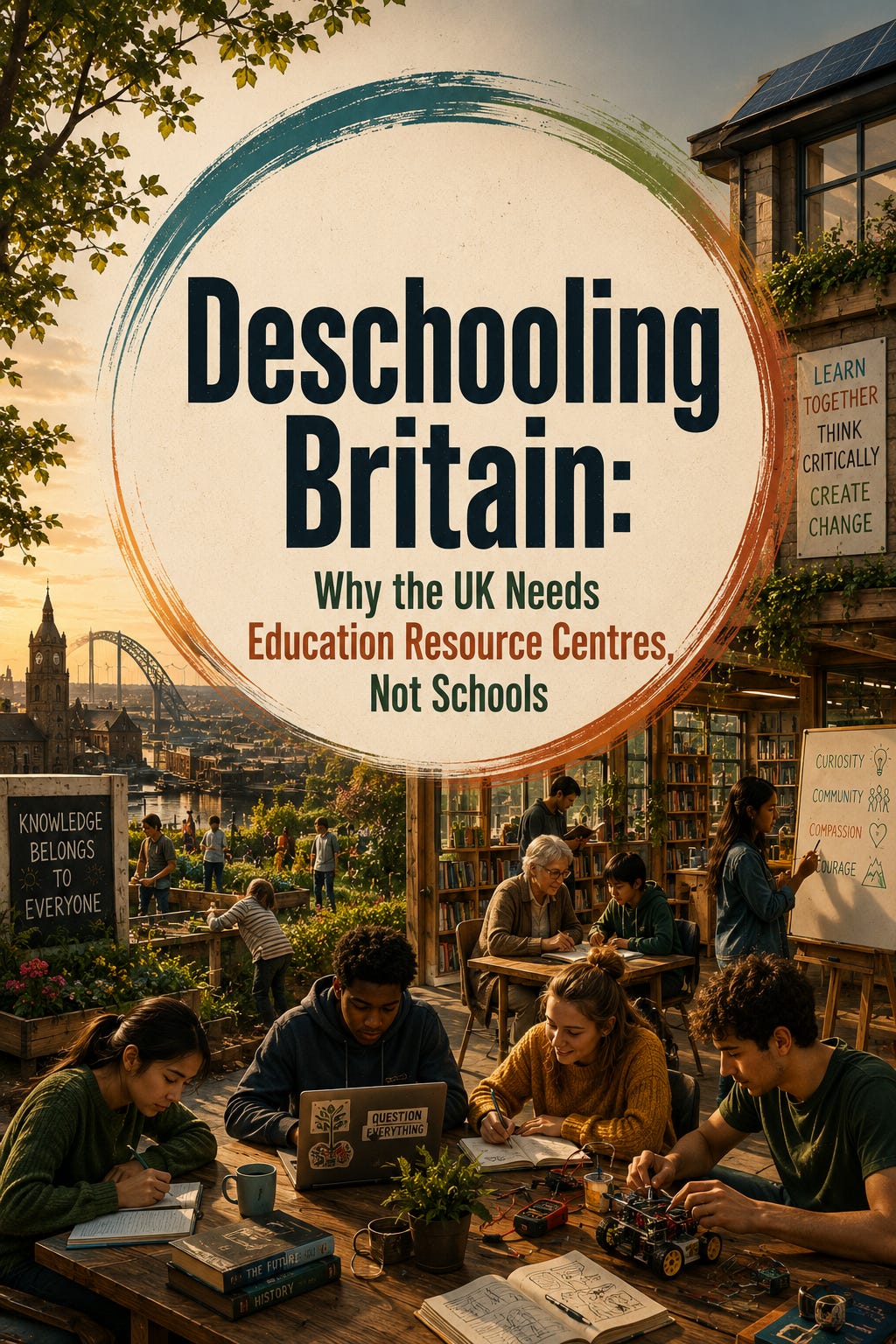
All essays in this series sit inside Radical Education, an archive for rethinking learning beyond the limits of schooling, obedience, exams, and institutional imagination.
No posts
Comments
Nothing yet. Say the first thing.
Sign in to join the conversation.