
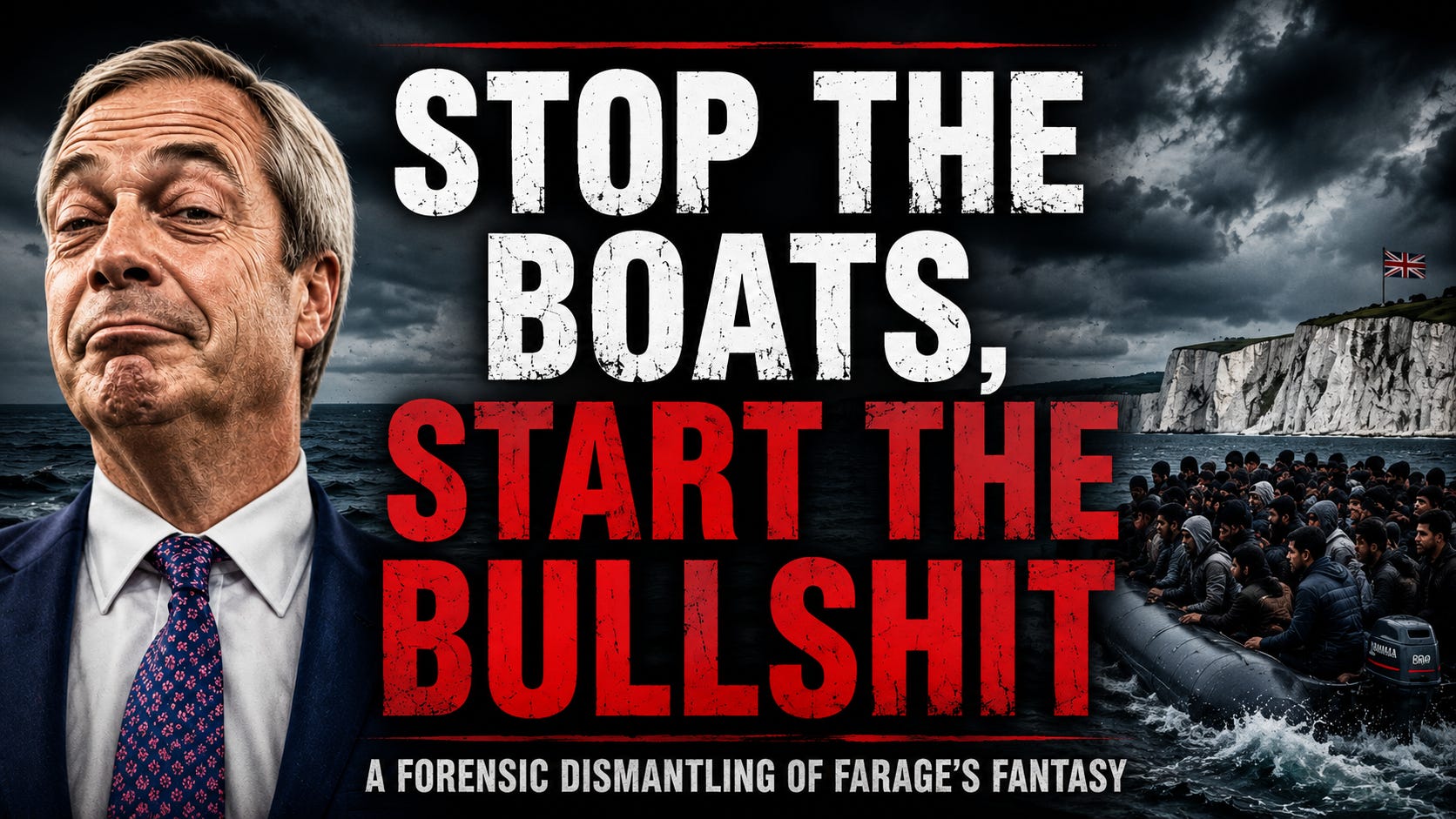
I deliberately left this one alone until after the Clacton by-election.
Nigel Farage published a Substack article during the Clacton campaign, and I didn’t want a forensic rebuttal getting muddled up with the election circus. Well, the circus has packed away, Nigel has got the job back that he resigned from, the parliamentary investigation into his £5 million gift can get moving again, and I can finally return to the article itself.
And Christ, there is a lot to unpack.
The clever thing about Farage’s piece is that it isn’t made entirely of lies. That would actually make it easier. Instead, it uses real crimes, real criminals, real security concerns and real failures of the asylum system, then stitches them together into a story the evidence simply does not support.
The method is simple. Find the most appalling individual cases you can. Put them one after another. Remove every denominator. Remove every comparison. Remove every inconvenient fact about the wider population. Then tell the reader that these cases reveal what “these men” are like.
That is not statistics. It is a horror anthology with a political manifesto stapled to the back.
Farage begins with the story of a man stabbed to death in France and claims the suspected killers had fled across the Channel among 165 people in one enormous dinghy. There really was a 165-person crossing on 23 July. It was, at the time, the largest recorded single-boat crossing, although it has since been surpassed by one carrying 230 people. But the murder connection was reported as a suspicion, with the alleged killers believed or feared to have boarded the boat. I cannot find evidence that this has subsequently been established as fact by French or British authorities.
Notice the trick immediately. An allegation becomes the opening scene. The uncertainty disappears into the prose and the emotional conclusion arrives before the evidence has put its trousers on.
Then come the criminals.
Lawangeen Abdulrahimzai is real. He murdered 21-year-old Thomas Roberts in Bournemouth. He had previously been convicted in absentia of two murders in Serbia and had lied about his age when he arrived in Britain. It was a catastrophic failure of the system and an appalling crime. Fayaz Khan really did threaten Farage and was jailed for five years. Three asylum seekers really were convicted over the horrific rape of an incapacitated woman on Brighton beach. Those victims deserve something rather better than becoming props in anybody’s immigration campaign.
But after establishing that individual asylum seekers have committed terrible crimes, Farage quietly swaps the subject.
We are no longer talking about Abdulrahimzai or Khan. We are suddenly talking about “these men”, then “the criminals arriving in Britain”, then the “violence and chaos” supposedly being imported from whole countries.
That’s where the argument falls apart.
If I gave you the most gruesome murders committed by British-born men during the past five years, one after another, and then concluded that British men were inherently dangerous, Nigel would quite rightly call me a lunatic. You cannot establish the behaviour of hundreds of thousands of people by arranging notorious offenders in a row like mugshots.
And the awkward problem for anyone trying to prove Farage’s broader claim is that Britain does not even produce the comprehensive offender-by-asylum-status dataset you would need to make it. The Office for National Statistics was specifically asked for figures on asylum seekers accused of rape and violent or sexual assault and replied that it does not hold that specific offender data.
So Farage cannot demonstrate from national crime statistics that asylum seekers as a group are more criminal than everybody else. Instead, he demonstrates that some asylum seekers are criminals.
Well done. Some vicars are criminals. Some MPs are criminals. Some policemen are criminals. I wouldn’t recommend building immigration policy by wandering through the Old Bailey shouting, “LOOK, ANOTHER ONE.”
He next tells us that more than 75% of small-boat arrivals are adult men. That one is broadly true. Official Home Office statistics show that since 2018 around three-quarters of small-boat arrivals have been adult males. The broader category of detected illegal-route arrivals is currently about 71% adult men.
Then he immediately poisons his own accurate statistic by adding that some of the remaining people will really be adult men pretending to be children.
How many? He doesn’t say. What percentage? No idea. Evidence? Not supplied.
It’s a lovely little Farage flourish. Start with a number that can be checked, then sprinkle an unquantified suspicion over whatever remains.
He also says around 200,000 people have crossed in small boats since 2018. Again, broadly correct. But notice what disappears from the picture. Almost all small-boat arrivals historically have claimed asylum, and the people arriving are disproportionately from countries including Eritrea, Afghanistan, Sudan, Iran and Somalia. In the year ending March 2026, those were the five largest nationalities arriving by small boat.
Those are not exactly nations famous for their abundance of peace, liberal democracy and functioning institutions.
Farage’s next exhibit is the asylum-hotel crime figure. This one is particularly instructive because the underlying reporting does contain something worth discussing. An investigation found 339 residents of 105 asylum hotels had appeared before courts in the first six months of 2025, involving offences ranging from theft and violence to sexual offences. Nobody serious should shrug at that. Crimes should be investigated, offenders prosecuted and, where the law permits after sentence, foreign offenders removed.
But the same reporting calculated the number as around one person in every hundred residents of those hotels and noted that the crude rate of court appearances was lower than that of the wider population. There are obvious demographic complications in comparing the two groups, but it certainly does not establish Farage’s sweeping claim that asylum accommodation is stuffed with roaming predators.
He gives you the numerator. He forgets to bring the denominator.
Funny how often that happens.
Then we arrive at Iran, where Farage has found something genuinely serious and somehow still manages to overcook it.
Three Iranian nationals really were charged under the National Security Act with allegedly assisting Iran’s intelligence service and preparing or facilitating serious violence. They had entered Britain irregularly over a period of years, by routes including small boats and a lorry. Those allegations are extremely serious and absolutely justify questions about vetting and national security. The men deny the charges and the proceedings remain subject to the criminal process.
There have also been credible reports that British authorities believe Iran has attempted to exploit irregular migration routes for covert operatives. Given the wider Iranian state threat to Britain, nobody sensible should wave that away.
But Farage then performs another magic trick.
Three charged men become evidence that “for every terrorist we catch, you can be assured that another one has slipped through the net.”
Can I? That’s a very precise-sounding assertion for something accompanied by absolutely no number whatsoever. One caught equals one escaped. Apparently.
Why not two? Why not seven? Why not 0.14?
This isn’t intelligence analysis. It’s Nigel’s Terrorist Buy-One-Get-One-Free offer.
If MI5 possesses evidence that every identified hostile-state operative implies another unidentified operative has entered by small boat, then by all means publish it. Farage doesn’t. He simply tells the reader to be “assured” that his imagination has the same evidential status as an intelligence assessment.
Then there is Ceuta.
The recent events there were extraordinary. Tens of thousands of people crossed from Morocco into the tiny Spanish enclave during a chaotic mass movement, many subsequently returning or being returned, and people died. Spain and Morocco have been dealing with an enormous humanitarian and security crisis.
Farage takes this event in North Africa and announces that it proves an “invasion of Europe, and an invasion of Britain.”
Britain is approximately 1,200 miles away.
Most of the people who entered Ceuta subsequently went back into Morocco. Thousands remain, and Spain is processing removals and asylum cases. There is no evidence that tens of thousands of those people are now marching north with Dover programmed into Google Maps.
But “complicated migration crisis in a Spanish enclave with most participants returning to Morocco” doesn’t quite have the same Wagnerian thunder as INVASION OF BRITAIN, does it?
And that word, invasion, does enormous work throughout the article.
An invasion is a military act. It has an aggressor, an objective and organised hostile force. The people crossing the Channel include refugees, asylum seekers, economic migrants, trafficking victims, people without valid claims, criminals and, potentially, hostile-state operatives. It is precisely because the population is mixed that governments have borders, screening, asylum procedures, intelligence services, police and courts.
Calling the entire movement an invading army allows Farage to erase every distinction between an Eritrean fleeing persecution, a Sudanese refugee, a smuggler, a rapist and an Iranian intelligence operative.
They’re all just the invasion now. Very convenient.
That framing becomes downright absurd when he gets to the Royal Navy.
Farage says Reform would detect every boat, intercept it, transfer everybody aboard to a safe vessel and take them back to France.
There is a tiny problem called France.
You cannot simply decide that another sovereign country will accept hundreds or thousands of people deposited on its coastline because Britain has announced a new policy. Returns require a legal and diplomatic framework. Britain already has a returns agreement with France under which some small-boat arrivals can be returned in exchange for people entering Britain through a controlled legal route. That agreement exists precisely because returns require French consent.
Farage knows this, which is why halfway through announcing his “straightforward” solution he suddenly starts hoping Marine Le Pen’s political allies win power in France.
Excellent. The straightforward British border-control plan depends on the result of next year’s French election.
Nothing says “taking back control” like outsourcing your immigration policy to French voters. And if France doesn’t cooperate? Farage tells us not to worry because he doesn’t believe French forces would fire on Royal Marines.
Just contemplate where his argument has arrived.
We began with “stop the boats”.
Within a few paragraphs we are discussing the reassuringly low probability of armed confrontation between British and French forces because Nigel would like to deposit people on French territory without an agreed mechanism for doing so.
The Royal Navy itself has legal obligations at sea. Ships have duties to rescue people in distress, including under the international law of the sea, and coastal states have corresponding responsibilities in territorial waters. You cannot turn those obligations off because somebody has written STOP THE INVASION on the mission folder.
More importantly, France is already intercepting boats and returning people. French maritime authorities have stopped boats at sea repeatedly this year, while French police have disrupted launches, seized equipment and arrested smugglers. Small-boat arrivals were down around 43% between January and mid-July compared with the same period in 2025, despite Farage writing as though everybody in France is standing on the beach waving them through.
That reduction may not last. Migration is volatile and weather, enforcement, European migration flows and smuggler tactics all matter. But it creates another problem for Nigel’s narrative.
At the precise moment he is announcing that Britain is undergoing an ever-intensifying invasion, the number of people crossing has fallen substantially compared with last year.
Meanwhile smugglers have adapted by using fewer but vastly larger boats. The average number of people per vessel has risen enormously, and we’ve now seen boats carrying 128, 165, 173 and finally 230 people. That’s dangerous and it demands policy. It also demonstrates something Farage never seems terribly interested in: border enforcement changes smugglers’ behaviour rather than making human movement disappear by ministerial decree.
Then he dismisses safe and legal routes because, he says, they would simply bring more people here.
And there lies the philosophical core of the whole piece. Farage doesn’t merely object to people arriving illegally. He explicitly says he doesn’t want them arriving legally either.
Because for most refugees there is no general British “asylum visa” they can apply for at an embassy abroad. Britain has specific humanitarian schemes, resettlement programmes and sponsorship routes, but they are limited and targeted. UNHCR has repeatedly pointed out that irregular arrival is often how people seek protection because an asylum applicant does not usually possess a neat government-approved route from persecution to Heathrow arrivals.
The Refugee Convention itself recognises this reality. Article 31 protects refugees in specified circumstances from penalties simply because they entered a country irregularly.
You can absolutely argue about how broad Britain’s asylum obligations should be. You can argue about safe-country rules, removals, detention, processing, international agreements and how many refugees Britain should accept.
But stop pretending “come legally” is the answer if your next sentence is we don’t want you coming legally either.
That’s not an argument about the route. That’s an argument about the refugee.
And perhaps the ugliest sentence in the entire piece is tucked almost casually among all the statistics and murder cases:
“Leopards don’t change their spots.”
Think about what he has just done there. He has selected criminals from a population and then reached for a phrase meaning inherent character cannot change.
Not those particular criminals. “The criminals arriving in Britain.”
Then he keeps widening the lens until “violence and chaos” from foreign countries are supposedly being imported into our streets and schools.
This is why I waited until after the election to dismantle the article. Because beneath all the boats and figures and lurid crimes is the political technique Farage has perfected for decades.
Take a real problem. Find its most frightening examples. Strip away proportion. Collapse asylum seeker, illegal entrant, criminal, terrorist and foreign agent into one silhouette.
Call the silhouette an invading army.
Then offer a beautifully simple solution which turns out, on examination, to require French consent, international agreements, maritime law, functioning asylum procedures, enormous detention capacity and, apparently, a favourable French election result.
There are serious problems with Britain’s asylum system. People who have no right to remain should be removed more efficiently. Dangerous offenders should not be wandering around because government departments failed to exchange information. Age assessments must work. Intelligence screening matters. Smuggling gangs need dismantling. Nobody should have to pretend otherwise simply because Farage talks about the subject.
But fear doesn’t become evidence just because you type it angrily.
Three Iranian defendants do not prove every boat contains terrorists. A collection of horrific crimes does not establish the criminality of an entire migrant population. A crisis in Ceuta does not mean Britain is being invaded. A 75% male statistic does not prove the other 25% are lying. A French state which is already intercepting boats has not become an “extension of the smuggling gangs”. And the Royal Navy cannot tow human beings into another sovereign country by the power of Nigel’s confidence.
Farage’s article begins with murder and ends with the Navy.
Everything between those two points is designed to make you frightened enough that you stop asking what the numbers actually show.
Unfortunately for Nigel, I rather enjoy asking.
And now the election is over, I have plenty of time to focus on every nasty little move Nigel makes.
Thanks for reading! This post is public so feel free to share it.
Who Is Behind Turning Point UK?: Nick Tenconi, UKIP and the network bringing American-style Christian nationalism into British politics
When Does a Riot Become Terrorism: The uncomfortable question raised by Thetford
The World’s Smallest Violin for Britain’s Biggest Victim
The Ann Widdecombe Case and the Mechanics of Narrative Collapse
Bin Face vs Frog Face - Special Report: Clacton 2026 Candidate Assessment
The Political Obituary of Nigel Farage (We Hope)
Nigel Farage: The Billionaire’s Man of the People
The Fall of Nigel Farage: The Pint-Man Prophet Finds the Bar Tab
Farage’s Brexit Betrayal Myth Is Just the Same Old Con in a New Hat
Farage Is Not Demanding Democracy. He Is Demanding Advantage.
Farage vs the Evidence: A forensic dismantling of the “two-tier Britain” narrative
How Do You Bring Them Back?: The Outrage Machine, the Failure of Politics, and the Working-Class Case for Reason How do you bring them back?
The Tide Is Coming In: Migration Is History Coming Home
Don’t Let Them Turn Henry Nowak Into a Race War Poster
Is Britain Turning Far Right, or Is the Megaphone Just Too Loud?
Fear, Freedom, and the Emotional Architecture of Politics
Democracy, Populism, and the Death of the Nation-State
Reform UK and the Cult of the Outrage Machine
Normalising Hate: The Political Decay of Post-Brexit Britain
Exposing the “Grooming Gangs” Myth: White British Men and the Truth About Sexual Abuse in the UK
The Big Lie vs The Big Truth: Who Really Abuses Women and Children in the UK
Debunking Common Myths About Immigrants and Asylum Seekers in the UK

No posts
Comments
Nothing yet. Say the first thing.
Sign in to join the conversation.