
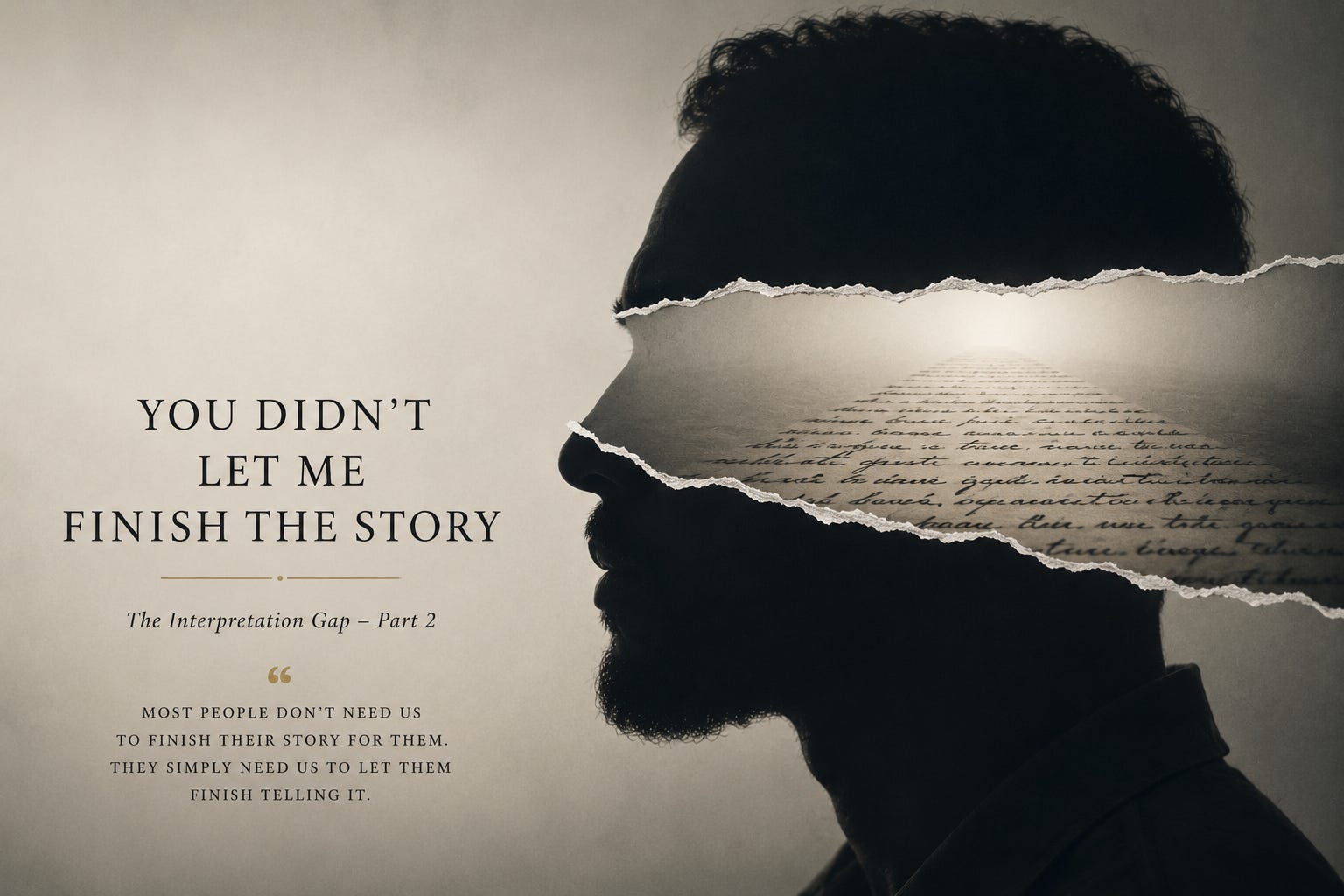
A series exploring the hidden assumptions that shape how we interpret people, Scripture, leadership, and everyday life.
“When I walk around, I represent you, and when you walk around, you represent me.”
— MSG Darhem Parker, speaking to fellow soldiers with medical shaving profiles
A few days ago, I watched a Facebook video posted by MSG Darhem Parker, a senior enlisted leader whom I respect. Like many soldiers with pseudofolliculitis barbae (PFB), he wears a beard because of a documented medical condition. I assumed he would spend most of the video discussing the military’s ongoing debate over grooming standards. Instead, he spoke directly to other soldiers who shared his condition.
His message wasn’t a rejection of standards. On the contrary, he made it clear that standards still matter. If a soldier’s beard falls outside the limits of the medical accommodation, it should be corrected. Professionalism matters. Accountability matters. What he rejected was the idea that a legitimate medical condition somehow makes a soldier less professional, less committed, or less worthy of respect.
Then he said something that I felt compelled to write down.
“When I walk around, I represent you, and when you walk around, you represent me.”
He wanted fellow soldiers with shaving profiles to know they were not “less than.” They were not defined by a medical accommodation. They were soldiers. Representation mattered.
I found myself asking a different question.
Why was that reminder necessary?
The answer began to emerge as I read through the comments beneath the video.
Some people discussed the policy itself. Others had already moved beyond the policy and were drawing conclusions about the people it affected. One commenter questioned why a Master Sergeant would be serving on a funeral detail, apparently assuming his assignment reflected something unusual. Others pointed out what had been overlooked: as a senior noncommissioned officer, he may well have been the NCO in charge of the detail.
The observation was accurate.
The conclusion was incomplete.
As I continued reading, I realized the beard had become almost incidental. The real discussion was no longer about facial hair. It was about what people believed the beard revealed about the person wearing it.
Somewhere between what people observed and what they concluded, the human mind had done what it so often does.
It filled in the gaps.
In the previous article, I suggested that our minds naturally move from observation to interpretation and eventually to belief. We observe something, assign meaning to it, and then begin responding to our interpretation as though it were an established fact.
Interpreting the world around us is not the problem. We could not navigate life without doing so. The challenge arises when we forget that our interpretation remains an interpretation rather than an established truth.
Daniel Kahneman helps explain why this happens. Our minds rely on mental shortcuts to process an extraordinary amount of information without becoming overwhelmed. Those shortcuts are indispensable. They are also incomplete. Rather than waiting for every piece of evidence, our minds often complete the story with the information already available.
The human mind rarely leaves observations uninterpreted.
Long before psychology gave us language for mental shortcuts, Scripture described the same tendency.
When Samuel arrived at Jesse’s house to anoint Israel’s next king, Eliab seemed the obvious choice. He looked like a king should look. Samuel’s observation wasn’t the problem. His conclusion was.
God redirected Samuel’s thinking with a reminder that continues to challenge our own.
“Man looks on the outward appearance, but the Lord looks on the heart.”
Samuel had observed accurately.
He had simply concluded too quickly.
During my years in the Army, I watched this pattern unfold repeatedly.
Soldiers with shaving profiles were sometimes viewed through a different lens than their peers. Others struggled with weight because of thyroid disorders, prescribed medications, or other legitimate medical conditions. Their circumstances were visible. Their character was not. Yet conversations often treated those visible conditions as reliable evidence of invisible qualities such as discipline, commitment, or leadership.
Experience repeatedly challenged those assumptions.
Some of the finest leaders I served with did not fit everyone’s mental picture of the ideal soldier. They possessed exceptional judgment, remarkable emotional intelligence, and the ability to lead people through uncertainty with calm confidence. When difficult decisions had to be made, they were often the individuals others sought out because they had earned trust over time.
Conversely, I also served alongside soldiers who looked exactly as one might expect a military leader to look. They excelled on physical fitness tests, impressed promotion boards, and projected confidence wherever they went. Many became outstanding leaders. Some, however, struggled to mentor others, build cohesive teams, or exercise sound judgment under pressure.
Looking the part and leading well were never synonymous.
None of this diminishes the importance of standards. Military organizations require standards because standards contribute to readiness, discipline, and cohesion.
The existence of standards is not the issue.
The issue arises when we unconsciously allow visible conditions to become evidence of invisible qualities.
A condition may explain someone’s circumstances. It cannot, by itself, explain someone’s character.
The military simply provides a vivid illustration of a much broader human tendency.
We do the same thing in our workplaces, churches, neighborhoods, and families. We encounter something observable, assign meaning to it almost automatically, and then relate to people according to the story we have constructed rather than the person standing before us.
Perhaps this is where humility serves us best.
Paul reminds us that, for now, we “see through a glass, darkly.” Our understanding is real, but it is also incomplete. That should not discourage us from forming conclusions. It should encourage us to hold them with humility.
I’ve become convinced that better thinking rarely begins with better answers.
More often, it begins with better questions.
Before we rewrite the stories we tell ourselves, we should first interrogate the assumptions from which those stories were constructed.
Perhaps the greatest act of intellectual humility is not abandoning our conclusions, but delaying them long enough to ask another question.
Most people don’t need us to finish their story for them.
They simply need us to let them finish telling it.
What conclusion have I reached about someone that deserves another question before it deserves my confidence?
No posts
Comments
Nothing yet. Say the first thing.
Sign in to join the conversation.