
Whether you're a person of faith, a leader, a coach, or just someone who has wondered why reasonable people can begin with the same authority yet arrive at different conclusions, I hope this framework encourages you to think more carefully about where disagreements actually begin. While the story that follows emerges from a theological conversation with my wife, I believe the principle extends far beyond theology.
My wife and I recently found ourselves in one of those conversations where neither of us questioned God’s goodness, the authority of Scripture, or the importance of prayer. Yet somehow, we still disagreed.
The conversation started in an unexpected place.
She had been researching the origins of Babushka dolls and wondered whether their historical connection to religious traditions should concern Christians. That led us to another topic she had been studying: cremation. We have the ashes of her aunt and my father in our home, and she questioned whether that practice aligned with a biblical worldview.
I admitted something that is becoming easier for me to say as I grow: I don’t know enough to have a settled opinion. I needed to study more before drawing conclusions. We talked about how cultural practices often look strange or even threatening to people outside that culture. Sometimes they are incompatible with Christianity. Sometimes they’re cultural expressions that lose their original meaning over time.
Somewhere in that conversation, we arrived at prayer.
She reflected on Job offering sacrifices for his children “just in case” they had sinned and connected that posture to the way she approaches prayer. She shared how deeply she values intercession and how she has been shaped by believers whose lives are marked by fervent prayer.
Then the conversation became personal.
Years ago, our daughter Anna was diagnosed with cancer. The doctors gave us little reason to hope. During that season, my wife spent countless hours crying out to God. As we reflected on those days, she shared that the experience forever shaped what faithful prayer looks like for her.
As I listened, something dawned on me.
We weren’t only discussing theology.
We were discussing one of the most sacred experiences of her life.
When she asked me, “What do you do after you pray?” I initially heard it as a challenge. Looking back, I think she was inviting me into a different question altogether.
What does faith look like while you’re waiting?
My answer surprised even me.
“I keep on living abundantly in the belief that my prayer was heard.”
That doesn’t mean I never pray about the situation again. Sometimes I do. Sometimes it comes back to mind. Sometimes I realize my faith is wavering, and I return to God with renewed dependence. Sometimes I need to remind myself that what concerns me has already been placed before Him. But I don’t see those prayers as attempts to convince God to act. I see them as opportunities to continue trusting the God who already heard me.
At one point, I told my wife that Christians have wrestled with these questions for centuries. We may disagree about the how without disagreeing about the Who.
So I asked her a question.
“Do we both believe that Jesus Christ died for our sins, rose from the dead, and sits at the right hand of the Father?”
“Yes.”
Then we had more common ground than disagreement.
As I reflected on our conversation, I realized we weren’t arguing about whether prayer matters.
We weren’t arguing about whether God hears prayers.
We weren’t even arguing about whether Christians should pray fervently.
We were disagreeing somewhere else.
That realization led me to a framework that has helped me think more clearly about disagreement in general.
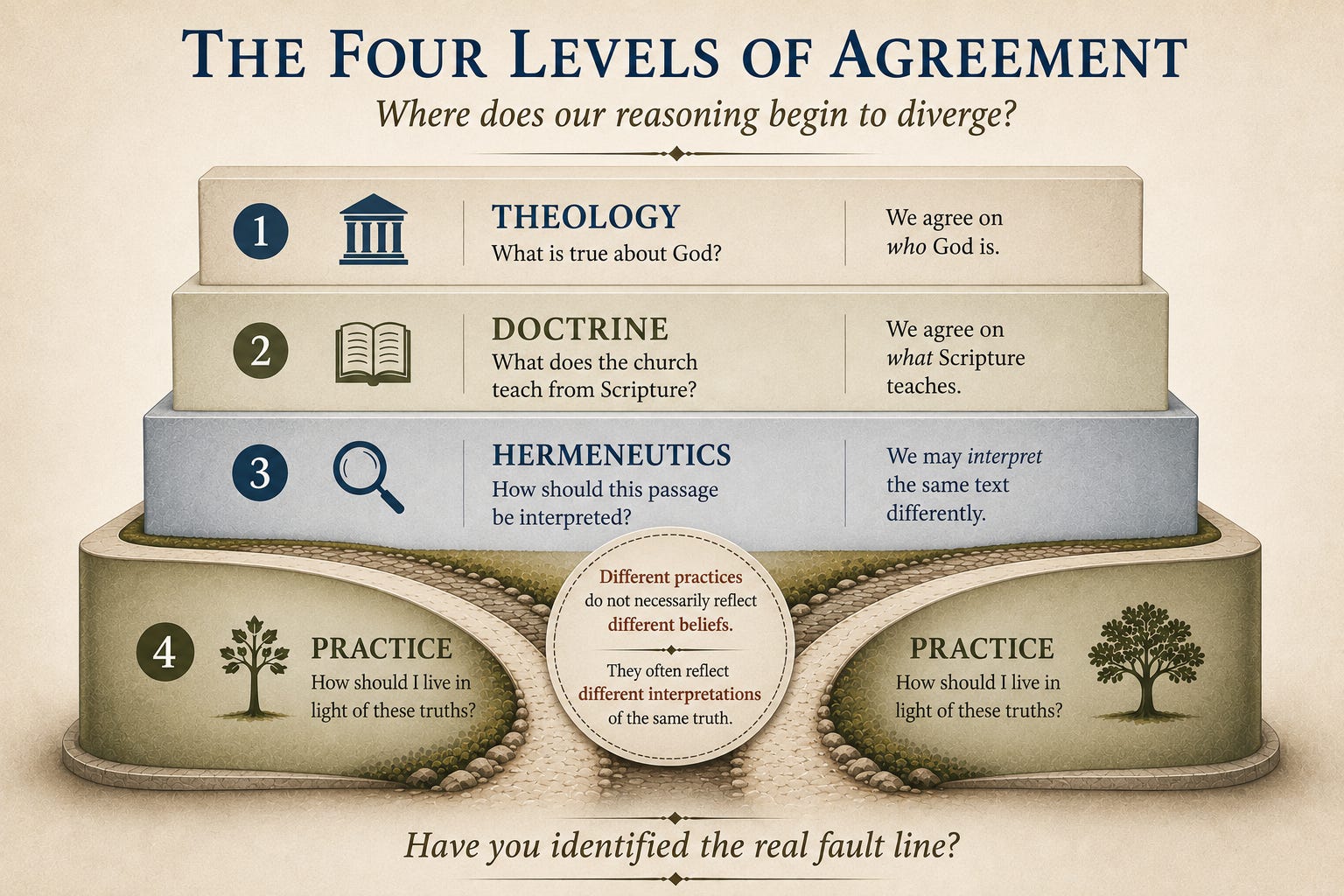
When people disagree, it helps to ask where the disagreement actually begins.
Theology asks, What is true about God?
Doctrine asks, What does the church teach from Scripture?
Hermeneutics asks, How should this passage be interpreted?
Practice asks, How should I live in light of these truths?
The more I reflected on our conversation, the more I realized my wife and I agreed on far more than I initially recognized.
We both believe God hears prayer.
We both believe prayer matters.
We both believe God is faithful.
We both believe Jesus Christ is Lord.
Our conversation began to diverge in how we interpreted certain passages and how those interpretations informed our practice.
That realization changed everything.
Instead of asking, “Who’s right?” I began asking a better question:
Where does our reasoning first begin to diverge?
The more I reflected on our conversation, the more I realized that our discussion about prayer wasn't really about prayer. It had actually exposed a pattern I'd seen throughout my life.
I first noticed it in the Army.
Every leader had access to the same regulation. Yet every installation seemed to implement those regulations a little differently. The regulation remained the authority, but commanders and senior noncommissioned officers interpreted and applied it in ways that shaped daily life.
The comparison isn’t between the Bible and Army regulations. Scripture is uniquely inspired and authoritative. The comparison is between the people reading them. Even when an authority is clear, people still interpret it, and those interpretations inevitably influence practice.
The same principle applies in leadership, education, coaching, business, and even marriage.
Policies become procedures.
Values become culture.
Scripture becomes lived obedience.
The question is never whether interpretation exists.
The question is whether we recognize that it exists.
One of the greatest mistakes leaders make is assuming that their interpretation is identical to the authority itself.
Mature leaders learn the difference.
They are willing to say, “Here’s how I understand this,” while remaining humble enough to continue learning.
That posture doesn’t weaken conviction.
It strengthens conversations.
I believe that’s what common ground really is.
It isn’t pretending we have no differences.
It isn’t compromising our convictions.
It is taking time to discover where our agreement ends and where our disagreement begins.
Because once we identify the real fault line, we stop arguing with caricatures and start listening to one another.
Maybe the most important question we can ask in any disagreement is not, “Who’s right?”
Maybe it’s this:
Before assuming we’re on opposite sides, have we taken the time to identify the common ground beneath our different conclusions?
Thanks for reading The Positive Perspectives Blog! This post is public, so feel free to share it.
No posts
Comments
Nothing yet. Say the first thing.
Sign in to join the conversation.