
“Sometimes what we need isn’t a new story. We need a better perspective on the one we’ve been telling ourselves.”
Sometimes the best lessons aren’t taught in a classroom, a boardroom, or even a coaching session.
Sometimes they show up in a rehearsal.
VOS was preparing for an upcoming performance. We were doing what musicians always do…you know running the setlist, tightening transitions, laughing, making adjustments, and inevitably talking about songs that weren’t even on the program.
That’s when someone mentioned “The Rubberband Man.”
It wasn’t on our setlist.
But that’s what happens when creative people get together. One song reminds you of another, and before you know it, you’re singing a chorus that has lived somewhere in the back of your mind for years.
As I sang it, something struck me.
Before that moment, “The Rubberband Man” had simply been one of those songs that lived in the soundtrack of life. Originally recorded by The Spinners, it’s upbeat, memorable, and hard not to sing along with. Maybe you’ve heard it while driving, cooking dinner, or walking through the grocery store. It’s familiar enough that it can easily become background noise.
But this time, I wasn’t just hearing the music.
I was thinking about the story behind it.
The more I learned about “The Rubberband Man,” the more I appreciated the brilliance behind it. Songwriter Thom Bell reportedly wrote the song after watching his son endure teasing because of his weight. Rather than allowing the label fat to become a source of shame, he chose to rewrite the narrative. He created a character who was joyful, confident, memorable, and impossible to ignore.
What if we did the same thing with the labels we’ve accepted about ourselves?
What if the words that once wounded us could become reminders of how we choose to live instead?
Whether we realize it or not, every one of us is living from a story.
Stories about who we are or aren’t.
Stories about what we’re capable of.
Stories about where we belong.
Some of those stories were spoken over us by parents, teachers, coaches, employers, or peers. Others were written by painful experiences that unfortunately convinced us we weren’t enough.
The problem isn’t that we have stories.
The problem is that we rarely stop to ask whether they’re true.
During my years as a Master Resilience Trainer, one of the core thinking skills we taught was the importance of being Flexible, Accurate, and Thorough when evaluating our thoughts and the stories we tell ourselves. The framework isn’t mine. It was developed as part of the Army’s resilience training curriculum. I simply had the privilege of teaching it to Soldiers, leaders, and organizations, and I watched firsthand how changing the story people told themselves often changed the direction of their lives.
As I reflected on the story behind this song, I couldn’t ignore the connection.
The same word that had once been used to diminish someone became a powerful reminder of one of resilience’s greatest lessons.
Be FAT.
Flexible. Accurate. Thorough.
That’s not an attempt to redefine the song’s history. It’s my way of honoring its deeper message.
Because resilience isn’t pretending the labels never existed.
It’s refusing to let them have the final word.
Don’t lock yourself into one version of yourself.
A label is not a life sentence.
The shy kid.
The troublemaker.
The failure.
The gifted one.
Those descriptions may reflect a moment in your life, but they don’t have to define the rest of it.
Growth requires movement.
Movement requires flexibility.
Give yourself permission to become someone your past could never have predicted.
Not every story you’ve believed about yourself is true.
Some are incomplete.
Some are distorted.
Some were never yours to begin with.
Ask yourself:
Is this a fact...or an interpretation I’ve repeated so often that it feels like a fact?
One failure does not make you a failure.
One success does not define your potential.
Accuracy means seeing yourself honestly, not through the lens of shame or pride, but through the lens of truth.
Don’t skim the surface.
Dig deeper.
Where did these beliefs come from?
Who reinforced them?
How have they influenced your relationships, your decisions, your confidence, and your willingness to take risks?
Reflection isn’t about living in the past.
It’s about understanding the past well enough to stop letting it unconsciously direct your future.
So here’s my challenge.
Think about the labels you’ve been carrying.
Not just the obvious ones.
The ones you’ve kept hidden.
The assumptions you’ve accepted without ever questioning them.
Which ones belong to someone else’s opinion?
Which ones have become part of your identity over time?
And what if the very thing you’ve spent years trying to hide is actually one of your greatest strengths?
What if your difference is your advantage?
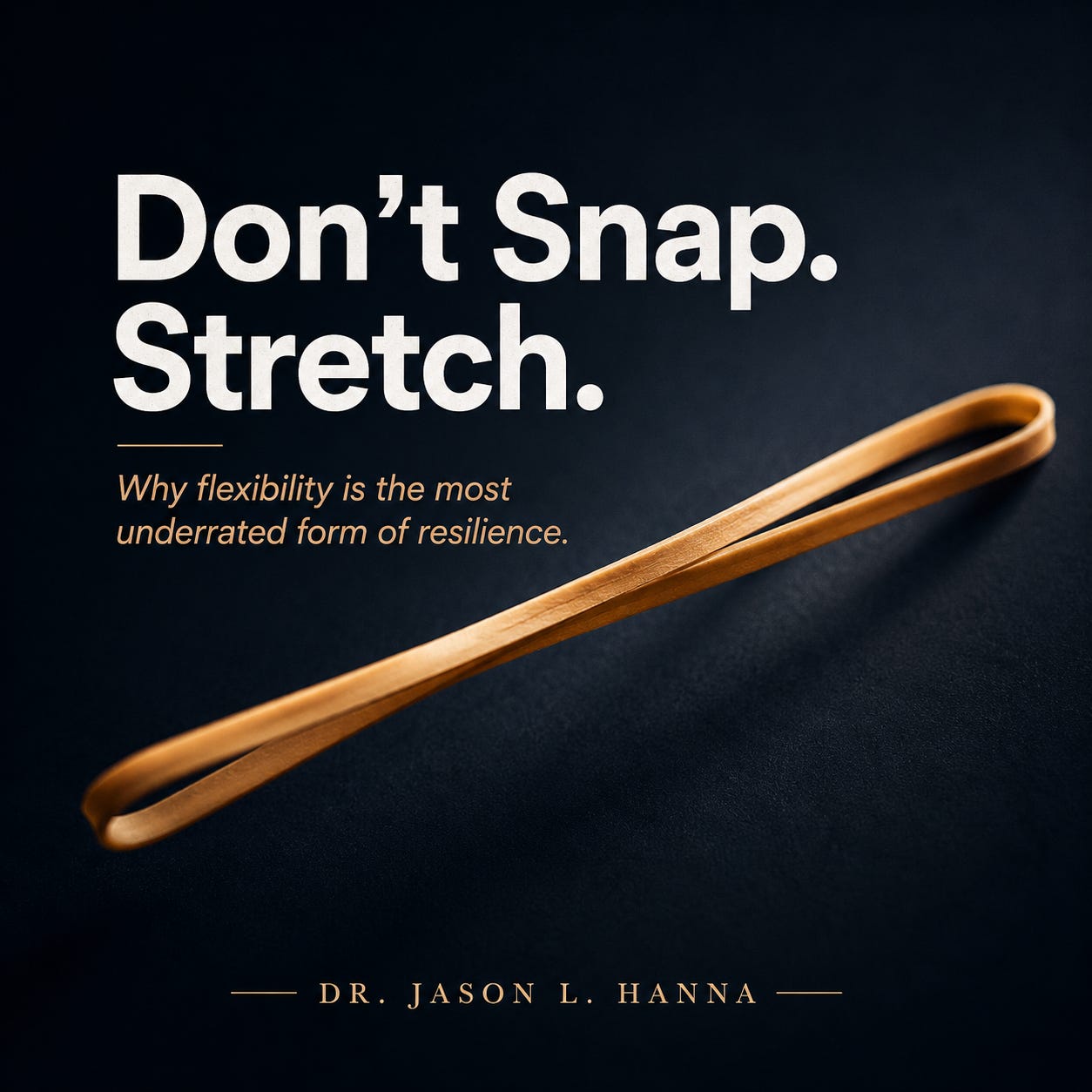
Like a rubber band, life will stretch you.
Sometimes far beyond what feels comfortable.
But stretching doesn’t have to mean breaking.
In fact, the healthiest people I know are the ones who have learned to bend without losing themselves, adapt without abandoning their values, and recover without letting setbacks define their identity.
Maybe that’s been the lesson all along.
Not just in the song.
But in life.
So here’s my invitation.
This week, take four minutes and listen to “The Rubberband Man.”
Let the bass line get stuck in your head.
Let the chorus become your earworm.
But this time, don’t just hear the music.
Hear a father’s encouragement.
Hear the power of perspective.
Hear the possibility of becoming more than the labels you’ve accepted.
And if you’re not careful, that song might just stay with you all day.
That’s okay.
Some songs get stuck in your head.
The best ones also get into your heart.
May this one remind you that your story is still being written.
You may finish the song before the song finishes its work in you.
And don’t be surprised if, somewhere along the way, you find yourself smiling...or even singing along.
After all, sometimes joy is the first sign that we’ve stopped believing the labels and started believing something better.
Think differently. Live brilliantly.
No posts
Comments
Nothing yet. Say the first thing.
Sign in to join the conversation.