
In year 5 of Russia’s 3-day “special military operation” against Ukraine, Ukraine has launched drone strikes into Moscow, setting fire to oil refineries and other targets.
Here’s a massive plume of smoke, visible to Muscovites for miles, from the Kapotnya oil refinery, as it burns:
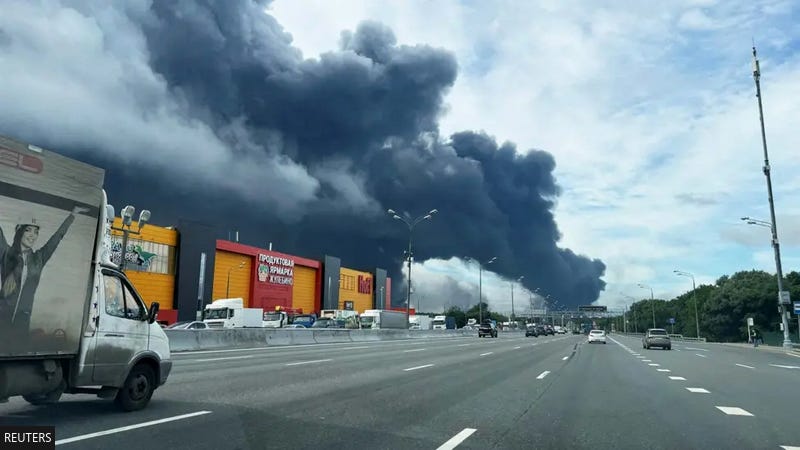
The Kapotnya oil refinery is just 10 miles away from the Kremlin, so you could probably see the smoke from Putin’s official residence, the Grand Kremlin Palace or from Putin’s office in the Senate Palace.
Are you feeling the heat yet, Putin?
Perun examines the cancellation of the FCAS 6th generation stealth aircraft:
Labour risks handing power to Reform without drastic change, says union leader Andrea Egan:
Andrea Egan is about to attend her first conference of the country’s biggest union, Unison, as its leader.
She has suggested that the union had previously been “a sleeping giant” which was too “subservient” to the Labour leadership.
“I have spoken out clearly about the threat Reform brings,” she said.
“It isn’t us that will hand the keys to No10 to Reform - it’s them, unless they change course. And drastically.”
What changes does Egan propose:
“They’ve got to start introducing progressive policies. Investment in infrastructure, pay restoration, better services, insourcing. They need to ensure that they deliver on promises they made when they came into government.”
What’s driving the Reform vote is concerns about immigration and anti-white racism. About 30% of electorate are strongly against these, and without tackling these issues, Labour will not persuade reform voters to switch to them.
See also my previous posts:
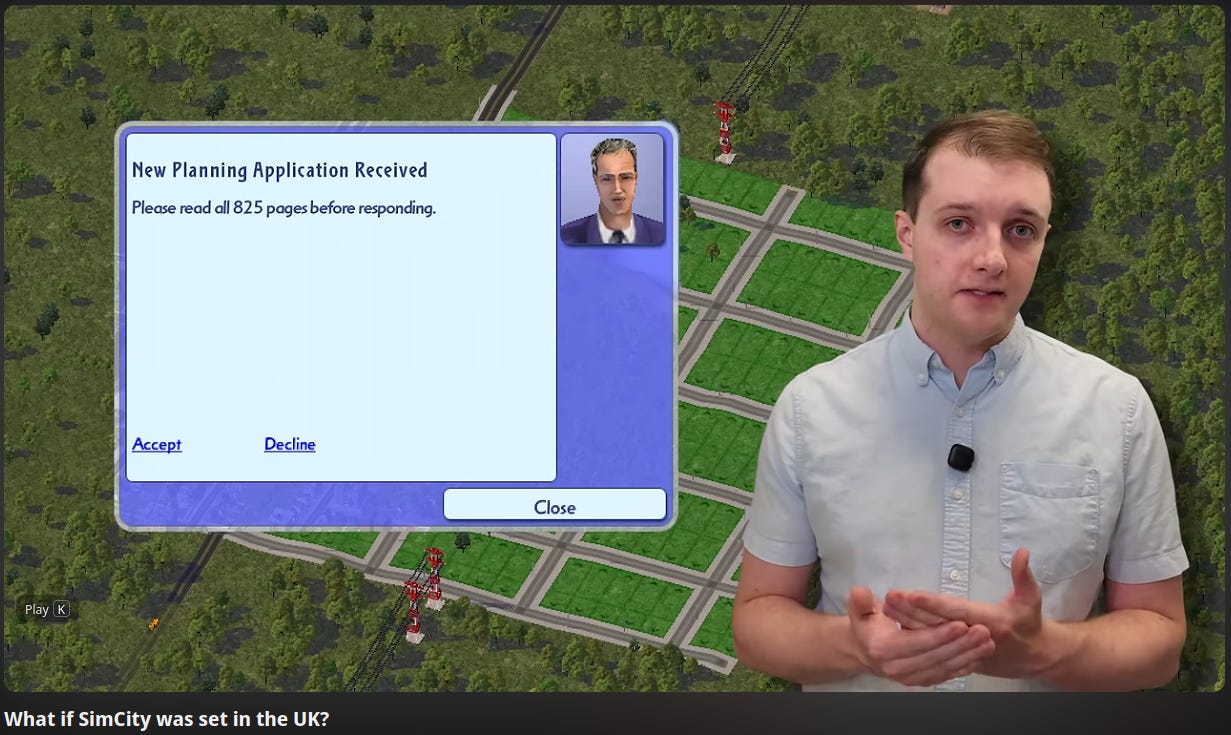
Chris Spargo asks What if the game Sim City was set in UK??
The answer is: lots more red tape!
Toby Young’s Free Speech Union went to court to prevent people publishing its list of donors, says Peter Geoghegan:
I was somewhat surprised to learn that last week Young’s organisation had itself obtained a High Court injunction - banning the publication of a list of its donors.
The court order followed the hacking of the organisation’s website earlier this month by the trans rights group Bash Back. On its own website, Bash Back accused the FSU of “purport[ing] to protect free speech” while in reality “work[ing] to protect transphobes, racists, and anti-choice activists,” and published a list of people who had donated £50 or more to the FSU over the past two years.
The High Court injunction prohibits Bash Back - or anyone else - from publishing the donor list. Breaching the order could lead to contempt of court sanctions, including imprisonment.
Geoghegan adds:
The FSU cares a lot about the funding of organisations it brands as ‘pro-censorship’. Last month, it announced the hiring of former Daily Mail journalist David Rose to investigate donors to Hope Not Hate and the Center for Countering Digital Hate. We asked the FSU whether this was somewhat ironic, given its refusal to disclose its own funding.
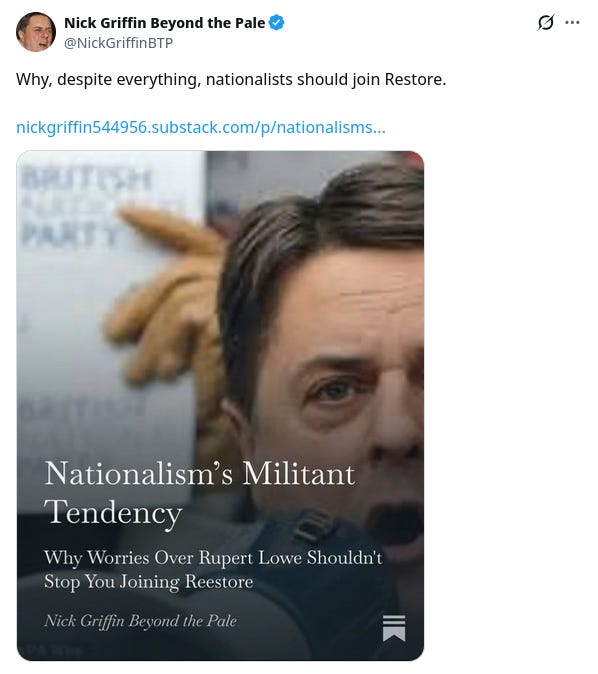
Nick Griffin proposes entryism into Restore Britain:
Nick Griffin published an entryism strategy on 23 June. Not in a private letter to trusted organisers. Not in a coded message to a closed network. On Substack, under his own name, with the heading “Nationalism’s Militant Tendency” and an explicit invitation to circulate it to Restore Britain supporters.
The target he named: Restore Britain and its 130,000 members. Ethnonationalists should join, keep quiet about their actual views, remove what he calls “hardline badges,” and work from within to convert Lowe’s membership into something more useful. The historical precedent he invoked was the Militant Tendency’s twenty-year campaign inside Labour. He published all of this under his own name and then asked his readers to spread it specifically among Restore’s base.
Griffin’s tweet:
Simon Pearson comments:
The tactical strangeness of this needs sitting with.
Entryism depends on concealment.
Jim Sillars has a draft Scottish foreign policy:
This is a draft outline of a Scottish foreign policy. The final paper will figure as a section of the comprehensive 2029 Independence for A Purpose manifesto. Where decisions on policy are indicated, these should be taken as preliminary.
On NATO and the EU the document states:
It is a major foreign policy decision, for security reasons, to seek/accept membership of NATO.
Of equal importance is a decision is to seek entry, for economic reasons, to either EU or EFTA/EEA
I agree that these would be the major international organisations / partnerships that an independent Scotland should join.
Andrea Miotti says we shouldn’t build artificial superintelligence (ASI), because it might kill everyone:
The entire international security architecture is built around the assumption that the most dangerous weapons are controlled by humans, and that the decision to take lives ultimately rests with humans. Superintelligence would upend this. Unlike nuclear weapons—the most lethal weapons we have today—superintelligent systems would not be tools humans can leverage, but rather agents able to pursue their own objectives with no human control over their actions. The leading AI companies are actively worsening the problem by making AIs as autonomous as possible and cutting humans out of the process of AI development.
Superintelligence thus represents the ultimate principal-agent problem, and it’s nowhere near being solved. Most alarming of all, Nobel Prize winners, leading AI scientists, and even the CEOs of the top AI companies warn that superintelligence poses an extinction risk to humanity. OpenAI’s CEO Sam Altman has repeatedly said that superhuman machine intelligence is the greatest threat to humanity’s continued existence
I agree.
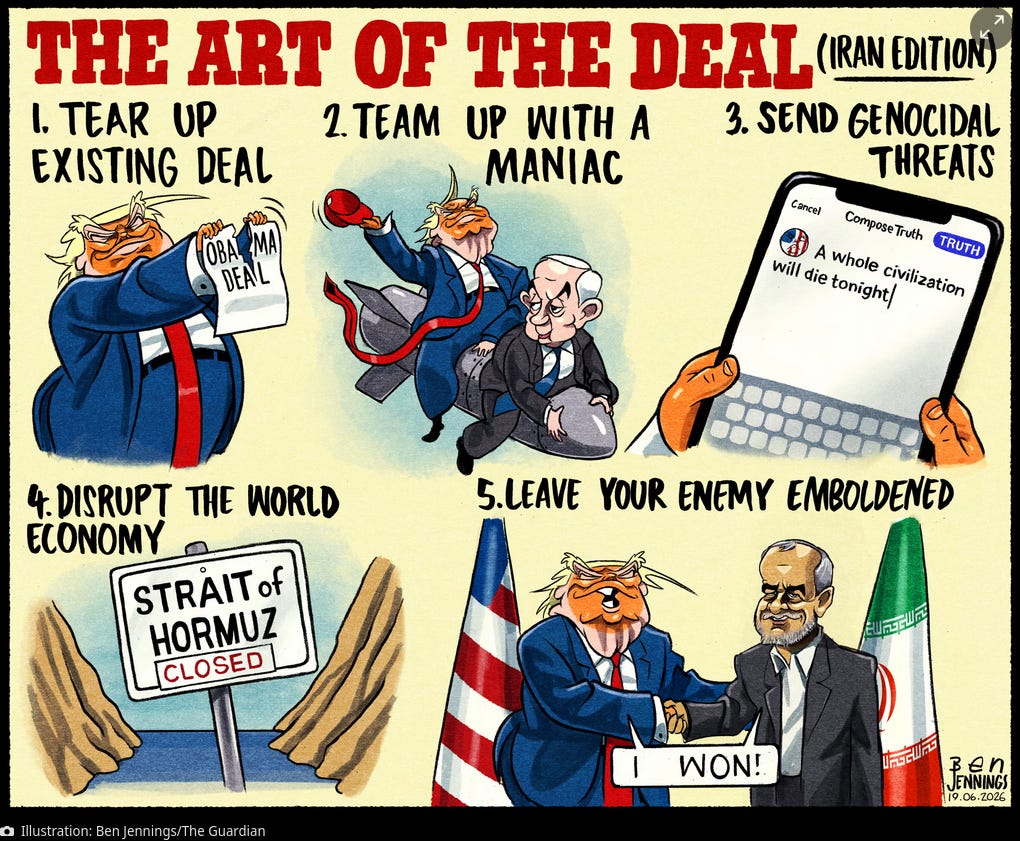
From the Guardian:
Comments
Nothing yet. Say the first thing.
Sign in to join the conversation.