
Al Carns, the former armed forces minister who recently resigned, has written a not-manifesto on X, which is either his bid for the Labour leadership (and therefore prime minister), or if he can't get that, then at least a place in a Burnham government.
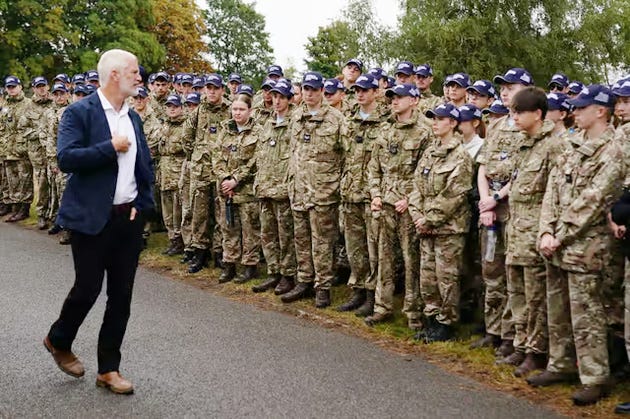
Here it is in full with my annotations:
THE FIVE TESTS
For weeks I’ve argued that this party, and this country, needs a proper debate about where we go next. Not a reshuffle. Not a few degrees of course correction. The big, difficult, honest choices we’ve spent thirty years avoiding.
A few people have asked me what that debate should actually be about. Fair enough. I spent 24 years in the Marines and two in government, and I resigned because I couldn’t win the argument I believed in from the inside. So let me make it here, plainly.
This isn’t a manifesto, but a set of five tests. Anyone asking to lead our country should be able to look down this list and say yes to all five.
(1) The Frontline Test
Do we give the people on the frontline the kit they need to do the job, and stand by them when the job is done?
I joined the Marines at 18. I’ve buried friends. So I do take this one personally.
I sat in government and watched us write a defence plan for a world that no longer exists, discussed in rooms I was kept out of. A 100k drone is now sinking warships that cost a billion. That is the reality of the wars being fought right now.
Passing this means 3% of GDP as the floor, not the ceiling.
The is a very real danger that if a non-modernised British army is fighting an enemy who is fully modernised for the drone age, we could lose badly. Countries such as Russia, China and Iran all have the ability to manufacture drones in vast quantities, so if Britain was fighting any of them, or any countries supplied by them, we would be in danger.
Buying for the next war, not the last. And fixing the Legacy Act so blokes in their seventies aren’t back in the dock for what they were cleared of decades ago.
Indeed. Idiot lawyers like Starmer only see this from a legal point of view so don’t appreciate this.
(2) The Next-Generation Test
Are we handing the next generation a better deal than the one we inherited, or a worse one?
It seems to me that Britain is a country where thinks gradually get worse, year on year.
I’m a lad from a tough part of Aberdeen. My mum raised five of us through some bleak years. The only reason I got out was because I was given an opportunity. That cannot be said for young people today.
Nearly a million young people, around one in eight, are now outside work, education or training. That isn’t their failure. It’s ours.
Fixing this means a NEETs and youth unemployment target with a date, the youth guarantee delivered not just announced. Restoring the link between work and a decent life for the under 30s, on housing, wages and opportunity. Skills and apprenticeship numbers that beat the last government, not just match it.
Talent is everywhere in this country. Opportunity isn’t. Fix that and you fix half of everything else...
(3) The Trillion-Pound Test
Is the plan to add a trillion pounds to what Britain earns, or to manage the decline more politely?
Here’s the lesson I learned from Ukraine and in government, and it never changes. We invent things. Other countries build them. Other countries decide. We’re brilliant at the first mile and absent for the next ninety nine.
So set a target and be judged on it. A trillion pounds added to our GDP within a decade. Yes, it’s ambitious. We should be ambitious!
Yes we need to grow the economy, which has underperformed for decades. This is easier said than done, in part because doing so means combatting vested interests, in particular nimbys.
Getting there means backing the high tech inventors just as much as the high street traders. Your local coffee shop shouldn’t be paying more tax per cappuccino than Starbucks does. So why on earth do they?
Starbucks need to pay their fair share of tax. If they won’t, fine, they don’t have to trade in Britain. We don’t need them.
It means an industrial strategy worth the name. Things to make and things to sell, in Barrow, in Derby, in every region. Our industrial base is national security, so we should fund it like it.
We should not have offshored manufacturing to China. We need to reverse that.
And it means building the chips and the compute here,
Yes. We need digital sovereignty: full ownership/control of all of our computing and communications infrastructure. Everything from chips to social media websites, and all technologies in between.
not inventing the breakthrough and watching someone else scale it. Data is the new gunpowder.
(4) The 10% Test
Can we make the country work 10% better, instead of only ever asking for 10% more?
I saw this from the inside. We patch the symptom this year, but the bill grows next year, and we end up paying for failure at the most expensive end of every system.
A 10% improvement in outcomes across a handful of our biggest problems, ill health, reoffending, wasted potential, would free up somewhere between £40 and £60 billion a year. We’re already paying those costs. We just pay them too late, when they’re at their worst.
Passing this means investing early instead of paying far more later, and having the honesty to admit that not every pound we spend today delivers an immediate return.
We absolutely need to do things more efficiently. For example the UK spends 12% of GDP on healthcare, whereas Singapore spends 4% and they live longer than us.
Running government efficiently needs to be done but is hard to do.
I suggest all government departments run multiple A/B tests, trying different things and seeing what works, on a continual ongoing basis.
(5) The Lights-On Test
Does our energy policy keep the lights on, the bills down and factories open, or do we keep chasing a target and hope the rest sorts itself out?
For years we’ve treated net zero as the only goal, and everything else, your bill, our industry, whether the grid even stays up, as a problem for later. That’s the wrong way around.
In practice net zero means offshoring our manufacturing to China. Time to end it. There is no point in us having zero emissions when other countries are vastly increasing theirs.
Make energy security the goal. Power that people, businesses, and industry can afford, and a grid that stays on when someone tries to switch it off. Do that and net zero follows. Chase the target on its own, and you end up with neither.
Passing this means a serious baseload, nuclear and the North Sea, built in time to matter. Strong countries have cheap, secure energy. Weak countries don’t.
None of this is complicated. It’s the oldest deal there is. You serve the country, the country stands by you. In uniform, in a hospital, in a classroom, on a building site. Right now that deal is broken, and everyone keeping our country going can feel it.
That broken deal is the real reason for the frustration out there.
A large part of why the deal is broken is anti-white racism, and mass immigration of people who’re an economic liability. No immigrant should be entitled to a single penny from the state until they’ve worked and paid tax for a number of years.
It’s why trust has drained out of politics. And it’s why our party that won a landslide is, halfway through the term, already arguing about who leads it.
But changing the person at the top fixes nothing if we don’t fix the deal underneath. Swap one leader for another and leave the deal broken, and we’ll be right back here in eighteen months, asking the same question all over again.
So I’m not interested in who gets what job. I’m interested in whether we’ve got the courage to pass these tests.
Yes. The important thing is good government not the person at the top.
We’ve been promised a debate. This is my opening offer to it. And if that debate ever becomes a contest, it should be fought on this ground, not on personalities.
I know where I stand.
GB news says Carns is giving an “ultimatum” to Burnham:
Andy Burnham has received an ultimatum ahead of next week as the Makerfield MP plots to become the next Labour leader and Prime Minister.
ex-Armed Forces Minister Al Carns is seen as a “dark horse” to run against Mr Burnham. The former Royal Marine commando, who was first elected to the House of Commons in 2024, gave Mr Burnham an ultimatum as the silver-haired Scotsman teased about standing himself.
He said: “Whoever wants to lead the country, tell me what you want it to be in 2029 and 2034.
“Let’s be really clear on the objectives you want to get to, the outcomes you want for this country. What’s the vision?”
The Scotsman asks who is Carns:
Lots of names have been bandied about as to who could replace [Starmer].
one, lesser known name, regularly comes up when any leadership chat is mentioned: Al Carns.
Although he was only elected as an MP in 2024, the Aberdeen native has made a big impression in his 22 months in Westminster.
He served five tours in Afghanistan and hit the headlines earlier this year when he criticised Donald Trump for claiming Nato troops avoided the frontline.
And:
The 45-year-old was born and raised in Aberdeen to a single mother and attended Hazlehead Academy.
Having initially been turned down from the military because of his colour blindness, he enlisted as a Royal Marine commando in 1999 aged 19.
Since then he has had a stellar 24-year military career, although much of it cannot be made public for national security reasons.
He served five tours of Afghanistan and in 2011 he won the Military Cross “in recognition of gallant and distinguished service”. Mr Carns also received a Distinguished Service Order and was given an OBE in the Queen’s birthday honours in 2022.
He is no stranger to a gruelling challenge. He went on an expedition to the Arctic earlier this year. Last year he climbed Mount Everest on an expedition with former special forces colleagues, and set a record by doing it in under five days by using xenon gas and hypoxic training to acclimatise.
Comments
Nothing yet. Say the first thing.
Sign in to join the conversation.