
Hi everyone,
With this essay I’m thrilled to introduce you all to a new writer for Polypharmacy, Dr. Kevin Kennedy, a fellow psychiatrist. Some of you may have already read some of Kevin’s work over at Thinking Psychiatry, or you may recognize him as the author of the critique of the Hennssler et al. paper I wrote about in Should All Depressed Patients Be On Adjunctive Mirtazapine? I’ve found Kevin’s essays to be filled with the sort of incisive, critically observant writing that challenges some of my core assumptions about the scientific literature and pushes me to be a more thoughtful, intellectually rigorous psychiatrist. I hope you will find Kevin’s writing similarly illuminating.
Kevin and I plan to write as we normally would, but publish under the same banner. For us, this means we have someone to edit our work and to share ideas with. For you, we hope this means more regular, interesting pieces to read. We have no plans to paywall any of our work. This is a new way of doing things for the both of us, so please share your feedback or ideas about how we can keep Polypharmacy a newsletter that you would like to keep seeing in your inbox. Thanks, as always, for reading.
-Nils
P.S. Next weekend will be my first post in a while!
While there is ongoing debate about the precise role of serotonin transmission in mood, there is broad agreement that the notion that SSRIs correct a “chemical imbalance” was wrong, misleading, and oversold to patients (I’ll call this a “myth” for this reason). The acknowledgement that the “chemical imbalance” model was a misleading marketing tool is a sign of progress for psychiatry.
But, on the heels of this collective reckoning, I’ve noticed a new explanation of depression and the mechanism of transcranial magnetic stimulation (TMS).
The new explanatory framework1 is that depression is caused by an underactive brain region involved in mood, and TMS activates that region which improves depression. Some clinics specifically state that TMS “corrects” an “imbalance” of brain region activity, “restores” a healthier balance, or “rebalances” affected brain regions. These explanations often have an anthropomorphic quality: TMS “calms” overactive regions or “wakes up” underactive ones.
Let me share a few examples (all emphases mine):
Here’s a head psychiatrist at the Medical University of South Carolina, one of the leading neuromodulation research centers:
“In people with major depressive disorder, there are usually parts of the brain that are underactive. With TMS, we produce an electromagnetic pulse that we apply to the top left part of the head. That pulse reactivates the part of the brain that’s underactive, leading to a resolution of depressive symptoms.”
Here’s Ohio State:
With TMS, brain areas that are overactive can be slowed, and brain areas that are underactive can be stimulated. People with depression tend to have brain areas that are underactive. Once those areas are stimulated, a person will begin to feel better.
And then TMS clinic websites, like:
There are specific areas in your brain that control mood. When synapses in those mood-regulating areas are underactive, connections are broken and depression can result. TMS revitalizes those dormant synapses, “waking up” the brain to function as it was meant to.
These areas of the brain are underperforming physiologically, which can explain symptoms of depression. Using very similar technology to a Magnetic Resonance Imaging (MRI) machine, TMS is able to stimulate the inactive areas of the brain, thereby improving symptoms of depression.
While the exact cause of depression is not known, it is known that depression is characterized by an imbalance of the brain’s chemical messengers (or neurotransmitters), as well as decreased activity in the frontal lobes of the brain.2
And:
Depression and other mood disorders often involve imbalances in brain activity. For instance, the left dorsolateral prefrontal cortex (associated with mood elevation), can become less active, while other areas may become overactive. TMS treatment in Los Angeles helps correct these imbalances by delivering magnetic pulses to targeted brain regions, encouraging new and healthier neural connections.
And then this from the LA Times:
This process, known technically as repetitive transcranial magnetic stimulation (rTMS), is designed to target key brain regions that have gone dormant or sluggish. The primary target? The dorsolateral prefrontal cortex. This is the CEO of your brain. It handles executive function and mood. When you are dealing with major depressive disorder or chronic stress, this area often shows low activity. It’s asleep at the wheel.
And, much as we had cartoons of neurotransmitters in psychiatrists’ offices to market SSRIs, many a TMS clinic website sports a colorful, eye-catching image from NeuroStar of a PET scan contrasting a depressed and non-depressed brain. The implication is simple: depression is a brain disease of underactive brain states, as evidenced by dark and bright colors.
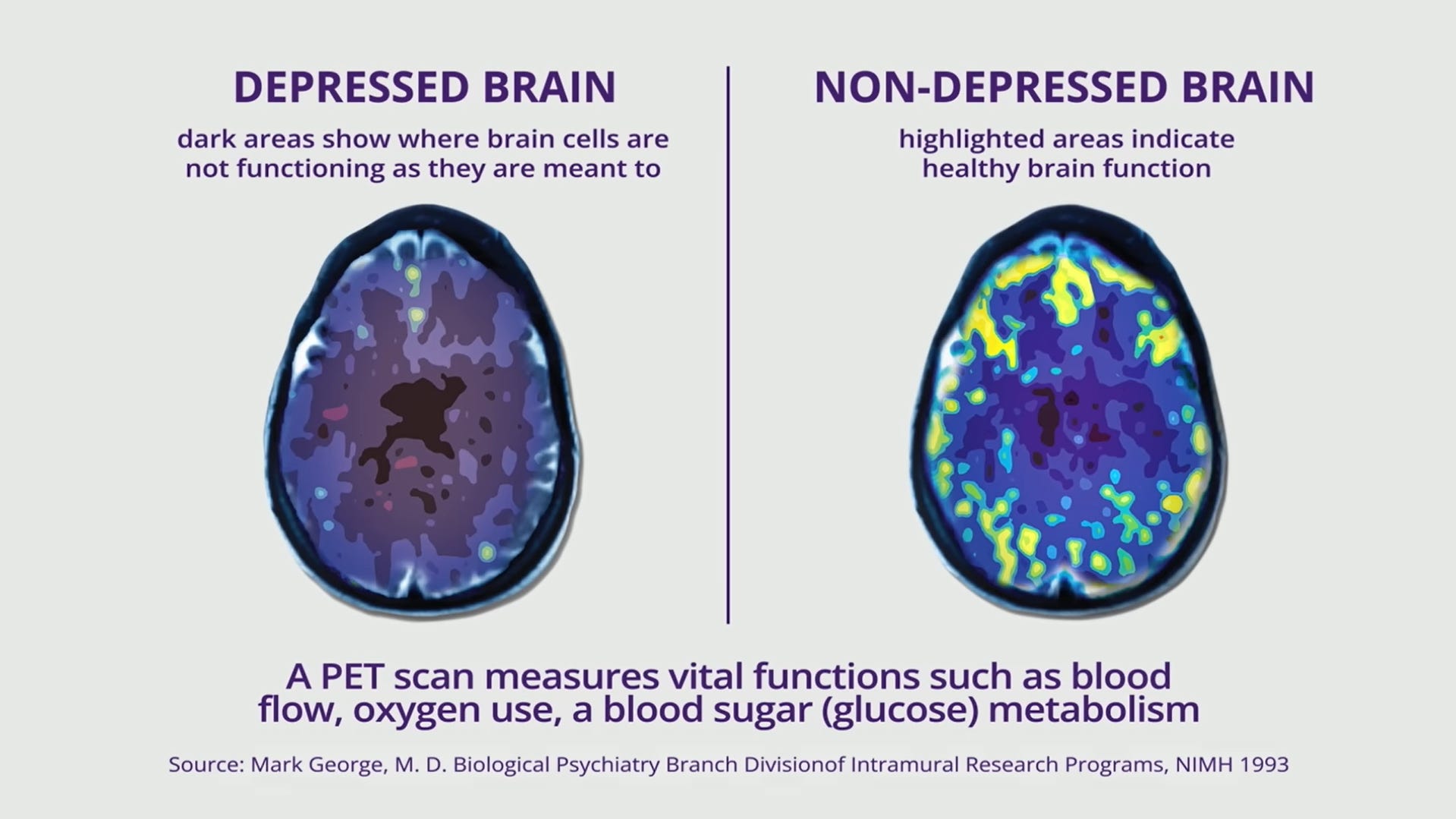
These are not cherry-picked examples, but a list solely of TMS clinics in Los Angeles. This language is present in some form on almost every TMS clinic website that I have read. I could have continued ad infinitum.
When I read the neuroimaging literature, it is clear how much this language inflates very weak and largely negative findings.3
At a minimum, the idea that depression is caused specifically by an “underactive” left dorsolateral prefrontal cortex (DLPFC) is not supported by the current literature. Here is a summary of the major neuroimaging meta-analyses from Gray et al., 2020, showing an utter lack of convergent findings in depression across hundreds or thousands of studies.
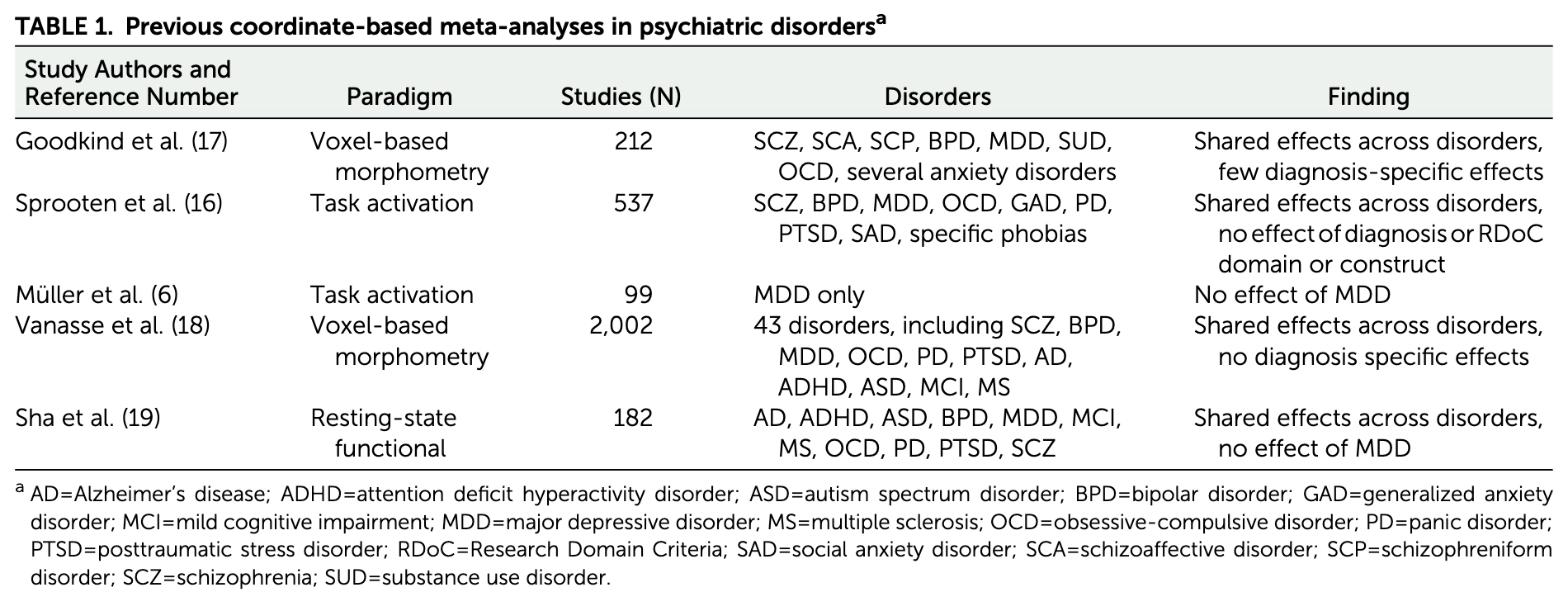
In their own meta-analysis, Gray and colleagues found no convergent finding in the primary analysis from 92 publications with 152 experiments in 2,928 patients with depression. When a large number of secondary analyses are conducted, including on a variety of subgroups (e.g. medication naïve patients), a range of other structures are inconsistently implicated, namely portions of the subgenual cingulate cortex, hippocampus, amygdala, and putamen. At best, this would imply that many regions are involved in mood. The simplification to a single target is inaccurate. The DLPFC itself—the standard TMS target—is not even identified among the many implicated regions.4
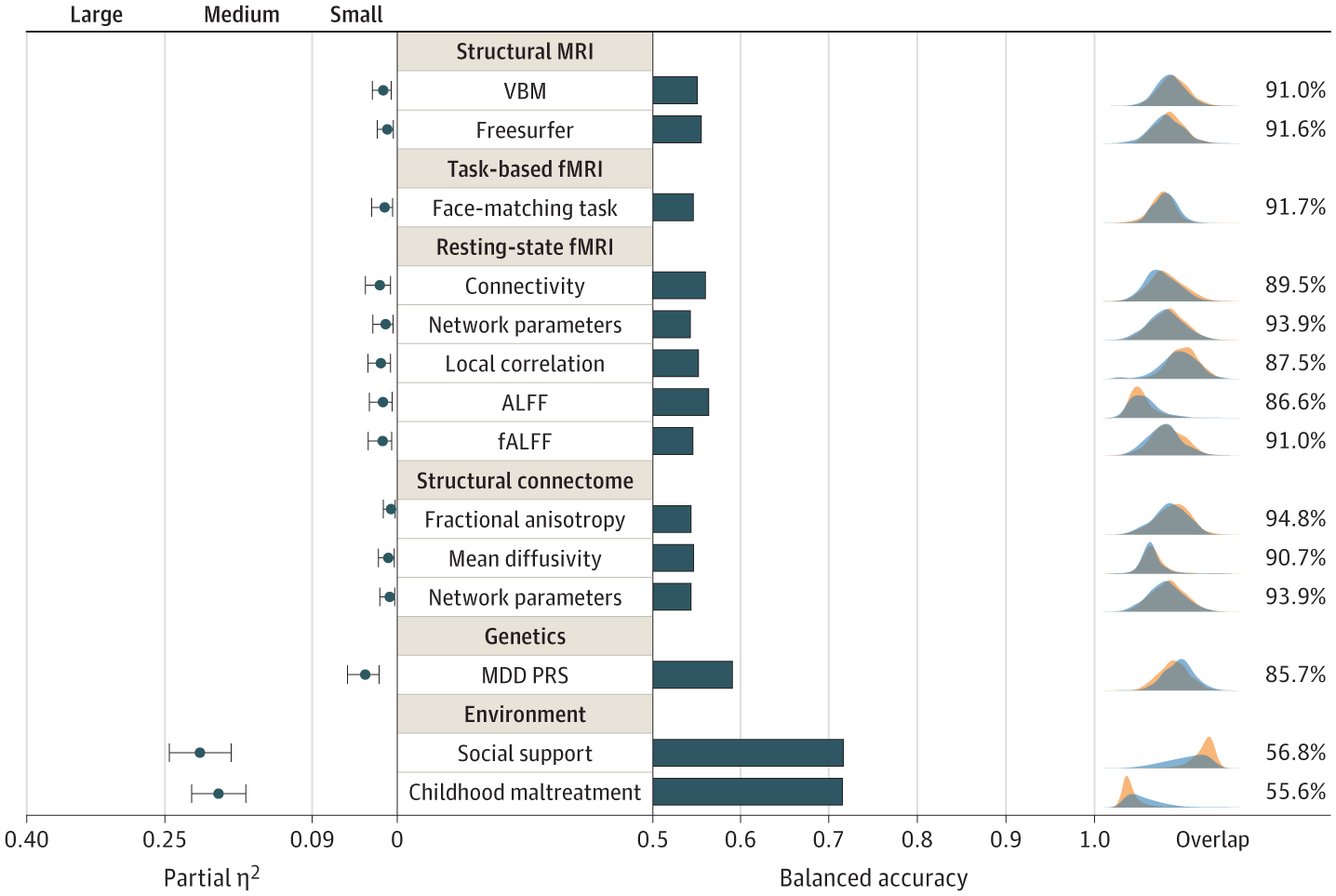
More importantly, these modest findings are differences in group averages that aren’t applicable clinically to individuals. There is no neuroimaging biomarker (reflective of a real deficit) that can meaningfully distinguish a healthy individual from a depressed individual. Here’s the conclusions of a large case-control study by Winters et al., 2025:
In this case-control study that included 1809 adults, the group differences in neuroimaging markers explained less than 2% variance, and the single-participant predictive utility was consistently below 56% accuracy. The distributional overlap between healthy individuals and those with depression even for the variables showing the largest difference was 87% to 95%.
In the right side of the the chart below, you can see the distribution of outcomes on various measures for patients with depression and healthy controls—with almost complete overlap.
Later, the authors are even more damning:
Even when considering the upper bound of the deviation in each modality, none could be considered informative from a personalized psychiatry perspective with both groups being nearly indistinguishable on a single-participant level. This is true despite near-ideal harmonization of study protocols, quality control, neuroimaging data acquisition, and clinical assessment, employing standard processing and analysis pipelines frequently used in the scientific community. Overall, no modality explained more than approximately 2% of the variance between healthy individuals and those with depression.
The idea that each individual with depression simply has a hypoactive DLPFC (or some other structure) that explains their depression relative to a healthy control is just not factually accurate.
When I trace the origin of the “hypoactive prefrontal cortex” model of depression, there is another parallel with the chemical imbalance model. In the same way that the serotonin model of depression was based on early research that didn’t replicate in larger studies, the model we are passing off to patients as cutting-edge is just a theory from the 1990s era of biological psychiatry that isn’t supported by three decades of additional research. 5
But at least our explanations of the effects of TMS are accurate, right?
Here, too, the data are messy and multifaceted. Good reviews are hard to find, so I’ll leave this section sparser and more speculative. But TMS appears to induce complex effects on a range of neurotransmitters, synaptic plasticity, brain wave patterns, and functional connectivity. The reduction to “simulates a hypoactive part of the brain” in depression is a gross oversimplification. Even the idea that TMS itself is simply “excitatory” at high frequency or “inhibitory” at low frequency appears to be debated. Recent reviews of the mechanism of TMS highlight the complex and uncertain mechanisms:
Although TMS protocols are classically considered ‘excitatory’ or ‘inhibitory’, the actual effects in individuals appear quite variable, and might be better understood at the level of populations of synapses rather than individual synapses.
And another major review from 2022:
The complexity of the response to TMS warrants cautious interpretation of its physiological and behavioural consequences, and a deeper understanding of the mechanistic underpinnings of TMS will be critical for advancing it as a scientific and therapeutic tool.
There is a simple explanation for the “TMS activates a hypoactive frontal lobe” language. Patients find it reassuring and compelling, so they pursue TMS treatment which earns revenue for clinics and device companies. The reality is that TMS is a product in a diverse market of depression treatments, against which it competes.6 An intuitive biological model of depression is a compelling marketing tool for a profitable treatment, which is why there appears to be an arms race in hyperbolic claims about TMS for depression. TMS not only stimulates an underactive frontal lobe, it rebalances brain regions, calms overactive regions, and revitalizes dormant synapses. Apparently, the use of fMRI in the SAINT TMS protocol is similar to “pinpoint[ing] the location of a tumor to precisely treat a patient’s cancer.”
Indeed, the fact that TMS clinicians feel the need to use this language proves how powerful these explanatory frameworks are. If frameworks like this didn’t matter, then why does every clinic use them? What downside could there be to communicating honestly about our lack of understanding the cause of depression and mechanism of TMS? It is precisely because these narratives are so powerful that we need to be so thoughtful about them.
I’m sure that clinicians convince themselves that patients benefit from this language: it reduces stigma and self-blame, it offers hope, and it encourages engagement in a beneficial treatment. But just because patients can be sold a compelling narrative does not make it true. And it does not mean we should peddle false narratives. This is what propagated the chemical imbalance myth: psychiatrists convinced themselves that patients benefited from this model, while companies knowingly marketed this myth to sell antidepressants. With both myths, psychiatrists get to feel like they are on the cutting edge of neuroscience and treating a “real” brain disorder.7 Psychiatrists and patients alike benefit from the false simplicity of the narrative.
While we can acknowledge the comforts of this language, we need to face its harms.
First, it means that the neuromodulation field is being built around a lack of honesty about our understanding of depression and its treatment. Intelligent patients, researchers, and clinicians will recognize that the language used to describe TMS is fundamentally inaccurate. We risk justifying the same accusations against psychiatry that the chemical imbalance language caused: of deception, over-treatment, over-medicalization, and corruption by industry.
Second, explanations of the cause and treatment of depression change people’s understanding of their own emotions. Psychiatry’s greatest power is in shaping our collective understanding of our emotions and our selves. A factually inaccurate metaphor for TMS causes patients to misunderstand their emotions. To me, this was the gravest sin of the “chemical imbalance” myth: it provided a powerful explanatory framework of negative emotions that was, fundamentally, bullshit. In my experience, TMS researchers and clinicians are not particularly interested in questions of identity and narratives, but these are arguably the most powerful consequences of these treatments.
While the research isn’t amazing, a few studies have suggested that simplified biological models of depression, like the “chemical imbalance” model, can give people the impression that their emotions (and ability to improve their own mood) are outside of their control. If people believe that the root cause of negative moods is a “chemical imbalance” or “hypoactive frontal lobe” outside of their direct control, they can become passive bystanders to their own emotions and mental health.
This may seem radical, but I think we need to be honest with our patients. We should be giving patients a more complex explanatory model for TMS by, for instance, stating that we don’t know exactly how TMS works or what the cause of depression is.
We could convey to patients that TMS has complex (and not well defined) effects, but a key part of improvement also appears to be a sense of hope with treatment, the behavioral activation from coming to treatment every day, contact with staff, and natural fluctuations in symptom severity over time. These explanations are both more accurate, and allow patients to be more active participants in their own care.
The solution to the false narrative of the chemical imbalance is not the false narrative of the “underactive frontal lobe.” It should be conveying the complexity and ambiguity of our diagnoses and treatments.
I’ll use explanatory framework, framework, and model interchangeably.
This appears to be boilerplate language, possibly from NeuroStar, as several clinic websites use this exact language.
I’ll emphasize that I am not a neuroscientist and this is not my expertise, so I welcome corrections if I am misreading this literature.
It has been argued that stimulation to the left DLPFC acts via functional connectivity with the subgenual cingulate—this idea influences the SAINT protocol—but this theoretical mechanism is very different from how TMS is described on clinic websites.
Ironically, some of these small, old studies were focused on how antidepressants—and not TMS—correct changes in prefrontal perfusion. I mention this to emphasize how the language we use with patients is based far more on culture and commercialization than on the actual science. Antidepressants resonated with a “chemical imbalance” model of depression but not with an “underactive prefrontal cortex model.” But TMS does.
As a physician interested in humanistic care, it is painful to acknowledge this reality.
More cynical readers might note that there is financial incentive on the part of physicians to use this language, separate from that of the device or pharmaceutical companies.
Comments
Nothing yet. Say the first thing.
Sign in to join the conversation.