
Despite the fact that the answer to this question bears heavily on both our abstract diagnostic concepts and our practical decisions when it comes to diagnosing and treating individual patients, this is a question that modern psychiatry seems to have little interest in. The amount of time we spend talking about Borderline Personality Disorder alone should indicate that a fair bit of modern psychiatric education focuses on scientific concepts of personality, but in reality personality is not much discussed outside of the (largely vibe-based) psychodynamic tradition.
I suspect that most psychiatrists would be relatively surprised to know that the field of psychometrics has largely agreed upon the existence of a single, generally applicable model of personality since about the 1980s.
This model, known as the Five Factor Model — abbreviated as the FFM (the shorthand I will be using here), the Big Five, or by the acronym OCEAN — is perhaps second only to the concept of General Intelligence (g) in the degree to which it has been studied and its levels of internal and external validity. Psychometricians have demonstrated that personality can be fairly well distilled down into a set of normally distributed traits and subtraits. These traits demonstrate good stability over the lifetime and tend to change in a small, predictable fashion over time. Heritability studies indicate that somewhere around 50% of the variation in personality traits are probably heritable. Cross-cultural studies indicate that the FFM is not unique to the English language or even what we might consider the “Western” cultural world.
There is actually quite a bit of disagreement about the ‘right’ word for each of the factors in the FFM, so keep in mind that these words are meant to give you a general sense of the category, not reflect their entire breadth:
O = Openness, Originality
C = Conscientiousness, Constraint, Control
E = Extraversion, Enthusiasm, Energy, Positive Affectivity
A = Agreeableness, Affiliation, Affection
N = Neuroticism, Nervousness, Negative Affectivity
To avoid picking sides, I will take my cues from two authorities in the field, Robert McCrae and Oliver John, and simply refer to them by their first letter (e.g. low A, high E).
First, because you probably have false assumptions about the nature of personality. Notice that N contains negative affectivity, but E contains positive affectivity. Someone can be both high N and high E, though we tend to assume they exist as opposites.
Second, because having a concept of who someone is, independent from the notion of a psychiatric diagnosis, seems important to avoid everything collapsing into the diagnostic black-holes that are things like “depression” and “anxiety.”
“No shit,” I hear you non-psychiatrists say.
But… listen. Psychiatrists are addicted to diagnosis. I cannot remember the last time I’ve seen a note that has declined to give a patient a diagnosis. At best we assign something “provisional”. There are many reasons for this behavior — some of it is that we don’t get paid without a valid billing code, even if we’re still diagnostically uncertain — but a large part of it is that our diagnostic criteria are so broad that we can find a diagnosis for just about anything we see as maladaptive.
Similarly, we suffer from an extremely narrow understanding of personality pathology. Even when psychiatrists do land on a personality-based diagnosis, it’s almost exclusively framed in talk about ‘Cluster B traits’ or ‘Borderline Personality Disorder.’
If we cannot grasp the idea that there exist individuals with high N, chronic negative affect starts looking to us like Major Depressive Disorder, or Generalized Anxiety Disorder, or PTSD, or whatever. If we cannot grasp the idea that individuals can be high N and high E, the presence of positive affect will confuse us and may lead us to think that the person is either overstating their symptoms or that they are “hiding” their depression. If we cannot grasp that there are more ways for the extremes of personality to manifest than just ‘Cluster B traits,’ then we miss opportunities to properly identify where their difficulties lie.
In short, the FFM allows us to think about people in an evidence-based way that doesn’t immediately dissolve into diagnosis. That sounds useful, doesn’t it?
Finally, while I think that there are strong conceptual reasons why psychiatrists should understand the FFM, I should admit that as I write this essay, I am not yet sufficiently familiar with the present personality literature to make precise proclamations about how we can or should integrate the FFM directly into psychiatric treatment. Part of why I am splitting this essay up into multiple pieces is so that I have the time to give the literature the reading and thinking it deserves.
In 1884, Sir Francis Galton — half-cousin of Charles Darwin, developer of the statistical concept of correlation and regression towards the mean, a founder of the modern field of psychometrics, developer of the dog whistle, and (depending on who you talk to) developer of the dog whistle — asked the following question in an essay appropriately called Measurement of Character in the Fortnightly Review:
Can we discover landmarks in character to serve as bases for a survey, or is it altogether too indefinite and fluctuating to admit of measurement? Is it liable to spontaneous changes, or to be in any way affected by a caprice that renders the future necessarily uncertain? Is man, with his power of choice and freedom of will, so different from a conscious machine, that any proposal to measure his moral qualities is based upon a fallacy? If so, it would be ridiculous to waste thought on the matter, but if our temperament and character are durable realities, and persistent factors of our conduct, we have no Proteus to deal with in either case, and our attempts to grasp and measure them are reasonable.
Where do you think the man who developed a system to try and measure human beauty came down on this question?
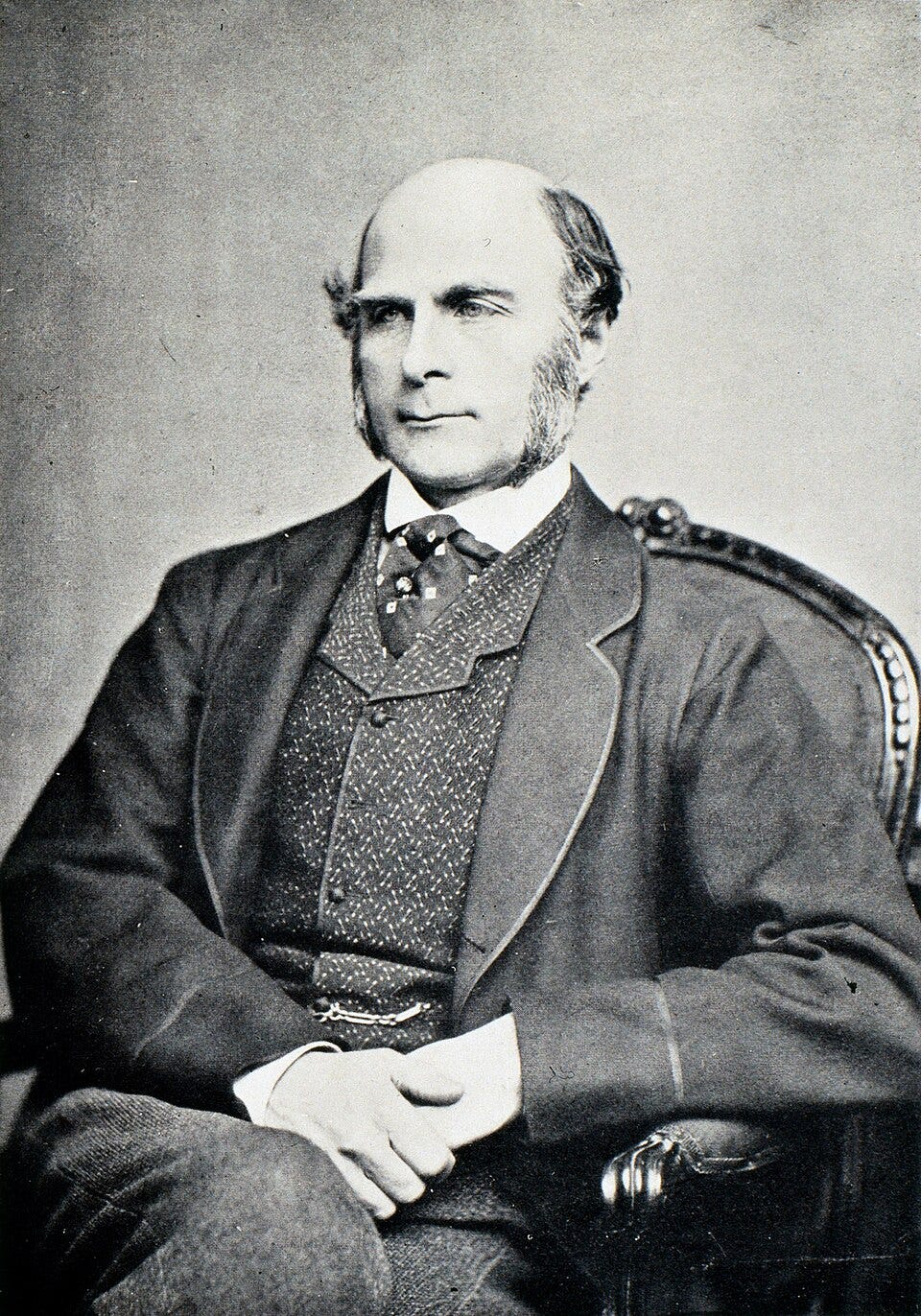
After deciding that “… the character which shapes our conduct is a definite and durable ‘something,’ and therefore that it is reasonable to attempt to measure it,” Galton first goes looking for the “more conspicuous aspects of the character” in language:
…by counting in an appropriate dictionary the words used to express them. Roget's Thesaurus was selected for that purpose, and I… estimated that it contained fully one thousand words expressive of character, each of which has a separate shade of meaning, while each shares a large part of its meaning with some of the rest.
In the essay, Galton quickly leaves his survey of the language behind and instead muses on the different sorts of ways that aspects of personality might be measured: by observation alone; through “experiments… that might be secretly made to elicit the manifestations we seek”, or “by observing physiologic changes in response to particular situations, and so on.”
Left behind or not, Galton thus becomes one of the first to articulate what has become known as the lexical hypothesis. It makes two major claims:
Individual differences that are salient and socially relevant in people’s lives will eventually become encoded into their language.
The more important such a difference, the more likely is it to become expressed as a single word.
Here the concepts sits for a few decades. Some small lists of traits are compiled in the 1910s and 1920s, but nothing really comes of them.
In 1936, five decades after Galton’s essay, Gordon W. Allport and Henry S. Odbert published Trait Names: A Psycho-lexical Study. In the opening they declare:
Sooner or later every psychologist working in the field of personality collides with the problem of trait-names. Whatever method he employs — rating scales, tests, factor-analysis, clinical interviews or any other technique — he is forced to ask himself whether the terms he is using in describing qualities and attributes of personality do actually denote psychic dispositions or traits, or whether these terms are mischievous verbal snares tempting him into the pitfalls of hypostatization and other perils of "verbal magic.”
[…]
What is clearly needed is a logic for naming traits that will engender caution and yet will not paralyze psychological investigators with metaphysical misgivings.
To this end they trawled through an unabridged version of Webster’s New International Dictionary — which contained some 600,000 entries1 — and constructed a ‘thesaurus’ of 17,953 terms.
You’d think it shouldn’t have taken 50 years. Allport and Odbert mention that many had tried, “but for one reason or another all these attempts were unfinished.”
Translation: “We were the only ones with enough perseverance and fortitude-of-will to keep making our grad students work on this do this all ourselves.”
These nearly 18,000 terms were organized into four columns:
Column I: contains what Allport and Odbert considered trait-names “in the strictest sense of the word…”
They note that “… in our stage of progress not all psychologists are willing to confine themselves to ‘the strictest sense of the word,’ or to embrace the special theory of traits outlined briefly in the monograph. [Ed.: Tell me how you really feel!] For this reason it has seemed best to use the designation ‘trait-names’ somewhat loosely for all four columns.”
Column II: Contains temporary moods and activities (e.g. infuriated, frightened, embarrassed)
Column III: Contains “weighted terms conveying social or characterial judgements of personal conduct or designating influence on others” (e.g. abnormal, ignorant, obsolete)
Column IV: A grab-bag that included “Designations of Physique, Capacities and Developmental Conditions: Metaphorical and Doubtful terms.” Amusingly, contains the word “cooked,” which apparently is not a Zoomerism, but instead has been around since at least 1708.
The list is a fascinating reminder of how ephemeral our shared sensibilities around language can be:
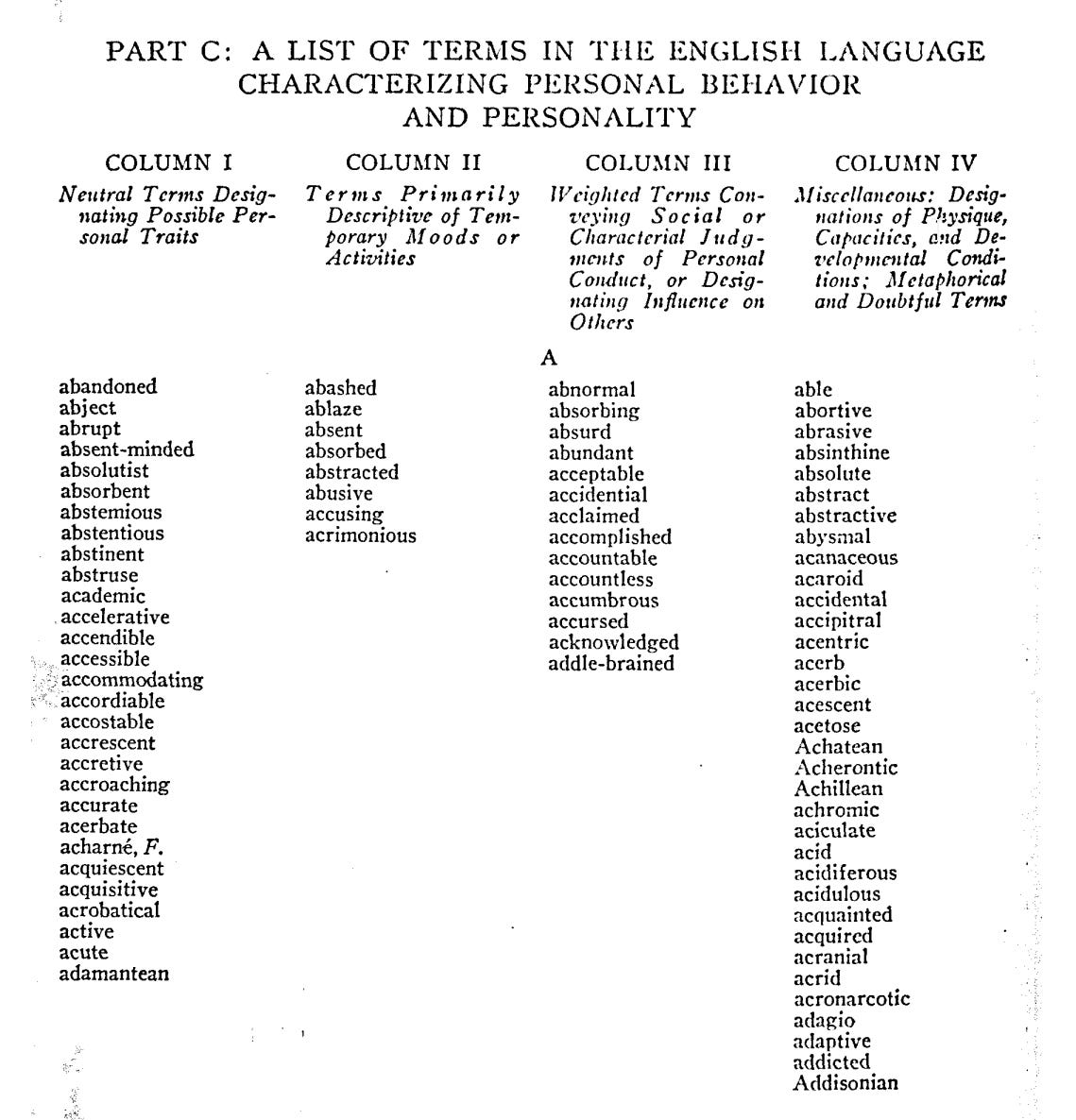
For example, “alcoholic” can be found in Column II, but in modern English it carries a far more judgmental connotation that would place it in Column III.
Many of the entries are marked with an italicized ‘R.’ to denote rareness. One wonders what circles Allport and Odbert frequented where individuals were regularly described as abstemious,2 ambagiosus,3 or clairaudient.45
British-American psychologist Raymond Cattell shared much of Allport and Odbert’s frustration with the field of psychology’s nebulous and subjective theorizing.
Psychology, he felt, needed rigorous mathematical analysis to rid itself of subjectivity. At least, as much as it plausibly could. In his 1955 paper The principal replicated factors discovered in objective personality tests, he writes:
Without objective and analytically powerful techniques of [multivariate methods], personality research must depend either on clinical concepts, more subjectively derived and seldom expressible in operational measurement to everyone’s satisfaction, or on arbitrary, atomistic “scales” or patent tests, which can be at least as numerous as psychologists!
Before we get into that, though, let me briefly lay out Cattell’s concept of personality traits. His concepts will be recognizable to most of us on an intuitive level, but with some nuance that will be useful in really understanding the concepts in this essay and the next. If you really want to understand the whole thing, you can read (The description of personality. I. Foundations of trait measurement)
Traits are the elements of the whole personality. If personality is an alloy, traits are the individual metals that comprise the alloy. Cattell distinguished between common traits — general aspects of personality that can be identified in most, if not all individuals — and unique traits, which may only appear in specific individuals or unique subpopulations. He also discusses the concept of basic or major traits — broad categories that contain separate, but related traits.
Importantly, Cattell believed that all traits existed in relation to an individual’s environment:
all traits [consist] essentially of a relationship between the individual and his environment rather than a reactive tendency which can be defined in terms of the individual alone, all traits become changed — in their boundaries and units of measurement — as the environment changes.
Traits are composed of trait elements. If traits are individual metals in the alloy of personality, trait elements are the atoms of those metals: specific behaviors, mannerisms, etc. that together make up a single trait.
Already the subjectivity problem rears its head. How do we decide which trait elements belong to which trait? Cattell argues that there are three main ways (what he calls ‘unities’) to group elements:
Dynamic/Motivational Unities: “Which the parts are integrated by the fact that they all lie on the path to some one goal of the organism.”
The italics are mine to emphasize that this unity captures individual wants/needs/urges. Cattell says that most of the dispositional traits are captured here, and gives the examples of “timidity, amorousness, assertiveness, acquisitiveness.”
Social Mold/Environmental Demand Unities: These represent “a unity from the standpoint of society’s needs or as occasioned by the pressure of the environment rather than from that of the individual’s ergic goals.” Again, italics are mine to indicate the clear separation from the individual-focused nature of the Dynamic/Motivational unities. Among others, Cattell offers conscientiousness, trustworthiness, tactfulness, and charm as examples of Social Mold traits.
Constitutional/Temperamental, non-dynamic Unities: These “spring from some unitary constitutional endowment of the organism, which, however, is not of a dynamic teleological nature.” These traits are distinguished from the previous two as being some innate aspect of the individual. Some examples given are excitability, extraversion-introversion, general emotionality, the innate “abilities” mentioned above, and “some psychotic and neurotic syndromes”
Cattell felt that factor analysis — a mathematical technique pioneered by his graduate advisor Charles Spearman (yes, that Spearman) — would be what allowed psychology to determine which of these unities form the common structure of human personality.
Factor analysis was nothing new in the 1940s — Spearman pioneered the concept in 1904 — but it was being used to analyze a more concrete psychological category termed the ‘abilities’ (or what we would probably refer to as general intelligence today) which referred to things like intelligence, mechanical aptitude, and verbal ability. The data from which these factors were derived were generated from tests that were relatively easy to design to cover the breadth and depth of cognitive functioning. Applying factor analysis to personality traits, susceptible as they were to the perils of “verbal magic”, was another story.
To understand Cattell’s difficulties, I need to explain something about personality tests and the basics of factor analysis. I will leave out how personality tests are constructed until we start talking about Cattell’s work later on.
Personality tests themselves are extremely simple in their nature. Some early tests simply asked a rater to decide which end of a bipolar spectrum of two traits an individual tended towards. For example, is this person more Formal or Casual? Headstrong or Gentle Tempered?
Most tests, like the NEO-PI (specifically tailored to measure the Five)6, ask simple questions about a single attribute and give the respondent the ability to choose how strongly or weakly they identify with that behavior. For example:
“I am the life of the party”
“I feel little concern for others”
“I get stressed out easily”
After you administer a test to a group of individuals, you end up with a couple hundred answers to each question — 240 questions in the case of the NEO-PI — but what to do with them?
You can eyeball the data and notice some obvious patterns. People who say that they are the life of the party also say that they are likely to start conversations with strangers. People who answer ‘Yes’ to “I make sure everything is in its proper place” tend to answer ‘No’ to “I can be extremely careless sometimes.”
This is all well and good, but the problem is that with 240 answers there are 28,680 different correlations to consider. Sure, you can start to see some basic clusters of responses that might represent a personality trait, but there are just too many comparisons to make to avoid missing important correlations (or anti-correlations!). In statistical speak, we are unable to know how many latent factors are hidden within our correlational data without doing some work first. Factor analysis is the mathematical solution to this problem.
The first thing we do is to generate all 28,680 correlations between your questions, in something called a correlation matrix. We take one question at a time and ask “If a respondent gives this answer to Question 1, how well does that predict their response to Question 2?” and so on.
Once we have our matrix, we can ask if our data has good factorability. We look for mathematical signals that indicate if there are patterns in the response data or if everything looks randomly correlated.
Now we move on to factor extraction.7 The best analogy I have for factor extraction is to compare it to drawing a line-of-best-fit in a regression analysis. Remember that lines-of-best-fit are used to find the maximum amount of variance that a single variable can explain about another. In more concrete terms, a line-of-best-fit is a single line where the total distance between the line and the points on the graph are as small as they can possibly be.
The first factor is like a line-of-best-fit drawn through a cloud of variables in n-dimensional space (n = # of items in your matrix).8 A single line9 that captures as much of the variance of the entire data set as possible; the single line that minimizes the distance between itself and all other variables in the matrix.
Unlike a regression analysis, however, we get to keep drawing ‘lines’ because we are asking a different sort of mathematical question that does not rely on a single variable to predict another. It turns out that — for reasons that Claude tells me is a “geometric necessity” — you can capture all of the variance in an n-dimensional space with exactly n lines drawn orthogonal to one another.
In less mind-melty language, this means that you extract as many factors as you have items in your matrix. That’d be 240 for the NEO-PI. We only keep 5 of these…
Before we get rid of our factors, we have to get to know them first.
The strength of the relationship between a response to a question and a factor is called its loading. A question can have a loading between -1 and 1 for any given factor; the closer to -1 or 1, the more correlated (or anti-correlated) that factor is with a positive (or negative) response to that question. A question with a factor loading of 0 means that there is no relationship between the factor and the question.10 Questions whose answers are strongly predicted by a particular factor are said to “load” heavily on that factor.
The amount of variance in the entire dataset that any one factor explains is called an eigenvalue, and the sum of all eigenvalues is the number of items in your matrix. If your test had 10 items and one factor has an eigenvalue of 4.0, knowing how a test-taker scores on that factor would explain 40% of the total variance in their answers.
The first few factors you extract have large eigenvalues, but the vast majority of them are so small as to be useless, and need to be culled. There are a few different ways to do this; just know that something called parallel analysis is currently the favored method. At the end, you’re usually left with a number of factors that is a small fraction of your starting items.
Now that we have our factors, we have to figure out what they mean. This is the most complicated part to explain, so bear with me.
It’s easiest to explain things visually. Imagine the factors as two lines on a 2D graph,11 and the questions as individual points on that graph. The distance from the dots to the axes represents an item’s loading on a particular factor. The closer the dot to the factor line, the higher the loading.
Let’s look at a graph with two factors, and a collection of questions from an imaginary personality test:
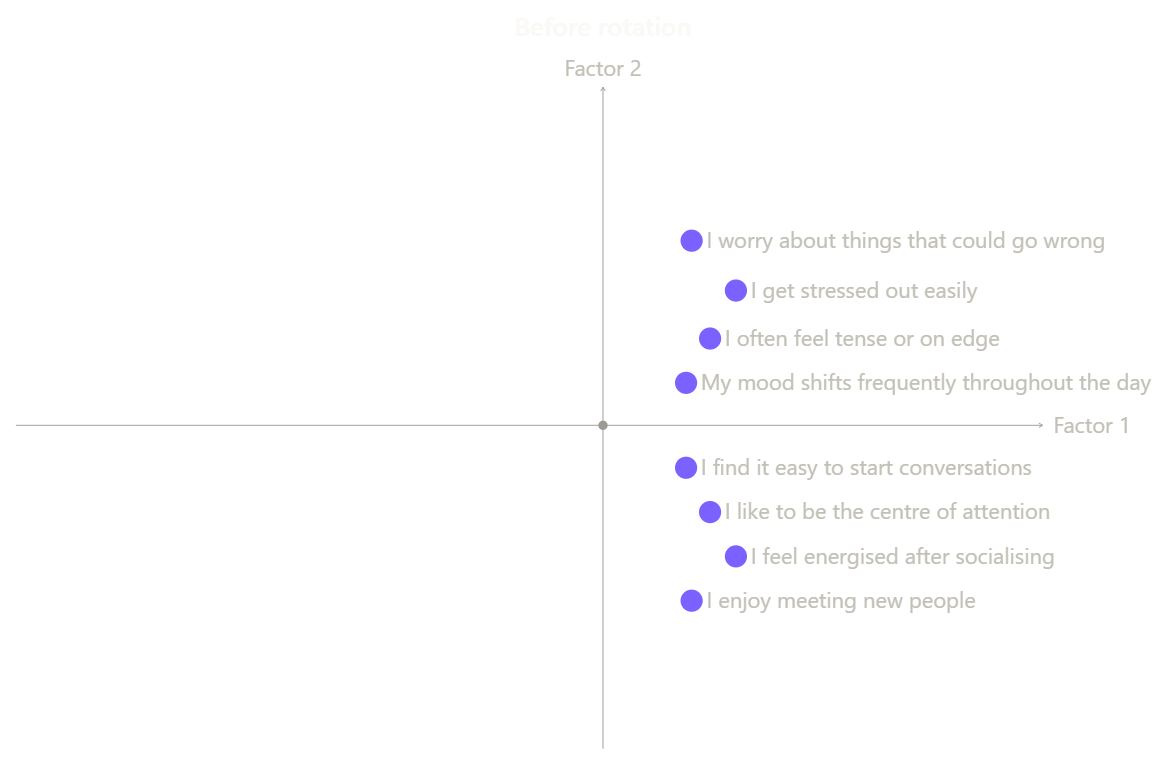
What do you notice?
First, it seems pretty clear that we have two distinct clusters of items. The group up top seems to be about negative emotions and emotional lability. The bottom group seems to be more defined by an enjoyment in social interactions and interpersonal attention.
Let’s give each cluster its own color so we can keep track of them:
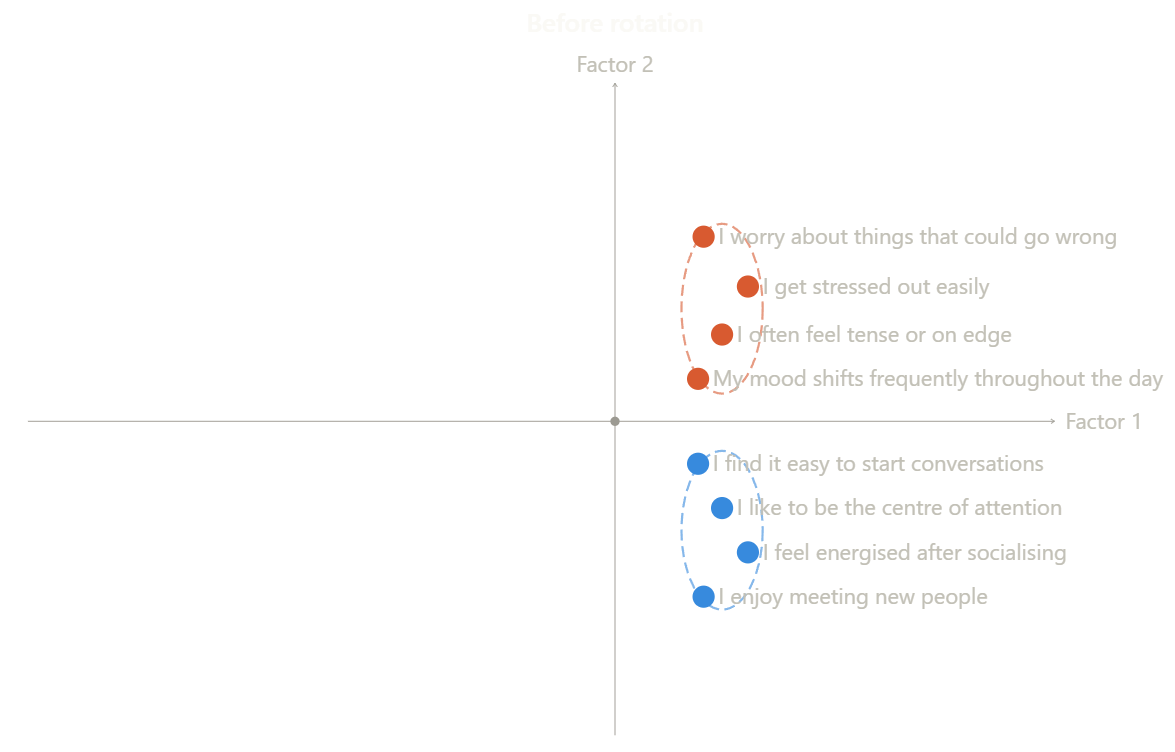
Conveniently we have two factors and two clusters, but neither factor is clearly pointing towards either cluster. In fact, Factor 1 is almost perfectly in the middle of all of the questions.
Fortunately — as long as we keep the sum of the eigenvalues explained by the factor solution the same12 (i.e. total variance can’t change) — factor analysis allows us to point the factor arrows in any direction we want. This process is called rotation. In this case, as long as Factor 1 and Factor 2 stay at a 90-degree angle to one another, we can rotate them around the center.13
The goal of rotation is to have each factor line clearly associated with a particular cluster of items. In slightly more mathematical terms, we are trying to ensure that each item has the majority of its loading on a single factor.
In this example rotation is very easy:
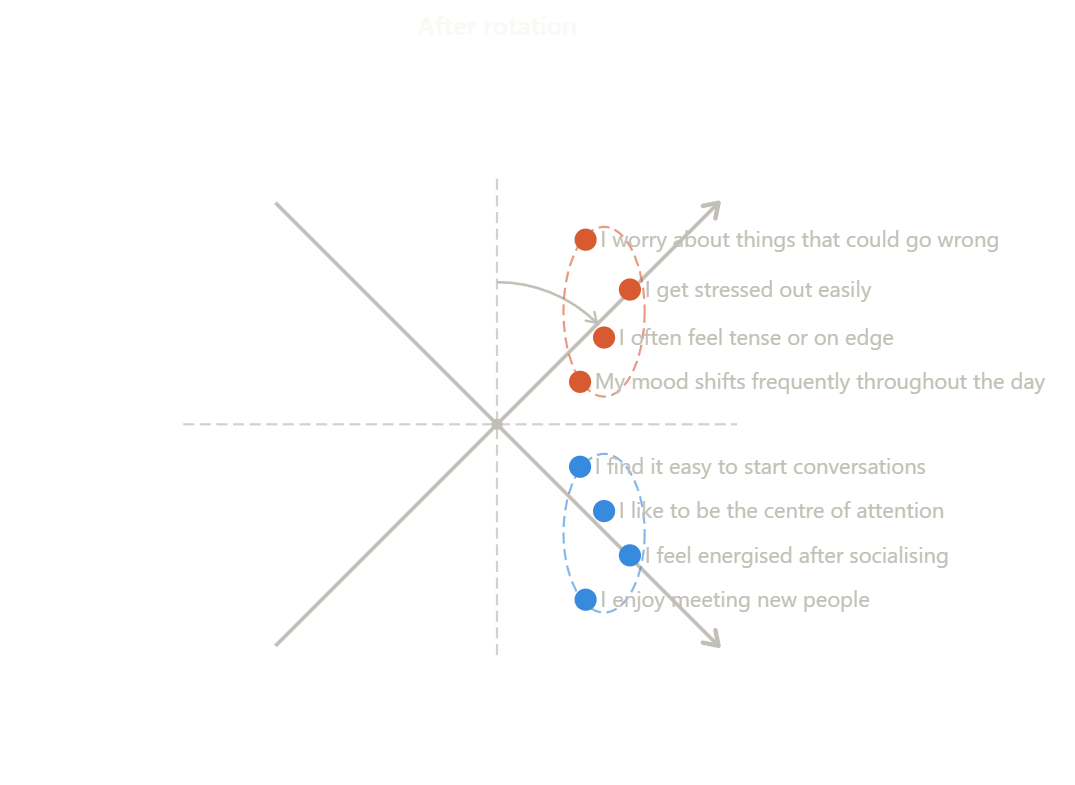
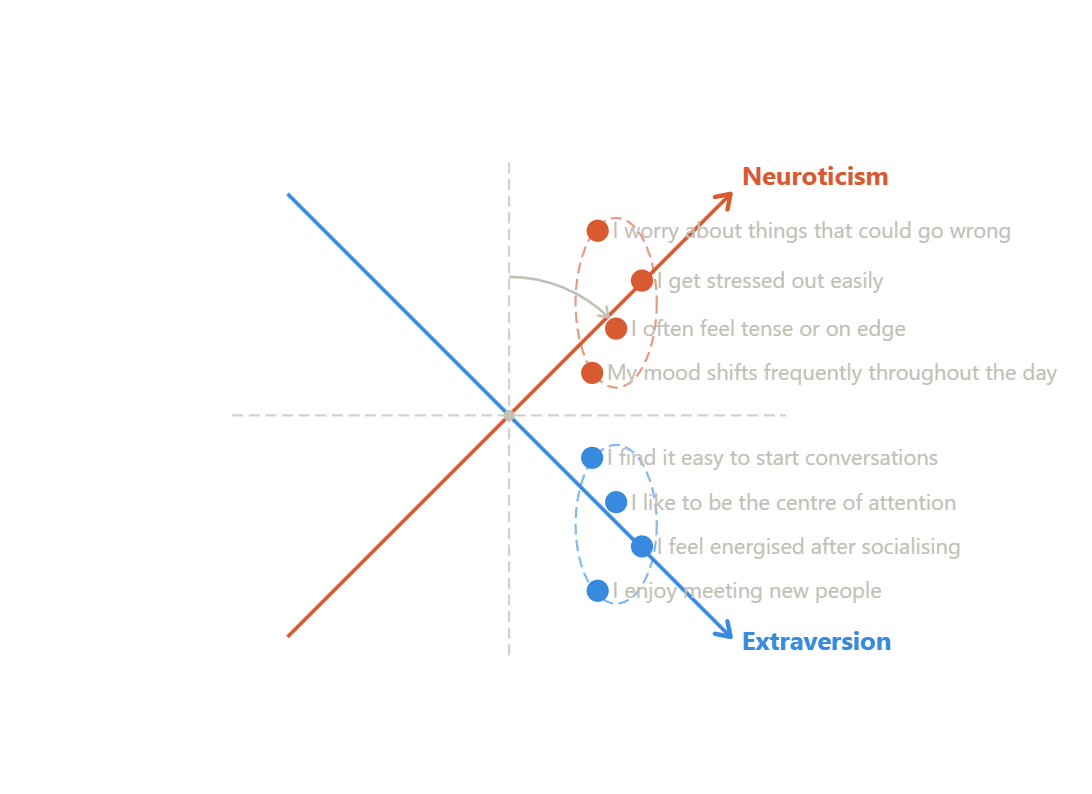
Hopefully, this example should make the utility of rotation clear.
Instead of saying:
“Factor 2 has an eigenvalue of 40, which means it explains 40% of the variance in my 100 item matrix”
We can now say:
“Factor 2 is heavily loaded upon by items in the matrix that code for tendency towards negative emotionality and emotional lability.”
We might even feel confident enough in the unifying themes of the items that load on our factors to give them names. We might call Factor 1 ‘Extraversion’ and Factor 2 ‘Neuroticism.’
Sometimes, though, your rotation gives you factors with a bunch of loadings that don’t form a coherent category. Take this green cluster for example:
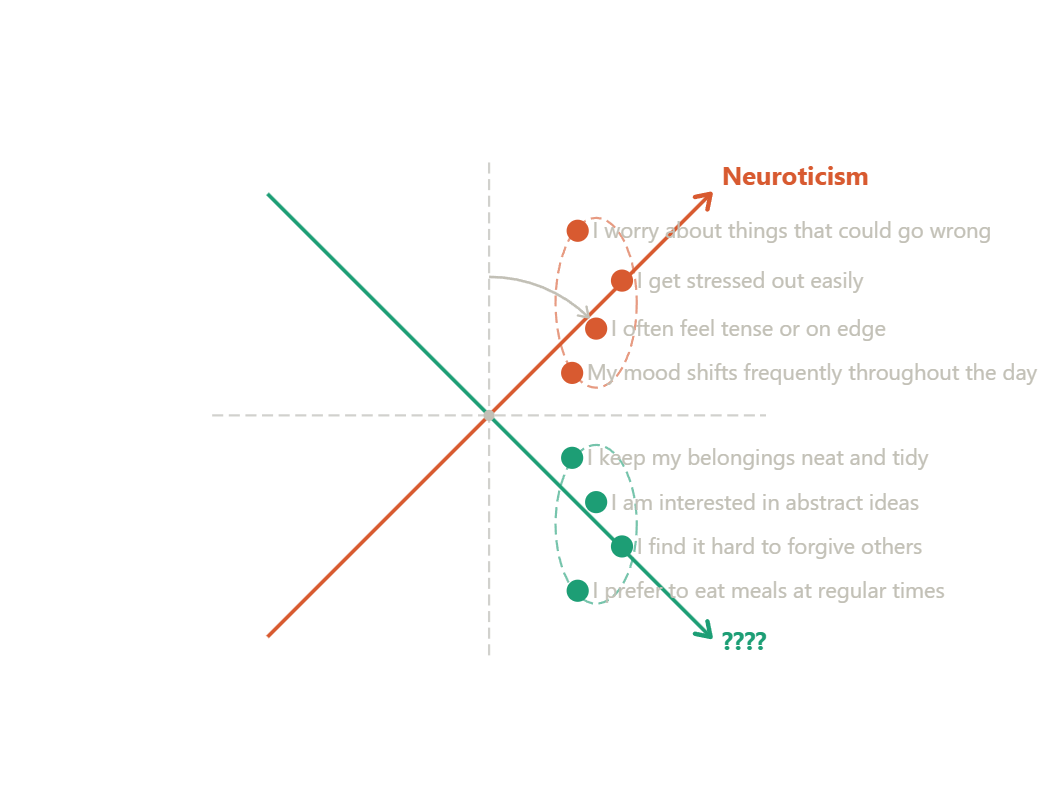
What even is that green cluster? The bits about tidiness and regular mealtimes point to some sort of preference for order, but the rest don’t hang together at all.
In this simplified case you would probably just trash the ‘????’ factor for being inscrutable. In actual factor analysis, you might do the same, but will probably have a few different factor solutions and/or a few different rotations to cycle through.
I hope the visual explainers have been helpful, but it is likewise important to understand that in the real-world, you are not going to be looking at a graph (unless you are an n-dimensional being) but at a table that contains a list of the questions and the factor loadings. For example, here’s the factor loading table from Cattell’s 1945 factor analysis:
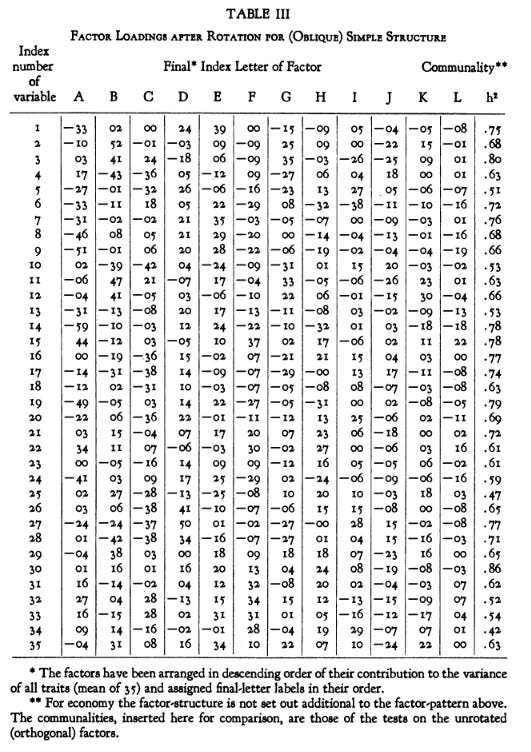
I think this is enough context. Please remember that (1) I am not a formally trained statistician (2) this is a very basic explanation of factor analysis that omits more complicated methodologies and techniques. If you are a formally trained statistician, please let me know if I have gotten anything horribly wrong.
Despite the clear appeal of factor analysis as a more objective method for discerning personality traits, it presented two large problems for Cattell, both of which were in tension with one another.
The first was a problem of computation. This was the mid-1940s, which means that all of these complicated computations needed to be done by hand. This will explain, in large part, Cattell’s drive to compress the personality space. He needed a set of variables that were computationally manageable.14 Even before Cattell started, it was obvious to him that this would have to be a small subset of extant trait lists.
On the other hand, a factor analysis cannot identify patterns between items that were not in the dataset. Thus we see Cattell’s dilemma. As did he. In his 1943 paper, The description of personality: II basic traits resolved into clusters, he writes:
As is now widely realized, the factor analyst can grind from his mathematical mills only the particular factors for which grist is already provided in the form of suitable trait elements. It is realized also that in experimental design the experimenter may “manipulate the electorate” of trait elements in such a way as to make minor factors appear larger, e.g., to make “specific” factors into “group” factors, or the latter into “general” factors. By other controls of trait or subject population one may also change the variance due to any factor or even make it disappear entirely.
To Cattell, the problem of “primary importance” was:
To find a means of choosing so complete a universe of traits that (1) no possible trait cluster will escape detection and (2) the interrelations of all important constellations will be given by the analysis.
The tool that Cattell sees available to define this universe is language:
The position we shall adopt is a very direct one, verging on a pragmatic philosophy, and making only the one assumption that all aspects of human personality which are or have been of importance, interest, or utility have already become recorded in the substance of language.
This is the Lexical Hypothesis.
It is worth traveling with Cattell through some objections that might be raised to the claim that language is a tool unequal to the proposed task.
Hi, Rhetorical Foil here. How do we know that language is capable of describing the entire universe of human traits? Is it possible that it has not yet evolved the entire repertoire of terminology it needs?
Good to see you again Mr. Foil.
Cattell’s response was that we might answer this question by looking at the corpus of personality terms and seeing if we have reached some sort of plateau. In surveying Allport and Odbert’s list, Cattell felt that this was indeed was where things were at:
Our experience in the present research process as described below, in which almost every trait term was found to have a retinue of exact synonyms and many approximate ones, provides a contingent answer.
Ok, so let’s agree that language is capable of describing the entire universe of traits. Isn’t it possible that there exist aspects of human behavior that we simply have not developed single words for?
Cattell argues that these examples certainly exist (e.g. “youthful exuberance” or “the ability to command a room”) but are unimpressive as critique. The absence of single words for particular traits suggests that they are “too narrow to deserve terms” and that language has “found other patterns more important and inclusive and has incorporated these minor traits in the larger pattern.”
Ok, ok, fine but what about words in other languages that capture some sort of precise concept that we don’t have an equivalent for in English? Like schadenfreude. Isn’t that a better example?
To this, Cattell says: (1) these aren’t that common (2) most of these correspond to Social Mold traits that do not exist in other cultures (e.g. the French esprit or Japanese ikigai) (3) there is no real gap but instead a “failure of coincidence of terms in the two languages.” That is, the behaviors that the word schadenfreude describes are really a combination of behaviors that English-speakers would capture under concepts like spitefulness, smugness, and malevolence.
Ok, let me attack this from a different angle. Let’s say that there is some new character trait that we just recently decided that we care about a few decades ago. It’s kinda like honesty, but it’s not quite honesty, but we use the word honesty because it’s a close enough approximation and so it just sticks. I mean, look, we didn’t have the word “selfish” until the Presbyterians or “bigoted” until the Protestant Reformation.
Again, Cattell has some persuasive answers. First, he says, surely there was a concept of selfishness before the Presbyterians and that people had a word for it.
Second — as to your honesty example — he would say that this is part of the nature of traits themselves:
all traits consist essentially of a relationship between the individual and his environment rather than a reactive tendency which can be defined in terms of the individual alone, all traits become changed—in their boundaries and units of measurement—as the environment changes.
So, doesn’t that mean that a set of factors found in one linguistic culture might not be found in another? Or that personality tests from 100 years ago might encode slightly different information than from the modern day?
This is outside of what Cattell addresses in this paper, but I think it logically follows. It certainly implies that the factors extracted from an English-speaking population cannot be assumed to exist in a German or Chinese-speaking population. They certainly could, but we’d need to test that hypothesis (We have! More on this in future pieces).
Cattell believed that personality space could be captured in what he termed a “Trait Sphere.” The selection of terms that would capture the breadth of all relevant personality traits. The goal was not to name literally every aspect of personality — something Cattell thought was unrealistic — but to define a collection of “general traits” that would be computationally manageable without leaving any crucial gaps.
To do this Cattell turned to Allport & Odbert’s thesaurus. Column I (the “neutral terms”) provided the bulk of the rough material. Terms were removed if they were “too vague… too figurative and metaphorical… or too rare and esoteric.”
Added were “a few hundred” terms from Column II (Temporary States) which were felt to reflect aspects of personality to some degree (e.g. grateful, rebellious), as well as some from the clinical/psychiatric literature.
All told, the raw lexical material to be shaped into the Trait Sphere numbered somewhere in the neighborhood of 4500 individual terms.
The initial set was winnowed down by having a psychologist and a “student of literature” working independently. Each started with the same original list of terms, and grouped words that appeared to be generally synonymous. In cases of disagreement or uncertainty, larger groups of researchers were consulted to help reach consensus. Once groups of synonyms were formed, and no further additions from the list could be found, a representative word was chosen that was felt to capture the nature of the word list. From a collection of synonyms that included the words alert, observant, vigilant, and omnipercipient, ‘Alert’ was ultimately chosen to represent the group.
Once these categories were agreed upon, the decision was made to attempt to match synonyms with their opposites and create a list of dichotomous scales, though this was also not so simple.
To frame the problem in somewhat familiar terms: Is the opposite of ‘love’ ‘hate’ or is it ‘indifference’?
Cattell’s solution was to deal with “psychological rather than logical opposites.” Traits were only paired together if they belonged to the same “unity” (i.e. Social Mold, Dynamic, or Constitutional). Cattell notes that the Social Mold traits were the easiest to find matches for, and constituted the majority of the bipoles. Fewer could be found for the Constitutionals. No opposites were found appropriate for any of the Dynamical traits.
In cases where no appropriate opposite could be found, no pairing happened. The opposite end of the dichotomy was implied to be the absence of that particular trait (e.g. flattering vs. not flattering)
This matching process produced a set of 171 dichotomous scales. Here’s an excerpt:
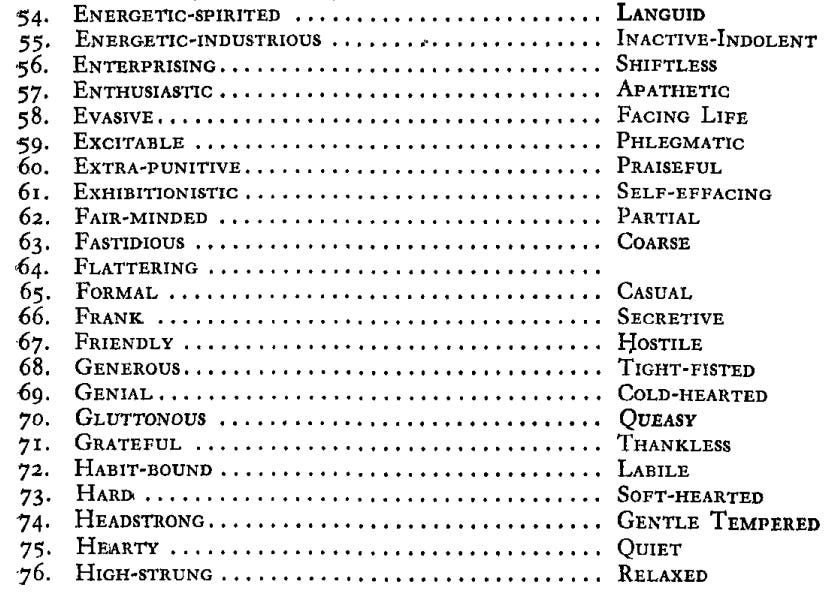
Most of it is legible to the modern English speaker, though there are a few opaque oddities in there. ‘Apollonian’ — the opposite of ‘Mystical’ — seems a bit esoteric and vague to me.
Either way, Cattell now had his Trait Sphere.
It was time to make… an even smaller list. 171 traits is much better than ~4500, but even a test that asks a single question on each would still produce a correlation matrix with 29,070 comparisons.
Cattell writes that his next purpose was:
the further reduction of this list, through strictly correlational methods, to a set of variables brief enough to permit their being very reliably estimated and completely factor analyzed with the time and facilities possible to one experimenter.
Like Galton and other psychologists before him, he looked down on the use of “mere self-ratings and questionnaire responses” which he believed needed to be remedied by “shifting from introspective self ratings to the observation and rating of behavior by judges or external measuring instruments.”
Thus, he found 100 individuals and asked an “intimate (but not emotionally involved)”15 acquaintance to rate them as above-average or below-average on each of the 171 different bipolar trait scales.
Additionally, Cattell was maximally open-minded in terms of what might influence personality traits. He believed that new or modified personality factors and traits might be found depending on age, sex, social background, and so would require studies to examine a broad range of individuals to ensure that the grist for the mathematical mills was not from a monocultural harvest. True to these concerns he is pleased to note that in this study:
The almost inevitable overrepresentation of intelligent, professional, and indeed academic types in psychological research was at least very greatly reduced and the final group contained domestic servants, janitors, artisans, a lumber jack, a Nova Scotian fisherman, and so on.
One gets the sense that he was particularly pleased about that fisherman.
With this data, Cattell used a form of cluster analysis to distill the 171 bipolar traits into 60 trait clusters. He would later further refine these into 35 surface trait clusters, in his 1945 paper, The principal trait clusters for describing personality, which would be the basis for his initial factor analysis.
Finally, Cattell would publish The Description of Personality: Principles and Findings in a Factor Analysis that contained his initial 12 factors. They were:
Cyclothyme v. Paranoid Schizothyme
General Mental Capacity [Spearman’s general intelligence factor (g)]
Emotionally Mature, Stable Character vs. General Emotionality
Hypomanic, Sthenic16 Emotionality vs. Phlegmatic17 Frustration-Tolerance
Dominance vs. Submissiveness
Surgency vs. Melancholy, Shy, Desurgency
Positive Character Integration vs. Immature, Dependent Character
Charitable, Adventurous Surgency vs. Inhibited, Insecure Desurgency
Sensitive, Imaginative, Neurotic Emotionality vs. Rigid, Tough Poise
Neurasthenic18 vs. Vigorous “Obsessional” Character
Trained, Cultured Mind vs. Boorishness
Rhathymic,19 Adjusted, Surgency vs. Schizoid Desurgency
I’ve tried to use footnotes to provide definitions for some of the more obscure language, but there are a few worth defining directly. First, schizoid behaviors refer to a tendency towards detachment from social reality, inwardness, and a kind of disconnection. When Cattell uses Surgency in factor 6, he is talking about high energy level, spontaneity, sociability, and a disposition toward positive affect. Elsewhere, and rather confusingly, surgency is simply used to indicate the “positive” end of the bipole.
This, of course, is not the end of the story. Cattell would refine his approach further, eventually settling on 16 factors and in 1949 publishing one of the first standardized personality tests derived from factor analysis: the Sixteen Personality Factor Questionnaire (16PF). You can take an approximation of it here, if you’re interested.
As we wrap up this first part, I admit that I have found myself to be quite the admirer of Cattell. Not so much for his decision to use factor analysis or any other particular set of decisions, but because of the mindset that his approach required.
I mean, yes, I know, the platonic idea of science is that we enter into research in an unbiased fashion, tabula rasa and all that, but… Let me put it this way. Just about everyone has some sense of what personality is just by being a human being; it’s not really a topic you can come to without prior knowledge. It’s definitely not a topic you can come to without prior experiential knowledge, which is the surest inducer of bias I have ever met.
Not only that, but there is often an immense amount of personal investment in how we perceive personality, because we are acutely aware of our own and form judgements about the personalities of others. Now, consider that Cattell was in his early 40s during the initial stages of this work and had spent most of his adult life thinking about human personality. The ability for someone who must have had both such a strong set of personal and professional priors to essentially say “I have no idea what the fundamental components of personality are” and then actually conduct his research that way, starting from the base lexical clay to avoid putting his finger on the scale, is something I find truly impressive.
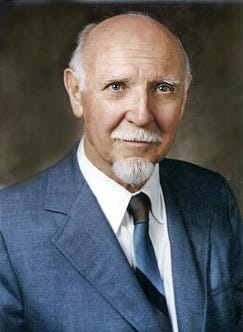
Also he just kinda looks like a kindly grandfather in his Wikipedia picture.
On Dragon Ball Z In Part 2, we’re going to meet some more interesting characters who play a part in the development of modern personality theory and the FFM should start to come into focus. We’ll:
Learn about the work of Hans Eysenck, a British-German psychologist and rival of Cattell, and his search for a more parsimonious explanation of personality with only 2(!) factors (which happened to be N and E).
The first ‘discovery’ of the Five Factors in the 1960s and their subsequent refinement.
The ‘facets’ or sub-traits that make up the individual factors
Discuss whether or not self-rating scales can really be all that accurate
Look at whether or not the FFM exists across cultures
Understand the ‘universality’ of the FFM
Think more about the clinical utility of the FFM
Interestingly, less than the “over 476,000 entries” that the most recent unabridged edition contains.
Roundabout, circuitous; a word which is obscure enough that my autocorrect suggests is a misspelled version of ambiguous
adj. having the power or faculty of hearing something not present to the ear but regarded as having objective reality
Just for fun, I went to the “Frequency” section of the Oxford English Dictionary for each of these terms (which itself just uses Google Books Ngrams) to see how often these words were used in the 1930s (and then threw in ‘acute’ as a less common but still more common comparison)
Ambagious: ~0.0003 usages per million words
Abstemious: 0.29 usages per million words
Clairaudient: 0.021 usages per million words
Acute: 1.3 per million words
I think maybe Allport and Odbert needed to look up the dictionary definition of rare, don’t you?
Previously read “which the FFM uses” which was incorrect. The NEO-PI is simply one of a handful of instruments used to measure the FFM.
There are various ways to do factor extraction that I am not really qualified to explain, so I won’t.
Don’t think about it too hard. Math is weird.
These are not really lines in the 2D sense of the term, but I’m trying to avoid melting our brains here
In other words, knowing the factor score does not tell you anything about how the person answered that question.
In reality they exist in a graph with n-dimensions where n is the number of factors
…kinda. Really what we have to preserve are the communalities
Preserving oblique angles between factors is one of the easiest ways to preserve total variance, but you don’t have to. These are called oblique rotations, and just involve more complicated mathematical book-keeping.
abounding in energy, vigor, or bodily strength
calm, even-tempered, and slow to anger or emotional outbursts
Indicative of physical and mental exhaustion, fatigue, and bodily weakness
Comments
Nothing yet. Say the first thing.
Sign in to join the conversation.