
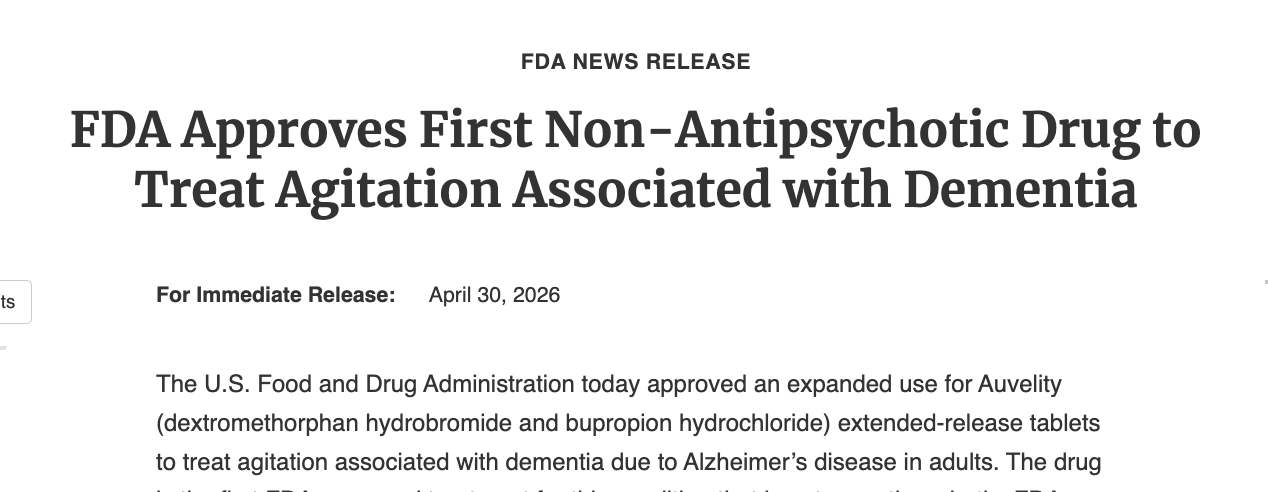
In April, the FDA approved Auvelity (dextromethorphan-bupropion) for agitation in Alzheimer’s dementia (ADA). In a press release, then-Commissioner Makary stated that this “approval represents a significant advancement in our ability to help patients and families dealing with one of the most challenging aspects of Alzheimer’s disease.”
According to the FDA, Auvelity was approved on the basis of two RCTs: the ADVANCE-1 acute-phase trial and then a discontinuation trial (ACCORD-2). In fact, there were five clinical trials of Auvelity in ADA: two acute phase trials (ADVANCE-1 and ADVANCE-2) and two randomized withdrawal/discontinuation trials (ACCORD-1 and ACCORD-2). There appears to be fifth trial that was an extension of ACCORD-2 and ADVANCE-2 which was terminated.1
First, one of the two large acute-phase trials was negative: the 408-subject ADVANCE-2 trial. This trial essentially does not exist in the medical literature because it is unpublished, not mentioned by the FDA in their press release, and is not described in academic reviews of Auvelity. There aren’t even results on clinicaltrials.gov.2 Most of what I know comes from a press release by Axsome Therapeutics, the sponsor.
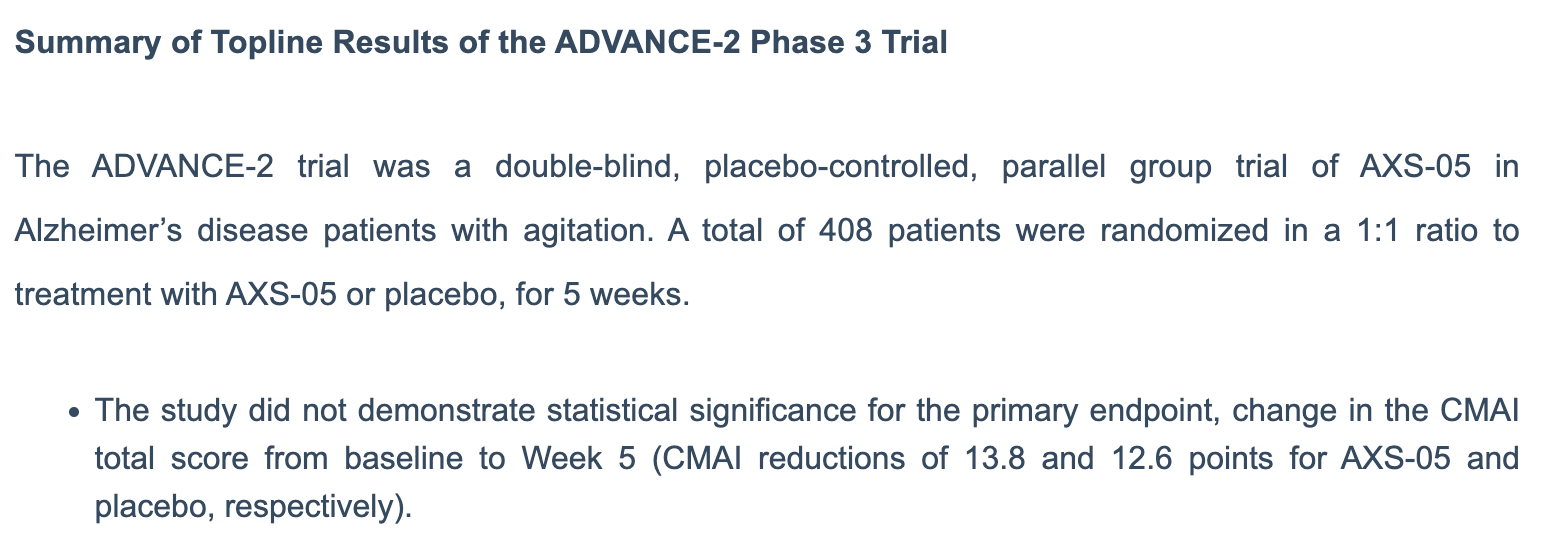
What we know is that ADVANCE-2 was large and that Auvelity did not outperform placebo. The primary outcome measure, the Cohen-Mansfield Agitation Inventory (CMAI), decreased by 13.8 points with Auvelity versus 12.6 points with placebo, with slightly higher overall adverse events with Auvelity. This means that this reportedly effective medication failed to outperform placebo in the larger of the two phase III trials.3
Second, even for the positive ADVANCE-1 trial, the effects appear weak and clinically insignificant. The primary outcome was an improvement on the CMAI of 15.4 points for Auvelity, 10.0 for bupropion, and 11.5 for placebo at 5 weeks. Let’s put that into context.
The CMAI is a scale ranging from 29 to 203 points, with higher scores indicating greater frequency of 29 agitation behaviors (scored 1-never to 7-several times per hour).4 Estimates of the minimum clinically important difference for the CMAI are 17 points and 20 points (range 15-25). The idea that a 4 point difference versus placebo is clinically meaningful is ridiculous, much less a 1.2 point difference, as in ADVANCE-2.
You might say that the improvement versus bupropion was impressive, but this arm had only 49 subjects versus ~160 in each of the other two arms. Why was this arm terminated early? Who knows (except the sponsor…). A cynical observer would worry about preliminary data analysis leading to termination of the bupropion arm while it’s outcomes were poor, which would make Auvelity look better.
Third, the FDA approved Auvelity, in part, based on a positive discontinuation (withdrawal) trial. In this trial design, patients are treated with the open-label medication, responders are then randomized to double-blind continuation on the medication or a switch to placebo (i.e. discontinuation). These are commonly used in psychiatry to study long-term outcomes, but they actually address a different question: do patients who respond to a medication have better short-term outcomes from staying on the medication versus having it abruptly stopped? The proper way to show long-term benefit is to run a standard trial with long-term outcomes, like at 6 or 12 months, rather than a 5-week trial followed by a withdrawal trial.5
Withdrawal trials constitute a flawed form of evidence. They have an “enriched” design because they evaluate outcomes among patients who have already responded. Effective unblinding and medication discontinuation can cause nocebo effects for subjective outcomes like the CMAI. They do not prove that new patients (who aren’t known responders) benefit long-term. In fact, medication risks (e.g. withdrawal symptoms) can appear as benefits. Imagine arguing that Xanax (alprazolam) has long-term efficacy for anxiety because patients become anxious when it is abruptly stopped.
Despite these methodological issues, the Auvelity withdrawal studies don’t appear particularly impressive. In ACCORD-1, roughly 75% of patients could remain “relapse-free” from agitation after stopping Auvelity, a somewhat surprising figure which raises questions about the need for treatment in the first place. (I’ll add, the open-label phase apparently demonstrated a 95% CMAI response rate with Auvelity…a treatment that was marginally better than placebo in one trial, and no better than placebo in another trial. Makes you wonder…)
Finally, how do we know that benefit isn’t just driven by the sedating effects of Auvelity, one of the key differences from bupropion?6 Although I’m a staunch advocate for placebo-controlled trials, there really should be a blinded active comparator arm. Does anyone really think that Auvelity is better than citalopram or low-dose quetiapine or the antihistamine hydroxyzine? Shouldn’t this be proven before we spend $1200+ per month, the current listed price of Auvelity? Shouldn’t this be proven before we describe Auvelity as a major advance for the field?
There is an argument for making more treatments available for agitation in Alzheimer’s dementia. I’ve cared for many older adults with dementia and agitation. I recognize how challenging and urgent this issue is. Being able to offer something feels important.
But we should also be honest about the quality of this research. The data for Auvelity looks really weak, as it did with brexpiprazole (Rexulti). Acting like Auvelity is a major step forward is misleading. If it’s effective, then it should be able to beat placebo more than 50% of the time in acute-phase trials! It helps no one to treat bad data as if its great data. In fact, it disincentivizes the development of effective treatments and sows distrust in our field (and the FDA) when psychiatrists like myself point out the bad data. If we want to offer a placebo-equivalent treatment to our patients to give them hope, we don’t need an expensive branded medication for that.
I wouldn’t be so bothered if it was just the pharmaceutical company who was selectively marketing the research. What troubles me is seeing the FDA do this.
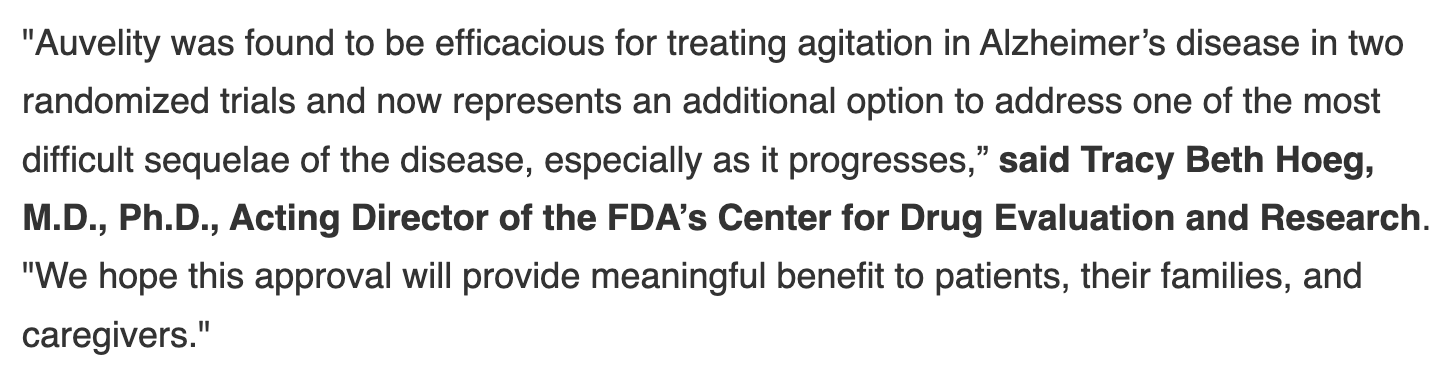
The FDA’s press release reminds me of the philosophical debates about the difference between lying and deceiving, where a statement can be factually accurate (there were two positive trials) but is deceptive in what it leaves out (a huge negative trial).7
Isn’t the FDA supposed to represent the best interest of the public in helping us judge the Auvelity data? Why can’t the FDA state that Auvelity met the bar for approval, but that one of the two acute phase trials was negative (which was the traditional requirement for approval)? Why can’t the FDA present basic factual information that informs the public?
But surely the academic literature will give a fair and balanced depiction of the research? Here, the academic literature is no better. I can’t find a single publication of any of the Auvelity trials. This is bizarre, now that we’re months into FDA approval. How exactly are physicians supposed to make informed decisions for their patients? Are we expected to rely on FDA and pharmaceutical company press releases?
Even if these trials were published, the negative trial probably never will be. How do I know this? Well, Axsome Therapeutics has never published the negative STRIDE-1 trial of Auvelity in treatment-resistant depression, which was completed by early 2020 (at the very latest). There’s not even data for STIDE-1 available on clinicaltrials.gov.
As of now, the available published abstracts and reviews appear industry-sponsored and do not mention the negative Phase III trial. For instance, one industry-sponsored abstract summarizing the “Results from the Phase 2/3 Development Program” does not even mention the negative ADVANCE-2 trial, even in passing.
I’m an early-career psychiatrist, but I spent much of my time in medical school reading about the history of psychopharmacology, including its many warts like the AstraZeneca CAFE Trial (Carl Elliott’s work) and GSK Study 329. As I’ve transitioned into my career, I strongly believed that the biggest flaws of the antidepressant era were behind us: pre-registering trials would prevent selective publication; clinicaltrials.gov would force publication and acknowledgement of negative trials; conflict of interest statements would negate paid key opinion leaders (conflicts were not always disclosed with Auvelity); and ghostwriting restrictions would prevent the veneer of academic involvement in industry-sponsored trials.
But I was wrong: who needs pharma to mislead us when we have the FDA?
I’ll note that I cannot find any full publication of any of these trials anywhere…presumably they will be published, but it’s really unusual to have no meaningful publications whatsoever about an FDA approved treatment. This abstract and this abstract reflect mostly of the published data on this entire research program. Why is there more information on these trials on NeurologyLive and Psychiatric Times than in academic publications? How can clinicians and researchers make intelligent, informed decisions about this medication for their patients without even the pretense of published data?
At the time of this writing. This applies to all of the dates and references to data/study availability.
You’ll notice that there was significant improvement in agitation in the placebo arm, as was seen in the brexpiprazole (Rexulti) trials for agitation in dementia. This is common in certain psychiatric drug trials, particularly for disorders like depression and anxiety. It probably reflects a combination of factors: spontaneous fluctuation in the severity of agitation, expectancy factors from taking a new medication by caregivers, and so forth. It’s very hard to know if these are factors that require the prescription of a medication in real-world settings to see improvement (placebo effects) or if the improvement is just natural symptom fluctuation and improvement.
I didn’t have time to dig into the psychometrics of the CMAI, but note that the scale appears equally weighted for behaviors of things like “Strange noises (weird laughter or crying)” or “complaining” or “hiding things” and “Making physical sexual advances” or “biting” or “Tearing things or destroying property.” So, summary scores could disguise improvements in the most critical domains. But we don’t have access to any publications from Auvelity evaluating this (at the time of this writing).
This issue is common in psychiatry for basically every psychiatric treatment for every disorder.
The open-label study appears reassuring about sedation, but seems to have a surprisingly low overall incidence of adverse events.
From the Stanford Eycyclopedia of Philosophy on lying: “According to Chisholm and Feehan, it is also possible to deceive “by omission” (Chisholm and Feehan 1977, 143–144). One may allow a person to acquire a false belief, or allow a person to continue with a false belief, or allow a person to cease to have a true belief, or allow a person to continue without a true belief. For example, one may allow a person to read a news story and acquire a belief that one knows is false (e.g., a news story about the CEO of your company resigning for health reasons, when you know he was forced out for mismanagement of funds), and one may allow a person to continue to have a false belief by not correcting the person’s false belief (e.g., not correcting a child’s belief in Santa Claus).”
Comments
Nothing yet. Say the first thing.
Sign in to join the conversation.