
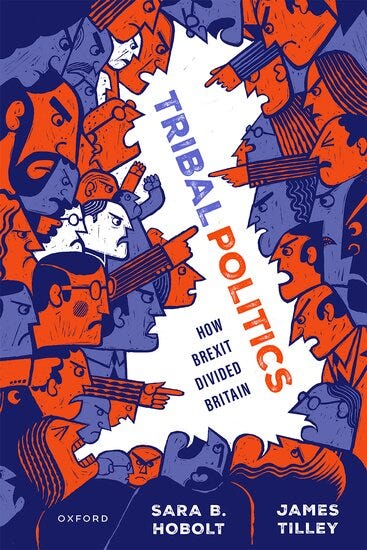
Ideas of political identity and subsequent rivalry based on identity have long been associated with the notion of partisanship — that is, the sense of identification or distaste one feels towards a specific political party. Sara Hobolt and James Tilley’s new book, Tribal Politics. How Brexit Divided Britain complicates that assumption.
Hobolt and Tilley, both experts in political behaviour and political competition, argue, as they have done in their decade of studying the effects of the United Kingdom’s decision to exit the European Union after a fiercely contested referendum, that under specific circumstances, emergent political issues like Brexit can create new and enduring political identities. These identities not only dictate behaviour at the ballot box, but mediate the ways in which people see themselves, their place in the world, their rivals, and their relationship with politics in general.
Drawing on original data collected throughout the near-decade since the referendum in 2016, Hobolt and Tilley posit that Brexit created a persisting political divide in the UK that has weakened traditional attachments to political parties, and also weakened the relatively well-established two party system that determined the governance of the country.
It is perhaps unsurprising that at the time of the referendum, Brexit-related identities were deeply salient among the British populace. The authors argue that the conditions were ripe for such an occurrence. The campaign in the run-up to the referendum was hotly contested, in what they call a “high-stakes” tone, and individual preferences vis-a-vis which side to vote for were publicly expressed through frequent demonstrations and mass participation on either side of the campaign. This salience was a consequence of the campaign more than anything. Presenting at the LSE Research Showcase in early March, Hobolt points to the fact that at the time of David Cameron’s announcement in 2013 that a re-elected Conservative Government would hold a referendum on the question of Britain’s membership in the EU, a minority of survey respondents ranked the issue as one that they found relatively prominent. In addition to the salience and vitriol that was brought about by the hotly contested campaign, the authors point to the fact that there was a lack of neat partisan alignment with the two sides of the issue. Indeed, the two figureheads of the Leave and Remain sides respectively, Boris Johnson and David Cameron, were members of the same party. These specific conditions, the authors argue, allowed the Brexit vote to transform from policy preference to political identity.
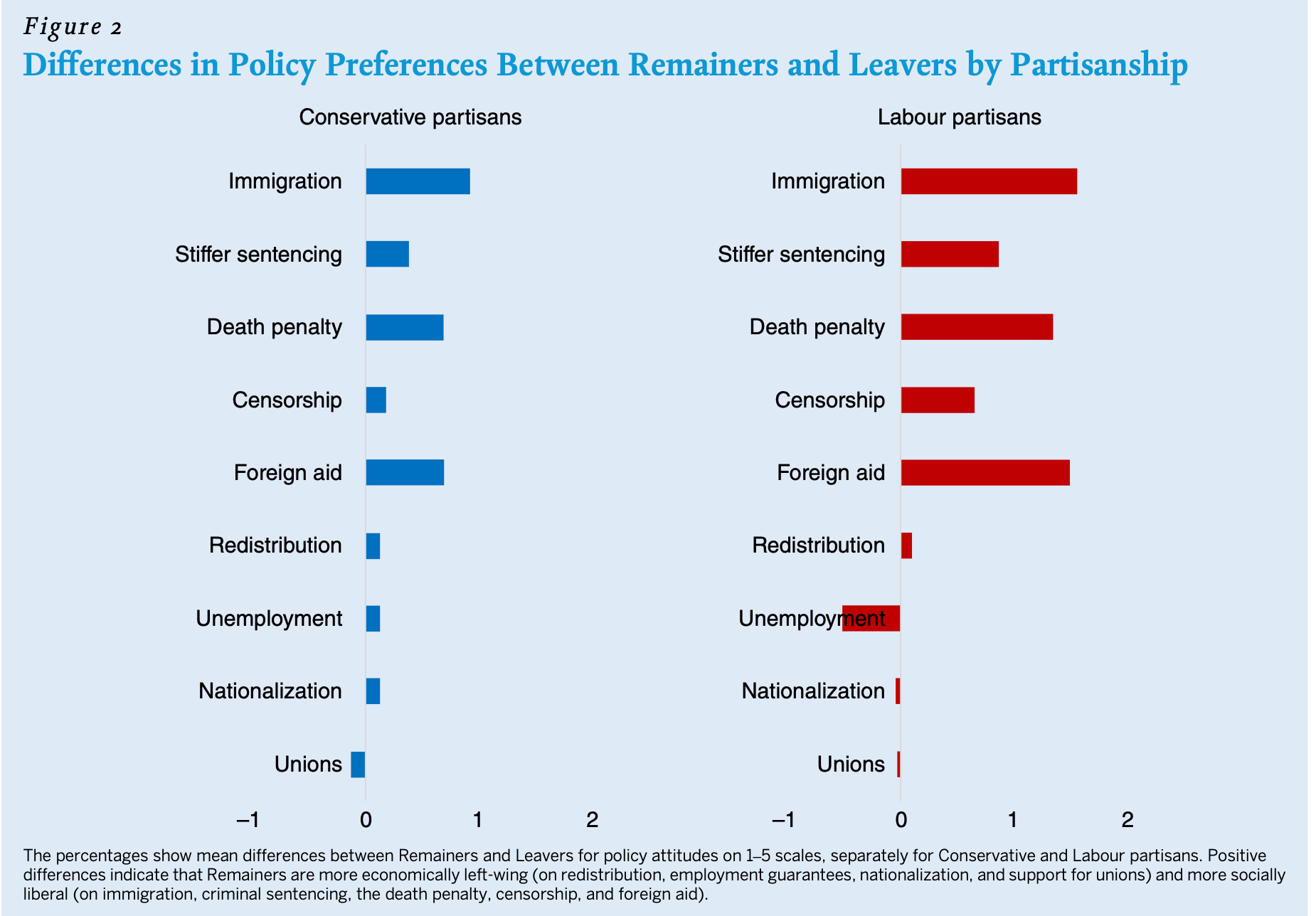
What does it do to a polity when a hotly-contested issue cross-cuts traditional political cleavages? Historically, competitive electoral politics in the United Kingdom has been defined by two fairly coherent camps : the left-of-centre Labour Party and right-of-centre Conservative Party who differed as a consequence of their views on unions, redistribution, nationalisation, and employment guarantees – broadly understood as the economic left-right spectrum. Through their decade of researching the effects of the UK’s decision to exit the EU in a fiercely contested referendum, Hobolt and Tilly argue that the Brexit vote, and the enduring identities that emerged as a consequence, cut across these traditional divides and exposed faultlines on cultural questions that threatened the existing political consensus. In their 2021 piece, the authors show that Leavers and Remainers within parties differed significantly in their views on immigration, the death penalty, foreign aid, and criminal sentencing. So, while pre-Brexit party-choice strongly correlated with views on economic matters, the two traditional parties found themselves inwardly split on cultural questions like immigration, with Leavers in both parties preferring more culturally “right-wing” politics, and Remainers in both parties preferring culturally “left-wing” ideas.
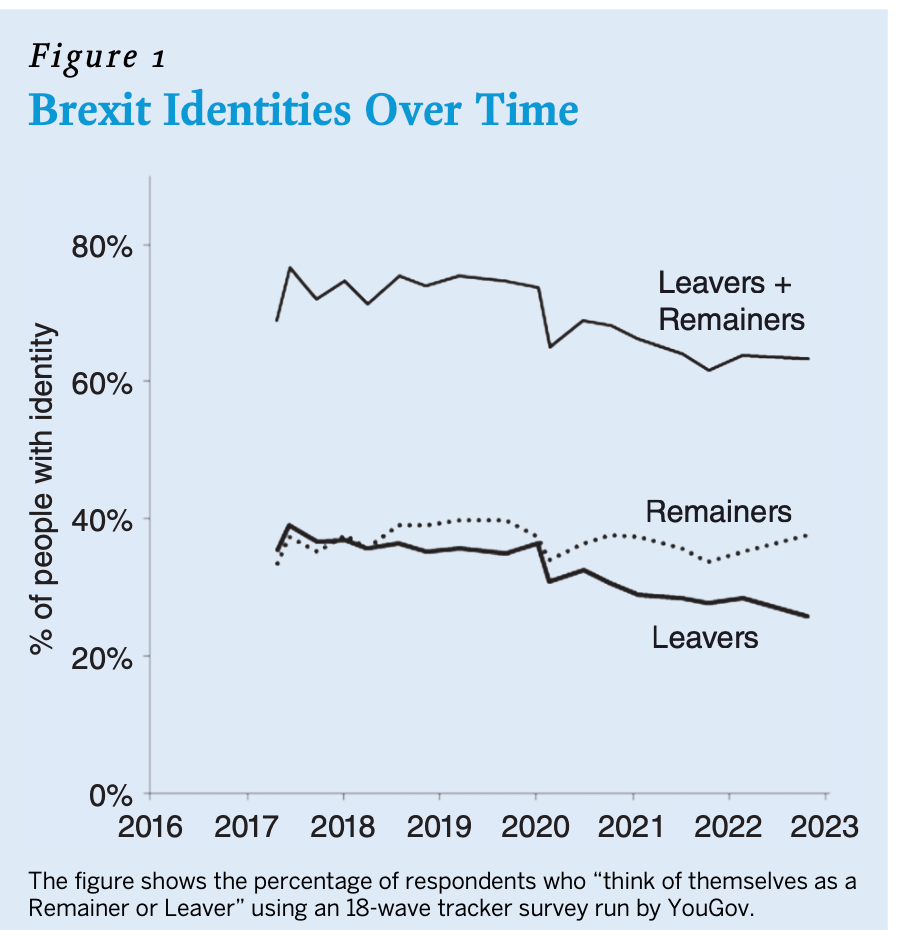
This leaves Britain’s two mainstream parties on confused footing. Not only are traditional voters divided amongst themselves, but that division evidently had immense staying-power. As of 2023, more than half the electorate continues to self-identify with their choice in the 2016 referendum.
This is not just because of the trifecta of contestation, expression, and misalignment that the authors describe, but also because of certain features intrinsic to the referendum process, such as the neat divide into a Yes/No vote with little room for nuance, and subsequent expressions of dissatisfaction with the result of the vote in the form of public and emotional outrage.
The rise of both Reform UK and the Green Party in recent years can be understood, at least in part, through precisely the lens Hobolt and Tilley provide. If Brexit cleaved the British electorate along cultural lines that cut across traditional party boundaries, then Reform and the Greens are the electoral expression of that cleavage finally finding its natural home. Reform has absorbed the culturally conservative Leaver identity — the demographic that felt, and in many cases still feels, that the political establishment failed to fully deliver on the spirit of the 2016 vote, and that neither Labour nor the Conservatives adequately represent their anxieties about immigration, national identity, and institutional distrust. The Greens, conversely, have become the vessel for a strand of Remainer identity that blends cultural progressivism and disillusionment with Labour’s perceived moderation on issues of migration and civil liberties.
Tribal Politics is out now on Kindle e-reader, and physical copies hit shelves at the end of March 2026.
No posts
Comments
Nothing yet. Say the first thing.
Sign in to join the conversation.