
Event windows around FOMC announcements on Fed Days are a privileged occasion to learn market participants’ judgement of monetary policy. This is because bond returns in a window around the announcement are highly unlikely to be confounded by any other macro development.1 After all, what could be bigger than the FOMC show?
Bonds of roughly two year maturity contain a good signal of the market’s estimate of the expected path of the policy rate. If these bonds sell off, that’s a hawkish surprise: the Fed’s announcement suggests that it is more hawkish than hitherto reckoned. If they get richer, that’s a dovish Fed surprise.
Bonds further out are stratified by duration risk. When duration risk sells off, longer bonds sell off harder. We can recover the duration risk premium from the return difference over the event window between long and short duration bonds. What information is contained in the duration risk premium? Duration sells when the perceived risk of inflation or higher rates beyond the immediate cycle goes up.
So we have two signals: (1) what has the market learned about the present path of the monetary cycle (the two year bond return), and (2) the market’s judgement of the longer term macro environment. Now, when the two movements disagree, (2) is a sort of second opinion on the Fed (1). The bond market is saying, sure, we believe you’re gonna go in this direction; but you’re wrong and you’ll be forced to backtrack.
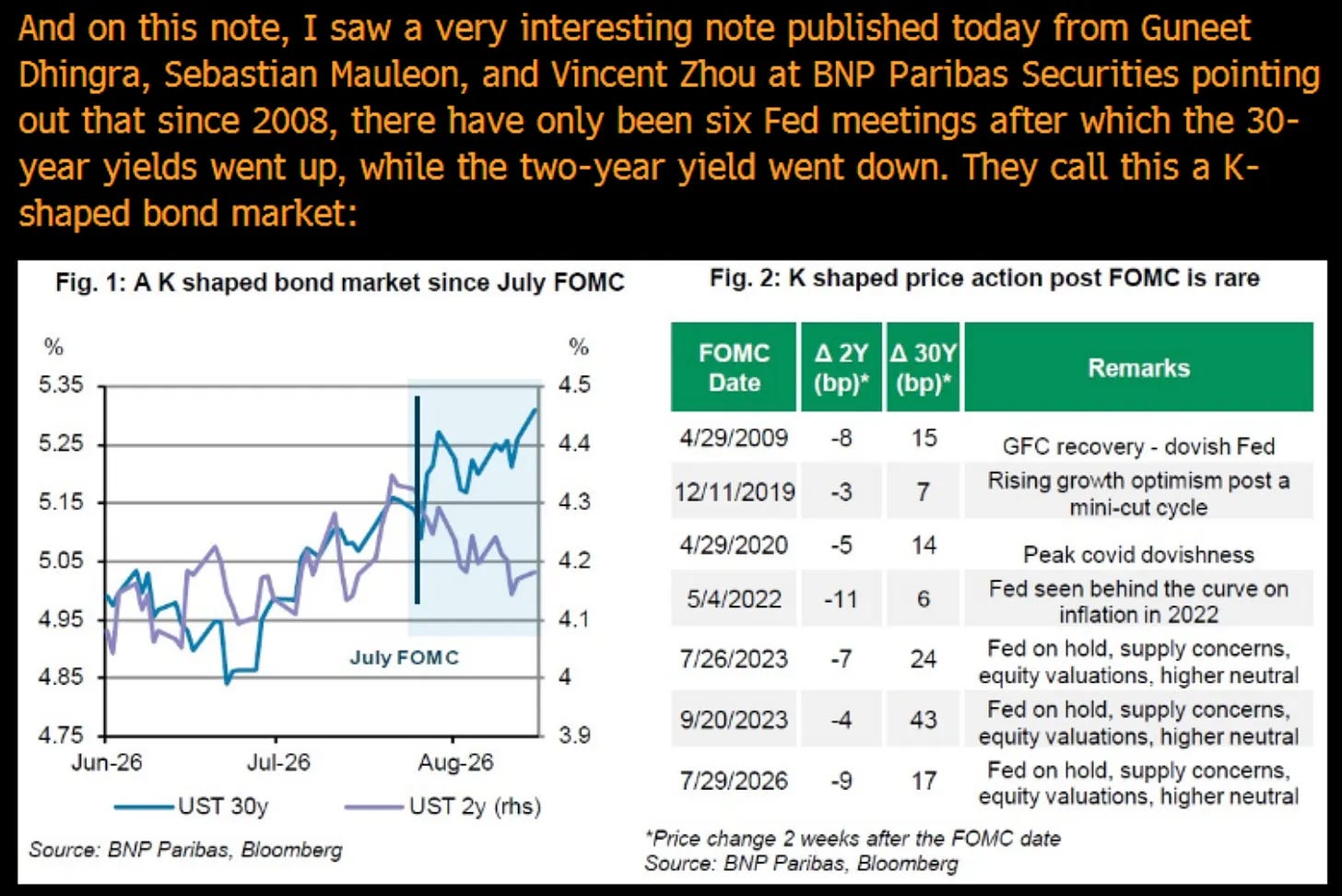
I was reminded to look into this from an interesting note from BNP Paribas analysts shared by Joe Wiesenthal that documented precisely this divergence at the last meeting. The 30-year yield has gone up (ie, duration sold off) while the 2-year yield went down (dovish Fed surprise). So, the market is suggesting that, whatever the short-term tactical maneuvers by the high priests, we’re secularly headed into a regime of higher inflation and rates.
I want to document how this signal can be recovered in a kosher way. We use TLT to proxy high-duration bonds and SHY to proxy low-duration bonds. We compute two event window returns around every Fed announcement.
(1) We compute volume-weighted average prices in a 10-min window on either side and compute their simple return. Call this the instantaneous return. The instantaneous return contains the market’s immediate response to the MP shock.
(2) We compute the daily return as the simple return from the prices at the opening and closing auctions. This contains informed investors’ reassessment of the macro outlook.2
Note that (2) contains more signal than (1) because informed traders are, well, more informed than day traders.
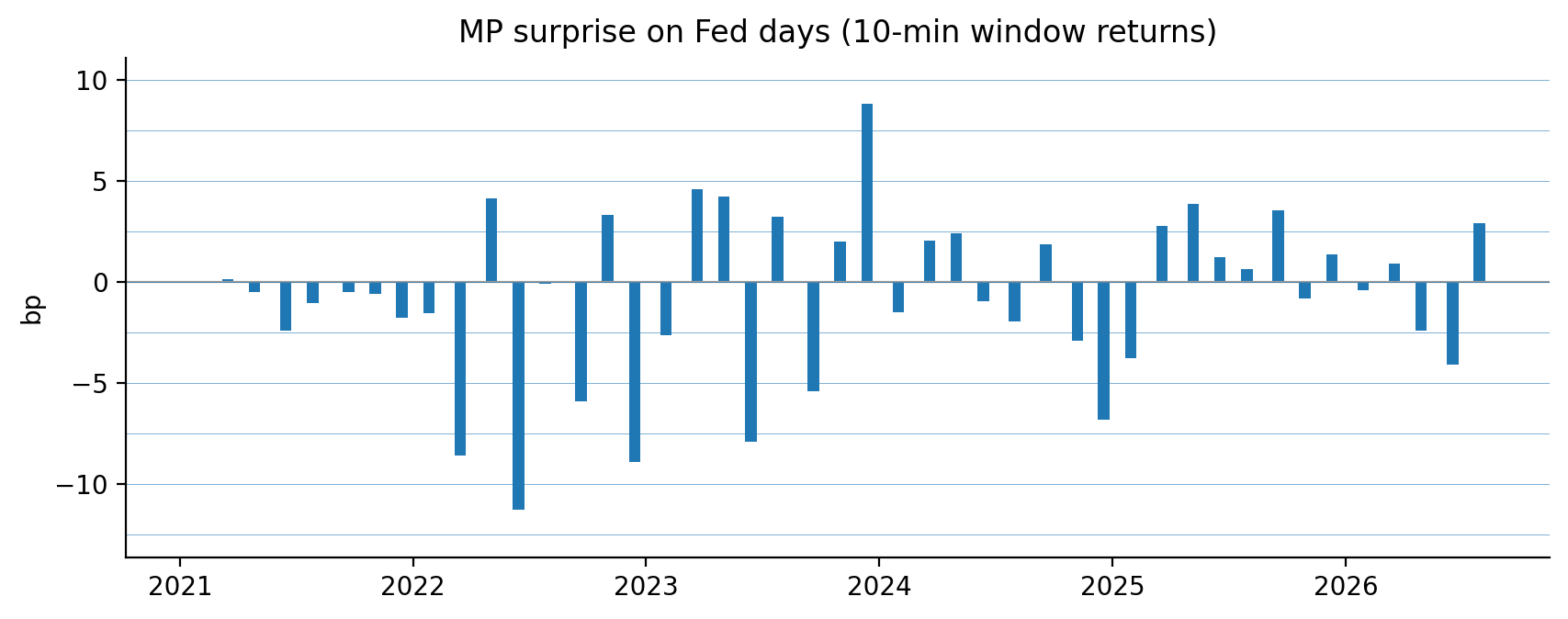
We start with MP surprise as captured by the instantaneous return. According to this immediate verdict, the last meeting yielded a dovish surprise from the Fed. (Recall that positive returns means yields have fallen.)
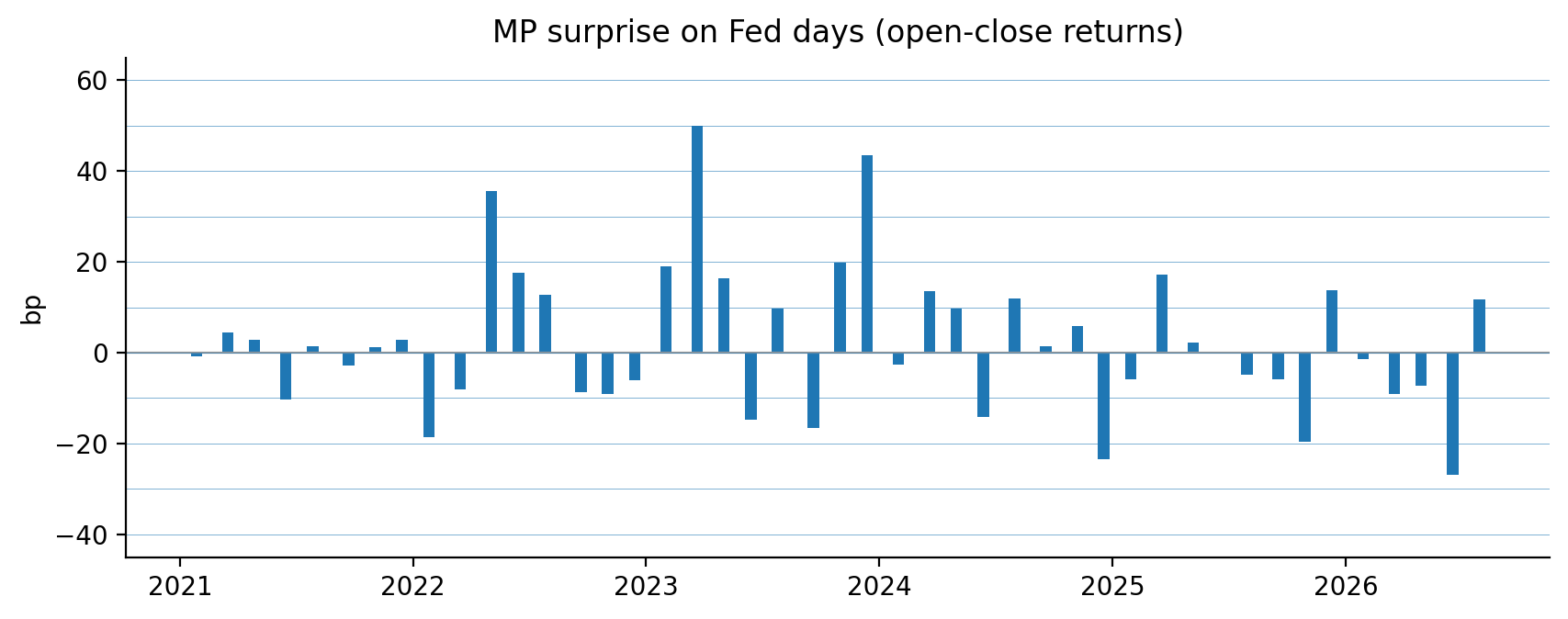
This verdict is ratified by informed traders at the closing auction. Both intraday and informed traders suggest a modest Fed surprise on the dovish side.
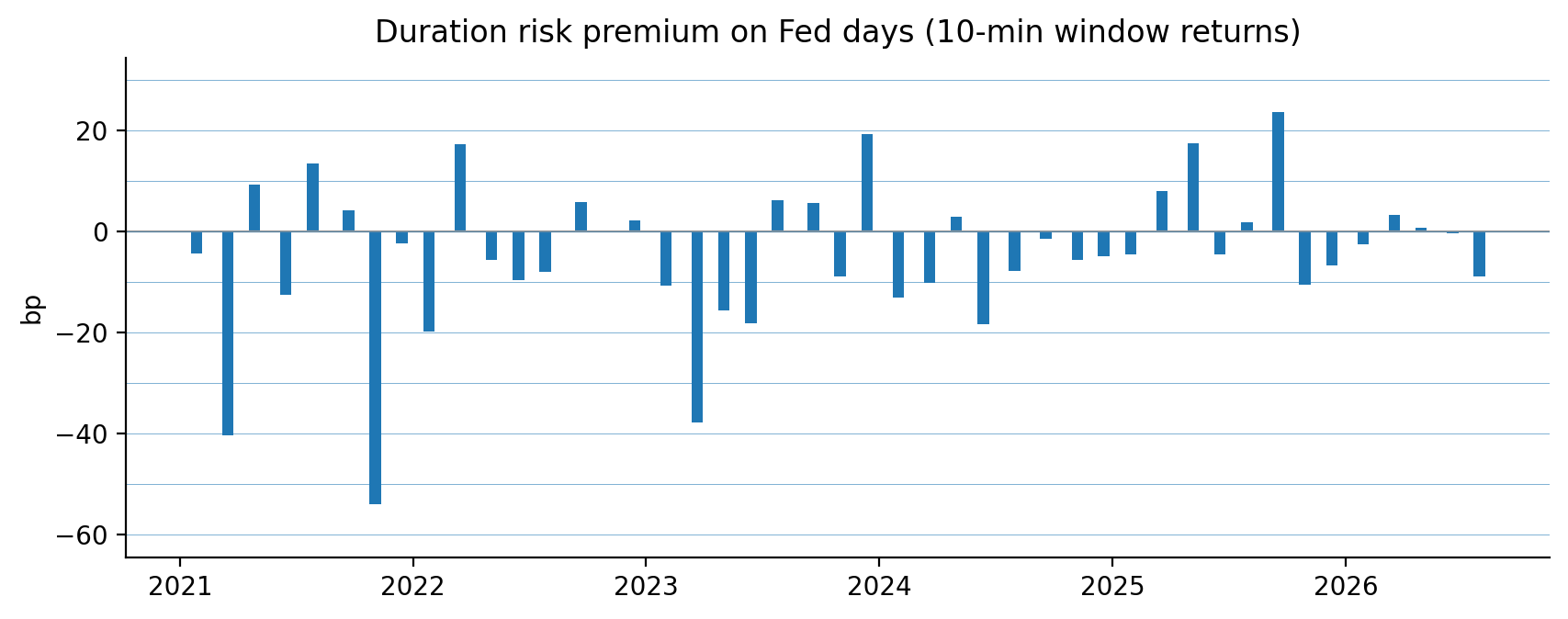
More interesting is the information contained in the duration risk premium. Recall that this is the long bond return in excess of the return on short bonds. It tells us how much those long duration made today relative to bond holders holding low duration bonds. In the 10-min event window, instead of a positive return, we find that the return to duration was negative. This incongruence is is what Joe reported.
What is especially shocking is informed traders didn’t just agree with the verdict of the day traders.3 Duration sold off harder at the closing auction, meaning that the informed traders think the medium-term macro outlook is even darker than the day traders.4
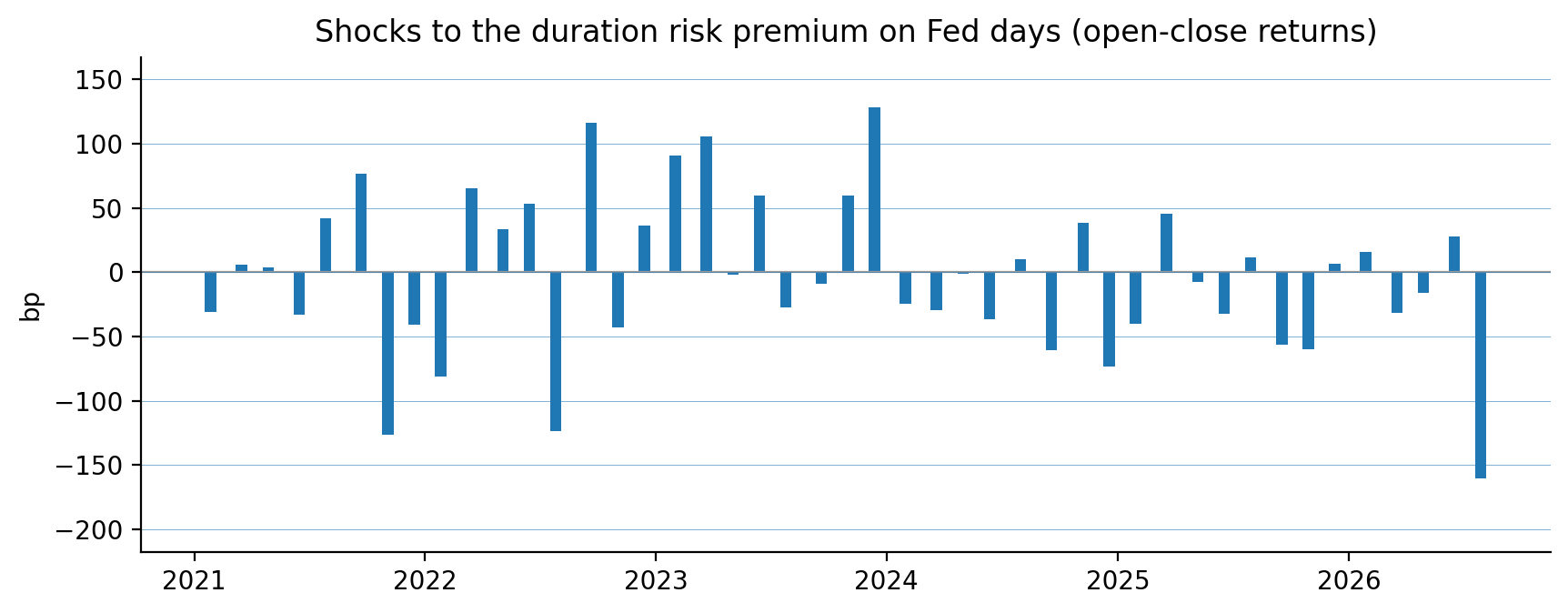
I want to show how the informed traders’ surprise about the macro outlook looks like over a longer time horizon. The following graph goes back to the right before the global financial crisis. You can see that the present Fed Day shock to the duration risk premium was only exceeded during the Great Recession in 2009-2010.
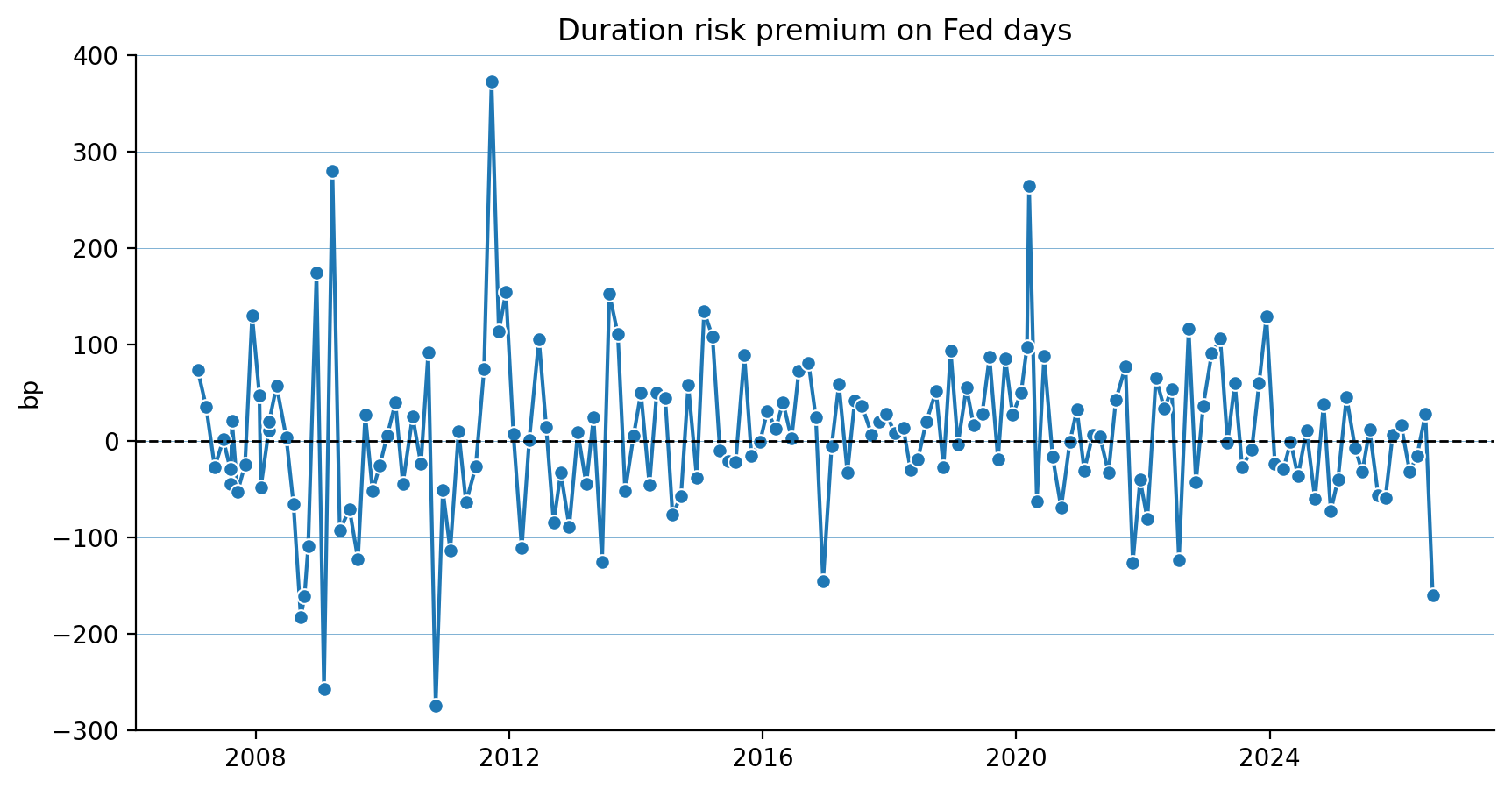
The evidence marshaled here is consistent with a reading of the rise in long-term interest rates that says that investors are getting worried. Inflation compensation far down the curve is still tame, suggesting that investors’ long-term inflation expectations remain well-anchored. However, investors are becoming more and more persuaded that we are in a secular inflationary or stagflationary cycle, so that rates may be much higher in the years ahead than they have been in the past.
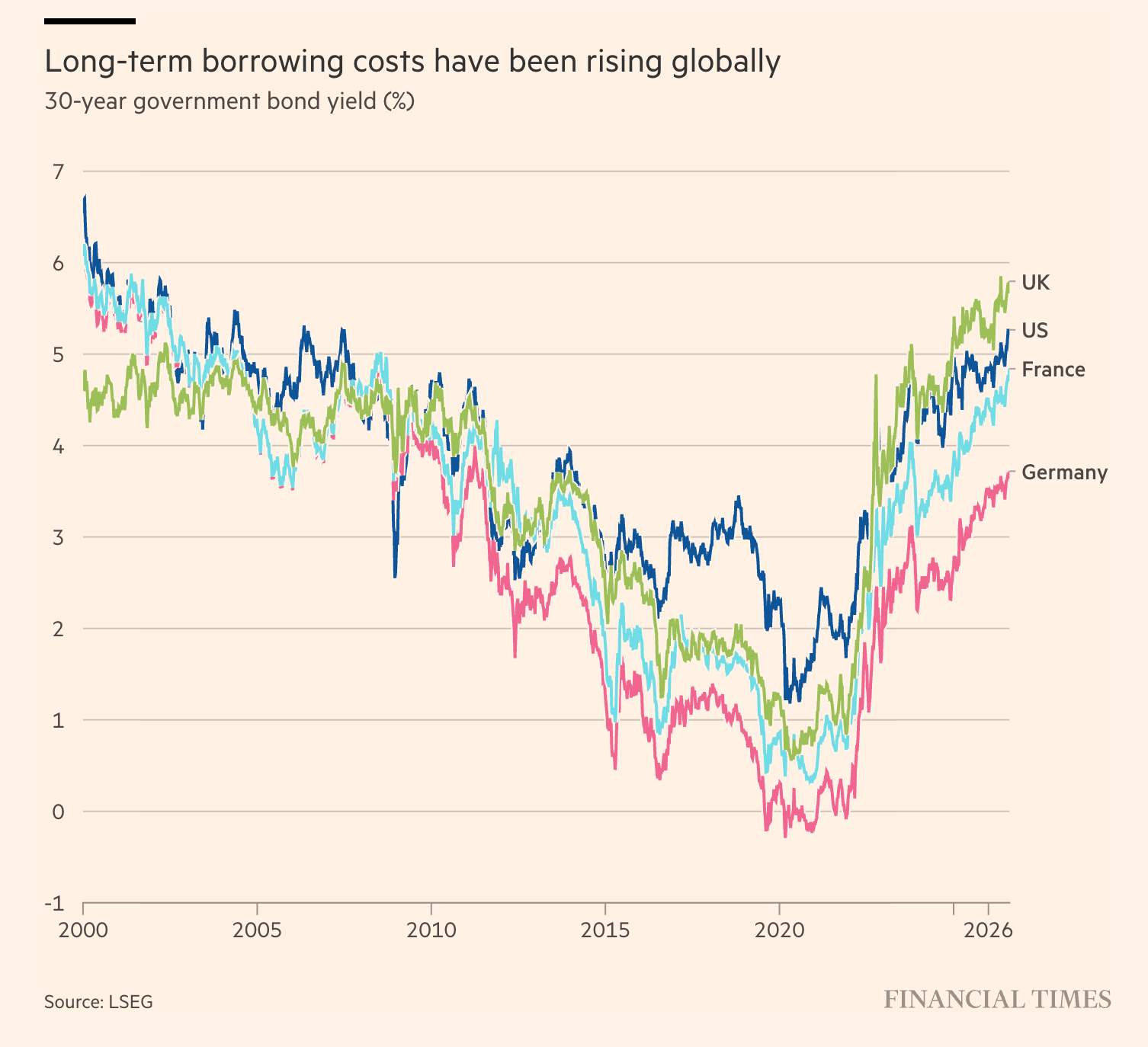
In general, investors are beginning to realize that we have been in a new macro regime since Covid. This is a secular inflationary regime with perhaps higher inflation, and certainly higher rates. And that this regime is not going anywhere but intensifying on account of the geopolitical instability and the weaponization of the world economy.
This is also true of stock returns. Although bond returns contain a stronger macro signal.
Informed traders are more active at the opening and especially the closing auction. According to market microstructure theory, informed traders must hide from market makers. They do this by trading at the auction and staggering their rebalancing trades over time. This does not mean all traders during regular market hours are noise traders. Just that informed traders’ perceptions are better reflected by the auctions.
Again, day traders are disproportionately noise traders. But there are others. Many hedge funds and most dealers trade throughout the day.
The open-close return is expected to be larger in magnitude than the instantaneous return. What I mean is that the shock is larger relative to their own historical variation, as is clear from inspection.
Comments
Nothing yet. Say the first thing.
Sign in to join the conversation.