

Dr. Sam Akbar is a Classicist and Psychologist who reframes ancient works and wisdom to help people live better in the 21st century. By bridging the gap between the philosophical insights of antiquity and the rigors of modern psychology, Dr Sam provides audiences with a unique toolkit for resilience, clarity, and purpose.
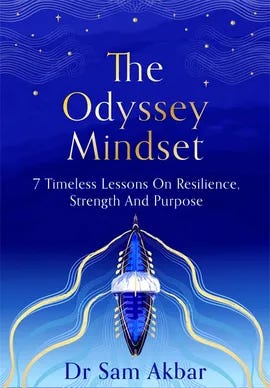
As an Oxford classicist and clinical psychologist, I have a unique dual expertise which allows me to weave together evidence-based psychology and the wisdom of the ancient world in a way that is relevant, current and practical for the modern 21st century reader. The result is the ‘The Odyssey Mindset: 7 timeless lessons for living’. The Odyssey Mindset powerfully reframes and recasts one of the world’s oldest and beloved myths into a guide that offers fresh perspectives on modern problems.
By delving deep into the text of the Odyssey, this book elevates self-help with narrative depth to look at what the Odyssey can teach us about ourselves and what it means to be human: how we navigate change, loss, grief, joy, and how we ultimately find a home within ourselves. It uses evidence-based psychology (CBT) to provide readers with exercises to help them navigate their own personal odyssey. The Odyssey Mindset focuses not only on Odysseus. It also brings to the fore the stories of Penelope, Odysseus’ wife, and his son Telemachus, as well as several other characters, allowing readers to look beyond just Odysseus.
The ancient world, its history, literature and wisdom will survive and thrive if we engage new audiences in compelling and relevant ways. If readers are helped in their own personal odysseys by this book, and if some of them come to love Homer because of it, then I am delighted to have made that contribution.
When Odysseus stands up at King Alcinous’ court and says I am Odysseus, and this is what happened to me, he is doing something psychologically meaningful.
The Odyssey is one of the grandest epic poems ever written, gods, monsters, a ten-year war, and at its heart is simply a man who misses his family and wants to sleep in his own bed. That ordinariness is the whole point for me; it’s what makes the poem universally accessible, and it’s also what makes it clinically useful.
When I work with traumatised refugees, one of the first things that gets stripped away is exactly that: the ordinary. The daily ordinariness of home like a particular smell, a garden, a routine, the faces of people who know your name. Catastrophic displacement takes away not just physical place but also dismantles the entire context in which a person understood themselves. You lose not just your house but your role, your status, your language, your history, your family and everything familiar. You arrive somewhere new and you are, without all the things that you thought made you ‘you’. That’s like Odysseus washing up naked on the beach, stripped of everything.
So, in clinical work, I find the nostos, the ancient Greek concept of the homeward journey, useful, because it reframes what we’re trying to do. We’re not trying to rebuild what was lost, which is often impossible. We’re trying to help someone find a way to come home to themselves and rebuild a different kind of life. We have to accept that life may never be the same again. That’s the really hard part to sit with because the loss is so deep.
In the book I talk about how “home becomes a place we find within ourselves.” With refugees, that process often begins with narrative. Approaches like Narrative Exposure Therapy, which I draw on in my clinical work, essentially ask people to do what Odysseus does with the Phaeacians: tell their own story, in their own words, in chronological order. When Odysseus stands up at King Alcinous’ court and says I am Odysseus, and this is what happened to me, he is doing something psychologically meaningful. He is becoming the narrator of his own experience rather than being narrated by it. He is able to tell his story with context and allow for emotional processing.
The question of what “home” means after extreme loss is very complex. For many of the people I work with, Ithaca, the literal home, is gone, or dangerous, or unreachable. So we have to find what Ithaca represents for them at the deepest level. Is it safety? Is it belonging? Is it the ability to be known by someone and feel safe with them? When you identify what home truly means beyond the physical place, you can begin to work towards it, even in circumstances that feel impossibly constrained.
What Homer understood, and what modern trauma psychology has since confirmed, is that this integration is never purely solitary. Odysseus’ homecoming isn’t complete when he reaches the shore of Ithaca. It’s complete only when he’s been recognised, by Eurycleia, by Telemachus, by Penelope, eventually by his whole kingdom. The community has to make space for the person who has returned changed. That’s why in my clinical work I think so much about the systems around the individual, family, community, whatever restorative relationships are available. Healing happens in relationship, not in isolation.
For many of the people I work with, what they are building is not a return to what was, but something very different. Odysseus doesn’t come back the same man who left. He comes back scarred, transformed, carrying enormous loss, and he has to find a way to inhabit that new self within the life he’s trying to reclaim. That’s the post-odyssey growth. It speaks to something remarkable about human resilience which I see in my patients everyday which is the capacity to make meaning from chaos and to keep walking forward.
Consistency would mean being the same person in every context, never failing.
Polytropos is one of the most interesting words in ancient Greek. It gets translated as “of many twists and turns,” but it also carries the sense of someone resourceful, adaptable, cunning. Homer uses it as the very first word to describe Odysseus. He doesn’t choose brave, or strong or noble, he chooses complicated. That’s the opening gambit of the whole poem. And Odysseus really is a mess: loyal to Penelope and spending years in the bed of Circe and Calypso, a brilliant strategist who makes catastrophically stupid decisions, capable of extraordinary tenderness and appalling violence. Homer never asks us to admire him uncritically. When we flatten Odysseus into a flawless hero, we lose the most useful thing about him. We like heroes who we can relate to in some way, even if we don’t like them. Flawless heroes are boring because we cannot see anything familiar in them.
His complexity shows us is that identity is about coherence, not consistency. These are very different things. Consistency would mean being the same person in every context, never failing. Coherence means having a guiding thread, a deeper self that holds together even when the surface is shifting. Odysseus can be the cunning strategist, the weeping exile, the brutal avenger, the loving father, because underneath all of those is something constant: the mission to get home, the knowledge of who he fundamentally is.
The real problem with the flawless hero ideal is what it does to self-knowledge. If you can only tolerate the acceptable parts of yourself, the rest goes underground. And things that go underground don’t disappear but pop up like a particularly persistent mole in your garden. They show up sideways or in patterns you don’t understand or in reactions that seem out of proportion. The Cyclops episode is a perfect example. Odysseus nearly escapes cleanly, and then cannot resist shouting his name across the water. His need for recognition overrides everything which is a psychological flaw, not a tactical one.
That capacity for honest self-appraisal, to say I know which part of me drove that, is what proper growth looks like, and you cannot get there if you are committed to being flawless.
Where there is an acknowledgement of complexity, there is room to evolve. The flawless hero has nowhere to go. Odysseus, with all his twists and turns, has the whole wine-dark sea.
I used to worry that I had taken too long on my Odyssey to find my thing! Now I see how helpful it has been to have a winding path, because it has given me so many different experiences and learning. Every ‘island’ I visited taught me something about what was important to me. Classics taught me about the richness of the ancient world – literature, history and philosophy. It also taught me how to think, not just what to think, and that’s crucial. Television taught me about telling stories and how different people live. Clinical psychology has helped me understand what makes people tick and what might help those in distress.
I feel like now I have found a niche I love – psychology and classics – and can now be a ‘psycho-classicist’, but as I say in the book, sometimes hybrids in the ancient world come to a sticky end – like the Minotaur although I don’t require sacrifices so maybe I’ll be ok.
I think it’s about assimilating all those different parts of yourself, and knowing that it takes time to get there, just like getting back to Ithaca. I would also add that nothing is really a straight line because that would presuppose you are in control of every outcome. Diversions happen to you whether you like it or not so learn what they tell you about yourself and what is important to you, and try to steer in that direction. Embrace the friction that life sends, even when it is painful, because sometimes that’s the only thing you can do.
Endure it, heart. You’ve borne worse in the past.
Book 20. 18-21
So, Odysseus is back on Ithaca, disguised as a beggar, watching the suitors who have overrun his home insult and humiliate those in his household. His rage is rising and everything he has fought to return to is being desecrated in front of him. Instead of acting on that fury, he turns inward and speaks directly to his own heart.
Here is one of the great warriors of the ancient world, a man of almost supernatural cunning and physical courage, and in his most agonising moment of restraint he doesn’t call on his strength or his cleverness but recalls his history of suffering. He reminds himself of what he has already survived, and that he can survive again.
Perhaps it is one of the earliest recorded examples of adaptive self-talk. It’s not toxic positivity nor the stiff upper lip of someone suppressing their feelings. He acknowledges the pain he has felt before. The thing that appeals to me is the tenderness of it. He talks to his heart like it’s a frightened animal. There is self-compassion in that address, a quality we often think of as modern and therapeutic, and yet here it is, woven into an archaic Greek epic. He is not berating himself to toughen up. He is just reminding himself of his own resilience. I have to say it to myself often.
You can find out more about me at my website: www.drsamakbar.com and on Instagram where I post about psychology and classics: @drsam_akbar
Books:
The Odyssey Mindset (published by Bluebird in the UK and in the US by Source Books) is out on June 11th 2026. It is currently being translated into the following languages: Spanish, Dutch, German, Greek (sadly not ancient Greek…yet!), Italian, Turkish, Arabic, Serbian, Polish, Portuguese, French, Hungarian, Ukrainian, Polish, Thai, Korean.
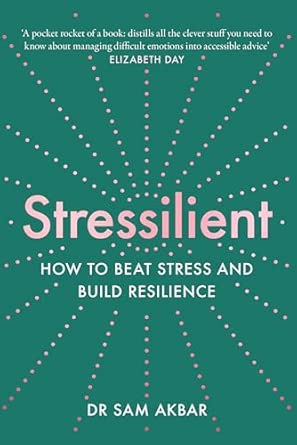
Stressilient: How To Beat Stress and Build Resilience (Fourth Estate, 2022). Translated into Spanish, Portuguese, Russian, Chinese, Arabic, Turkish, Korean, Lithuanian, Hungarian.
I would offer a hecatomb to the gods, maybe a little libation and do a little dance if there was an opportunity to do that. So, that’s a yes.
The book ends with something that I think is the most important question any of us can ask, The epilogue says: “Your Ithaca may never be an actual destination but a way of living.” And the last chapter asks us to sit with the uncomfortable truth that arrival is never final, that it is always both a beginning and an ending.
So the question I’d like to leave you with is simply this:
Do you know what your Ithaca is?
Not what someone else’s looks like, not the version of success or home or belonging that you absorbed from your family, your culture or your Instagram feed. Because as the book argues, if you don’t define your own Ithaca clearly and honestly, you risk, as Odysseus nearly does on several occasions, being seduced by someone else’s vision of what your life should look like.
It sounds like a simple question but it’s a hard one to answer.
No posts
Comments
Nothing yet. Say the first thing.
Sign in to join the conversation.