
This plant’s most obvious feature is that its flowerheads look like little aliens. They’re about two or three inches wide and maybe twice as tall. I find them kind of creepy, though they are striking as all get out.
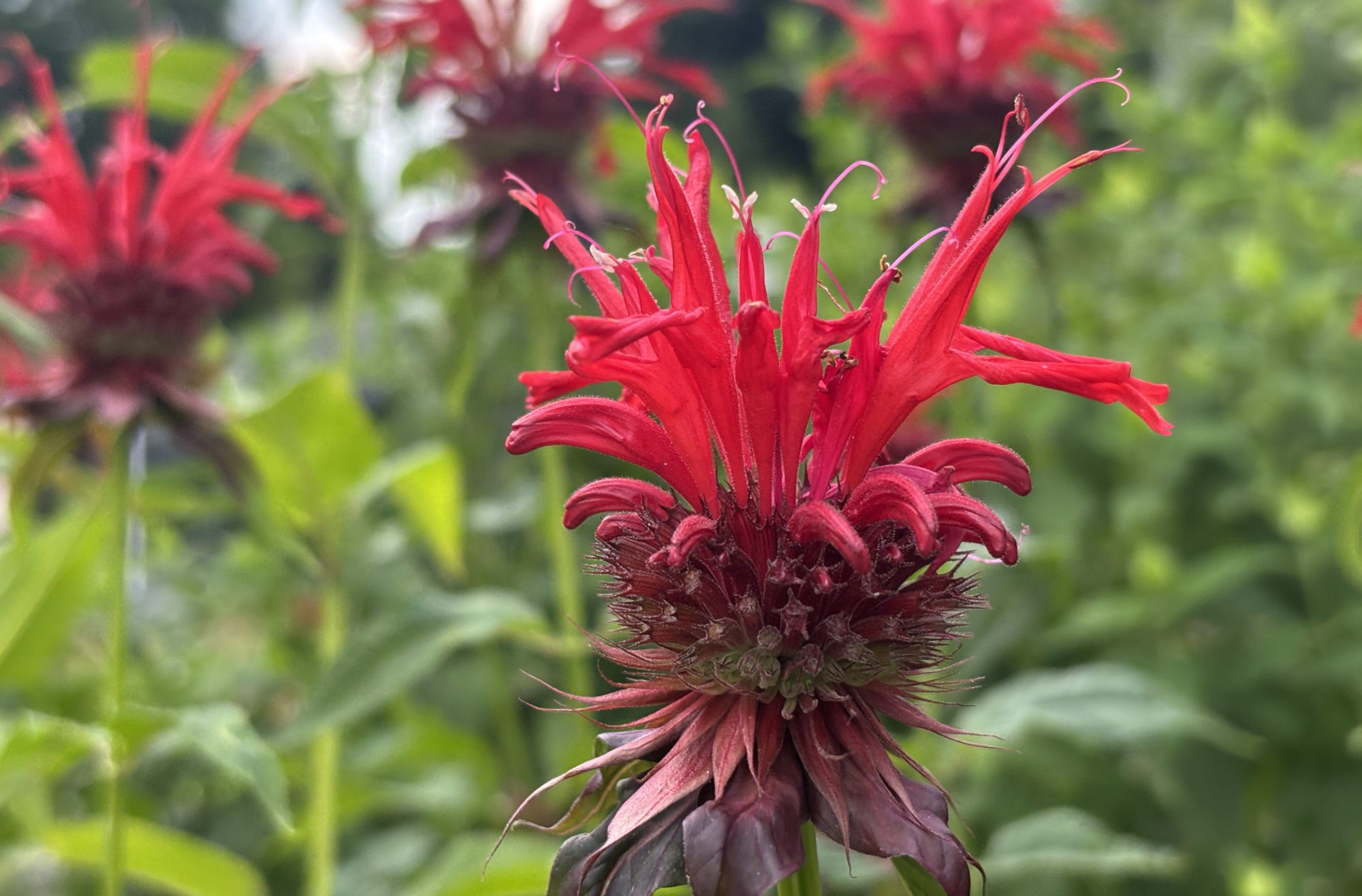
At the top are bright red tubes. Each of these is an individual flower, its petals fused and rolled. Flowerheads can contain at least a couple dozen flowers, and many more in cultivated varieties. (There’s probably a tradeoff. For example, Monarda “Cotton Candy” supposedly contains 280 flowers on its flowerheads, but one wonders how much nectar or pollen the plant has to sacrifice to make all these.)
The flowers don’t bloom all at once. They start in the center and work outward over time, sort of like a blastwave in an action movie. What’s great about this is that it means the overall bloom time is long, from June through August, and longer in cooler climates.
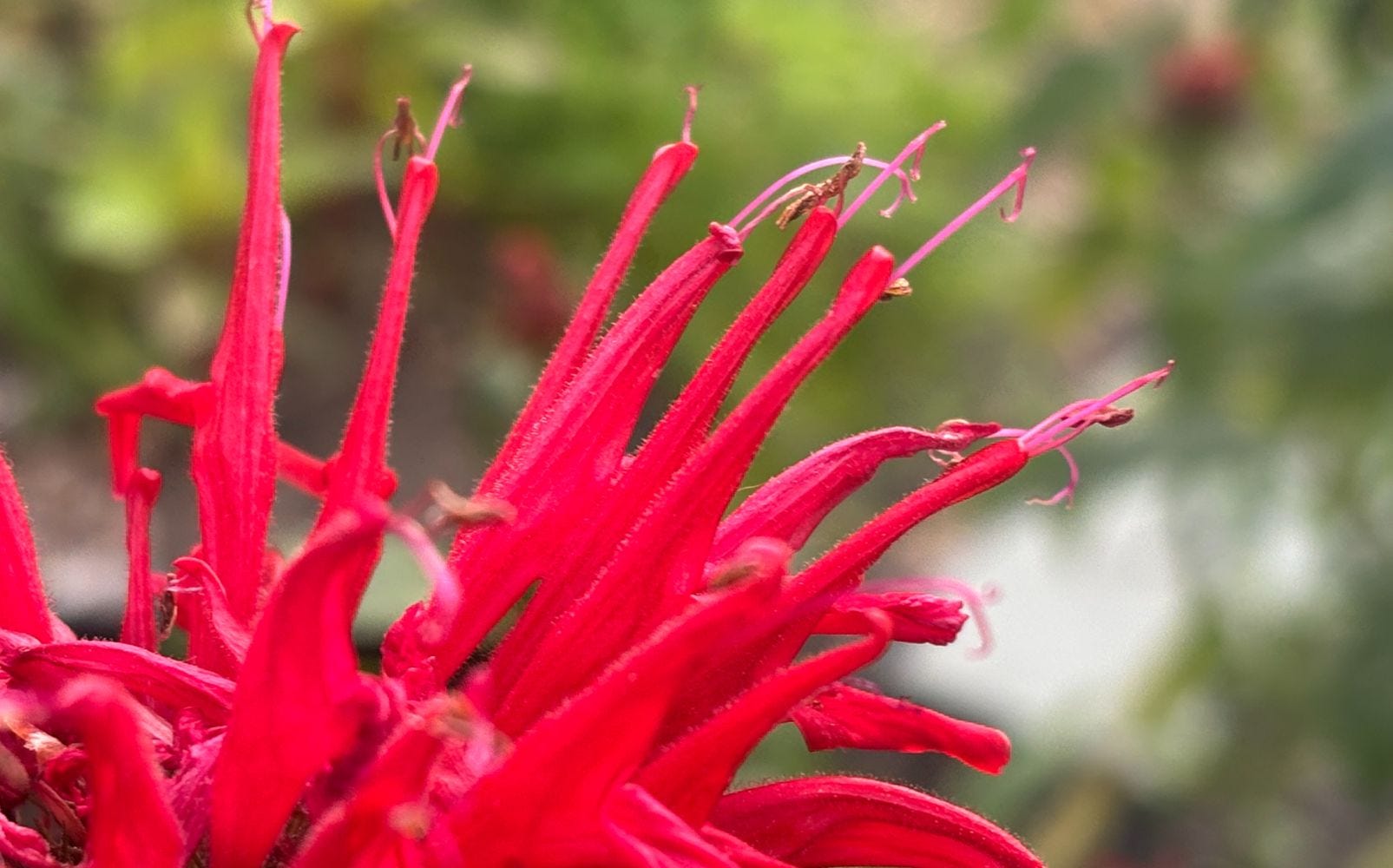
Like other mint family flowers, the tubes look like they end with a pair of lips (they’re bilabiate). The stamens and styles poke out the top, and the tubes seem to stick out chaotically. The effect is something like a muppet that’s fallen on hard times.
It’s not actually chaos, though. This plant has flower structures called verticillasters. This is a structure where two arcs of flowers come together in what appears to be a ring. And in this species, they’re basically completely mashed together in the flower head. Hence the messy haircut look.
Beneath the scarlet petals are reddish and green sepals, which protect and support the flower. Beneath those are reddish, leaflike bracts, which have a similar job. In scarlet bee balm, bracts also make the whole red flowerhead bigger and easier to see. Go go gadget hummingbird billboard, etc.
Monarda didyma has the mint family traits of square stems and leaves opposite one another on the stem. If you crush the leaves, they smell minty. The leaves are dark green—darker and larger, in my experience, than wild bergamot’s (Monarda fistulosa). Little teeth run all along their edges. They’re somewhere between egg- and lance-shaped (ovate and lanceolate).
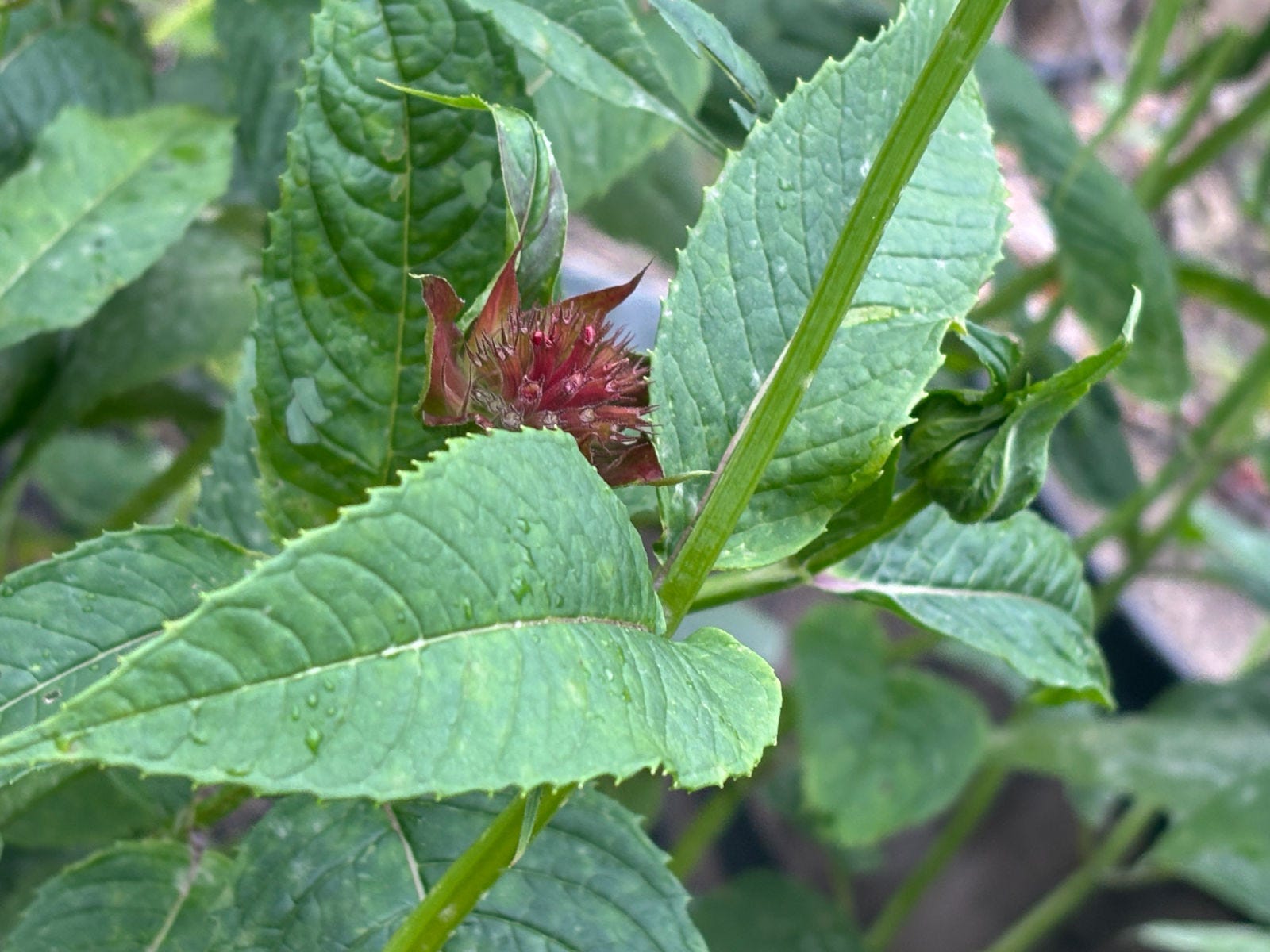
Scarlet bee balm also doesn’t have any basal foliage, or the foliage that appears in a ring around the soil. It just sends its stems vigorously upward. All its leaves are on its stems (cauline).
Illinois wildflowers observes that in hot weather, the lower leaves can fall off (especially if the plant is also struggling with powdery mildew). This isn’t the end of the world, though it does tell us that this plant that prefers slightly cooler temperatures and some moisture in the soil.
Many popular Monarda species, including this one, are infamous for getting powdery mildew. Powdery mildew’s a fungus that creates a white, powdery film over the plants’ leaves. Monarda like to grow in tight drifts, contributing to the kind of humid, moist conditions that powdery mildew likes.
Powdery mildew is mostly cosmetic damage. It doesn’t stop the plant from reproducing. But it’s not amazing to look at. Supposedly you can slow it down a bit by dividing clumps so there’s more airflow, clearing infected leaves, or using mildew-resistant varieties such as Jacob Cline.
Grows in the moist understory of mountain forests up to 6500 feet, especially where there’s an opening that allows in a little more sun. The cooler temperatures and extra water in the forest understory probably protect it in the southern part of its range. It doesn’t love dry soil or being blasted with sun.
Flora of The Southeastern U.S. mentions that it appears wetlands, along streams and waterways, and in seepage slopes, or hillsides where groundwater keeps the soil continually wet.
Scarlet bee balm’s native range might originally have tracked the Appalachian mountains from Alabama and Georgia through Maine. The range then continues up in a narrow strip through New Brunswick in Canada.
The plant’s range has expanded probably in part because the horticultural industry sells it. It’s now found east to the Atlantic coast and west as far as Minnesota.
A wonky acknowledgement: Because this plant’s range has expanded so much, you might read “expanded” as meaning, “the horticulture industry and its customers brought this plant to new places, and we don’t know what it means for the ecosystems it’s now a part of.” To which someone might respond, “but the new place is geographically right next to the old place. A lot of the things that depended on it in the old places also live in the new places.” And the debate could continue from there—but not in this post.
This is one of those plants that appears on lists of hummingbird favorites, and with good reason.
The flower tube’s shape makes it seem almost like a little sock for a hummingbird beak, and Monarda didyma is especially associated with the ruby-throated hummingbird. As an aside, there’s been some debate about if red really is associated with birds. A 2025 paper in Current Biology makes a very convincing case that they are. The authors show that red and orange flowers in North America bloom in time for the arrival of migrating hummingbirds.
Anyway, whenever someone mentions that something’s a hummingbird plant, a good bet is that it’s also a butterfly plant. Many butterflies have an organ called a proboscis, or tube-like feeding structure, sort of like you had a straw for a mouth. Or in this case, as if you had a hummingbird beak for a mouth. This allows them to reach the nectar in scarlet bee balm’s tubes.
Some bees will nectar on scarlet bee balm, too, especially if they’re a long-tongued variety (like many bumblebees). I assume they still have to crawl part way down the tube to get at the nectar, resulting in one of those extremely cute Protruding Bee Butt situations.
A few bees specialize on pollen produced by plants in the Monarda genus, though I’d imagine they prefer spotted bee balm or wild bergamot, since those plants’ pollen is more accessible. These bees include the beebalm shortface bee (Dufourea monardae) and the delightfully-named Bee Balm Fairy Bee (Perdita gerhardi). Another cited species, Protandrena abdominalis, is some type of rare mining bee that I found very little info about. For what it’s worth, none of the iNaturalist observations I saw of these bees were on M. didyma.
A few different caterpillars use this plant as a host. One, the hermit sphinx caterpillar (Lintneria eremitus) looks like it crawled out of the Upside Down in Stranger Things. Others include the gray marvel (Agriopodes teratophora), and a couple of pretty moths, the orange mint moth (Pyrausta orphisalis) and the raspberry pyrausta (Pyrausta signatalis).
The HOSTS dataset includes 4 records of species using scarlet bee balm and 20 across the Monarda genus. (Some of these may also eat M. didyma, but HOSTS is a record of literature mentioning relationships between caterpillars and plants, and that literature may not have focused on scarlet bee balm.) Interestingly, neither the hermit sphinx nor orange mint moth is included here—a hint at the limits of our knowledge.
In case you’re wondering (because I was) if powdery mildew makes this plant taste worse to caterpillars: maybe not? I found one study that said that caterpillars on field mustards didn’t care about powdery mildew, though their wasp predators did.
This plant’s valuable for wildlife after it’s finished blooming, too. Small, overwintering songbirds will eat the seeds, including American goldfinches and song sparrows.
Some solitary bees will also nest in the stems over the winter. In general, they do this by finding a hollow or pithy stem and creating a nest cavity. Carpenter bees will chew through pith to make a nest, and others have to find a stem that’s already hollow. Similarly, some can tunnel into a flower with the head on, and some need a stem that’s already open.
The standard advice for creating bee habitat is to cut back to 1 or 2 feet in the fall. However, cutting the stem does dump the seedheads that the birds like. So you could cut the stems and leave the seed heads on the ground for the winter. If this looks too messy, you could gather the seed heads and neatly pile them or put them in an out-of-the-way spot so that birds can still get them.
Scarlet bee balm spreads through two types of runners. It sends out rhizomes, or underground stems that travel horizontally and poke up new shoots, like mint plants (the herb). And it also has stolons, or aboveground horizontal stems. (Strawberries and clover are also other plants you might’ve seen spread by stolons.) Both rhizomes and stolons form clones of the original plant.
When it spreads this way, it forms drifts and colonies, and can do so vigorously. It has a bit of a reputation as an “aggressive” garden plant. On the other hand, it’s nice that it creates fairly large drifts quickly. You can cut the drift into a nice, even shape every so often.
What I’d avoid is planting it next to slower growing, clump-forming, shorter plants. It’d certainly be happy to encroach on and overtake a newly planted hosta (if you’re into those) or peony. Even some taller plants, like purple coneflower, may need you to tell the bee balm (i.e. with your clippers) to back off. Missouri Botanical Garden recommends dividing every few years.
Monarda didyma also spreads by seeds. This accomplishes two things. First, genetic diversity: they’re not clones of the parent plant. Second, it allows it to reach sites beyond its current drift or colony.
After the flowers have been pollinated, they form little containers with 4 nutlets, or small, dry fruits with a single seed inside. Since each tube is a flower, each creates its own container of nutlets. These may drop or be carried by birds to new locations.
If you’re growing it: most guides I checked said that it’ll germinate whenever you sow it. A few others said cold treatment helps (i.e. simulating winter). If you’re not in a rush, I’d do the cold treatment; your germination rate will likely be a lot better.
Don’t bury the seeds. They need sunlight to grow; just scatter them on the surface.
Scarlet bee balm’s leaves are edible, and taste a little like minty oregano. One of its uses among indigenous people was, not surprisingly, to make tea. The common name Oswego tea probably refers to Oswego, New York, which is where colonists may have learned about the plant from the local people, who were members of the Haudenosaunee (or Iroquois) confederacy.
The book Cherokee Plants and Their Uses—A 400 Year History (Paul Hamel and Mary Chiltoskey) also lists a few ways the Cherokee used this plant medicinally. These included to treat colds and to cause sweating (as a diaphoretic). The Cherokee’s original land occupied a good chunk of the southern Appalachian mountains, overlapping this plant’s native range.
Today, we use this plant a lot in gardens, both for its ecological benefits and because it’s pretty. The International Registrar of Monarda cultivars lists 83 Monarda didyma varieties as of 2024, including hybrids. This tells us there’s a bit of a market for this plant.
Which is nice. One loves to see a native plant make it to the horticultural big leagues, as it were. A warning here, though: some nurseries or growers will treat plants with pesticides so they’ll appear “fresher” on the shelf. If you’re planting it to support wildlife, this is counterproductive. You’d want to buy from a trusted source, or at least be the annoying customer at the unknown source who wants to know where a plant came from and if it’s been treated with something.
Plants in Plain Language is free. Subscribe to get fun and plant nerdery in your inbox.
You can also help me rationalize spending even more time on this—writing, researching, trying to get photos of very spontaneous bees—by buying me a coffee or becoming a monthly sponsor.
No posts
Comments
Nothing yet. Say the first thing.
Sign in to join the conversation.