
Iris people have decided, for whatever reason, that there’s not enough jargon in botany, and they need to come up with their own. Admittedly, theirs is cooler. For example, instead of sepals and petals, they talk about falls and standards. Throughout this piece, I’ll write the “normal” botanical word first and the Iris Talk word second, e.g. "sepals (falls).”
Northern blue flag is about two or three feet tall from its base to the top of its flowers. A mature clump may send up four or five blooms, usually not at the same time.1 It’s a solidly medium-sized iris, though smaller than the hulks commonly sold at nurseries, such as Siberian irises and bearded irises. Still, it holds its own in the area most people come to irises for, the flowers.
Iris flowers are the muscle cars of the gardening world: they’re loud, colorful, and run out of gas kind of quickly. My blue flags, for example, flower in late May and finish up in June. They’re mostly purple with deep purple veins and three yellow signal blazes, or signals.
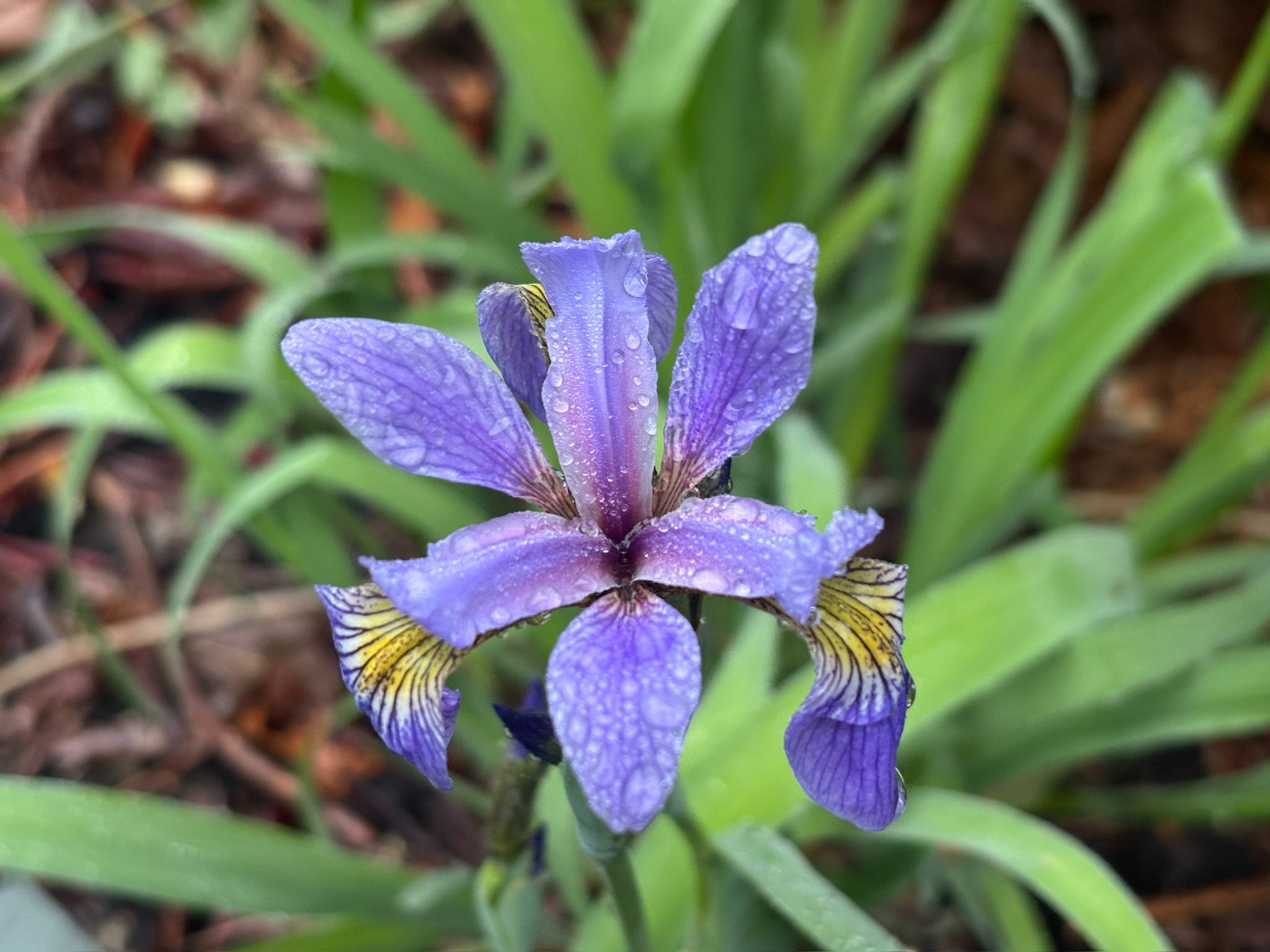
Northern blue flag flowers are not subtle. Here are the major pieces, which sit on top of each other like an interlocking layer cake.
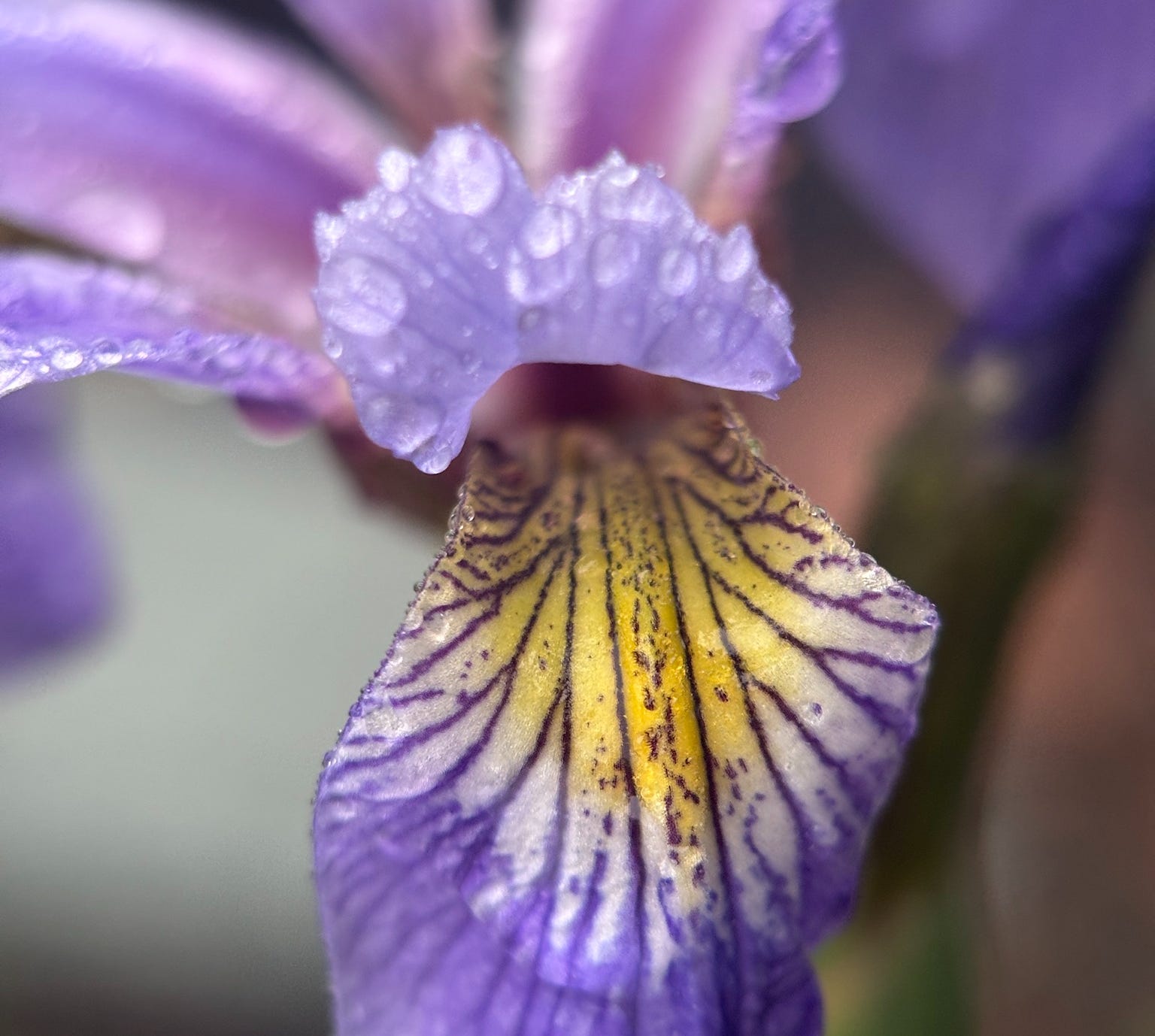
Three large, drooping sepals (falls) that end in yellow signals. The signal isn’t just for you. It’s also a landing strip for bees.
Three rounded, lightly veined petals (standards) sit in the gaps between sepals.
Three rectangular style arms hover over the sepals. These are actually modified pistils, the female reproductive part of a flower.
The purple veining persists through the signal, which is one of the cool and distinguishing features of this species. Supposedly this helps you distinguish it from southern blue flag. However, there are lots of research grade observations on iNaturalist where the southern species also has heavy purple veining.
Iris leaves, including Iris versicolor’s, are one of the defining features of the family they belong to, Iridaceae. They’re long, narrow, pointed, and often described as “swordlike.” Unnecessarily, there are 2 technical terms for this structure: ensiform or gladiate. Ensiform is from the Latin ensisformis, or sword shape. Gladiate comes from gladius, or sword. They also spread out in a fan from the base.
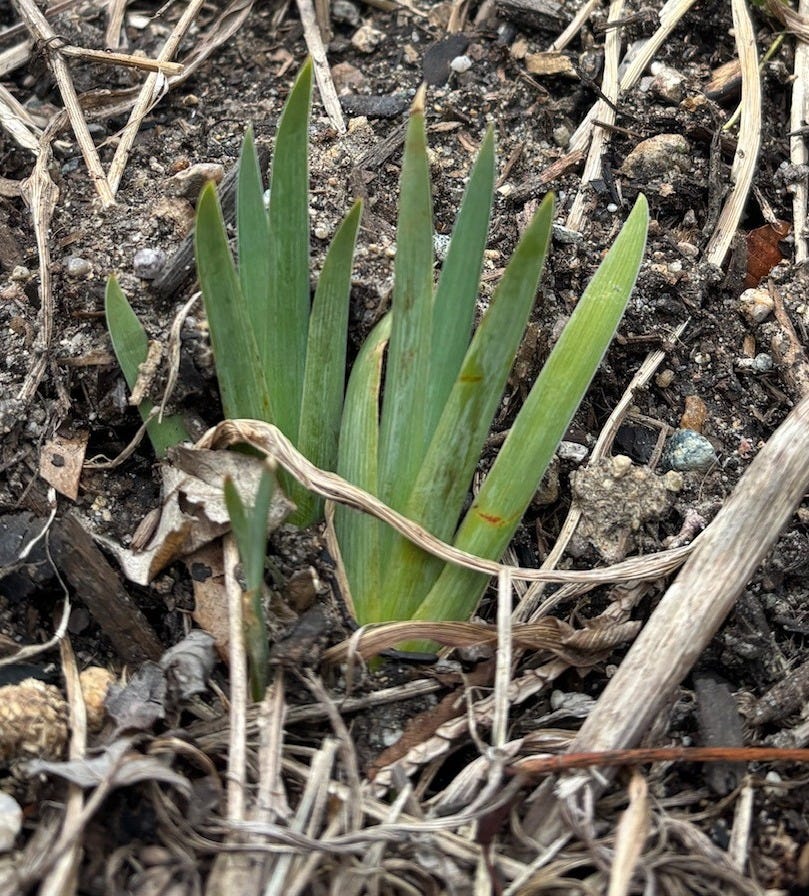
A bizarre feature of iris leaves is that they’re folded in half, like someone’s begun a paper airplane. This is easiest to see at the base, where the fold is open enough to clasp the stem. As you move up the leaves, though, they fuse together. This means you are always looking at the lower side of the leaf (the abaxial side). The upper leaf (adaxial side) is enclosed in the fold.
This is a plant that lives for summer vacation: wet feet and sun and acidic, rich soil. Okay, the last one’s not a fit, but it’s useful if you want to learn what it likes.
Northern blue flag grows along streambanks, shorelines, marshes and sedge meadows. A sedge meadow is a type of wetland populated by sedges and water-loving grasses.
Let’s dwell for a moment here, since it tells us about the niche this plant fills—not just the ecological one, but the horticultural one. Maybe you don’t live on a river. But do you have a wet, mucky place in your yard? This plant would like to go there. Clay soil? Put it there. Part of the yard that gets flooded? Put several of it there and let it start a rain garden. One university extension article suggests it does fine even under “4 inches of standing water.” Just make sure it gets a lot of sun.
Northern blue flag iris is native to the eastern U.S. and parts of southern Canada. Its range stretches south to the northern edge of Florida. It also grows in the north central part of North America, including Iowa, Minnesota, Michigan, and the southern edges of Manitoba and Ontario.
By comparison, southern blue flag’s range extends from Florida north to the mid-Atlantic. It extends further west, too; the northern species peters out before reaching much of the south central U.S.
Mostly pollinated by bumble bees and long-horned bees. Hummingbirds, hummingbird moths, and butterflies are also sometimes attracted to the flowers.
The sepals (or falls, or just “the big showy parts”) work like landing pads that guide visitors to nectar. To do this, they have to brush past the anthers, getting coated with pollen in the process.
In its native habitat, northern blue flag provides shelter for amphibians and insects. It hosts a handful of butterflies and moths, such as the Iris borer moth (Macronoctua onusta), Virginia ctenucha (Ctenucha virginica), and according to at least 1 iNaturalist observation, the smeared dagger (Acronicta oblinita).2
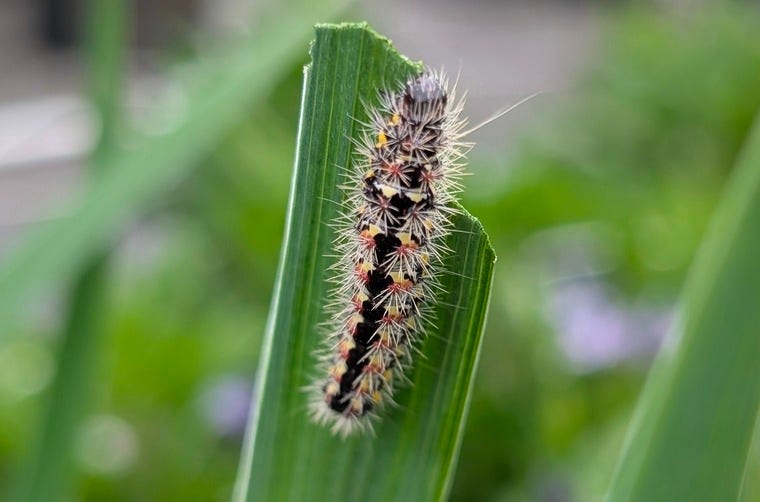
Weevils, flies, aphids, and other insects feed on this plant, but as usual, there’s a little less interest in things that aren’t Lepidoptera (butterflies and moths).
Iris versicolor’s roots and leaves contain a chemical called irisin or iridin, which is what several sources delicately refer to as a “purgative irritant.” Means that eating irises can cause uncontrollable pooping. Not great—unless you are a gardener hoping to plant something deer and rabbit won’t eat.3
Spreads through roots (rhizomatously) and seeds. A rhizome is technically an underground stem that can sprout new shoots and roots—and whole new plants. When it spreads this way it forms clumps, and eventually whole colonies. Its seeds often float away to a new location in water. Spreading seeds this way is called hydrochory.
To divide a clump of northern blue flag, dig it up and pull the rhizomes apart, making sure each has at least a fan of foliage and some roots. Then replant them.
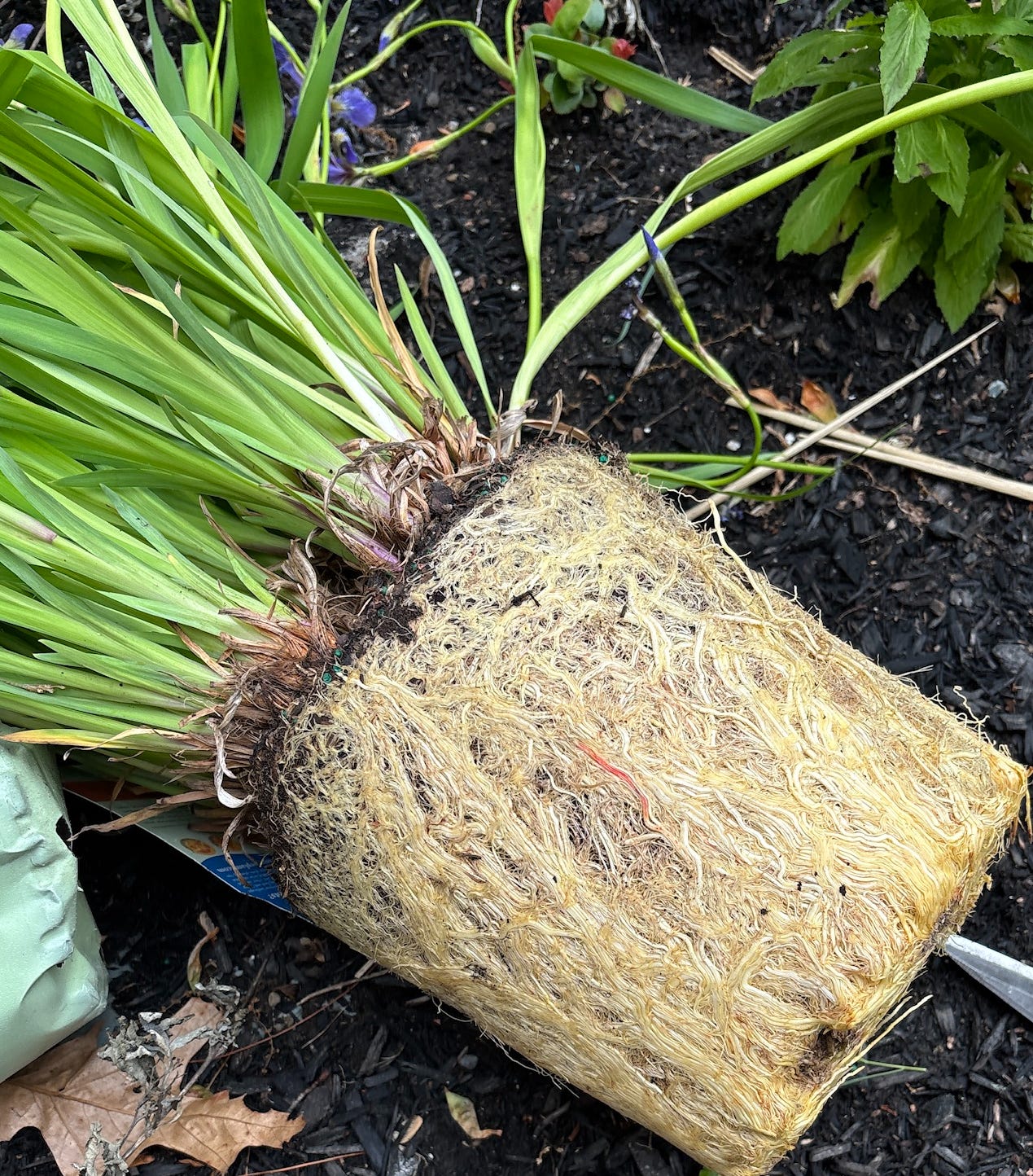
Various Native American peoples used this plant’s roots for a variety of reasons, including treating wounds and dressing burns.4 Two peoples, Mi’kmaq (or Micmac) and Penobscot, both indigenous to what is now the U.S. northeast and southern Canada, may have used it for treating cholera.
As a reminder: this plant’s roots are poisonous for mammals. Presumably people who used it knew how to prepare it. You shouldn’t if you don’t!
The Potawatomi people (Great Lakes region) used the leaves in basket weaving.
Iris versicolor is the official provincial flower of Québec.
The most reliable difference between northern blue flag and southern blue flag is that the northern’s flowers are taller than its leaves. On southern blue flag, the leaves extend above the flowers.
Supposedly their colors differ. For example, northern blue flag’s flowers are often described as deeper violet with more prominent veining, and southern blue flag’s signal is a brighter yellow. However, I’ve now spent quite a lot of time looking at both species. And these things tend to be true on average. Which I don’t find all that useful for confidently identifying a plant.
The northern species is cold hardier, the southern heat hardier. But also, they hybridize where their ranges overlap, making the whole idea of distinguishing them a bit of a fool’s errand.
Note: Irisin is also a hormone produced when you exercise. Web searches turn up a lot more about that than the toxic plant chemical.
No posts
Comments
Nothing yet. Say the first thing.
Sign in to join the conversation.