
The Mt. Cuba Center, a botanical garden in Hockessin, Delaware, regularly runs trials where they evaluate plants like asters, echinacea, and phlox for their “horticultural and ecological value.” Their reports on how these plants do in typical garden conditions are widely anticipated by people in industry—and by plant nerds like yours truly.
Their most recent research was on goldenrods, the Solidago genus. This is a group with a bit of a jagged reputation. They’re falsely blamed for causing allergies. (Their pollen spreads on bees, not the wind.) They’re keystone species because of their immense value to wildlife. They’re perceived as weedy and aggressive. A couple of species are quite ambitious. Canada goldenrod and smooth goldenrod, for example, are genuine problems in Europe. But there are more than 100 species in this genus, most of which are perfectly “polite” in the garden.
Various gardening podcasts and articles have covered the “top performing”1 goldenrods in the trial. That is, the ones that looked good, bloomed prolifically, resisted disease, etc. But I’m going to focus on the trial’s data on insect interaction. I want to know which goldenrods might conjure the coolest and most interesting bugs to run after and make the subject of clumsy, blurry photographs.
Alternatively, if you’re not into bugs, then which goldenrods will conjure the most food for cool and interesting birds. Hummingbirds, for example, need protein, and they can’t get it from the red plastic feeder. They eat ants, mosquitoes, weevils. They even raid spiderwebs—both for the spider’s meal and the spider. So in a way, a goldenrod is a hummingbird feeder.
The trial data comes from regular observations of 70 goldenrods between May and November over 3 years. A researcher would go stare at a cluster of flowers for 60 seconds and write down what they saw. From this, they extracted a couple of metrics:
Average insects per observation: The total number of insects they saw divided by the total number of observations.
Total bumble bee observations: Raw count of bumble bees over the course of the observations.2
One caveat. Mt. Cuba describes the trial as happening in “full sun in ‘average’ garden soil best described as a clay-loam with a pH near 6.5.” And it’s in Delaware, in zone 7a. So the conditions here might not be perfect for a forest-dwelling goldenrod more at home in northern Maine.
Still, the results are interesting, and competition is fun. So in this post, I’m going to report on the top goldenrods across these two metrics, average insects and bees.
Note: I’m leaving one species, Sand or Locust Fork goldenrod (Solidago arenicola) out, even though it wiped the floor with the competition as far as bumble bee visits go. It has a small, very specific native range, and doesn’t seem like something you’d be able to easily purchase seeds for, anyway.
Insects per observation: 12.37 (1st place)
Bumble bee observations: 74 (4th place, tied)
I must emphasize how much this plant won the “insects per observations” category. The average insects across trial plants was 3.3 per observation. That’s actually pretty good. Go look at a flower in your garden for a minute, and you might not see 3 insects. But Leavenworth’s goldenrod averaged 12.37 per observation!
A few things might’ve contributed to this. First, it’s a very large plant, the largest in the trial, with a huge number of flowers, perhaps as many as 350. It also bloomed late in the year in Delaware, October and November. Perhaps it was the main thing available, even as many insects were beginning to pack it in for the winter.
Mt. Cuba assigned it a score of 3.5 because its foliage tended to flop. One tool we sometimes use to prevent floppiness is the so-called Chelsea chop, where you cut a plant back by about a third to keep it shorter and neater. Unfortunately, Leavenworth’s probably isn’t a candidate for this, since it already blooms late. Chelsea chopping delays flowering. In this case, it might delay it until after most pollinators can use it.
Leavenworth’s goldenrod is native to the southeastern U.S. north to the mid-Atlantic. It lives in bogs and along coastal plains. (A coastal plain is flat, low elevation land near the coast.)
See Mt. Cuba’s summary for Leavenworth’s goldenrod.
Height: About 8 feet
Moisture: Native to wet and boggy soils, but Mt. Cuba’s data says it’s also fine in dryer soils.
Sun: Full sun, not shade tolerant.
Bloomed in Delaware: Late fall, October through November in Delaware.
How it spreads: Ambitiously, even aggressively, through rhizomes. Will create large drifts. (Seeds also spread in wind.)
Editorial note: Might look good alongside Joe Pye or ironweed, especially in a larger space.
Note: I included the second latin name because I saw at least one well-known seed seller using it. The reason there are two latin names is that taxonomists are having an argument that’s at once perfectly reasonable and annoying to those of us who like to think latin names are stable.
Insects per observation: 9.15 (2nd place)
Bumble bee observations: 86 (3rd place)
This plant was an insect favorite. Its overall score was only 3.7, a little lower than the top plants because it had a tendency to flop. 3
However, to be fair to other species that “performed worse,” this plant really benefits from the way Mt. Cuba collects data. Riddell’s only blooms for a couple weeks. This means all of its flowers open basically at the same time—and it may have around 450 flowers per plant.
Mt. Cuba measures insect visits per 60 seconds. If all of your flowers are open at once, you’re likely to get more in 60 seconds than if you bloom over a long period of time, and only some of your flowers are open. (This makes Leavenworth’s goldenrod, which blooms over a couple months, even more impressive to me!).
That said, it also benefits from its flower structure. Like a few other goldenrods, Riddell’s has flat-topped corymbs, essentially a flat landing pad made of flowers.4 This makes flower access potentially easier than the wands and spikes other goldenrods feature.
This is a midwestern species that lives in wet meadows and near waterways. Think “sunny rain garden,” right next to your irises.
Mt. Cuba’s summary of Riddell’s goldenrod.
Height: About 5 feet
Moisture: Wants moist soil, though it did well in the “average” conditions of Mt. Cuba’s trial garden.
Sun: Full sun, not shade tolerant
Bloomed in Delaware: September
How it spreads: Seeds spread in wind. Also has short rhizomes that let it form “well-behaved” clumps.
Other common names for this species include forest goldenrod and cut-leaf goldenrod.
Insects per observation: 7.25 (3rd)
Bumble bee observations: 74 (4th place, tied)
This goldenrod would’ve preferred the dappled light of a forest edge to the full sun of the trial garden. It nevertheless did extremely well—at least as far as feeding the insects goes. A last factor might be because it bloomed basically all fall, late August to late October.
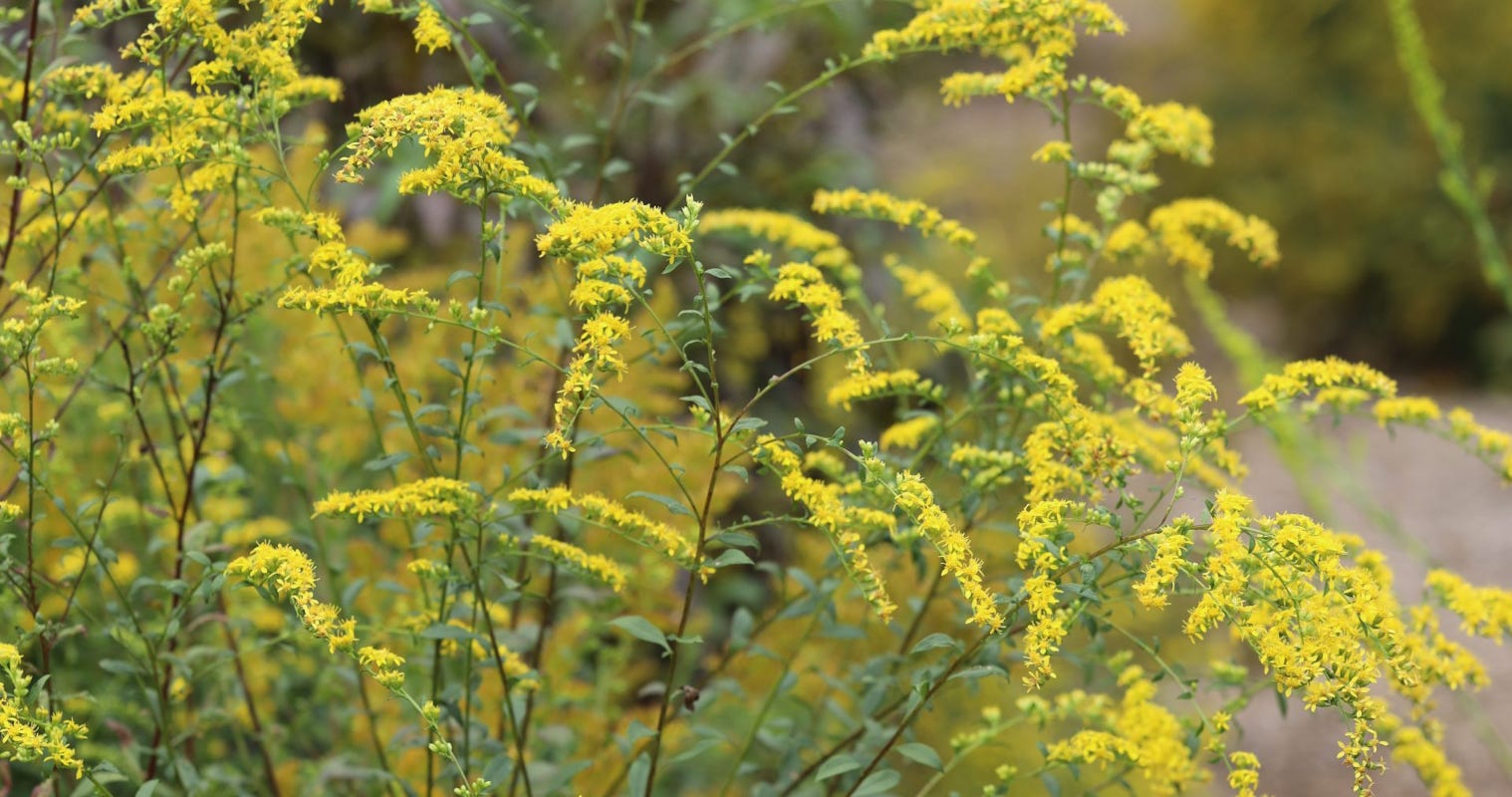
Solidago arguta has a flower structure that could also be a great band name: pyramidal plumes. In botany, this name refers to a structure where a central stem supports a tower of flowering stems that’s widest at the bottom. Some plume-creating flowers, like Solidago arguta, only create flowers along the upper part of the stems, instead of all around. This is called a pyramidal secund (with a “u”) plume.
This plant is normally found near forests across the eastern U.S. and into Canada. Its overall score was 3.5. Mt. Cuba reported that its “stems tended to flop and the foliage was affected by lace bug and powdery mildew,” but also that it might’ve done better “if provided some shade and drier soils.”
Mt. Cuba Center’s summary of Atlantic goldenrod.
Height: Mt. Cuba says 5.5 to 7.5 feet. Possibly much shorter (2-3 feet) in the shadier habitats it typically grows in, though.
Sun: Very shade tolerant. May have suffered appearance wise a little in full sun (though Mt. Cuba suggests the issue may actually have been moisture.)
Bloomed in Delaware: Late August to late October.
Moisture: Prefers dryer soils.
How it spreads: Seeds spread in wind. Also has short rhizomes that let it form “well-behaved” clumps.
Note: In researching for this piece, I stumbled on another species, Solidago flaccidifolia, that’s so similar to this one that they might just be varieties of each other. And its common names are mountain goldenrod or mountain decumbent goldenrod.
Insects per observation: 6.58 (4th place)
Bumble bee observations: 118 (2nd place)
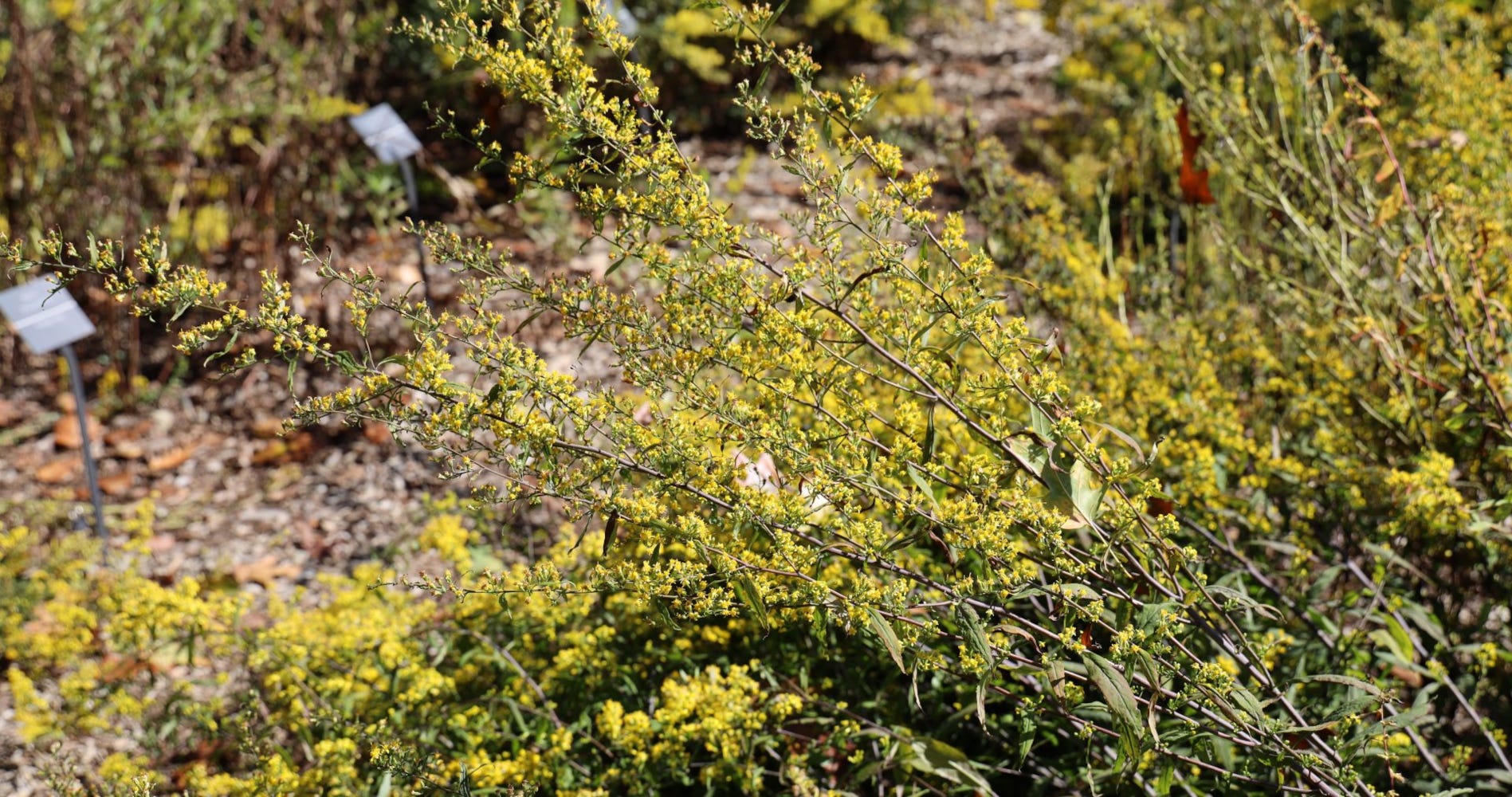
This was the 4th highest insect count in the trial. It was 2nd for bumble bees—and by a lot.
This goldenrod’s associated with the southern portion of the Appalachian Mountains. It’s native through the mountainous southeastern U.S. as far north as the mid-Atlantic states (e.g. Pennsylvania, Delaware). It’s a woodland plant, at home in the shady understory, though it apparently also did very well in the full sun conditions of the trial. Mt. Cuba assigned it a trial score of 3.9, in the top 20% of species.
Mt. Cuba Center’s summary of mountain goldenrod.
Height: Mt. Cuba says about 6 feet. However, this is another case where it might grow much shorter, e.g. 1-3 feet, with shade.
Sun: Can handle both full sun and a lot of shade.
Bloomed in Delaware: September to October.
Moisture: Not too wet. Think, “Lives in the dry, shady understory of a mountain forest.”
How it spreads: Seeds spread in wind. Also has short rhizomes that let it form “well-behaved” clumps.
Insects per observation: 6.05 (8th place, tied)
Bumble bee observations: 51 (8th place)
This species didn’t do as well as the others I’m writing about, and Mt. Cuba only assigned it a 3.4 overall (for floppy stems and a poor floral display). However, it’s more promising than it looks. The average insects score of plants 4th-9th was, on average, 6.32—only slightly higher than this one. And Mt. Cuba’s own analysis is that it would do better in rockier, dryer soils. In its home habitat, it’s a pretty stunning plant.
Showy goldenrod is native basically across the entire eastern half of the U.S. It’s found in sandy prairies and dry open fields.
Mt. Cuba Center’s summary of showy goldenrod.
Height: About 5 feet
Sun: Full. Not shade tolerant
Bloomed in Delaware: mid September through late October. Pretty impressive!
Moisture: Prefers dry soil.
How it spreads: Seeds spread in wind.Also has short rhizomes that create clumps.
Plants in Plain Language is free. Subscribe to get fun and plant nerdery in your inbox.
You can also help me rationalize spending even more time on this—writing, researching, trying to get photos of very spontaneous bees—by buying me a coffee or becoming a monthly sponsor.
The trial’s scoring methodology appears on page 6 of their “flipbook.” They rate plants on flowers, disease resistance, and “overall.” The latter category, which is weighted highest, includes “foliage, form, vigor, habit.”
Why bumble bees? Because they are rockstar native pollinators. You get to eat blueberries and peppers and pumpkins because of bumble bees. And because honey bees aren’t native to the U.S., but many bumble bees are.
One could try cutting it back by a third earlier in the season to see if it improves its posture. That said, Mt. Cuba did “Chelsea chop” 50% of all species. Perhaps even with this cutback, it was still a little messy for the typical garden. Another option might be supporting it with a drift of tall grasses nearby.
No posts
Comments
Nothing yet. Say the first thing.
Sign in to join the conversation.