
In my previous post, I explained that—although many herbaceous perennials grow more or less continuously under favorable conditions, reaching or approaching mature size in a single season—others allocate only a limited amount of energy to above-ground growth each season, stopping well short of mature size even when conditions remain ideal (see Figure 1). For lack of a better term, I refer to that latter pattern of limited growth, stopping well short of mature size, as “Type 2.”
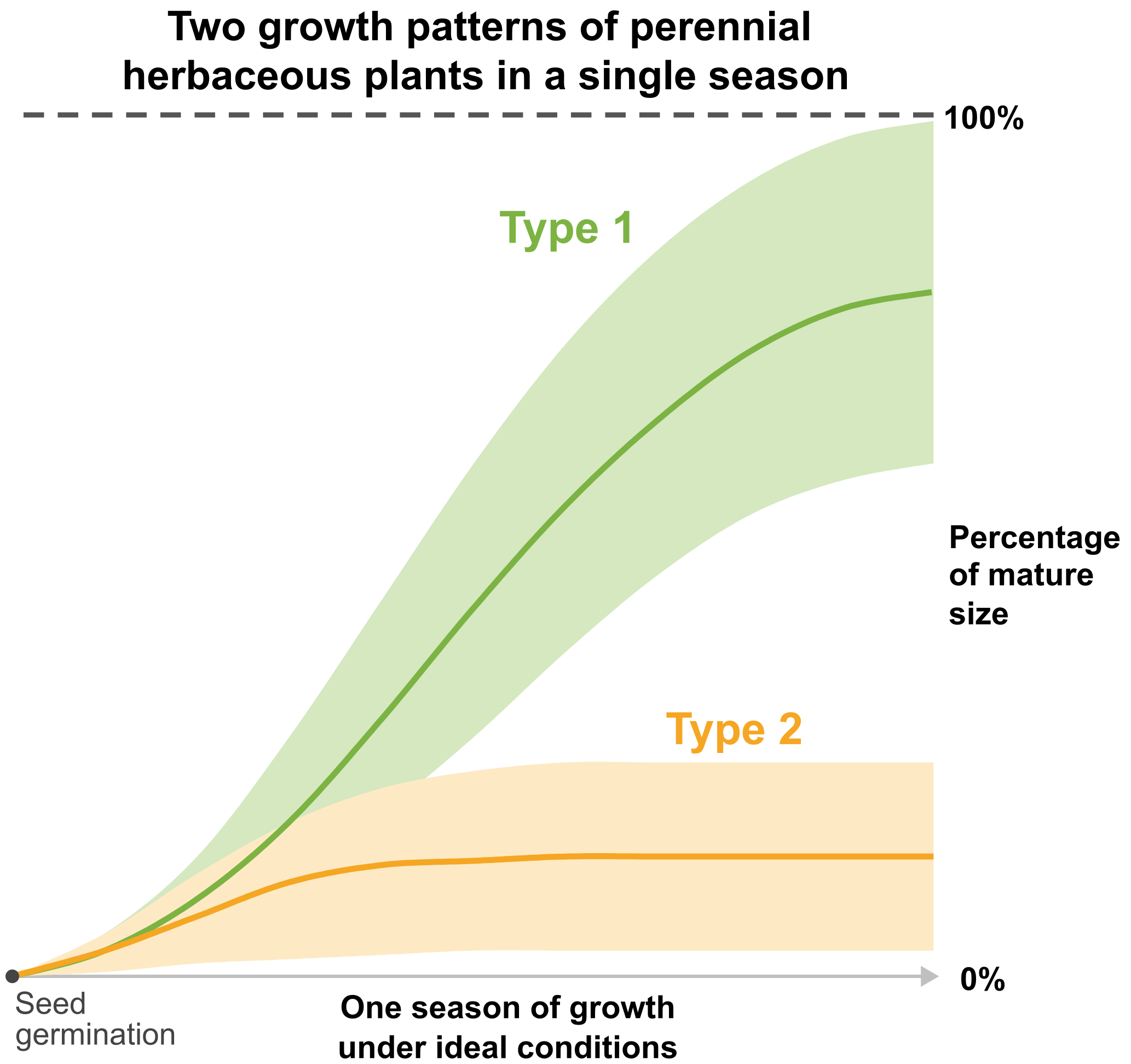
When producing plugs of native plants, it’s straightforward to handle species that grow continuously until mature size is reached (plants in my Type 1 category): simply grow them out until you’re happy with their size and root mass. Plants with Type 2 growth, however, pose a bit more of a challenge to nurseries and home growers. I like to transplant my perennials when their root mass is just substantial enough to hold together the potting medium of their containers. So what do I do if my plants have stopped growing, but don’t have enough root mass to transplant? Or what if my plants have stopped growing, but are too small to survive competition in the garden/restoration they are destined for?
The simplest option—and likely the most common—is to overwinter these plants, relying on the fact that winter conditions will spur growth in the spring. This process can be repeated for as many years as it takes to produce plants of usable size. This is a perfectly fine method, but I don’t often use it.
Usually, I prefer to chill my plants in a refrigerator because:
It’s a more efficient use of time. Spring ephemerals, for instance, only actively grow for a couple months, and they spend the remaining nine to ten months of the year dormant. But they often only require two to four months of chilling to break dormancy. So if you’re in a hurry to grow a plant (which maybe you aren’t), why wait nine to ten months for something you can do in two to four months? Artificial chilling, admittedly, takes up energy. But if you have a chest freezer in a cold basement rigged up to an external thermostat to run at refrigerator temperatures (just like a DIY kegerator), you’re likely using a very minimal amount of electricity.
It’s a more efficient use of space. I have limited propagation space, so space is valuable to me. The more quickly I can get plants matured, the sooner I can repurpose space for a different set of plants. If a tray of plants takes up approximately two square feet of space for three months, then gets transplanted outside, that tray of plants has cost me 0.5 square-foot-years of space. If a tray of plants takes up two square feet of space for three years, it has cost me six square-foot-years. Maybe I’ve lost you on my math, but the point is that I like to minimize the residence time of my plants to keep space open for growing other plants.
It gives me flexibility in when I have my Type 2 plants in the grow area. My propagation area usually fills up the closer I get to spring planting. So in March and April, plants are squeezed in like sardines, and there isn’t an inch of surface area to spare. In the summer, however, my propagation area is mostly empty. For this reason, it’s very convenient for me to have my Type 2 plants in cold storage from April through May when space is scarce, and then bring them out to grow in June.
It’s low risk. Plants in the ground are well-insulated by the soil and by organic debris above the soil. So when temperatures drop to ‑30°F (-34°C) here in Wisconsin, the plants in the ground may be only a few degrees below freezing (especially if there is snow). But with containerized plants held above ground, there is much greater risk that the plants will experience extreme cold. It’s true that many native plants can tolerate fairly extreme cold, but I don’t like to take my chances on valuable species.
I have jumping worms in my area, so I keep my plants mostly indoors. I am perhaps excessively paranoid about jumping worms. But I don’t want to be the guy to spread them further than they’ve already been spread. So my plants only go outside for a brief hardening-off period before transplanting, and even then they are kept well above the ground. So keeping my plants outside for months at a time makes me a bit nervous.
The use of controlled cold exposure to break dormancy and manipulate plant growth is well-established in commercial horticulture. The Dutch cut tulip industry is perhaps the most dramatic example: millions of bulbs pass through climate-controlled chilling facilities each year, enabling growers to force flower production in months in which tulips would not ordinarily bloom. When prolonged cold exposure confers or accelerates flowering competence, the treatment is called—confusingly—vernalization.1 This contrasts with the chilling I describe, which does not confer or accelerate flowering, but releases plants from dormancy so that vegetative growth can be resumed (and—in the case of some lilioids and gentians—induce cryomorphosis). So the chilling I describe is not vernalization in the strict sense, but the technique of chilling is the same technique I would use for vernalization.
Although the principle of controlled chilling has been applied with great sophistication in the ornamental bulb trade, it remains largely unexploited in native plant production, where growers typically rely on natural overwintering and accept a single annual growth cycle as a given (or else don’t grow containerized Type 2 plants at all). That represents a missed opportunity. Many native perennials—especially spring ephemerals, lilioids, and true gentians—have chilling requirements that, once satisfied under controlled conditions, allow plants to be brought out of dormancy weeks or months ahead of natural schedule. For instance, whereas spring ephemerals naturally have a single growth spurt per year, with chilling, they can often undergo two periods of growth in a year, cutting the time to produce mature plants in half.
Chilling plants is sort of like boiling pasta: it might seem exceptionally easy to those with experience, but remember that anything can be daunting if you’ve never done it before. Like pasta, it’s mostly a matter of timing, temperature, and moisture. Below are the steps I take to chill my containerized plants. Some of this info might seem very obvious, but in the interest of making this protocol as accessible as possible, I’m stating even the most obvious steps.
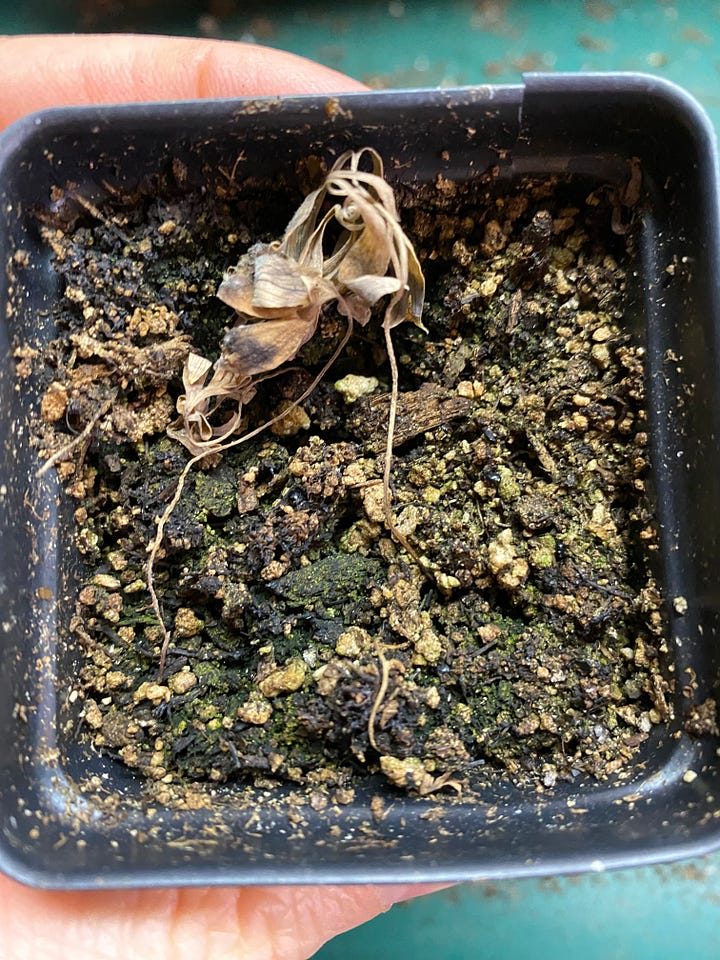
If you’re working with a spring ephemeral, this will be fairly easy: just wait until the above-ground growth has senesced (see Figure 2). Once foliage begins to senesce, I generally water sparingly. I’m not sure if it’s really necessary to water at all at this point, but I have an aversion to bone-dry potting medium, so I keep my plants just barely damp. If you’re growing in a controlled environment, be aware that your plants may not senesce as thoroughly as plants outside would. Whereas heat, sun, and wind conspire to utterly desiccate the senesced foliage of spring ephemerals growing outside, no such elements are at play indoors, so leaves may remain green or yellow rather than shriveling up. Generally speaking, this is fine, and there’s no need to wait until full shrivel has been achieved. If you’re working with a plant that is not a spring ephemeral, but does show Type 2 growth (such as true gentians), then you may never achieve full senescence. I typically let these plants grow for five months or so, and then arbitrarily decide it’s time to chill.
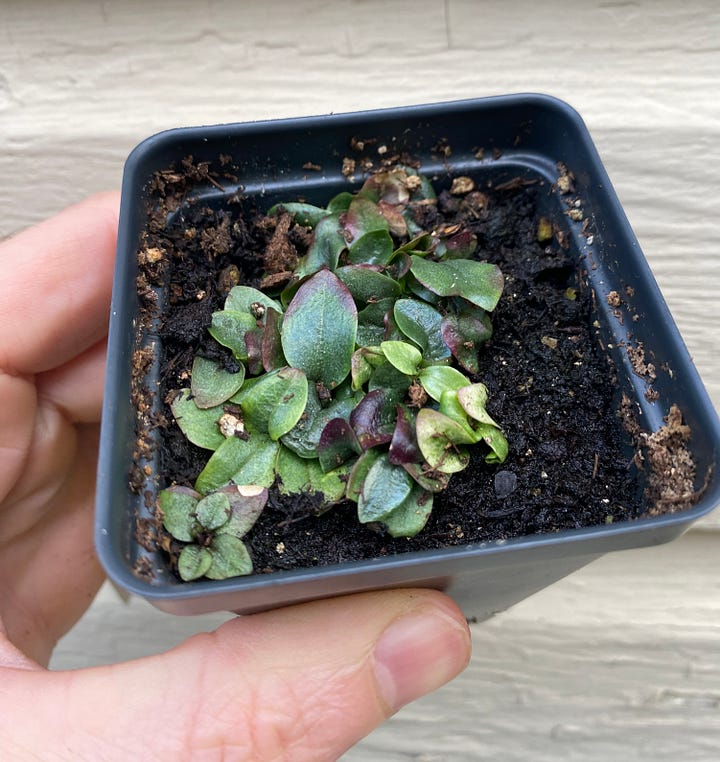
Before chilling, I like my plants to be in potting medium that is just barely damp. At this level of moisture, the potting medium is moist, but no excess water can be squeezed out of it. I have no real evidence that this is preferable, but generally speaking, more air pockets and less water equate to lower mold risk, so I think it’s a good idea.
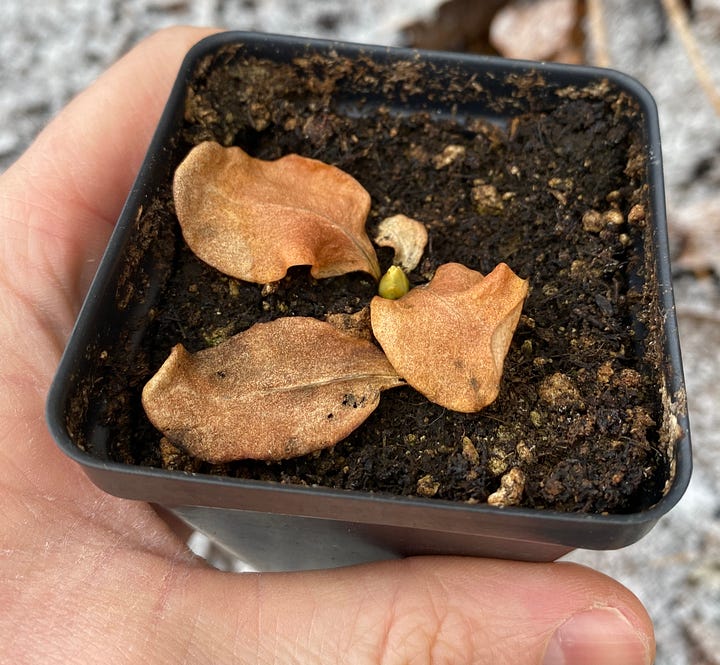
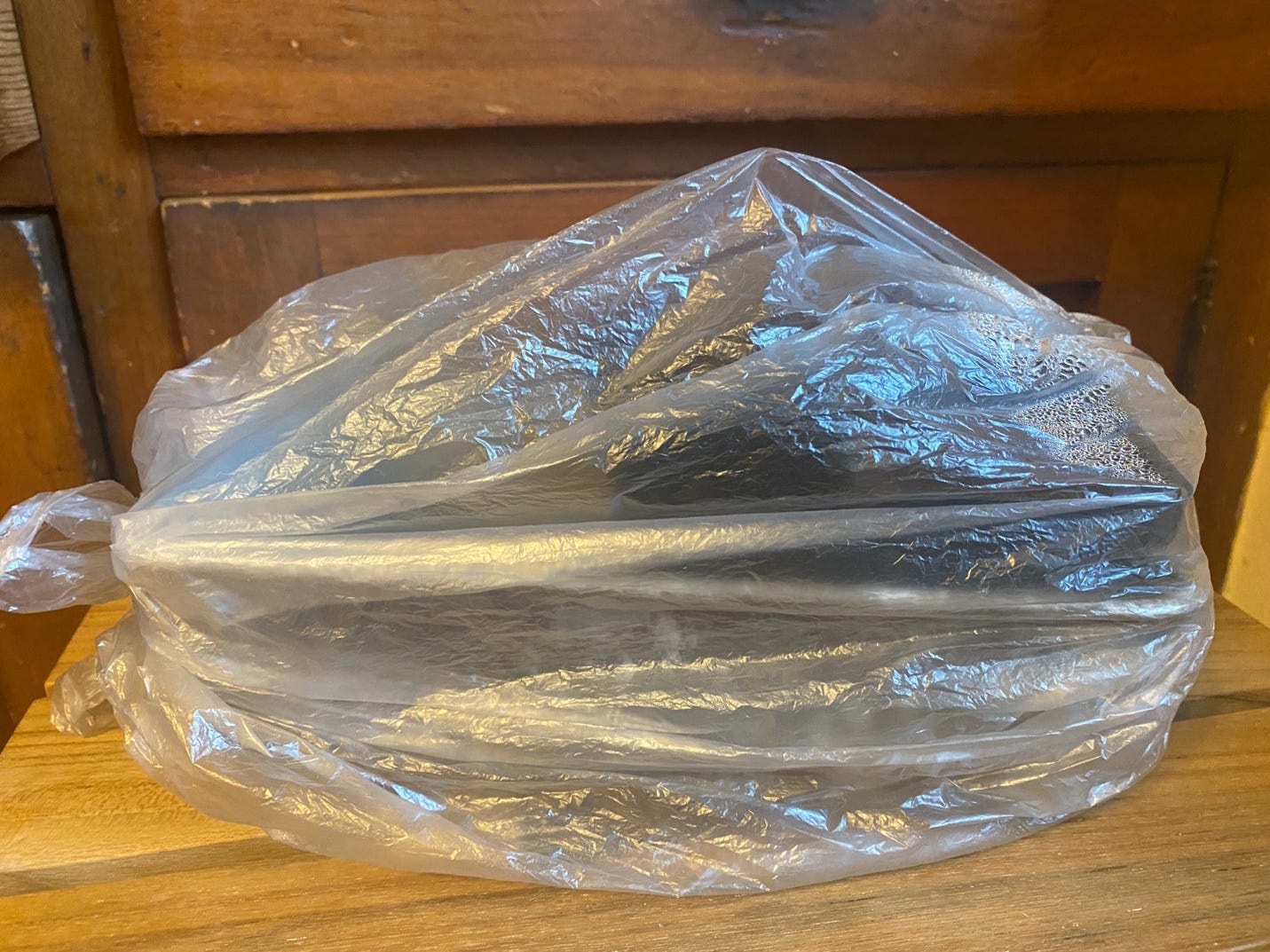
Once my potting medium is at the right level of just-barely-damp, I seal up my containers. If I have a whole 1020 tray of containers, I usually just wrap the whole thing in cling wrap. If I have fewer, I put them in a plastic container with a lid. Plastic bags work too. In general, I don’t worry about the lack of airflow. Don’t overthink this part (see Figure 3).
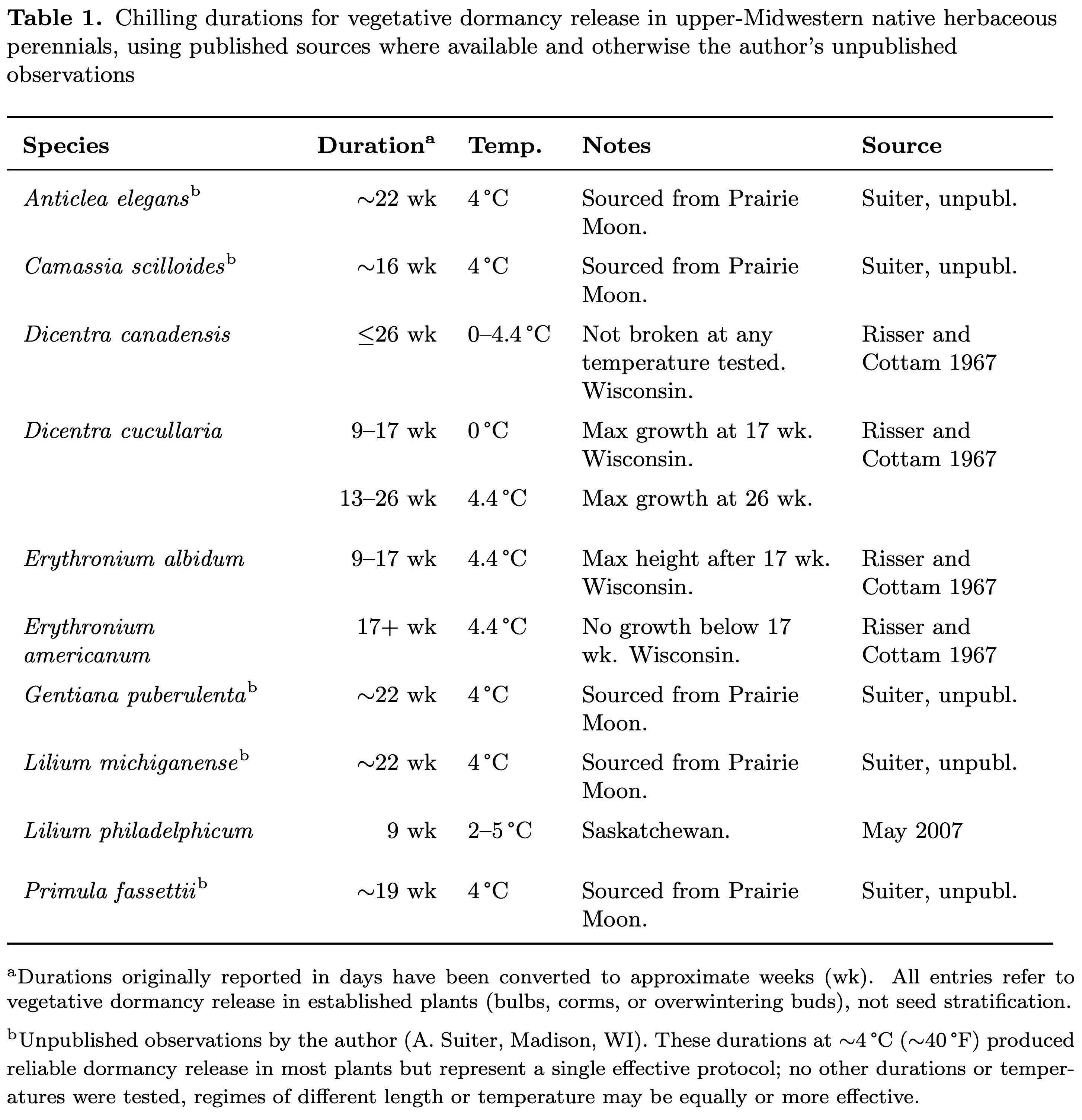
Take your sealed pots and put them in the fridge. Do not use a freezer. If you get really into this process, you may want to buy an auxiliary fridge. Domestic partners may not be enthusiastic about plants taking up valuable fridge space. I have not conducted tests on how many days of chilling are required for various species, but I’ve put together some info in Table 1 that combines published chilling requirements with my personal observations.2 I typically default to twelve weeks, though I’m sure I could get away with less for some species. I sometimes open up my containers every four weeks or so to make sure they’re neither too wet nor too dry. This is also a good time to see if there is any moldy organic material to remove.
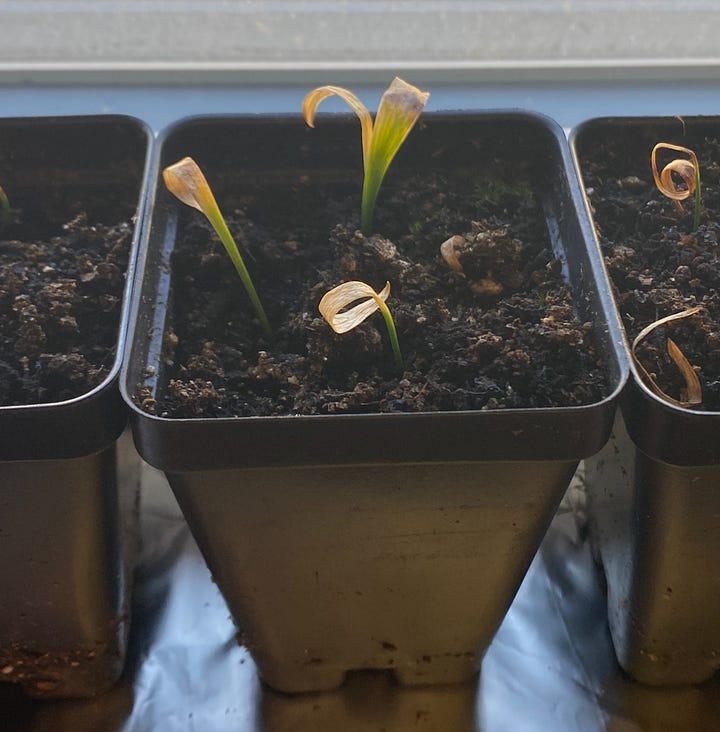
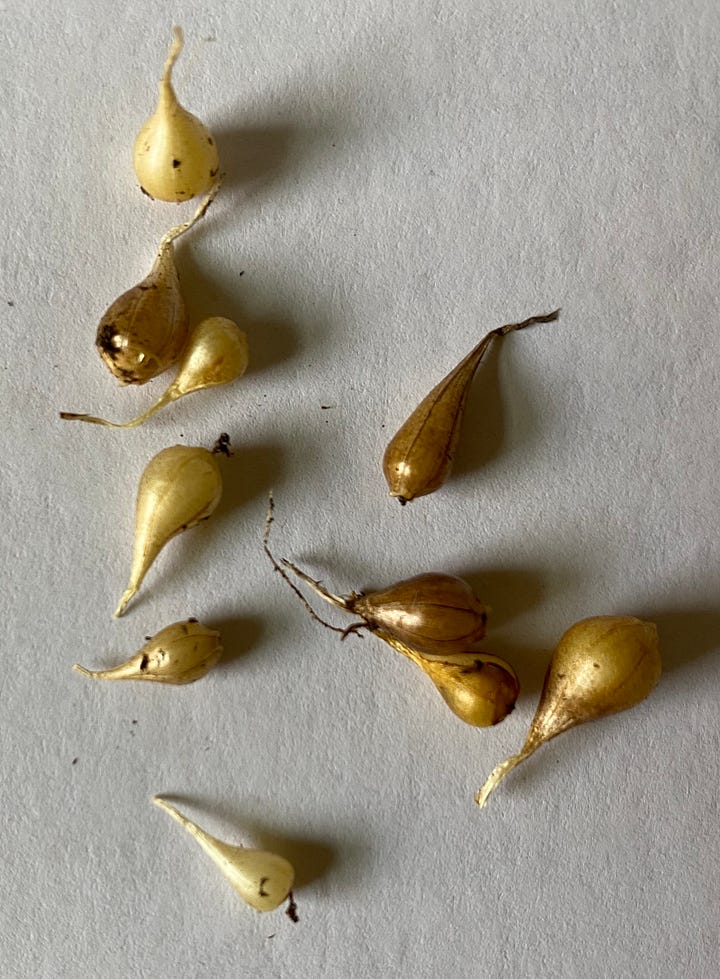
All good things must come to an end, even chilling. After twelve weeks (or however long you’ve determined is appropriate), remove the plants, water them well, and move them to your growing area. Growth usually becomes visible within a couple of weeks. Some plants will begin growing in the fridge when they’ve reached their chilling requirement (e.g., Camassia scilloides); generally speaking, it’s good to get these plants out of the fridge before they’ve grown too much, since in the absence of light, fridge growth can be very spindly and prone to flopping (see Figure 4).
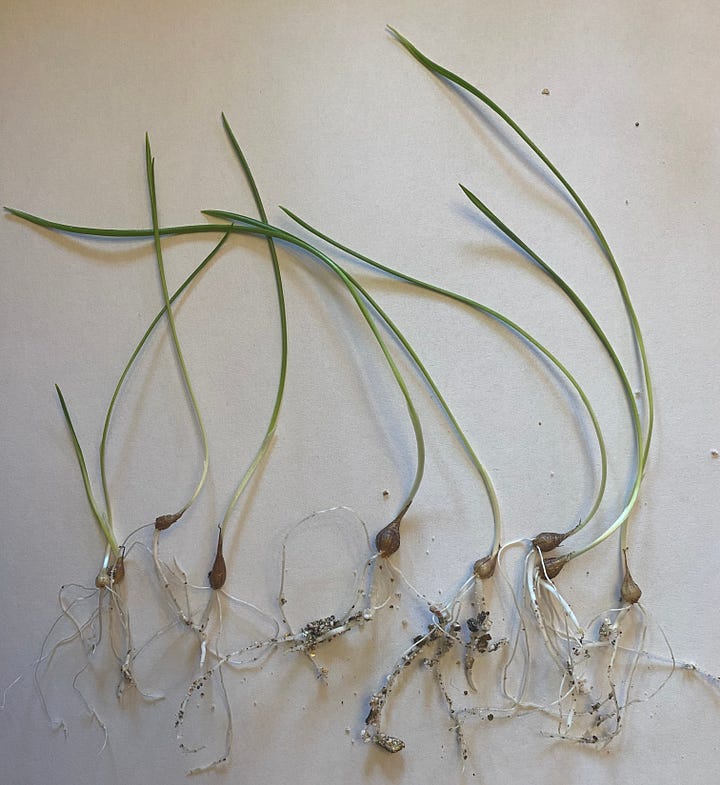
Some plants will only need one cycle of chilling (two cycles of growth) in order to be large enough to plant out. Others will need many cycles. So just keep repeating the grow-chill cycle until your plants are large enough to fend for themselves outside in the garden or restoration. ■
Have a question? If you have questions about Midwestern native plant propagation that you want answered in a future post, I’d love to hear from you! Shoot me an email at plantpropagationproject@gmail.com
Want to support this work? Buy me a cup of coffee (or a bag of potting medium)!
The term vernalization derives from the Latin vernum, and readers familiar with equinoxes, witch hazels, or amphibian migrations will know that it refers to the springtime. This is confusing because vernalization does not refer to subjecting plants to springtime temperatures. Rather, it refers to the process of subjecting plants to winter cold so that they become competent to flower when spring arrives.
Sources cited in table: Paul Risser and Grant Cottam, “Influence of Temperature on the Dormancy of Some Spring Ephemerals,” Ecology 48, no. 3 (1967): 500–503, https://doi.org/10.2307/1932687; Lisa L. May, “Forcing cycles speed growth and flowering in western red lily (Lilium philadelphicum L.),” Native Plants Journal 8, no. 1 (2007): 11–15, https://muse.jhu.edu/article/212905.
No posts
Comments
Nothing yet. Say the first thing.
Sign in to join the conversation.